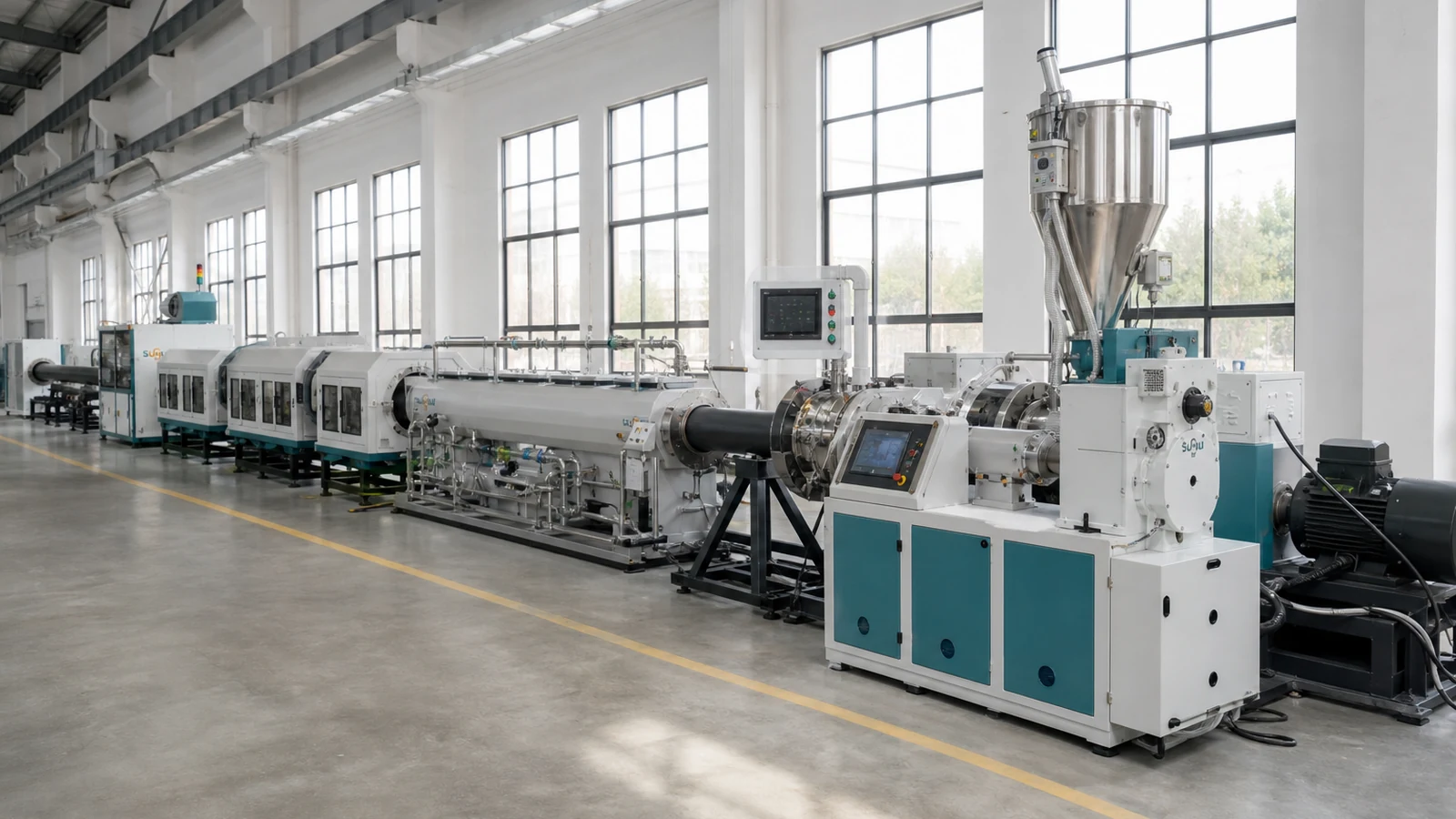
An HDPE pipe extrusion line produces HDPE pipes through extrusion, vacuum calibration, cooling, haul-off, cutting and downstream pipe handling.
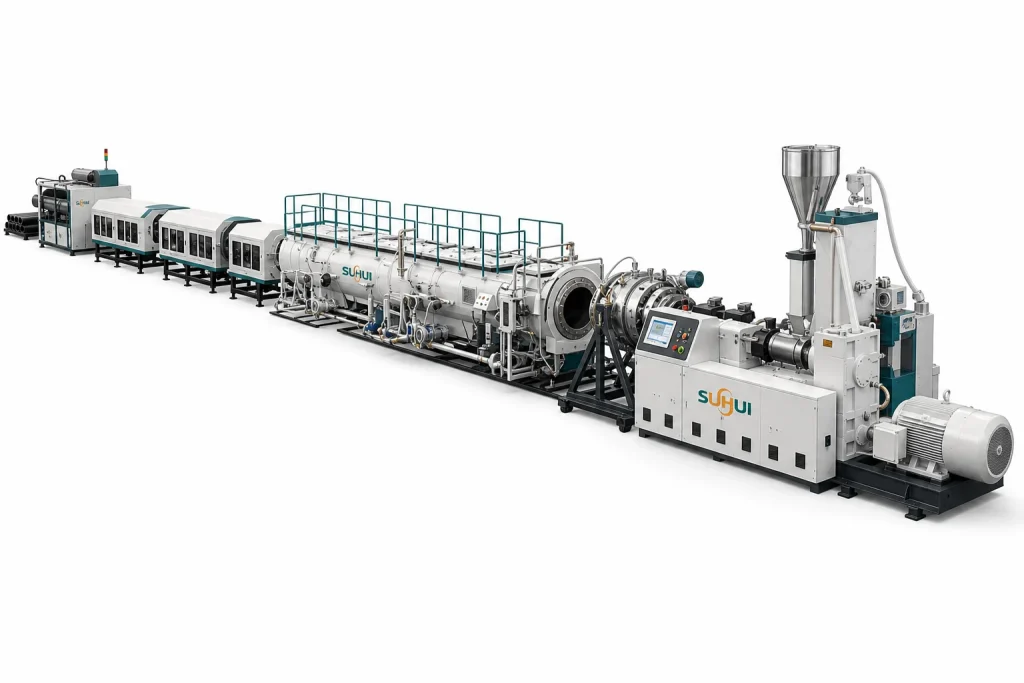
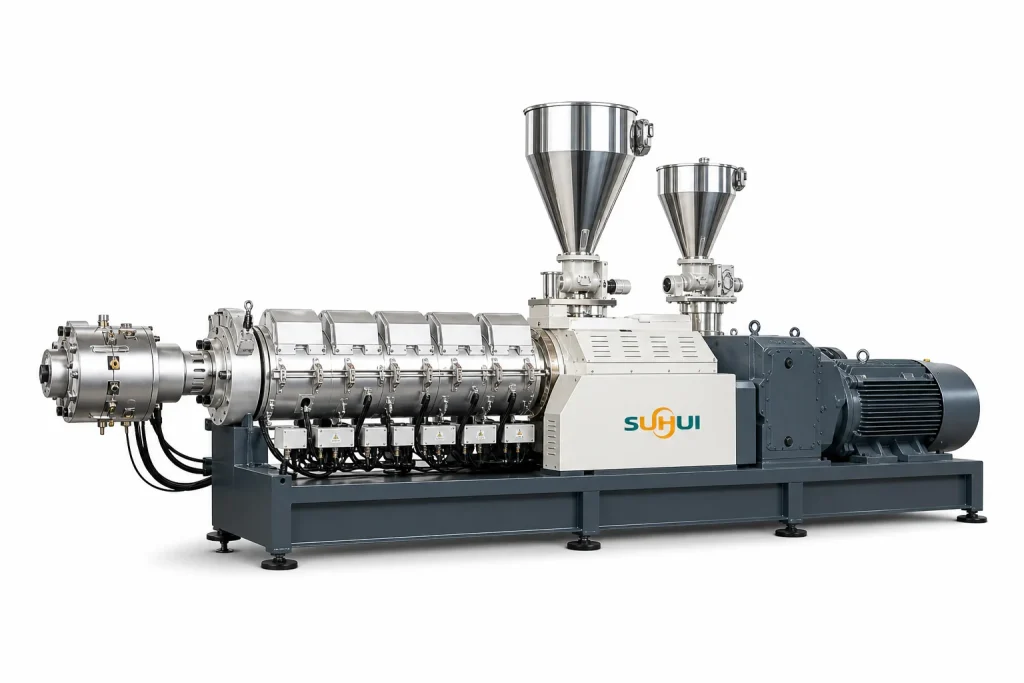
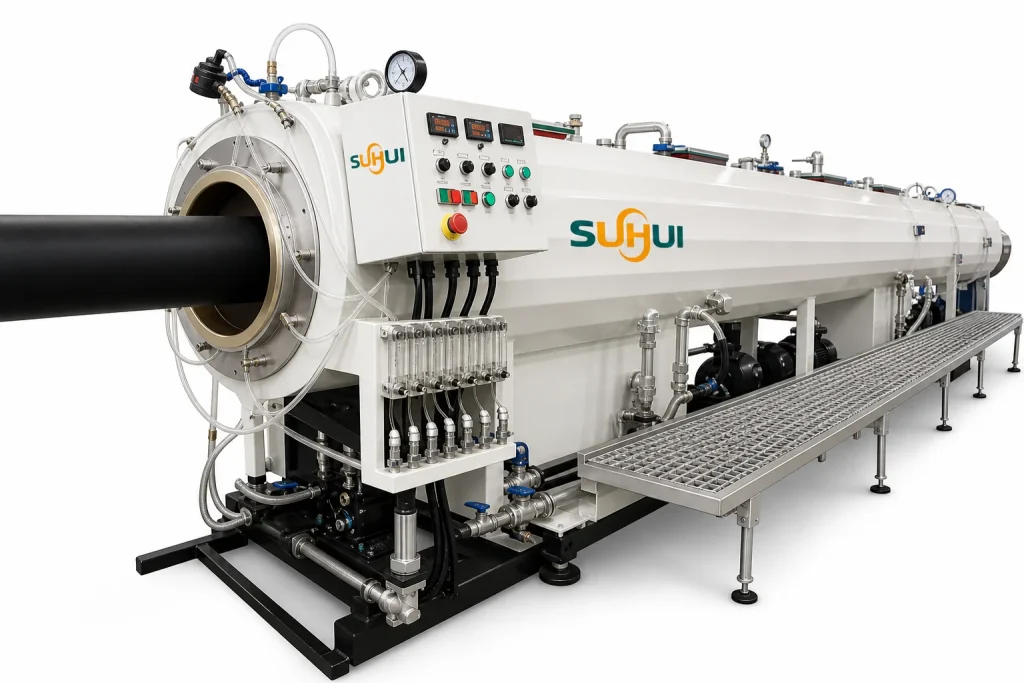
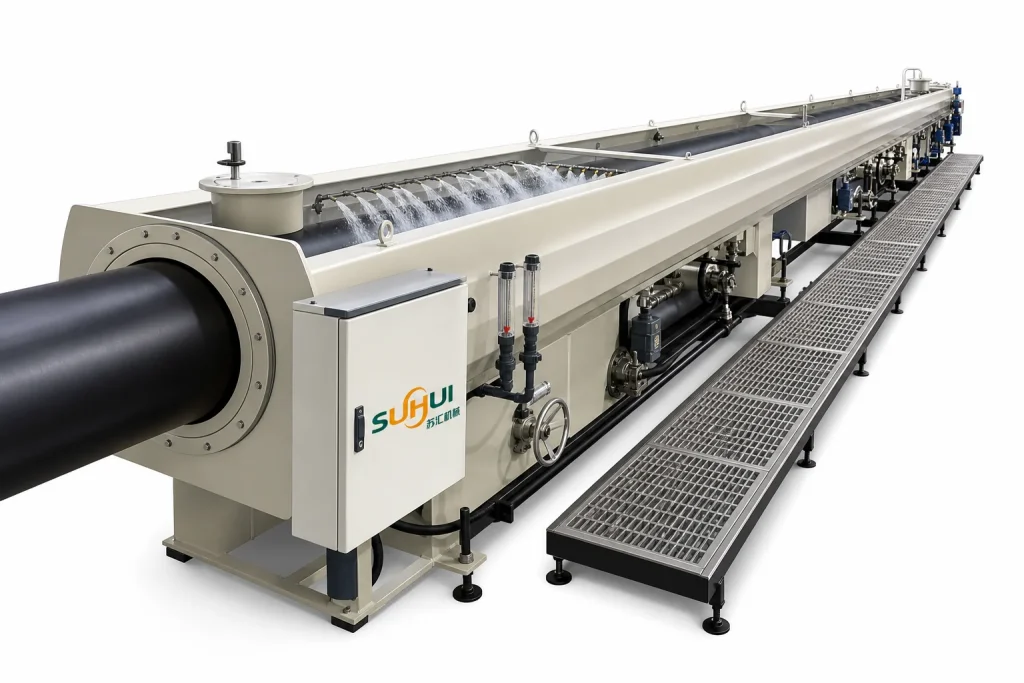
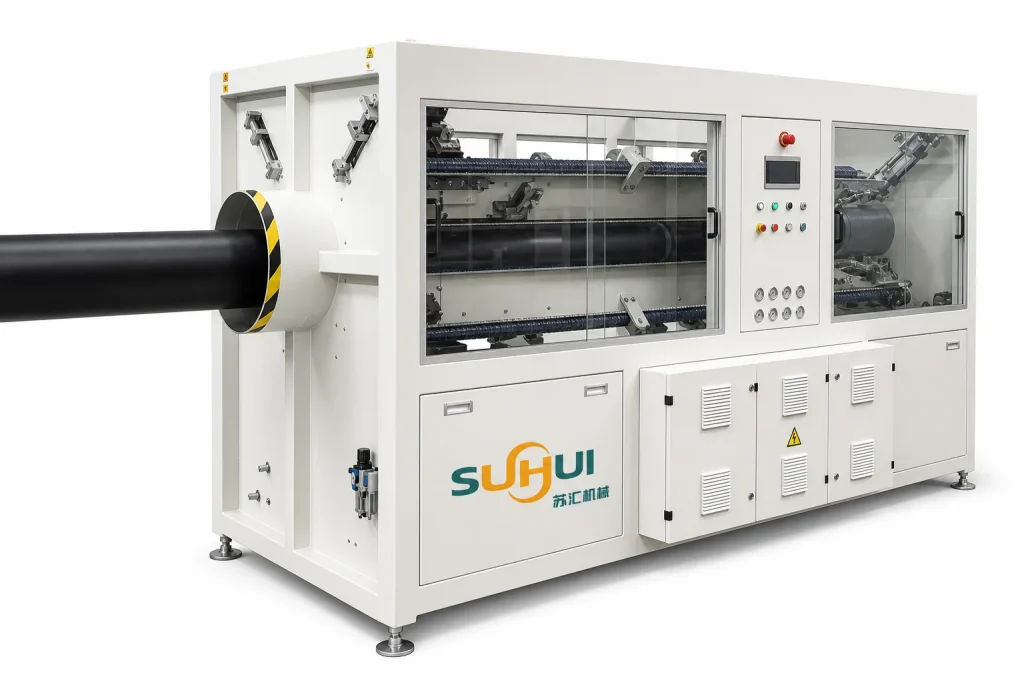
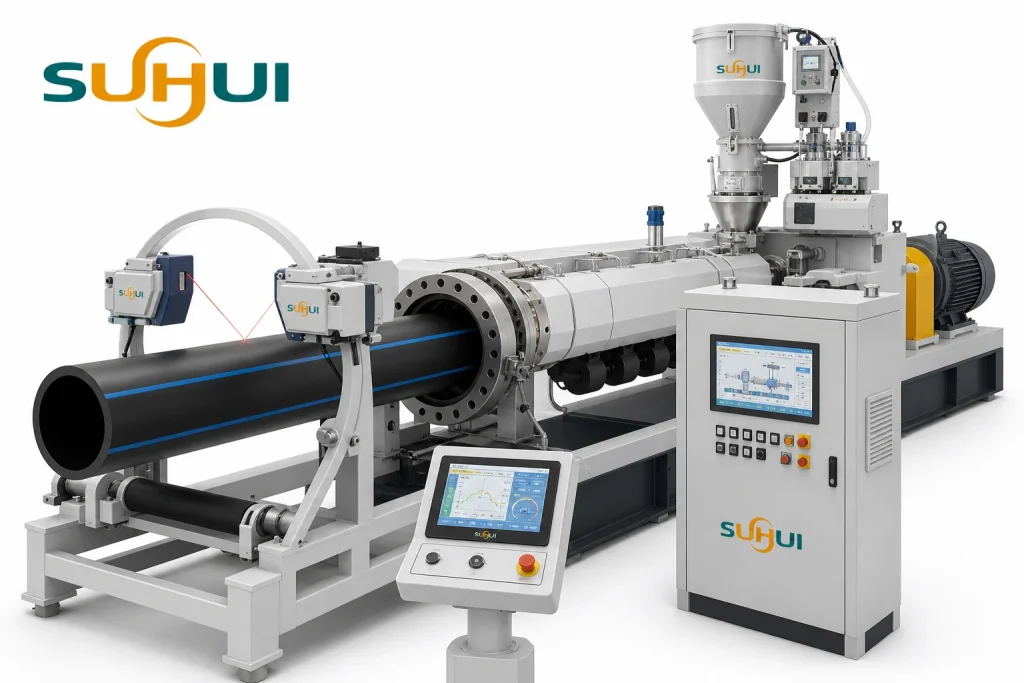
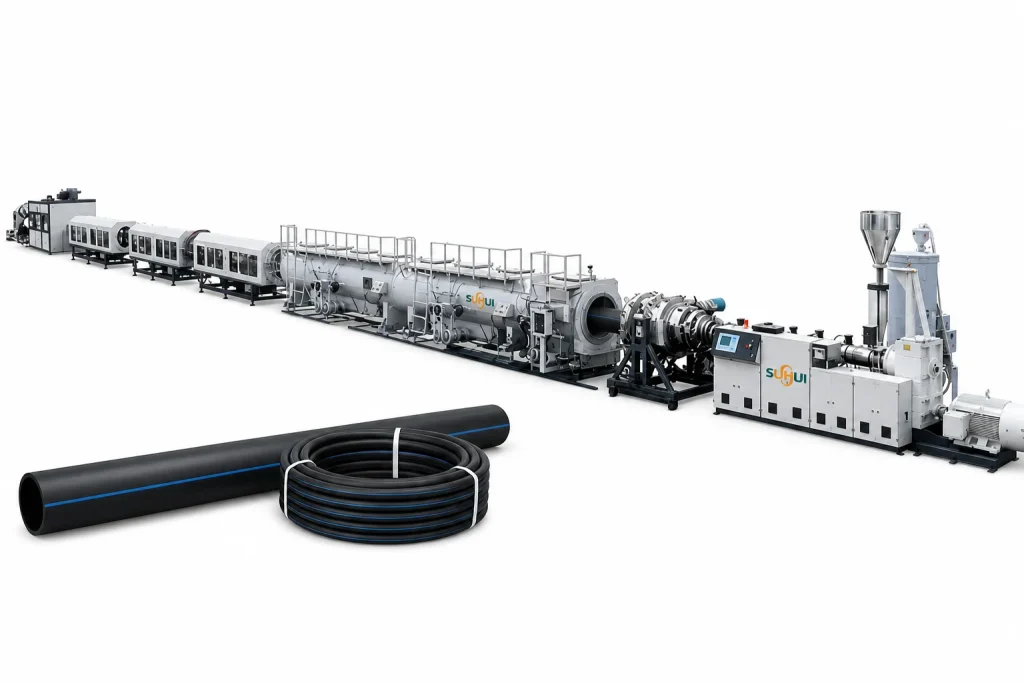
The SUHUI HDPE pipe extrusion line produces high-density polyethylene pipes for water supply, gas distribution, sewage, drainage, and industrial pipelines. The complete system integrates material feeding, single-screw extrusion, die forming, vacuum calibration, multi-stage cooling, online gauging, haul-off, cutting, and pipe handling. Standard 33D configurations cover Φ20-1,200 mm, while 38D high-performance configurations support up to Φ20-1,600 mm.
The SUHUI HDPE pipe extrusion line is a complete manufacturing system for producing high-density polyethylene pipes used in water supply, gas distribution, sewage and drainage, and industrial pipeline projects. It combines a high-output single-screw extruder, precision die head, vacuum calibration, multi-stage cooling, online gauging, haul-off, cutting, and pipe handling into one stable production line.
For manufacturers comparing an HDPE pipe extrusion machine, PE pipe extrusion line, or broader plastic pipe extrusion line, the key requirements are stable melt quality, accurate pipe diameter, consistent wall thickness, and reliable downstream synchronization. SUHUI configures the line according to pipe diameter, output target, pressure grade, material recipe, and plant layout so the system can support both standard pipe production and large-diameter infrastructure pipe projects.
The line supports 33D and 38D series configurations. The 33D series covers standard output requirements up to Φ20–1,200 mm, while the 38D high-performance series extends the range up to Φ20–1,600 mm with higher throughput for large-diameter HDPE pipe production.
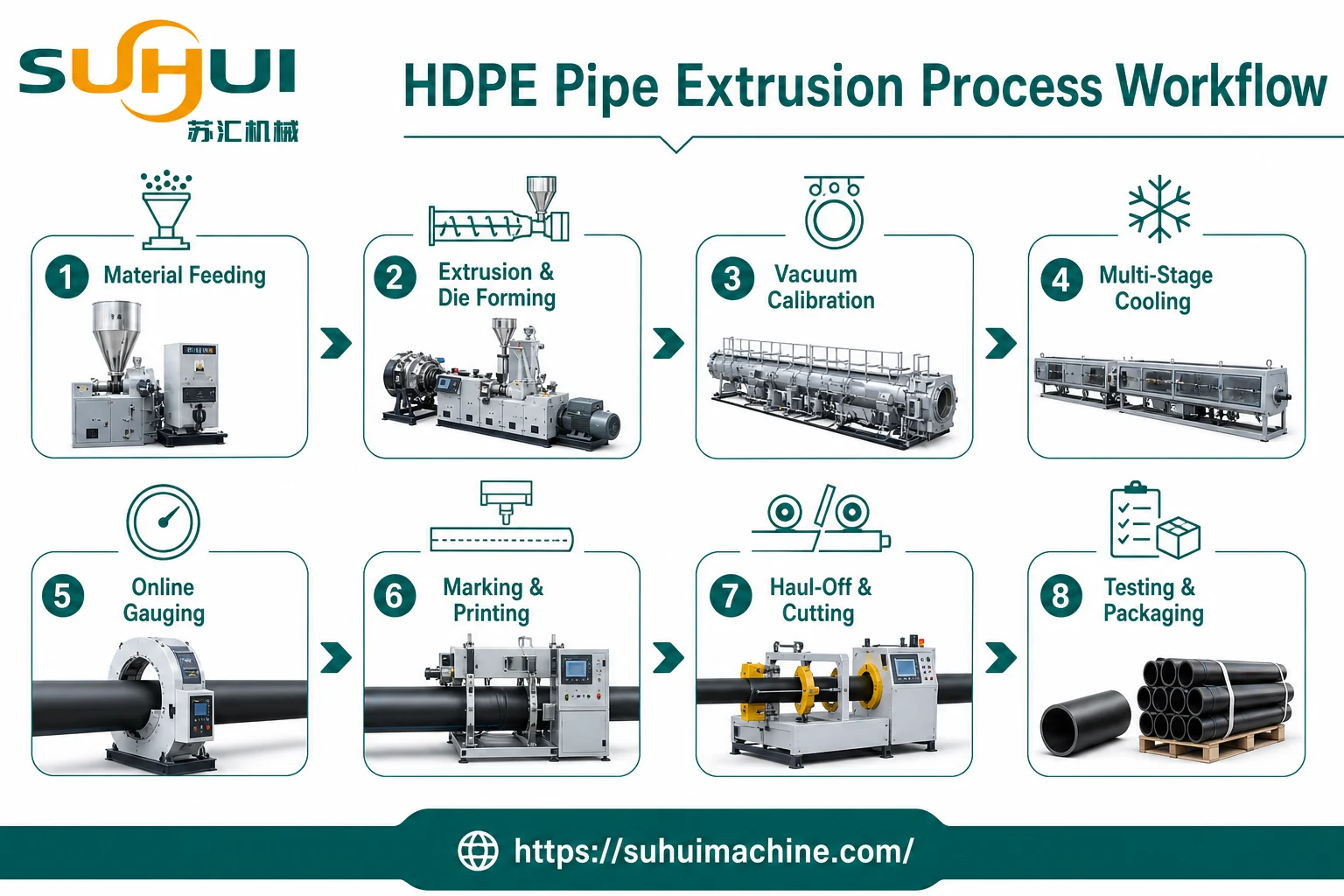
HDPE pipe extrusion process workflow from material feeding, extrusion and die forming to vacuum calibration, cooling, gauging, marking, haul-off, cutting, testing and packaging.
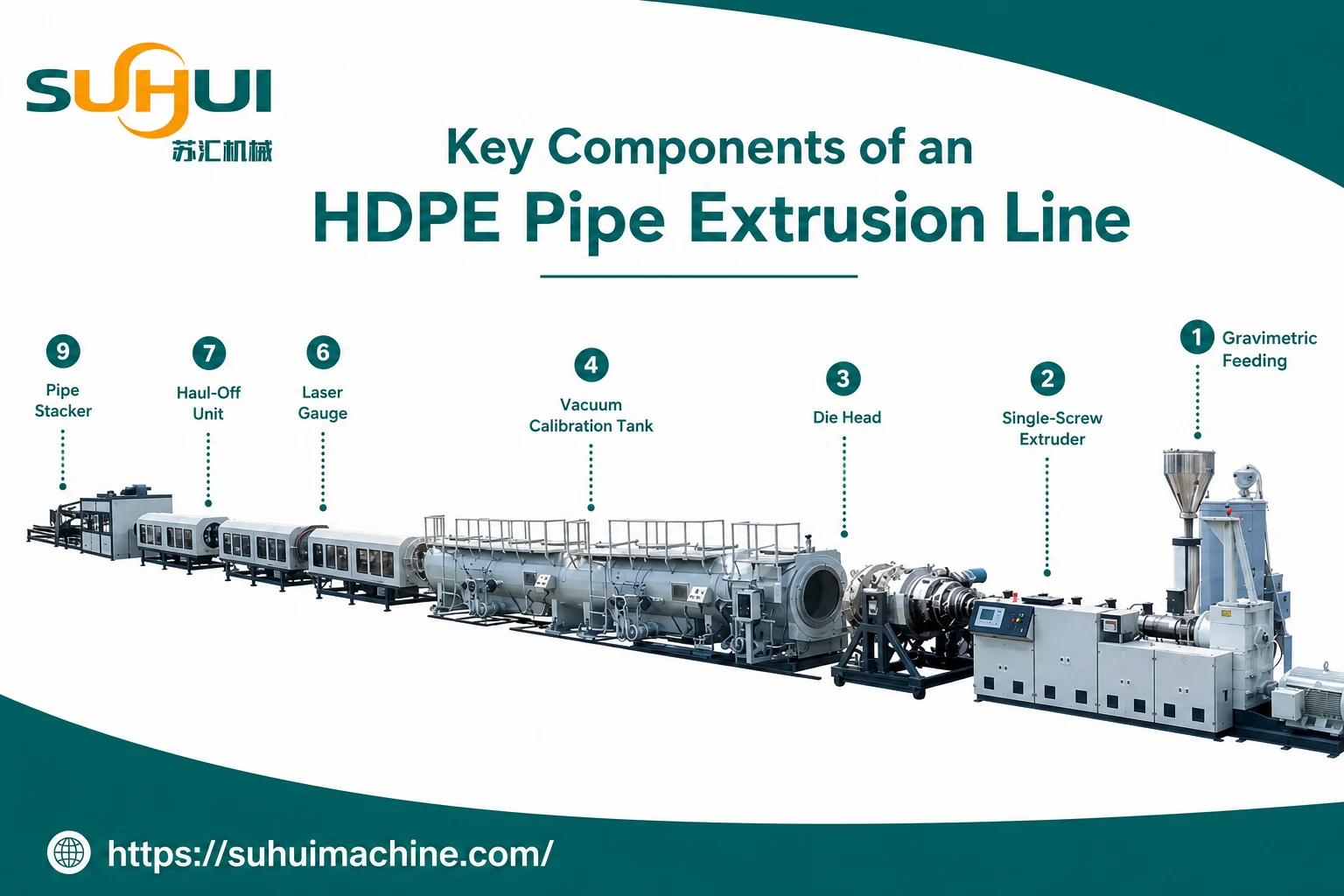
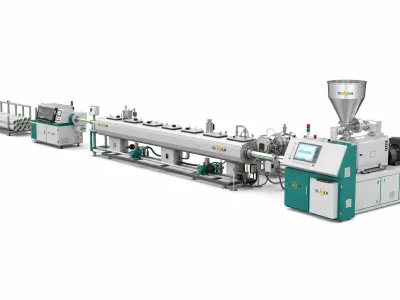
Key HDPE pipe extrusion line components include material feeding, single-screw extruder, die head, vacuum calibration, cooling, online gauging, haul-off, cutting and pipe stacking.
| Model | O.D. Range | Extruder | Max. Output | Max. Haul-Off Speed | Motor Power |
|---|---|---|---|---|---|
| PE63 | Φ20–63 mm | SJ65/33 | 220 kg/h | 15 m/min | 55 kW |
| PE110 | Φ20–110 mm | SJ65/33 | 220 kg/h | 15 m/min | 55 kW |
| PE160 | Φ50–160 mm | SJ75/33 | 400 kg/h | 12 m/min | 110 kW |
| PE250 | Φ90–250 mm | SJ75/33 | 400 kg/h | 8 m/min | 110 kW |
| PE450 | Φ160–450 mm | SJ90/33 | 500 kg/h | 5 m/min | 160 kW |
| PE630 | Φ315–630 mm | SJ120/33 | 850 kg/h | 3.3 m/min | 280 kW |
| PE800 | Φ500–800 mm | SJ120/33 | 1,000 kg/h | 1.8 m/min | 315 kW |
| PE1200 | Φ710–1,200 mm | SJ150/33 | 1,300 kg/h | 0.8 m/min | 355 kW |
| Model | O.D. Range | Extruder | Max. Output | Max. Haul-Off Speed | Motor Power |
|---|---|---|---|---|---|
| HPE63 | Φ16–63 mm | HSJ60/38 | 350 kg/h | 30 m/min | 90 kW |
| HPE110 | Φ20–125 mm | HSJ60/38 | 450 kg/h | 25 m/min | 110 kW |
| HPE160 | Φ50–160 mm | HSJ75/38 | 550 kg/h | 15 m/min | 132 kW |
| HPE250 | Φ75–315 mm | HSJ75/38 | 650 kg/h | 12 m/min | 160 kW |
| HPE450 | Φ160–500 mm | HSJ90/38 | 900 kg/h | 8 m/min | 250 kW |
| HPE630 | Φ315–630 mm | HSJ90/38 | 1,050 kg/h | 5 m/min | 280 kW |
| HPE800 | Φ500–800 mm | HSJ120/38 | 1,300 kg/h | 2.5 m/min | 355 kW |
| HPE1200 | Φ710–1,200 mm | HSJ175/38 + HSJ90/38 | 1,400 kg/h | 1.2 m/min | 160 + 250 kW |
| HPE1600 | Φ1,000–1,600 mm | HSJ90/38 × 2 | 1,600 kg/h | 0.7 m/min | 250 × 2 kW |
Final model selection depends on pipe diameter, wall thickness, pressure grade, output target, material recipe, and downstream handling requirements. Contact SUHUI for a customized HDPE pipe making machine proposal.
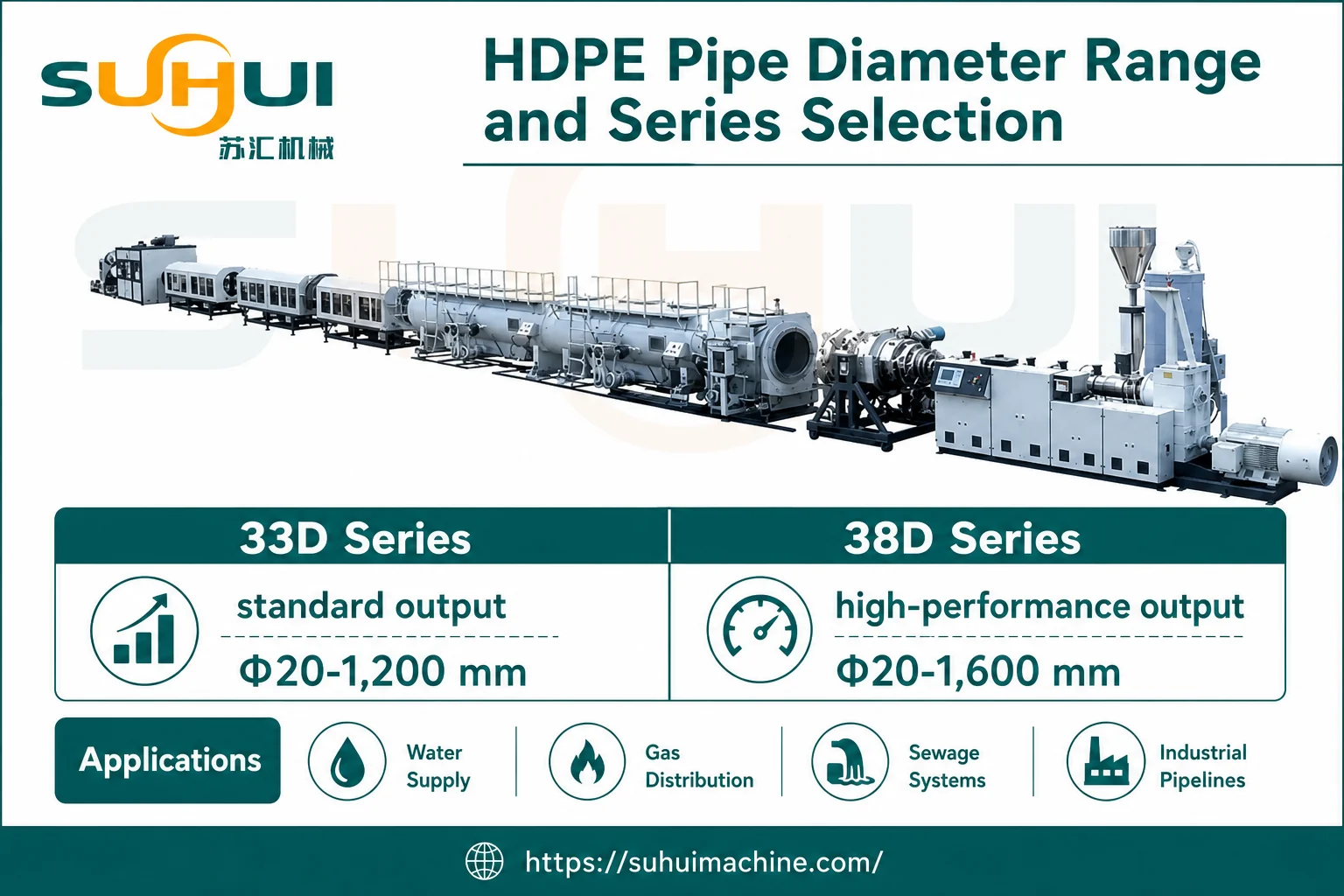
The 33D and 38D series support different diameter ranges and output targets for standard and high-performance HDPE pipe production.
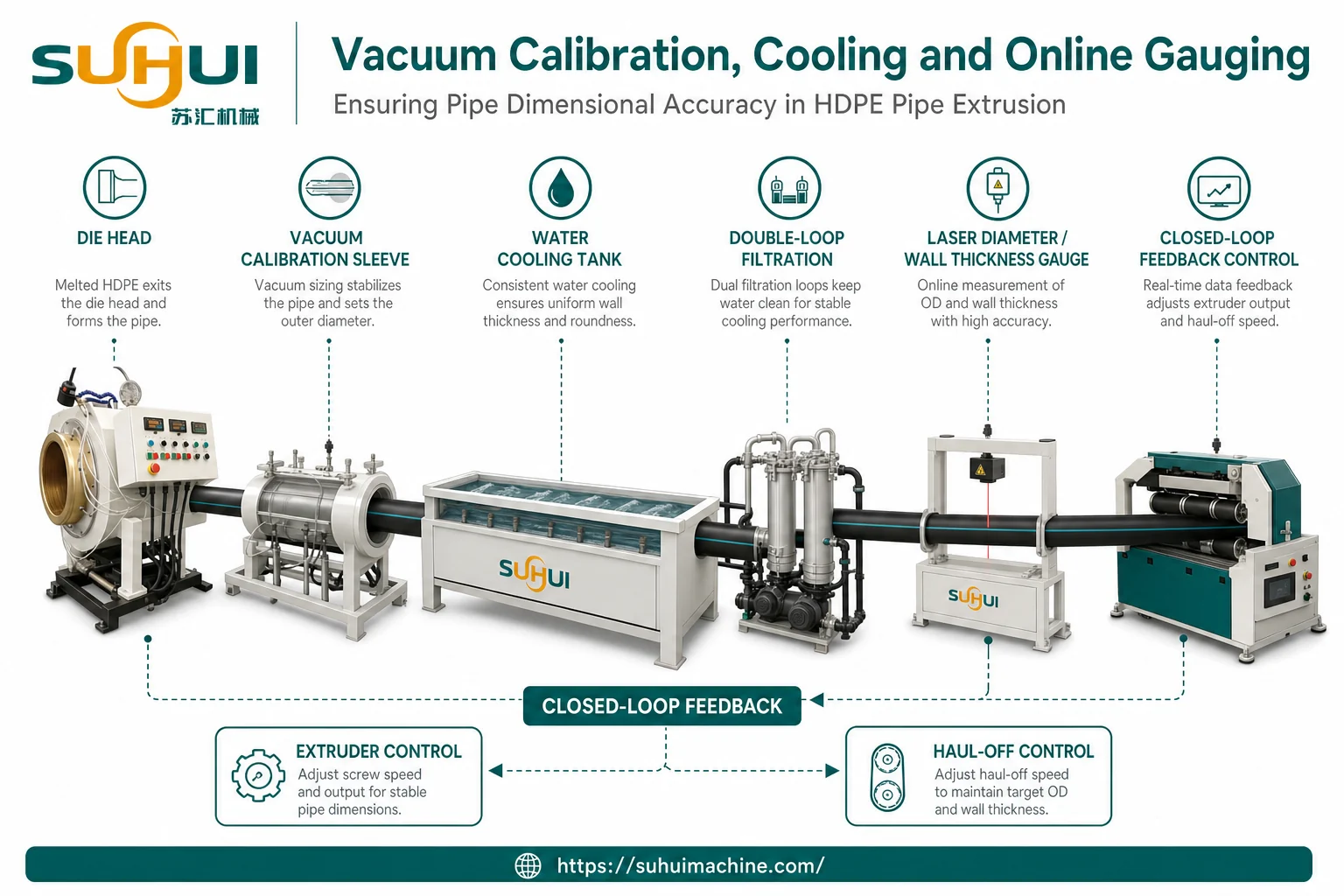
Vacuum calibration, cooling, online gauging and closed-loop feedback help control HDPE pipe diameter, wall thickness and roundness.
Stable HDPE pipe extrusion depends on the coordination of the screw and barrel, die head, cooling system, haul-off, and control system. SUHUI matches the extruder model, gearbox, motor drive, heating zones, cooling layout, and PLC/HMI control to the pipe size range and output target.
For buyers evaluating an HDPE pipe manufacturing machine, the control system is especially important because pipe wall thickness can change when melt pressure, cooling conditions, or haul-off speed are unstable. Online gauging and feedback control help operators identify deviations early and make process corrections before they become quality problems.
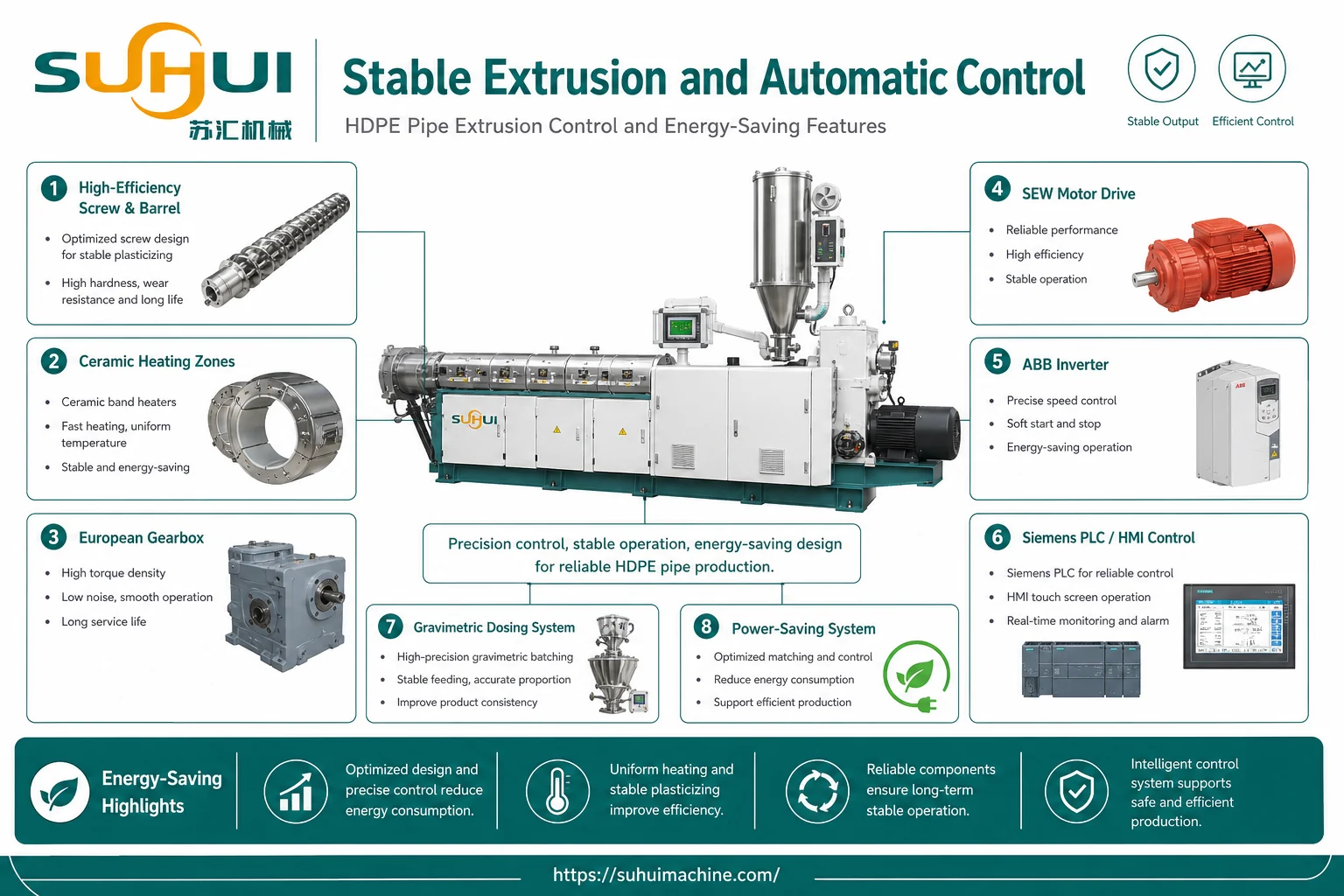
Extruder design, gearbox, motor drive, inverter, dosing and PLC/HMI control work together to support stable HDPE pipe production.
HDPE pipes produced on this line are suitable for water supply networks, gas distribution, sewage and drainage systems, agricultural irrigation, mining pipelines, and industrial fluid transport. HDPE is widely used because it offers corrosion resistance, flexibility, butt-fusion weldability, and long service life in buried and above-ground pipeline projects.
The production line can be configured to support common HDPE pipe requirements such as ISO 4427, ASTM D3350, and PN6–PN25 pressure grades. Exact compliance depends on resin grade, tooling, line configuration, production control, testing, and the required local market standard.
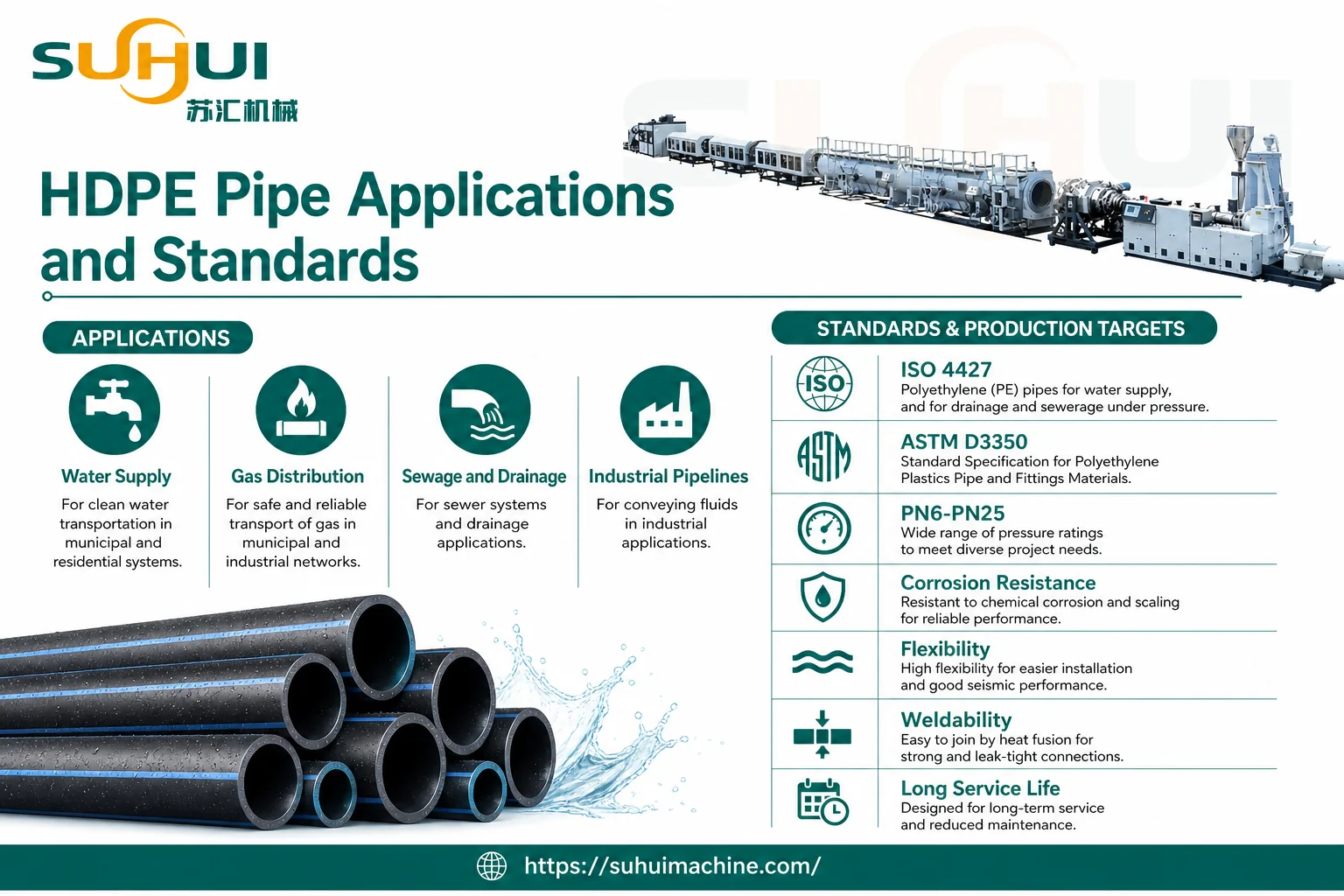
HDPE pipe applications include water supply, gas distribution, sewage and drainage, and industrial pipelines, with production targets matched to required standards and pressure grades.
HDPE pipe extrusion feeds HDPE pellets into a single-screw extruder, melts and homogenizes the material, forms the pipe through a die head, fixes diameter through vacuum calibration, cools the pipe, monitors dimensions online, then pulls, cuts, tests, and packages the finished pipe.
An HDPE pipe extrusion machine usually refers to the extruder or core production equipment, while an HDPE pipe extrusion line includes the complete system: feeding, extruder, die head, calibration tank, cooling tanks, gauging, haul-off, cutting, and pipe handling.
SUHUI configurations cover Φ20–1,200 mm in the 33D series and up to Φ20–1,600 mm in the 38D high-performance series. The exact line configuration depends on pipe diameter, pressure grade, output target, and wall thickness.
Vacuum calibration fixes the outside diameter and roundness while the pipe is still hot and formable. It helps prevent ovality, improves dimensional accuracy, and provides a stable pipe shape before the pipe enters the main cooling tanks.
Yes, the line can be configured to blend approved recycled HDPE with virgin material when the final pipe application allows it. The usable percentage depends on recycled material quality, pipe standard, pressure grade, and customer quality requirements.
Choose the 33D series for standard output and pipe ranges up to Φ1,200 mm. Choose the 38D series when higher throughput, faster production speed, or large-diameter pipe up to Φ1,600 mm is required.
HDPE pipes from this line can be used for water supply, gas distribution, sewage and drainage, irrigation, mining slurry, and industrial fluid transport. Final suitability depends on resin grade, pipe pressure class, standard compliance, and testing requirements.
Tell us your material type, condition, required capacity and target output. Photos or videos help.
SUHUI reviews the feeding method, process route and machine configuration for your material.
You receive an equipment list and quotation, with capacity, layout, voltage and automation matched to the project.
Production, testing, export packing and installation guidance through to commissioning.
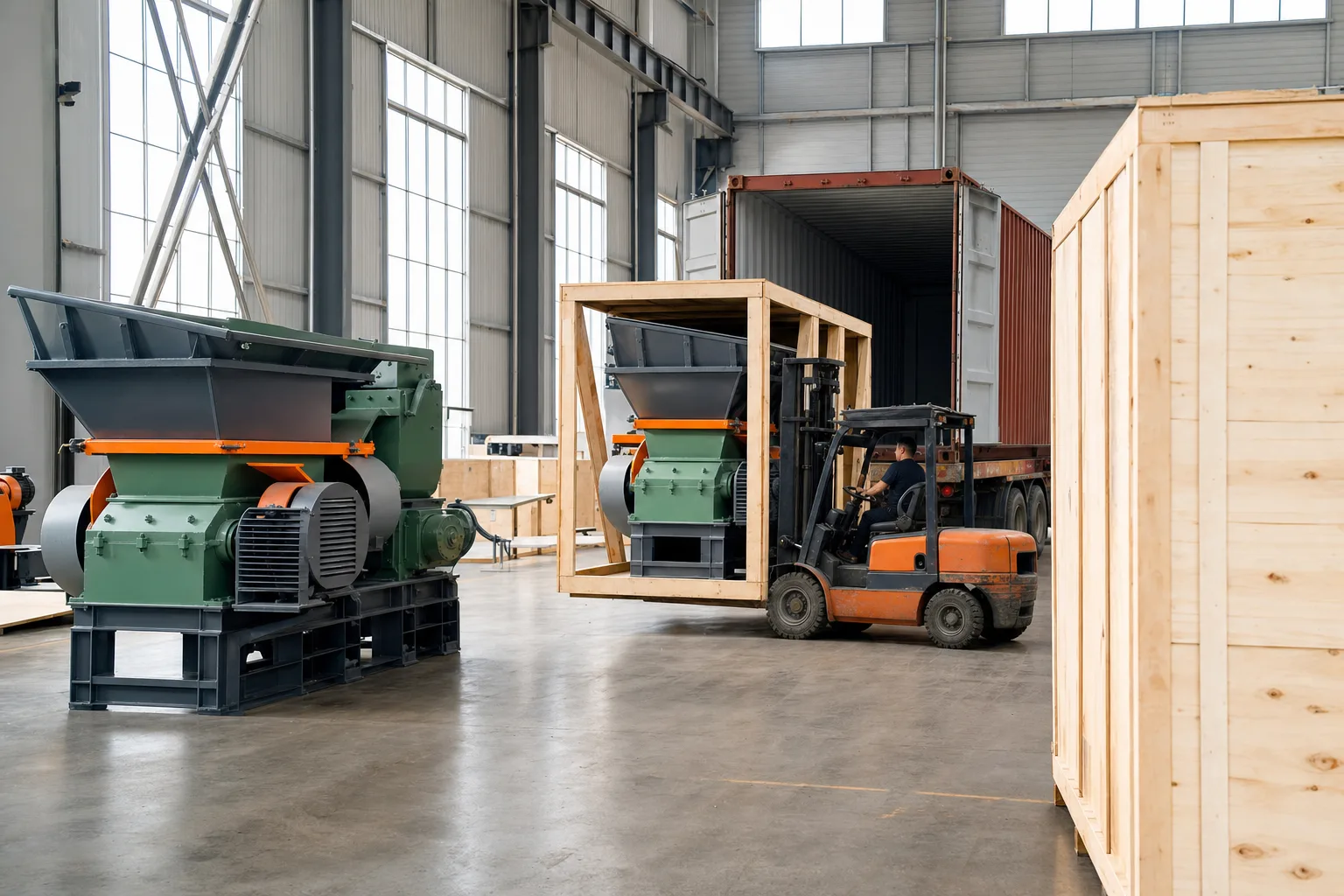
To receive a more accurate recommendation, please include your material type, target product size, output requirement, line speed expectation, available workshop space, voltage and destination country in the message.
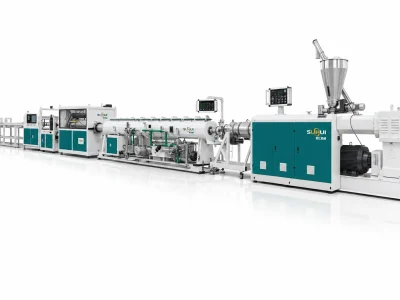
The SUHUI PVC pipe extrusion line produces rigid PVC and UPVC pipes for water supply, drainage, sewage, irrigation, electrical conduit, air conditioning condensate and industrial pipelines. The complete line integrates material mixing, conical twin-screw extrusion, fast-locking pipe die, vacuum calibration, cooling, servo haul-off, planetary cutting, optional inline belling and pipe stacking. Configurations support Φ16-800 mm pipe diameters with single, dual and four-cavity die options.
The SUHUI PPR pipe extrusion line produces single-layer and 3-5 layer PPR pipes for hot and cold water supply, heating systems, building plumbing and industrial fluid transport. Configurations support Φ20-250 mm pipe diameters, PPR, PE-RT, PB and MPP materials, glass fiber reinforced PPR, aluminum foil barrier PPR, thermal insulation composite pipe, vacuum sizing, closed-loop cooling, marking, servo haul-off and flying saw cutting.