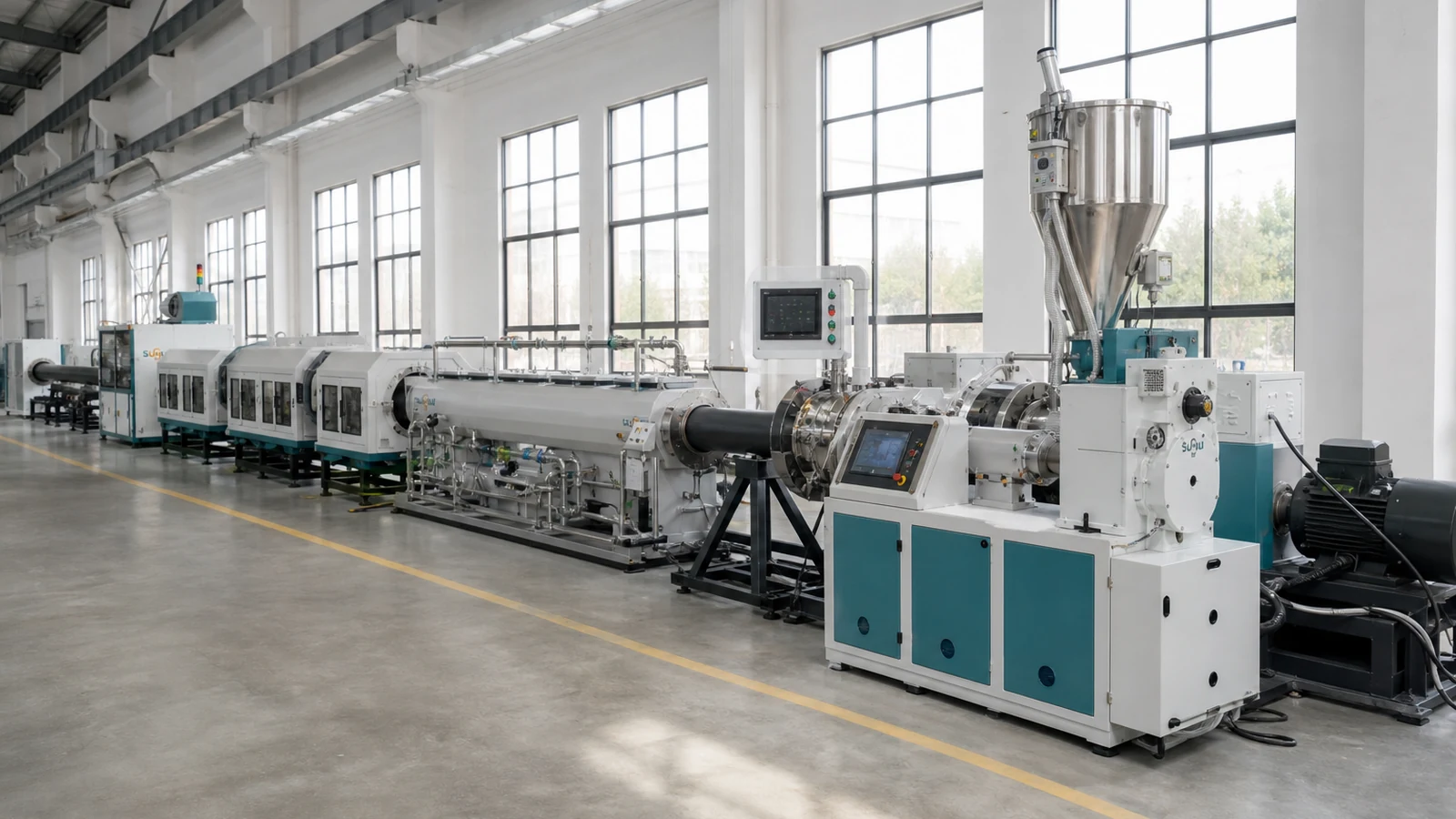
A PVC pipe extrusion line produces rigid PVC and UPVC pipes for water supply, drainage and conduit through extrusion, calibration, cooling, haul-off and cutting.
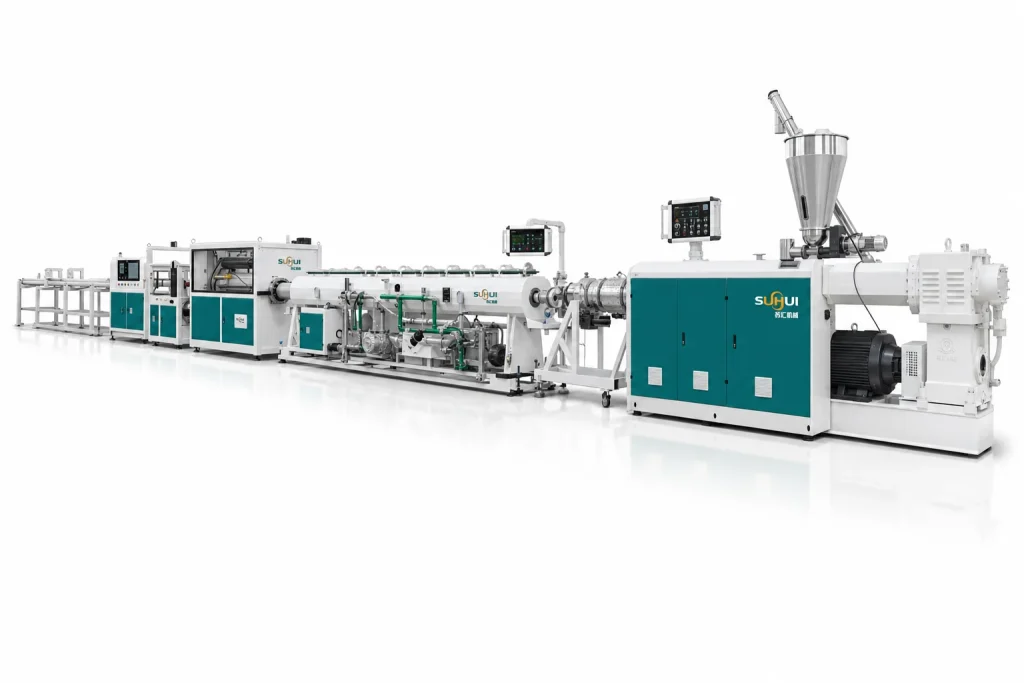
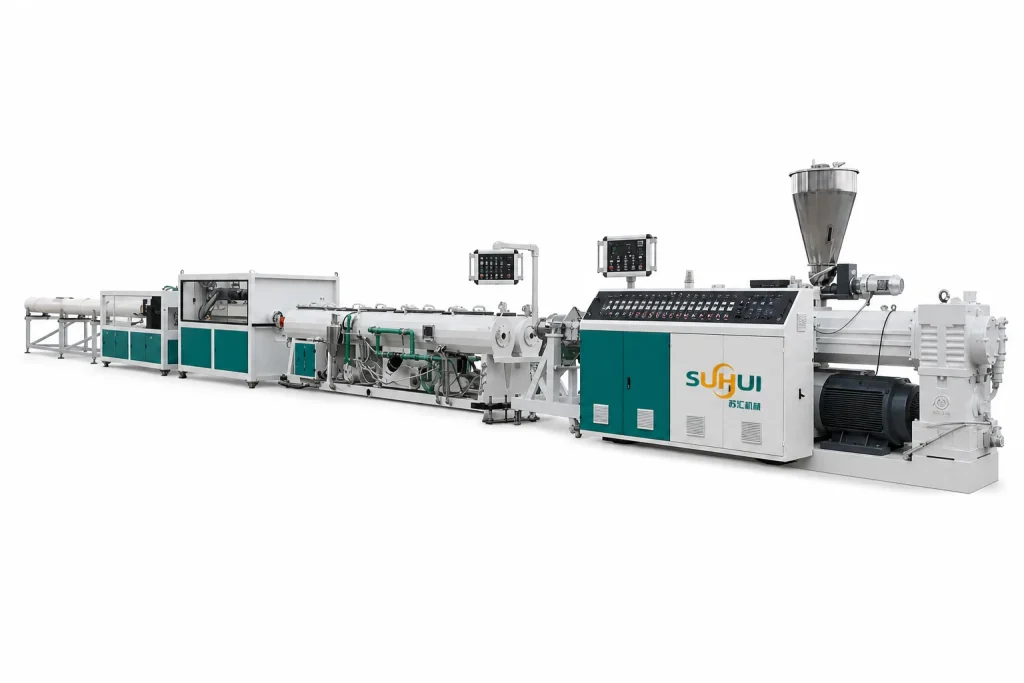
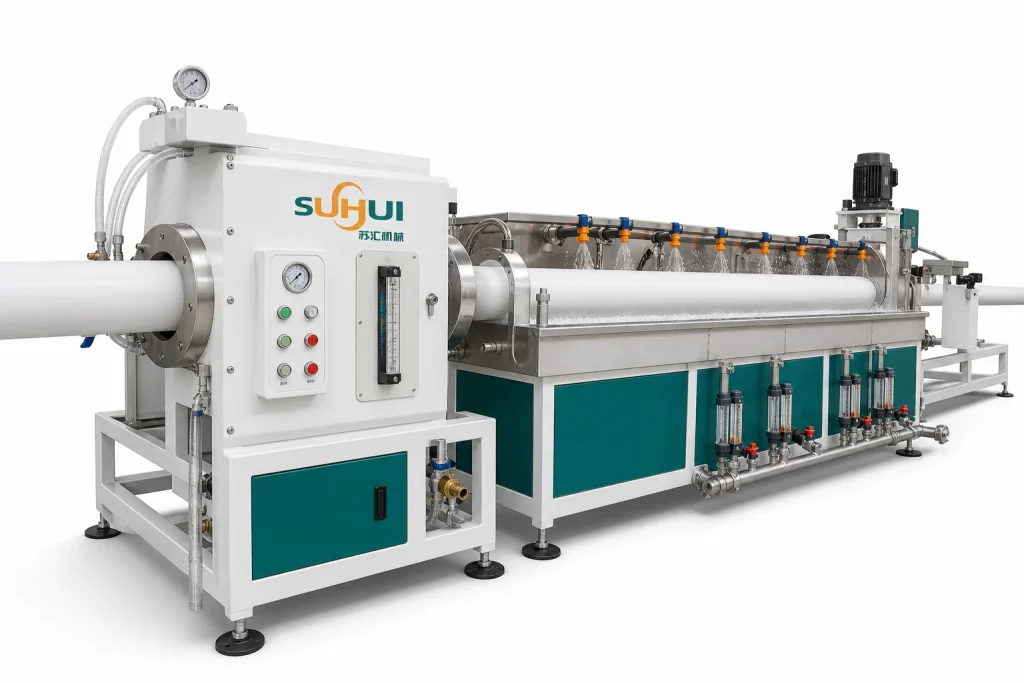
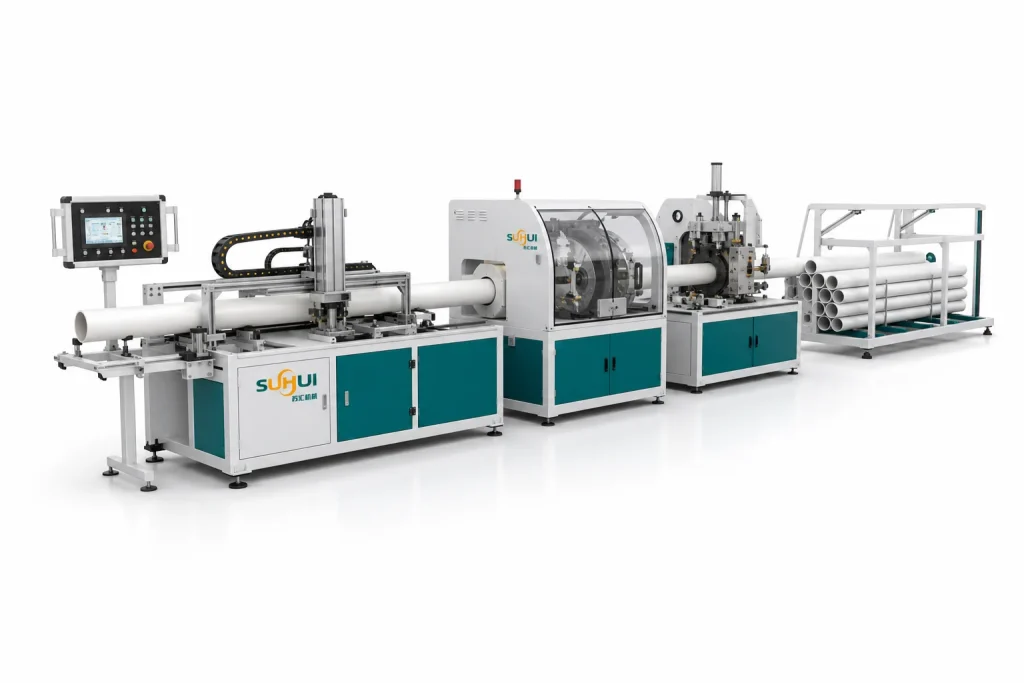
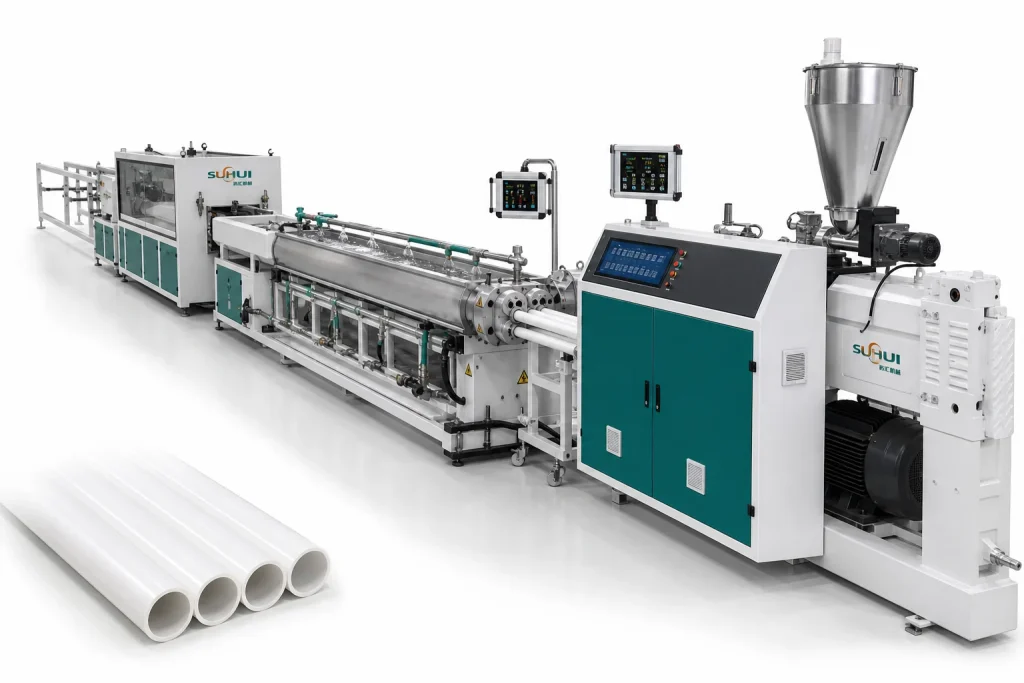
The SUHUI PVC pipe extrusion line produces rigid PVC and UPVC pipes for water supply, drainage, sewage, irrigation, electrical conduit, air conditioning condensate and industrial pipelines. The complete line integrates material mixing, conical twin-screw extrusion, fast-locking pipe die, vacuum calibration, cooling, servo haul-off, planetary cutting, optional inline belling and pipe stacking. Configurations support Φ16-800 mm pipe diameters with single, dual and four-cavity die options.
The SUHUI PVC pipe extrusion line is a fully automated manufacturing system for producing rigid PVC and UPVC pipes used in water supply, drainage, sewage, irrigation, electrical conduit, air conditioning condensate water systems, and industrial pipeline applications. It combines conical twin-screw extrusion, fast-locking pipe die heads, precision vacuum calibration, multi-stage cooling, servo haul-off, planetary cutting, and optional inline belling.
For manufacturers comparing a PVC pipe extrusion machine, PVC pipe production line, or broader plastic pipe extrusion line, the core challenge is stable PVC plasticizing. PVC is heat-sensitive, so the line must control shear, temperature, residence time, calibration, and pulling speed to prevent degradation while maintaining pipe dimensions and smooth inner and outer surfaces.
SUHUI PVC pipe making machine configurations support Φ16–800 mm pipe diameters across single-cavity, dual-cavity, and four-cavity die options. Small-diameter conduit lines can use multi-cavity production to increase output, while large-diameter drainage and sewage pipe lines use matched extruder, die, vacuum tank, haul-off, cutter, and optional belling equipment.
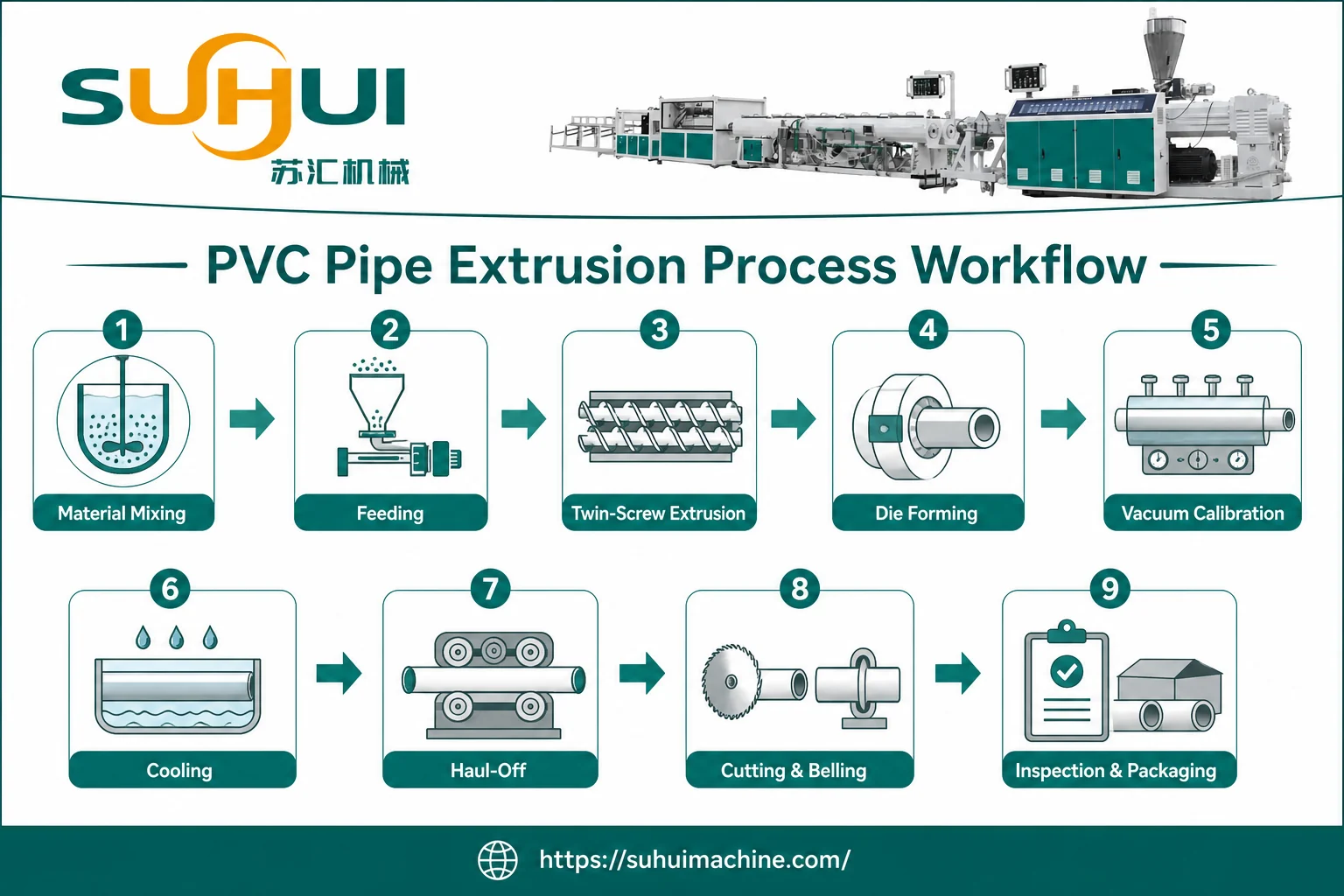
PVC pipe extrusion process workflow from material mixing and feeding to twin-screw extrusion, die forming, calibration, cooling, haul-off, cutting, optional belling, inspection and packaging.
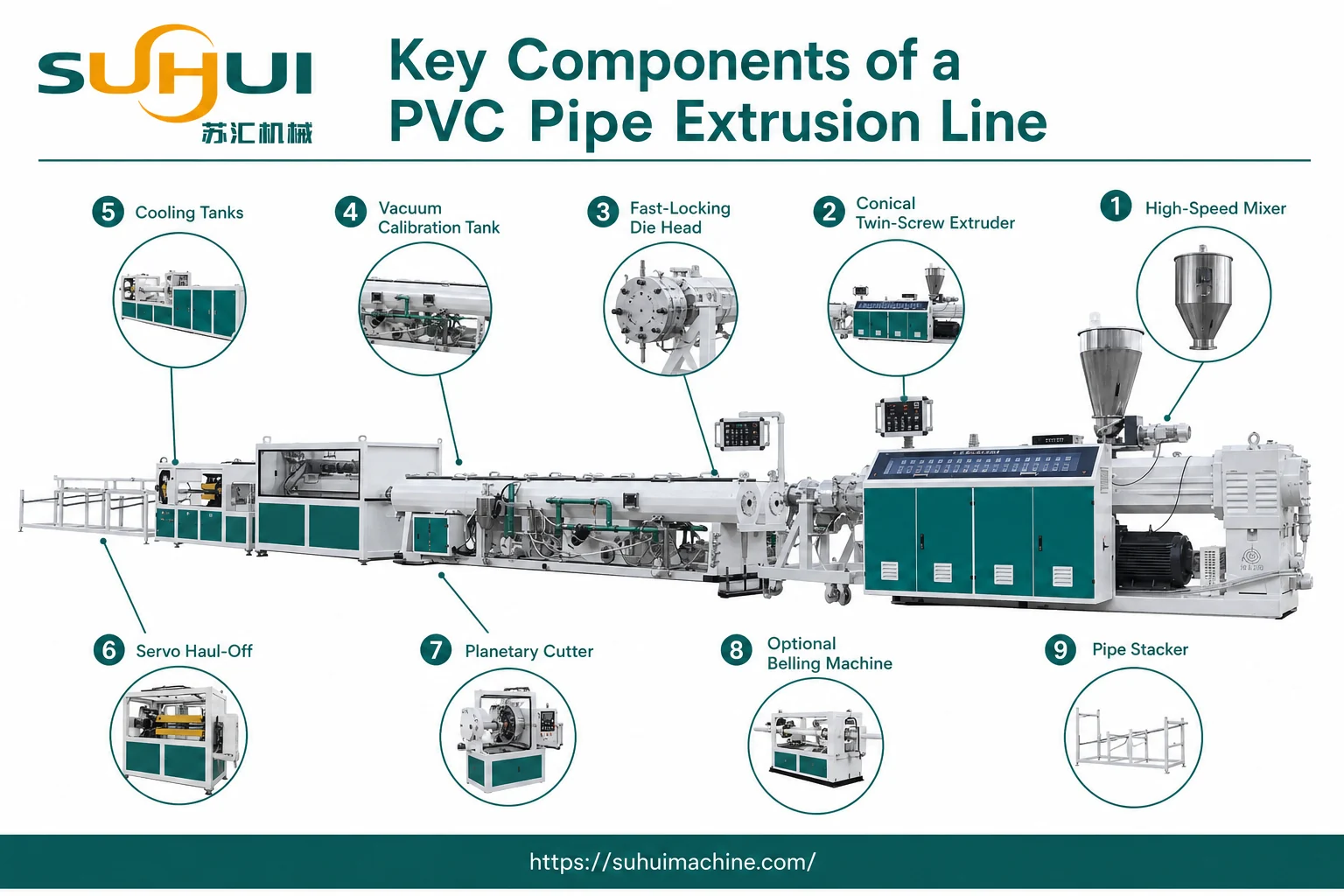
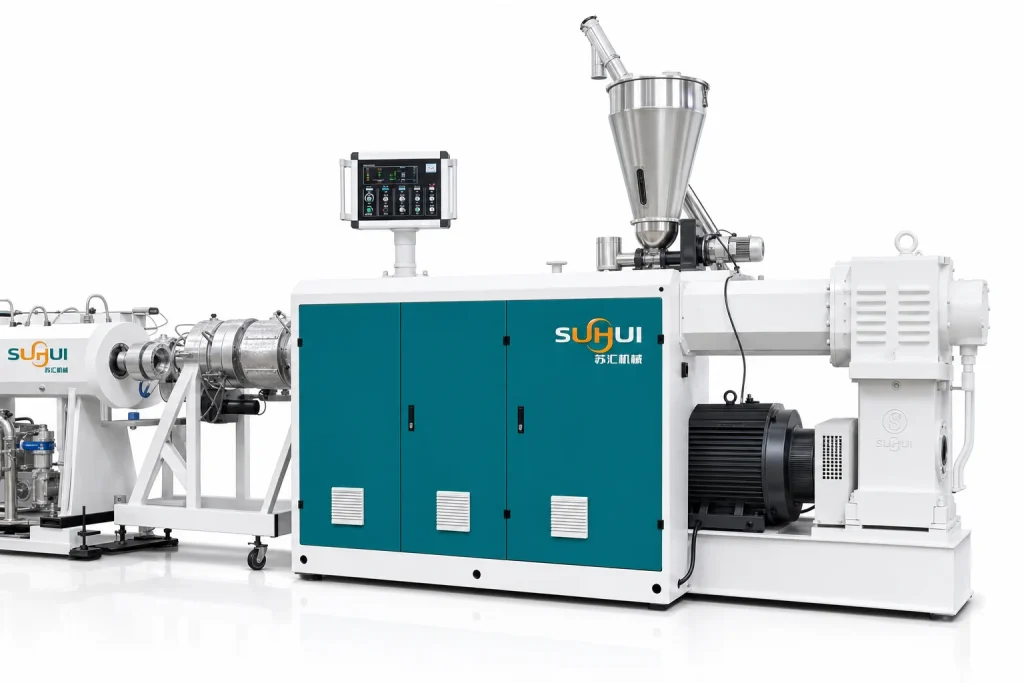
Key PVC pipe extrusion line components include mixer, conical twin-screw extruder, fast-locking die head, vacuum calibration tank, cooling tanks, haul-off, cutter, optional belling machine and pipe stacker.
| Model | O.D. Range | Extruder | Max. Output | Max. Haul-Off Speed | Motor Power |
|---|---|---|---|---|---|
| PVC32 Four | Φ16–32 mm | SJZ65/132 | 250 kg/h | 8 × 4 m/min | 37 AC kW |
| PVC40 Dual | Φ16–40 mm | SJ51/105 | 120 kg/h | 8 × 2 m/min | 18.5 AC kW |
| PVC63 Dual | Φ20–63 mm | SJZ65/132 | 250 kg/h | 12 × 2 m/min | 37 AC kW |
| PVC63 Single | Φ20–63 mm | SJZ55/110 | 180 kg/h | 12 m/min | 22 AC kW |
| PVC110 Single | Φ40–110 mm | SJZ65/132 | 250 kg/h | 6 m/min | 37 AC kW |
| PVC110 Dual | Φ40–110 mm | SJZ80/156 | 400 kg/h | 6 × 2 m/min | 55 AC kW |
| PVC160 | Φ50–160 mm | SJX65/132 | 250 kg/h | 5 m/min | 37 AC kW |
| PVC200 | Φ63–200 mm | SJZ80/156 | 350 kg/h | 6 m/min | 55 AC kW |
| PVC250 | Φ75–250 mm | SJZ80/156 | 400 kg/h | 5.5 m/min | 55 AC kW |
| PVC315 | Φ110–315 mm | SJZ80/156 | 400 kg/h | 5 m/min | 75 AC kW |
| PVC400 | Φ160–450 mm | SJZ92/188 | 600 kg/h | 3.5 m/min | 110 AC kW |
| PVC630 | Φ315–630 mm | SJZ92/188 | 800 kg/h | 2 m/min | 110 AC kW |
| PVC800 | Φ500–800 mm | SJP130/28 | 1,100 kg/h | 1.3 m/min | 160 AC kW |
Final configuration, die head, cooling length, haul-off type, cutter, and belling system are matched to your pipe diameter range, output target, PVC formulation, and product standard. Contact SUHUI for a complete PVC pipe production line proposal.
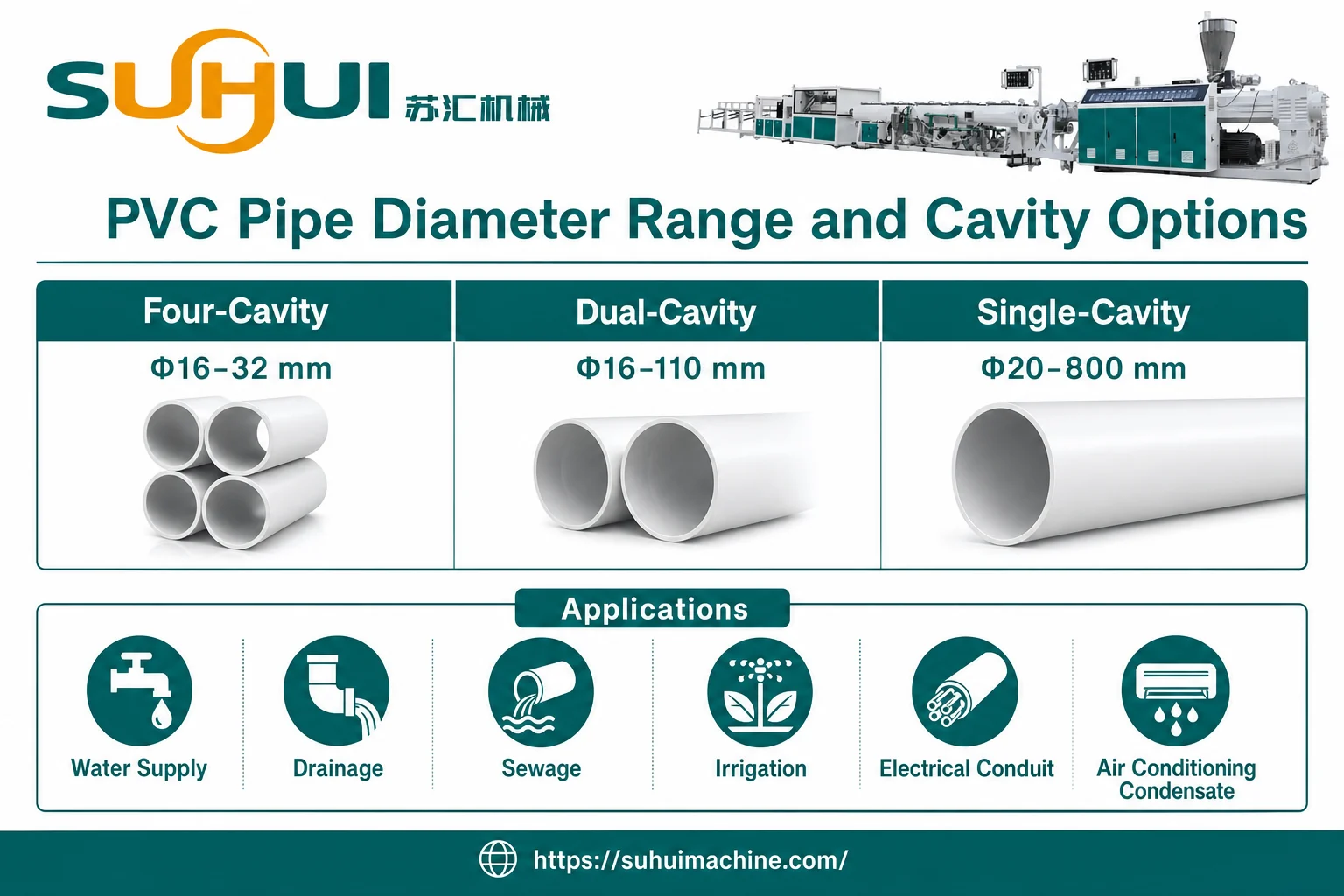
Four-cavity, dual-cavity, and single-cavity configurations allow the PVC pipe line to cover small conduit, medium pipe, and large drainage or sewage pipe production.
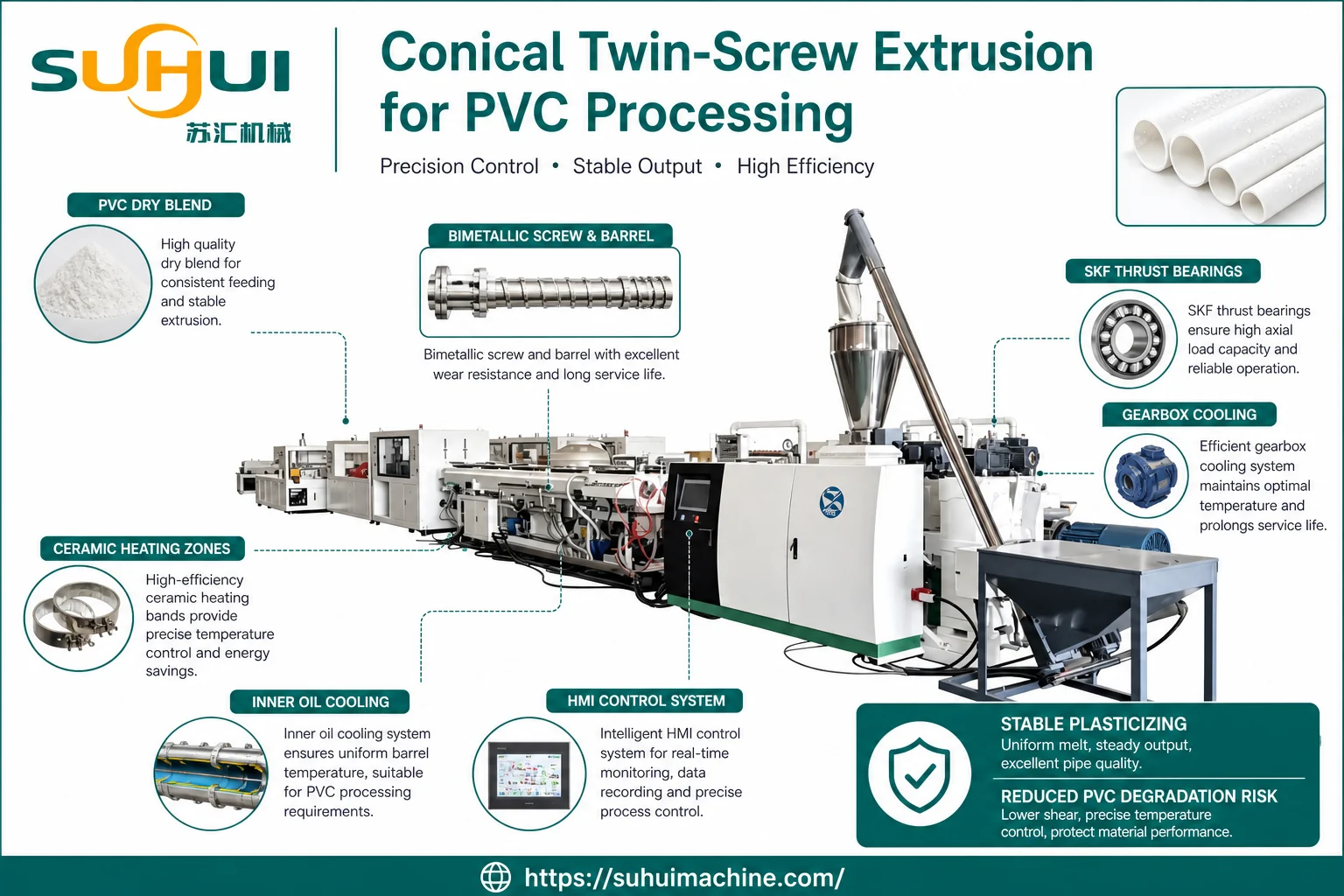
Conical twin-screw extrusion control helps process heat-sensitive PVC dry blend with stable plasticizing, temperature control, and reduced degradation risk.
After die forming, vacuum calibration determines whether the pipe keeps its required outside diameter, roundness, and surface finish. The pipe then passes through cooling tanks, haul-off, length measurement, and planetary cutting. For socket pipe production, an inline belling machine can form the bell end immediately after cutting, reducing the need for a separate offline process.
This downstream section is especially important for drainage pipe, sewage pipe, conduit, and pressure pipe manufacturers because inconsistent traction, cooling, or cutting can cause ovality, burrs, socket defects, or unstable installation quality.
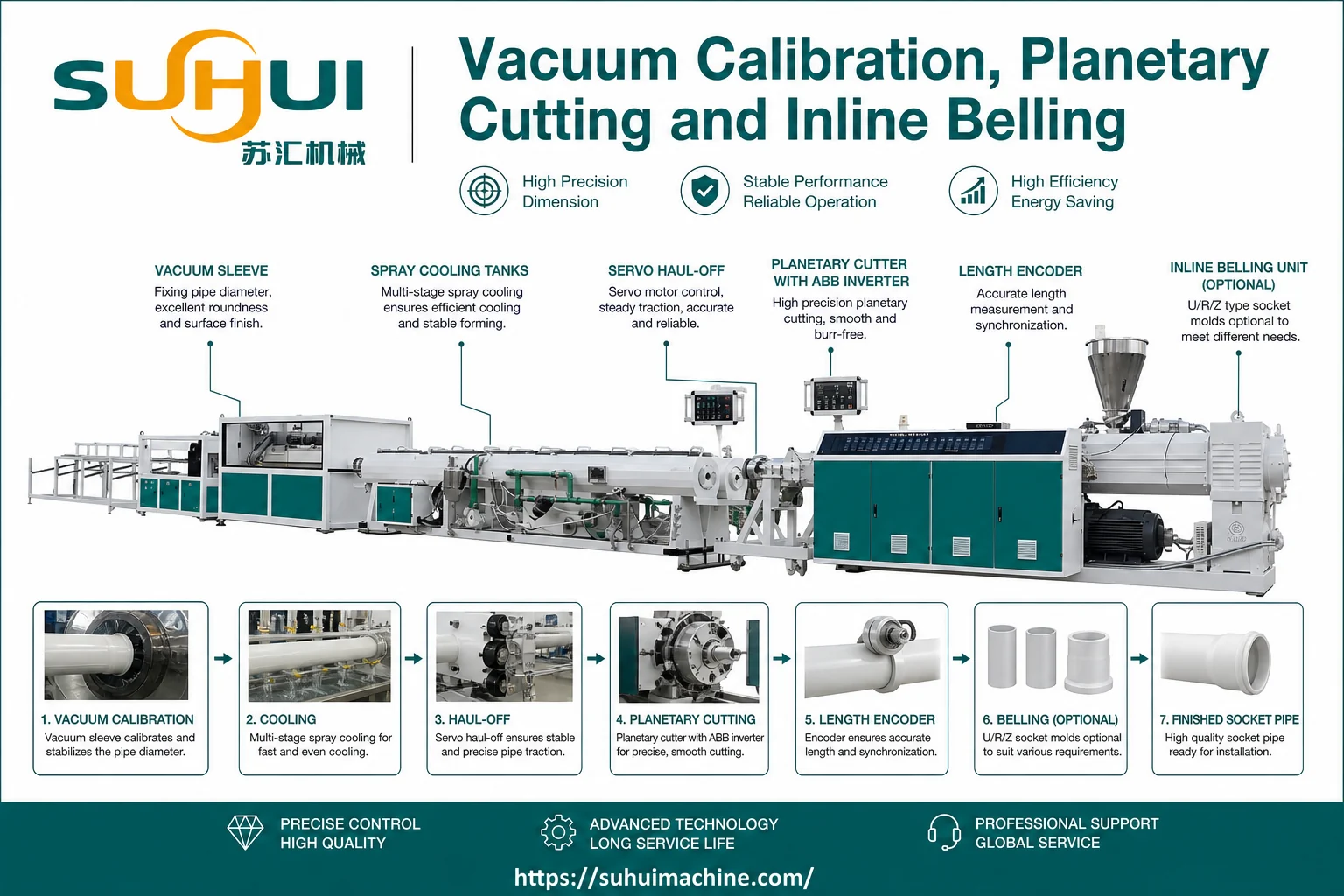
Vacuum calibration, spray cooling, servo haul-off, planetary cutting and optional belling work together to support precise PVC pipe dimensions and socket quality.
PVC and UPVC pipes from this line can be used for water supply, drainage, sewage, irrigation, electrical conduit, air conditioning condensate water, and industrial pipeline systems. The required equipment configuration depends on pipe diameter, pressure grade, wall thickness, socket type, formulation, and local standard requirements.
SUHUI can configure the line to support production targets related to ISO 4422, EN 1401, and ASTM D1785. Final compliance depends on resin grade, formulation, tooling, process control, testing method, and the buyer’s target market.
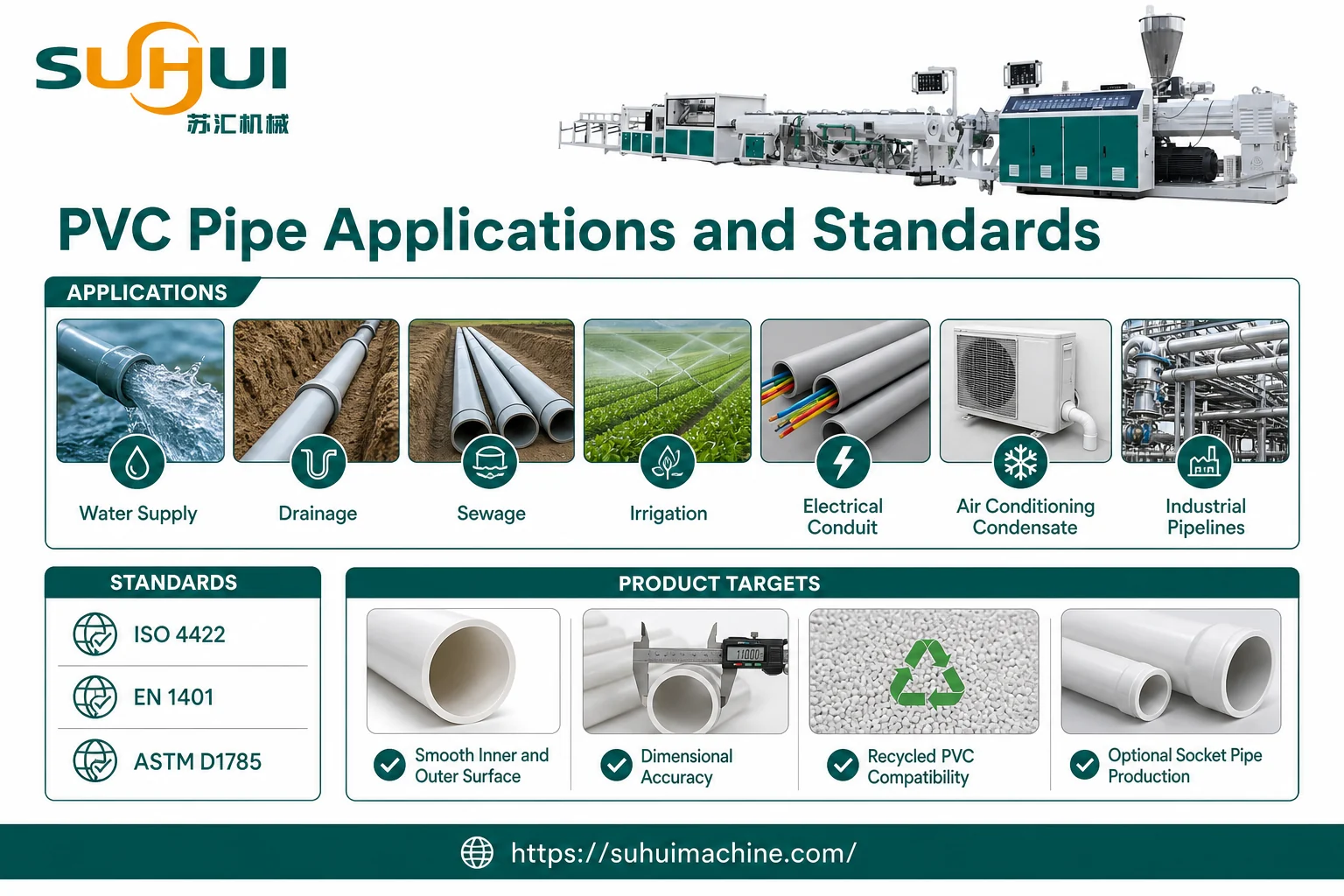
PVC pipe applications include water supply, drainage, sewage, irrigation, electrical conduit, air conditioning condensate and industrial pipelines, with production targets matched to required standards.
Yes. PVC pipe can be extruded when PVC resin is compounded with stabilizers, lubricants, modifiers, fillers, and pigments, then processed through a controlled twin-screw extruder, pipe die, vacuum calibration tank, cooling tanks, haul-off, cutter, and optional belling machine.
PVC is heat-sensitive and requires stable mixing at controlled temperature. A conical twin-screw extruder provides strong feeding, good PVC dry blend plasticizing, controlled shear, and stable pressure, which helps reduce degradation and supports consistent pipe quality.
SUHUI configurations support Φ16–800 mm PVC and UPVC pipe production. Four-cavity lines are suited to small conduit pipes, dual-cavity lines increase output for small to medium pipes, and single-cavity lines cover medium to large pipe diameters.
The process includes PVC dry blend mixing, controlled feeding, conical twin-screw extrusion, die forming, vacuum calibration, water cooling, servo haul-off, planetary cutting, optional inline belling, inspection, and packaging.
Yes. Recycled PVC regrind or pellets can be blended into the formulation when the final pipe application allows it. Non-pressure drainage and conduit pipes usually allow more recycled content than pressure-rated water supply pipes.
A PVC pipe belling machine forms socket ends after pipe cutting. Inline belling can produce U, R, or Z-shape sockets continuously, helping pressure pipe, drainage pipe, and conduit manufacturers reduce separate offline socket-forming steps.
The line can be configured to support PVC pipe requirements such as ISO 4422 for water supply, EN 1401 for underground drainage and sewage, and ASTM D1785 for PVC plastic pipe. Final compliance depends on formulation, tooling, process control, and testing.
Tell us your material type, condition, required capacity and target output. Photos or videos help.
SUHUI reviews the feeding method, process route and machine configuration for your material.
You receive an equipment list and quotation, with capacity, layout, voltage and automation matched to the project.
Production, testing, export packing and installation guidance through to commissioning.
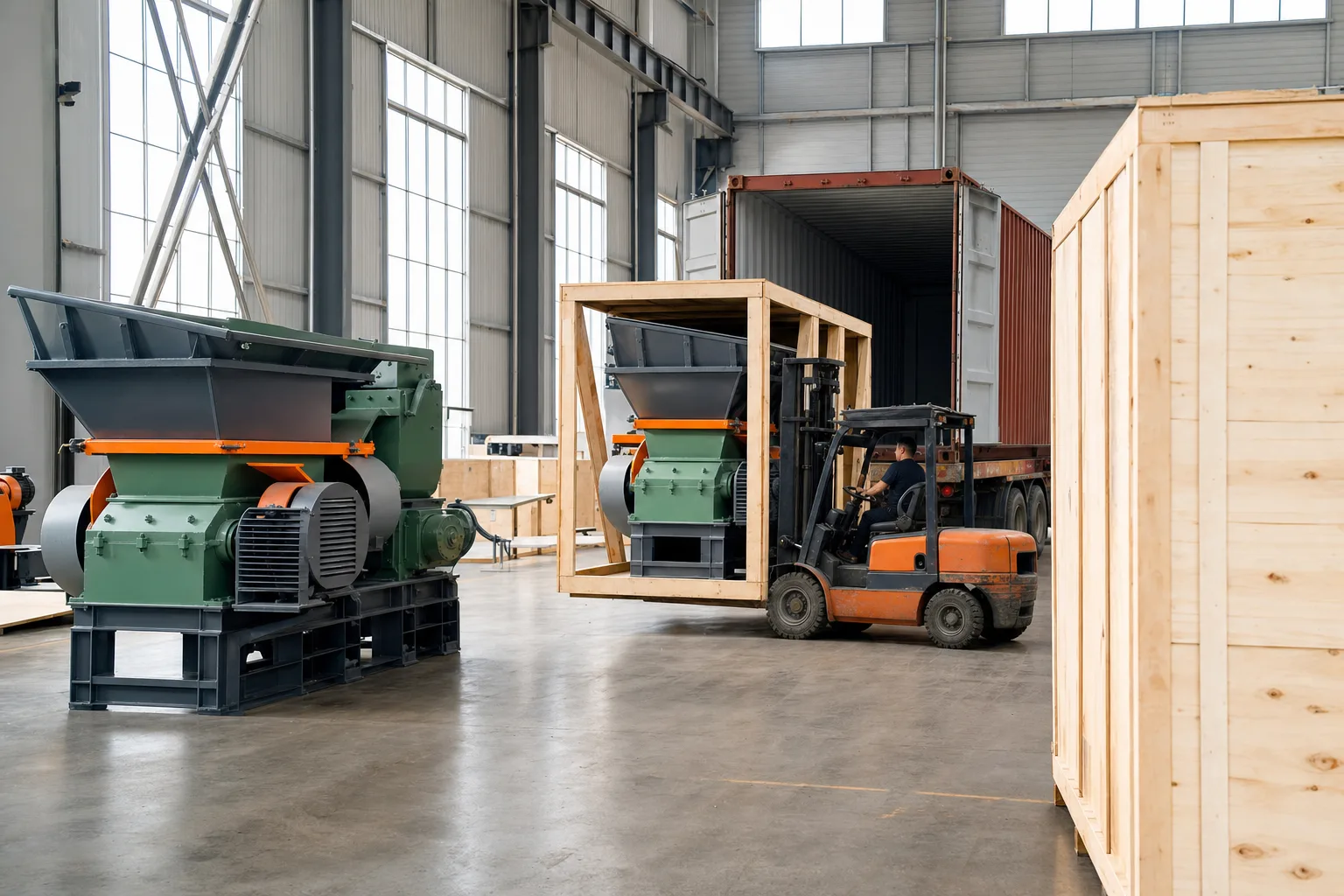
To receive a more accurate recommendation, please include your material type, target product size, output requirement, line speed expectation, available workshop space, voltage and destination country in the message.
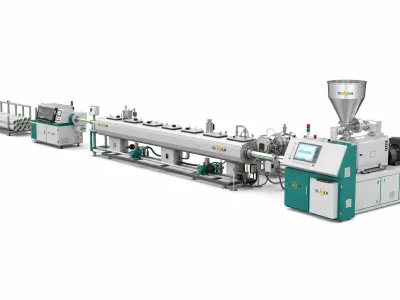
The SUHUI PPR pipe extrusion line produces single-layer and 3-5 layer PPR pipes for hot and cold water supply, heating systems, building plumbing and industrial fluid transport. Configurations support Φ20-250 mm pipe diameters, PPR, PE-RT, PB and MPP materials, glass fiber reinforced PPR, aluminum foil barrier PPR, thermal insulation composite pipe, vacuum sizing, closed-loop cooling, marking, servo haul-off and flying saw cutting.
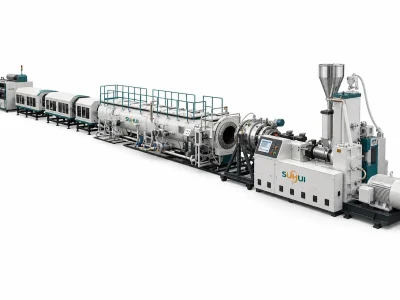
The SUHUI HDPE pipe extrusion line produces high-density polyethylene pipes for water supply, gas distribution, sewage, drainage, and industrial pipelines. The complete system integrates material feeding, single-screw extrusion, die forming, vacuum calibration, multi-stage cooling, online gauging, haul-off, cutting, and pipe handling. Standard 33D configurations cover Φ20-1,200 mm, while 38D high-performance configurations support up to Φ20-1,600 mm.