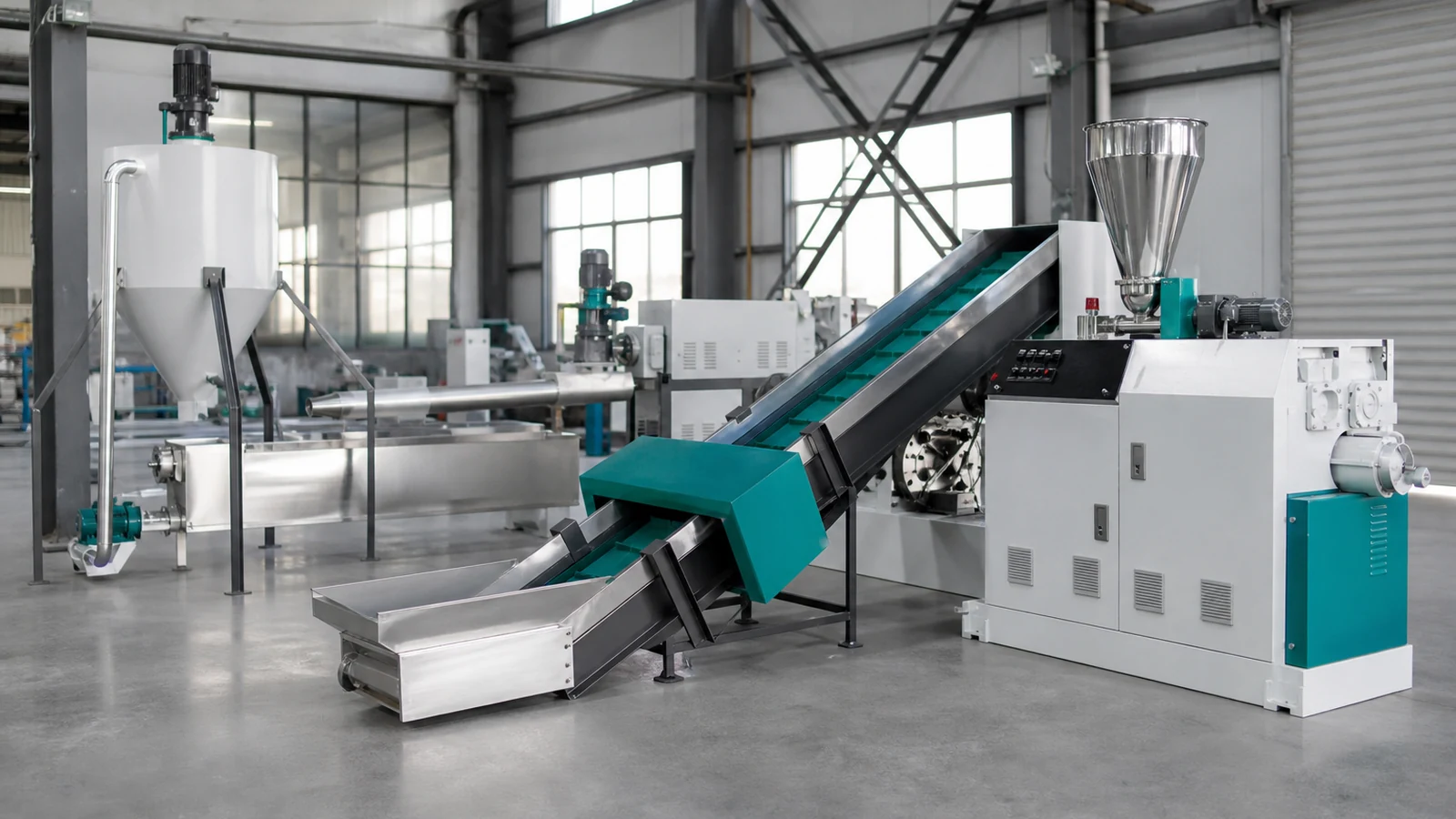
A rigid plastic granulating pelletizing line converts clean HDPE, PP, ABS, PS and mixed rigid plastic regrind into reusable pellets for molding or extrusion.
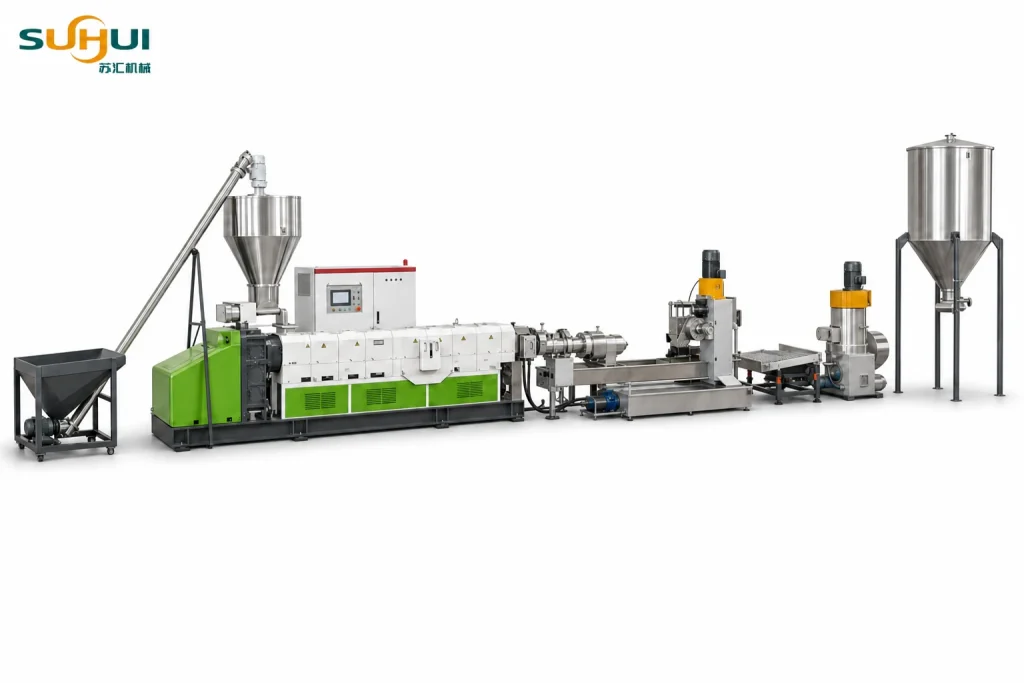
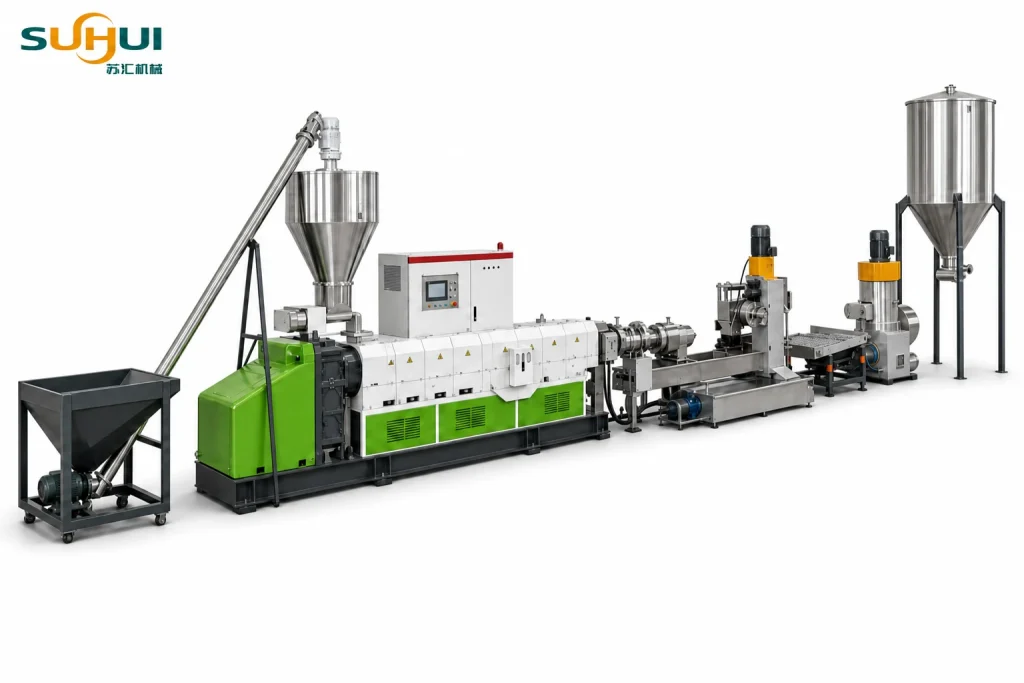
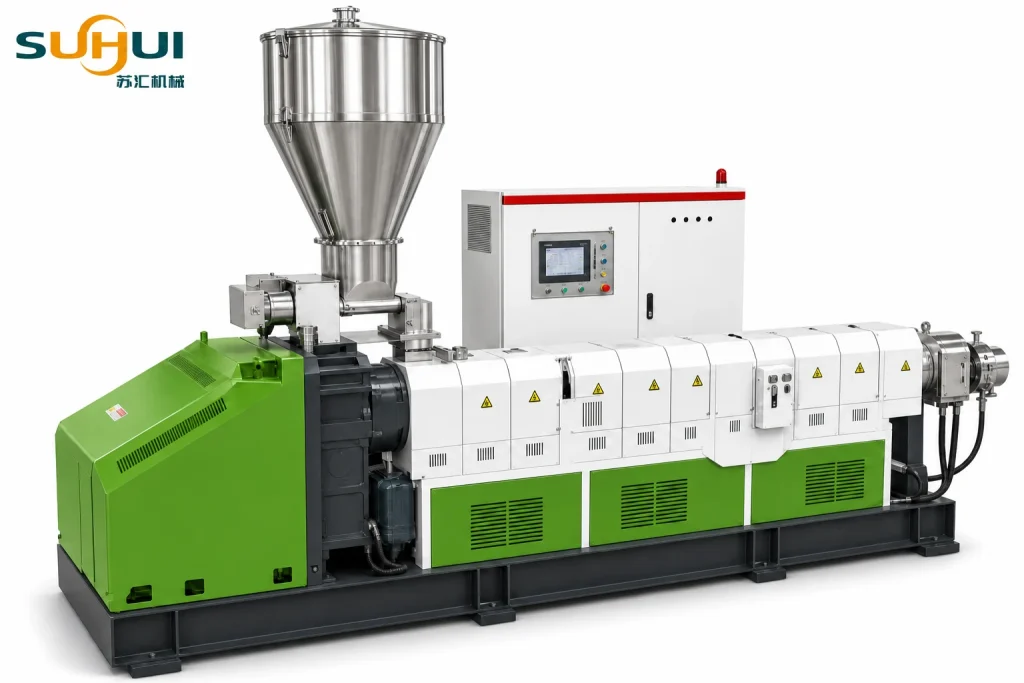
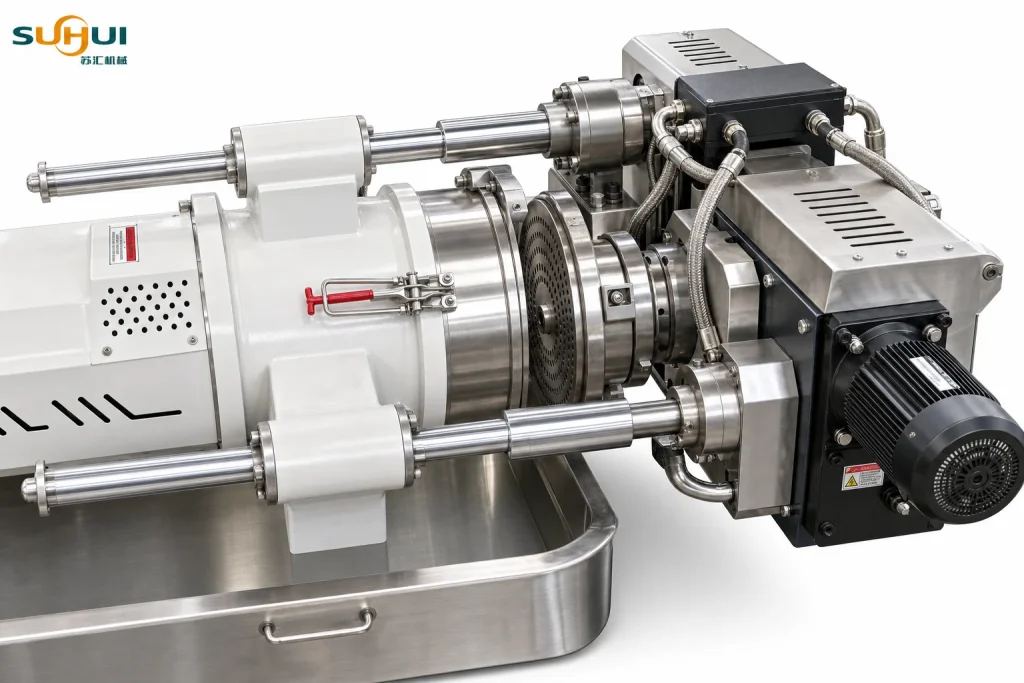
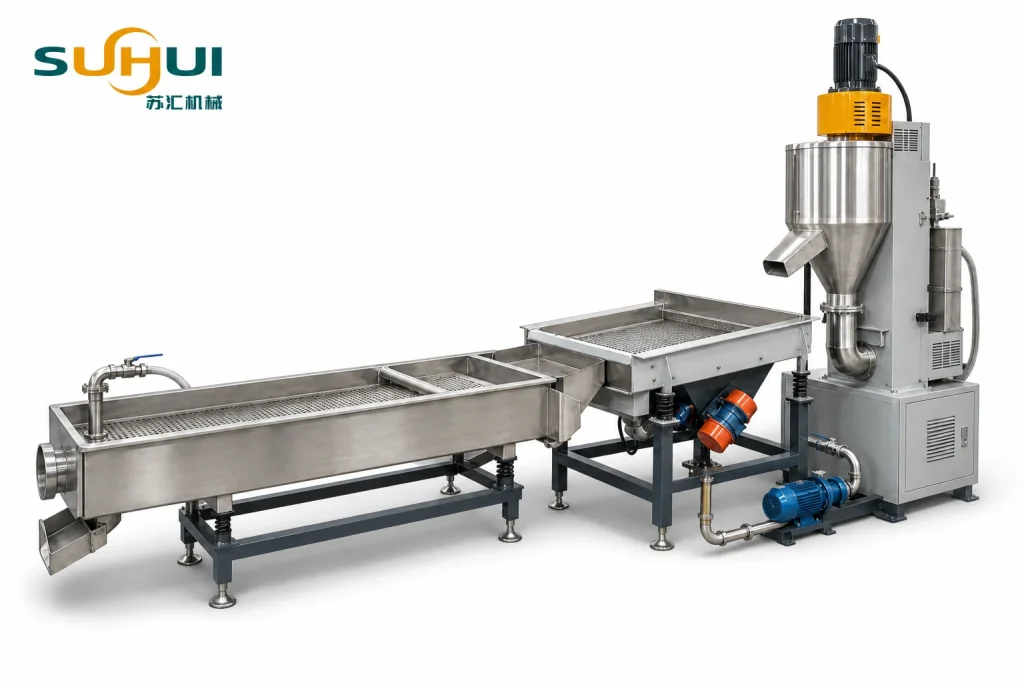
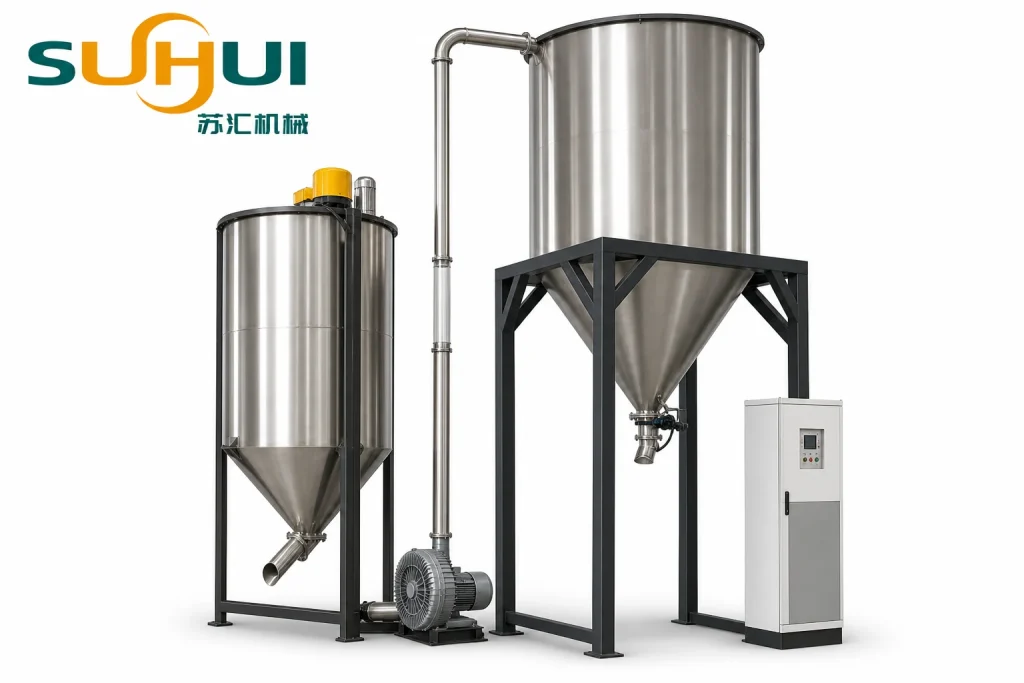
The SUHUI rigid plastic granulating pelletizing line processes HDPE, PP, PS, ABS and mixed rigid plastic waste into uniform 2–5 mm recycled pellets. Heavy-duty granulating, high-torque twin-screw extrusion, multi-stage melt filtration and precision pelletizing handle industrial scrap, post-consumer rigid packaging and moulding offcuts at 300–3,000 kg/h, producing clean raw material for injection moulding, blow moulding and extrusion.
The SUHUI rigid plastic granulating pelletizing line processes rigid plastic waste including HDPE, PP, PS, ABS, and mixed rigid plastics into high-quality uniform recycled pellets. Designed for industrial scrap, post-consumer packaging, and manufacturing offcuts, it transforms bulky rigid plastic waste into clean, reusable raw material for injection molding, blow molding, and extrusion applications.
The line integrates heavy-duty granulating, twin-screw extrusion, multi-stage melt filtration, and precision pelletizing technologies to handle the toughest rigid plastic materials consistently and efficiently. A multi-stage screen changer removes fine contaminants from the melt, ensuring pellet purity for demanding downstream applications. Every plastic pelletizing machine in the line — extruder, screen changer, die-face pelletizer, cooling trough and centrifugal dryer — is specified for dense, abrasive rigid regrind rather than for film.
Scalable from 300 to 3,000 kg/h, the SUHUI rigid plastic pelletizing line serves small recycling operations through to large-scale industrial plastic reprocessing facilities. Quick material changeover capability allows the same line to process different rigid plastic types with minimal downtime.
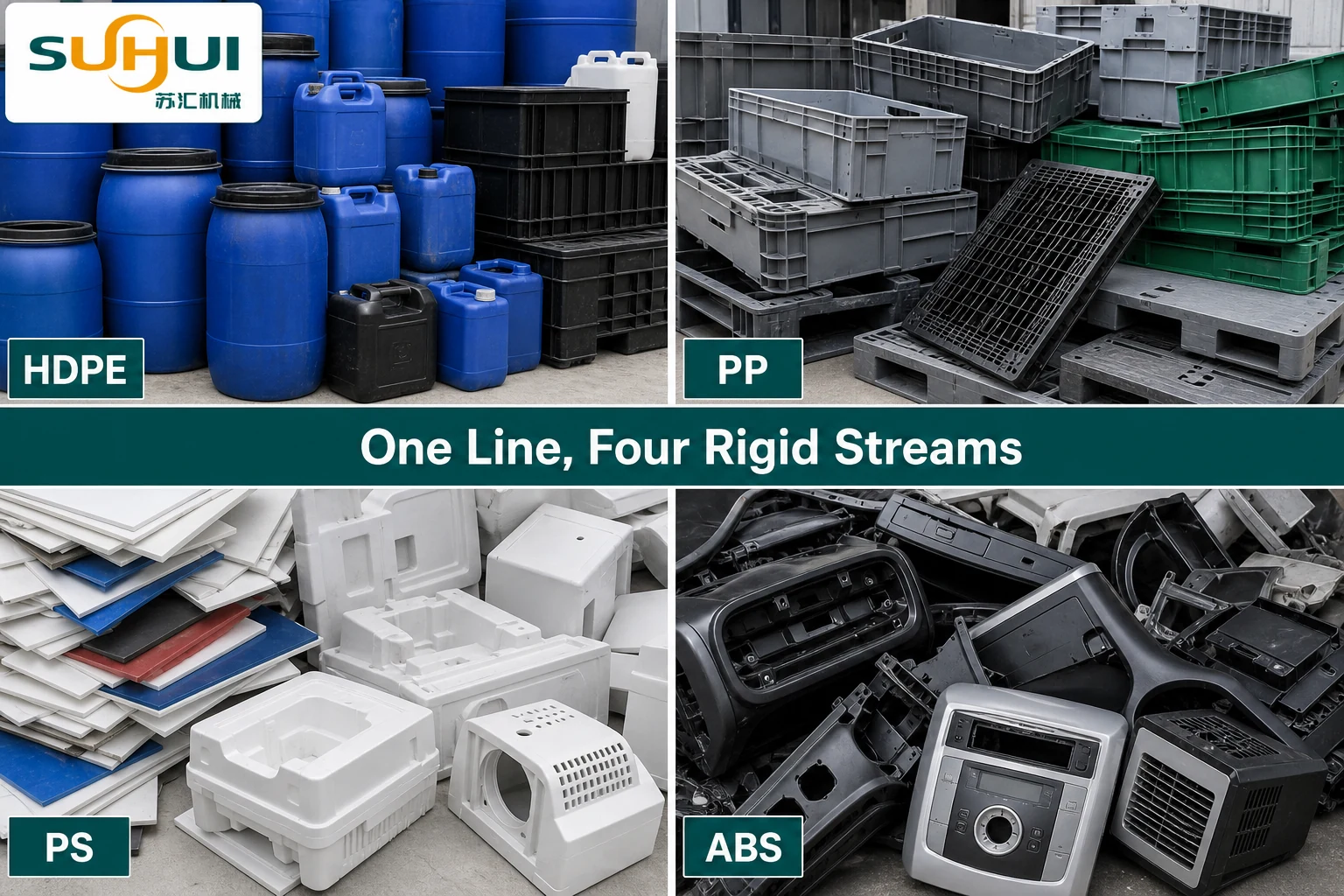
One line, four rigid streams: HDPE drums and jerrycans, PP crates and pallets, PS sheet offcuts, and ABS appliance and automotive housings.
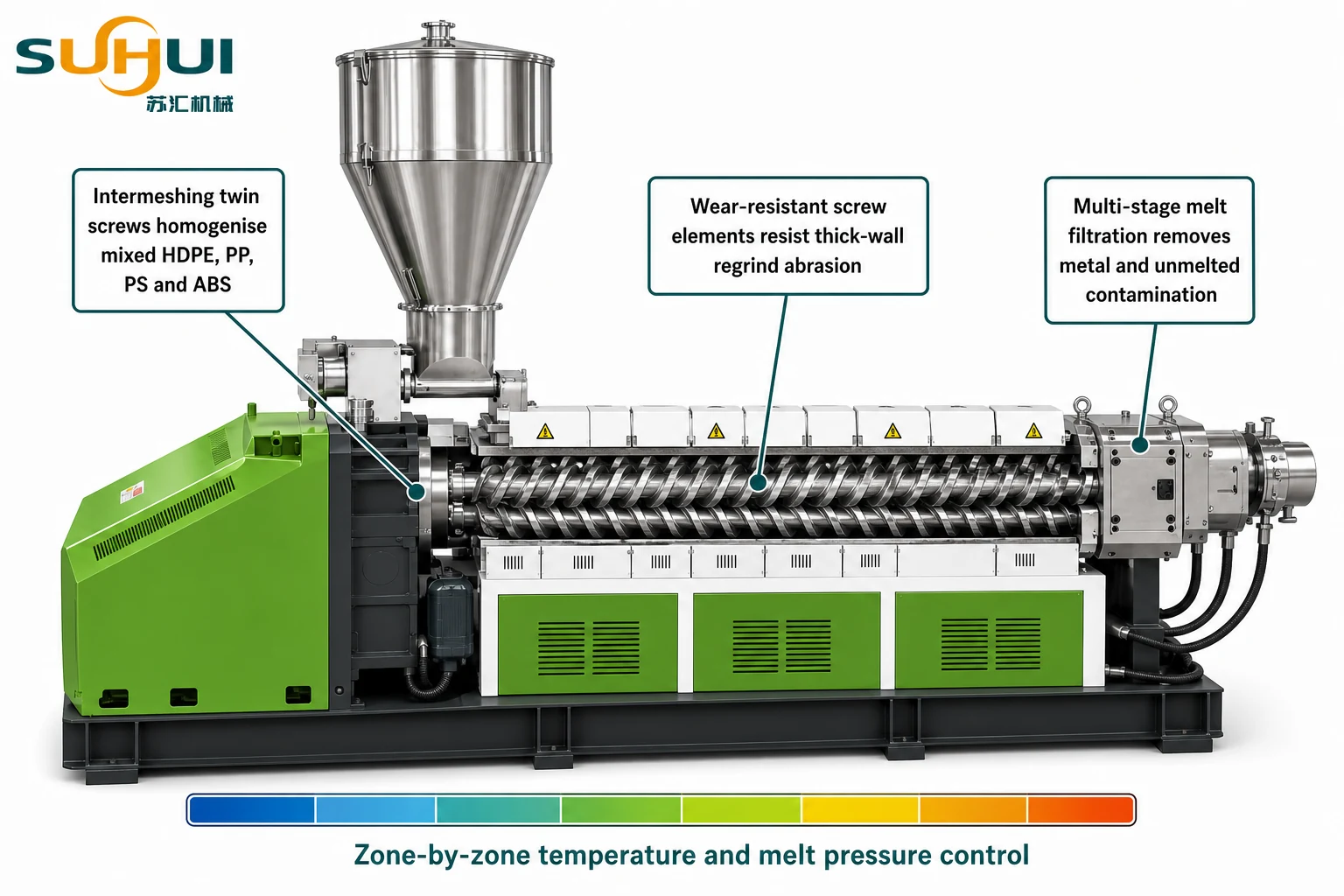
Intermeshing twin screws homogenise mixed HDPE, PP, PS and ABS along the barrel, wear-resistant elements absorb thick-wall regrind abrasion, and the screen changer filters the melt before the die.
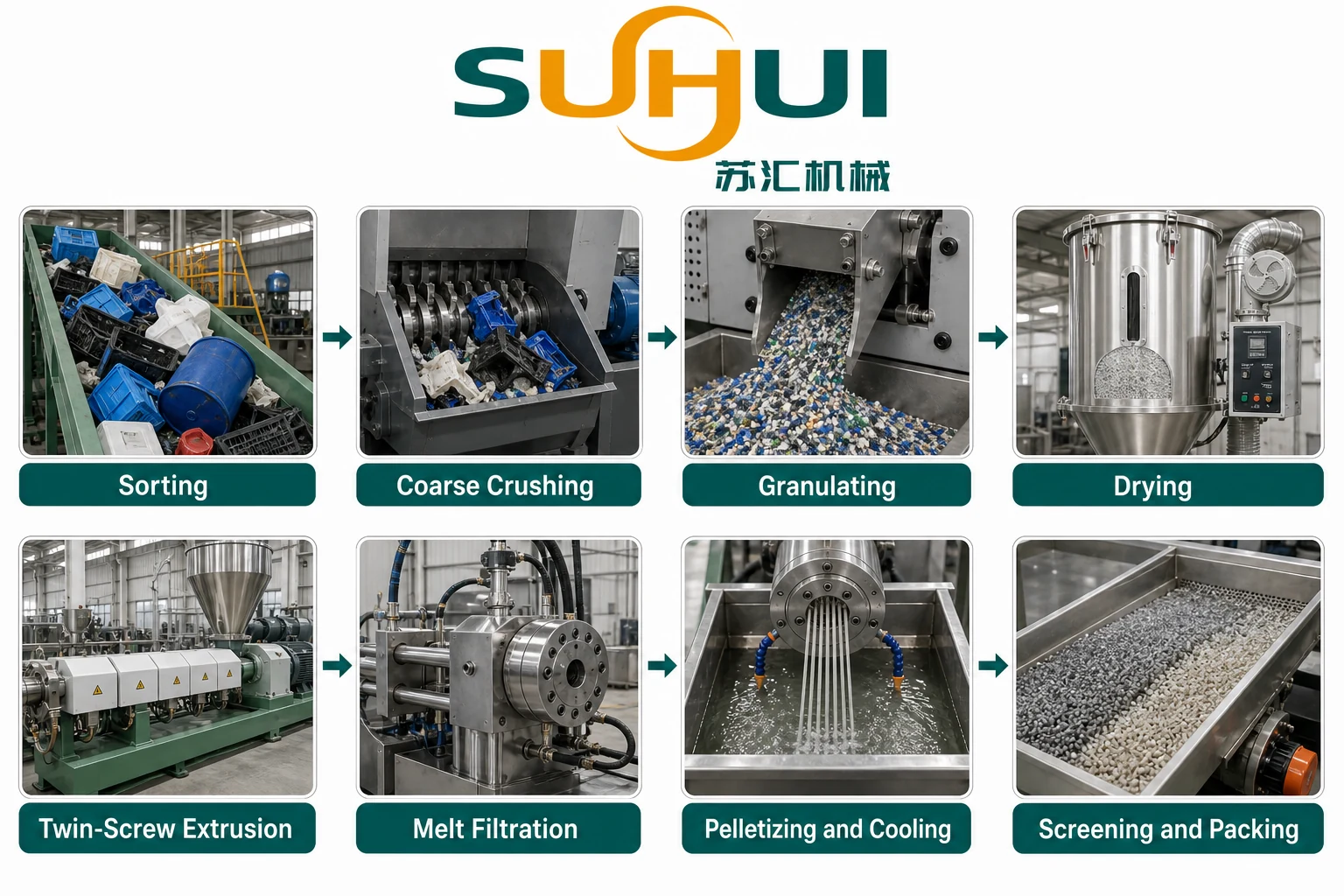
The complete rigid plastic pelletizing route: sorting, coarse crushing, granulating and drying, then twin-screw extrusion, melt filtration, pelletizing and cooling, screening and packing.
Rigid scrap is the opposite problem to film. Film is light, tangles and traps moisture, so the difficulty is getting enough material into the extruder. Rigid regrind feeds easily — the difficulty is everything that comes with it: high bulk density, thick wall sections that carry heat unevenly, and a feedstock that is almost never a single polymer.
A general-purpose plastic pelletizing machine built for clean single-grade pellets will run rigid scrap, but not for long. Three constraints decide whether the configuration holds up:
Where the scrap is genuinely single-grade and clean — in-house offcuts from your own moulding, for example — a simpler configuration is often enough, and we will say so rather than quote a line you do not need. Where the feed is mixed post-consumer rigid, the twin-screw and filtration stages are what separate a line that hits rated output from one that does not.
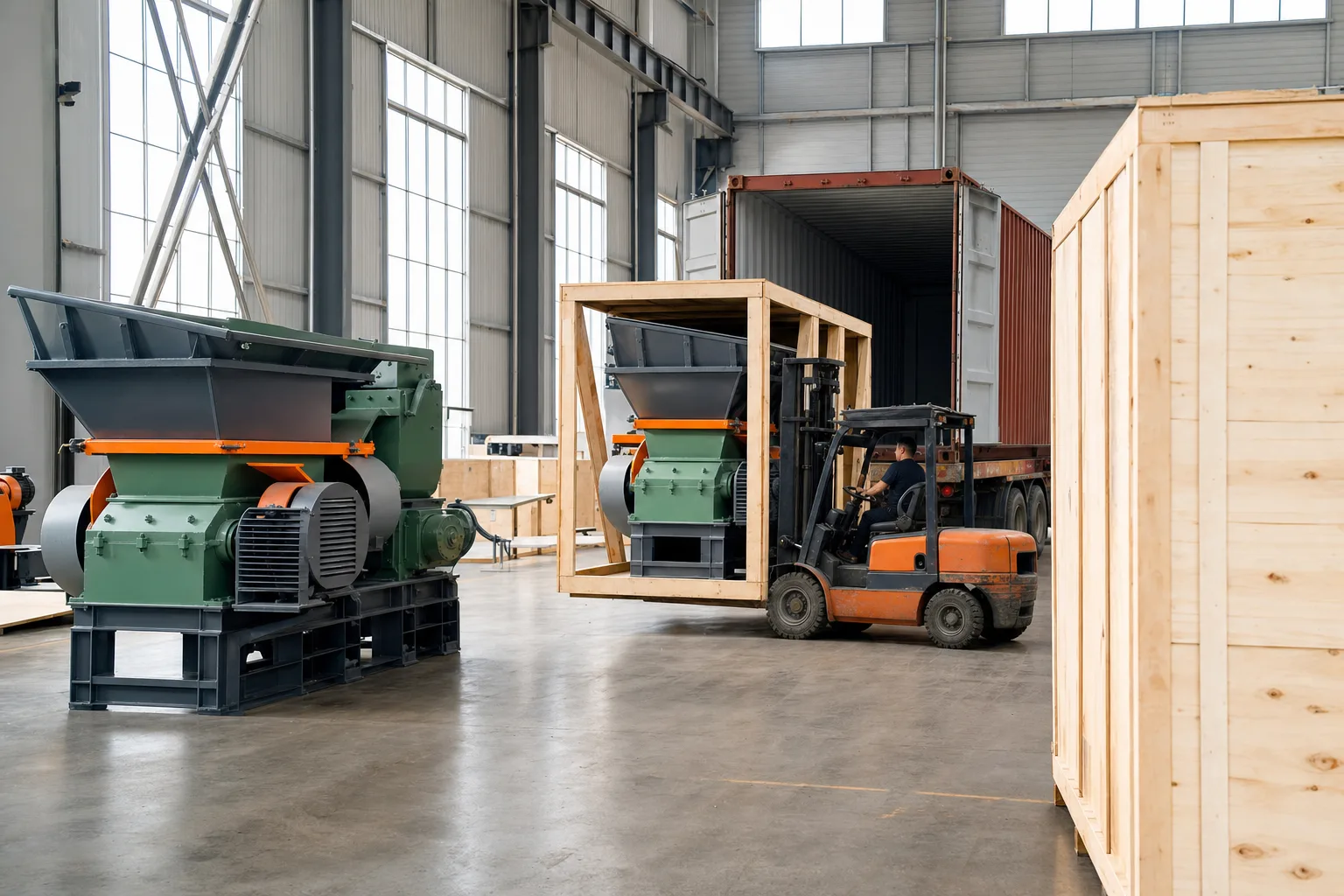
Every line is assembled and test-run in the SUHUI workshop before shipment:
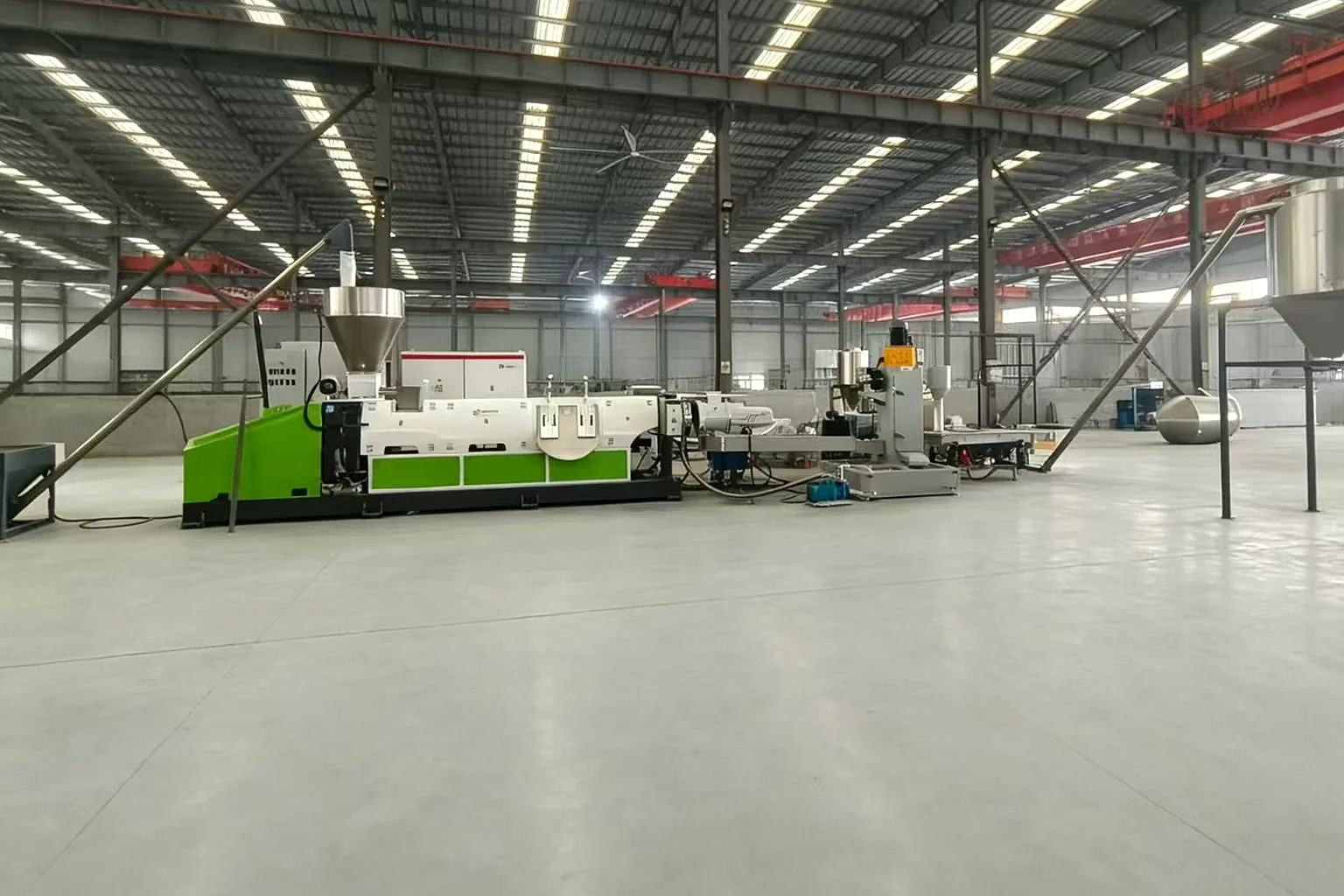
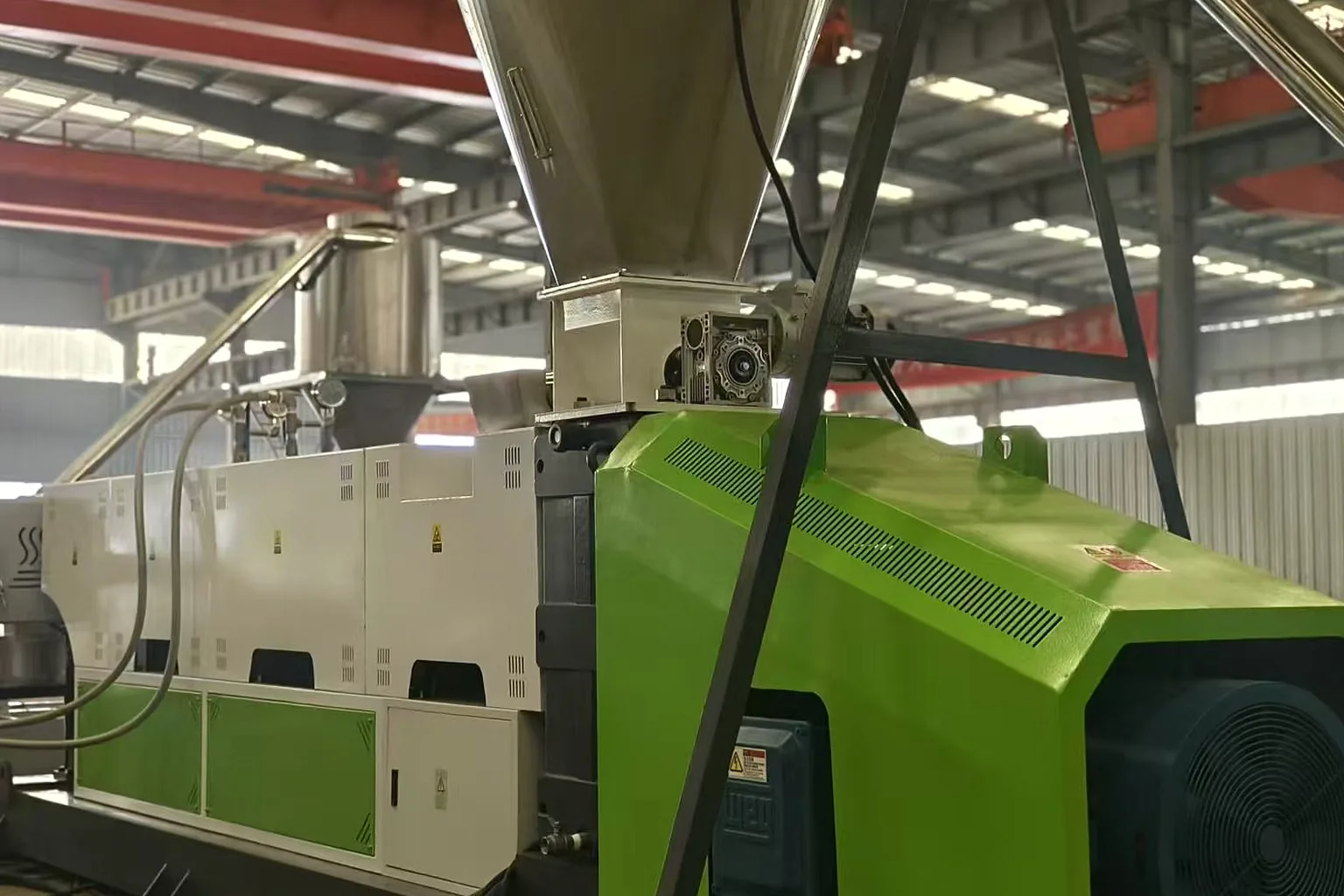
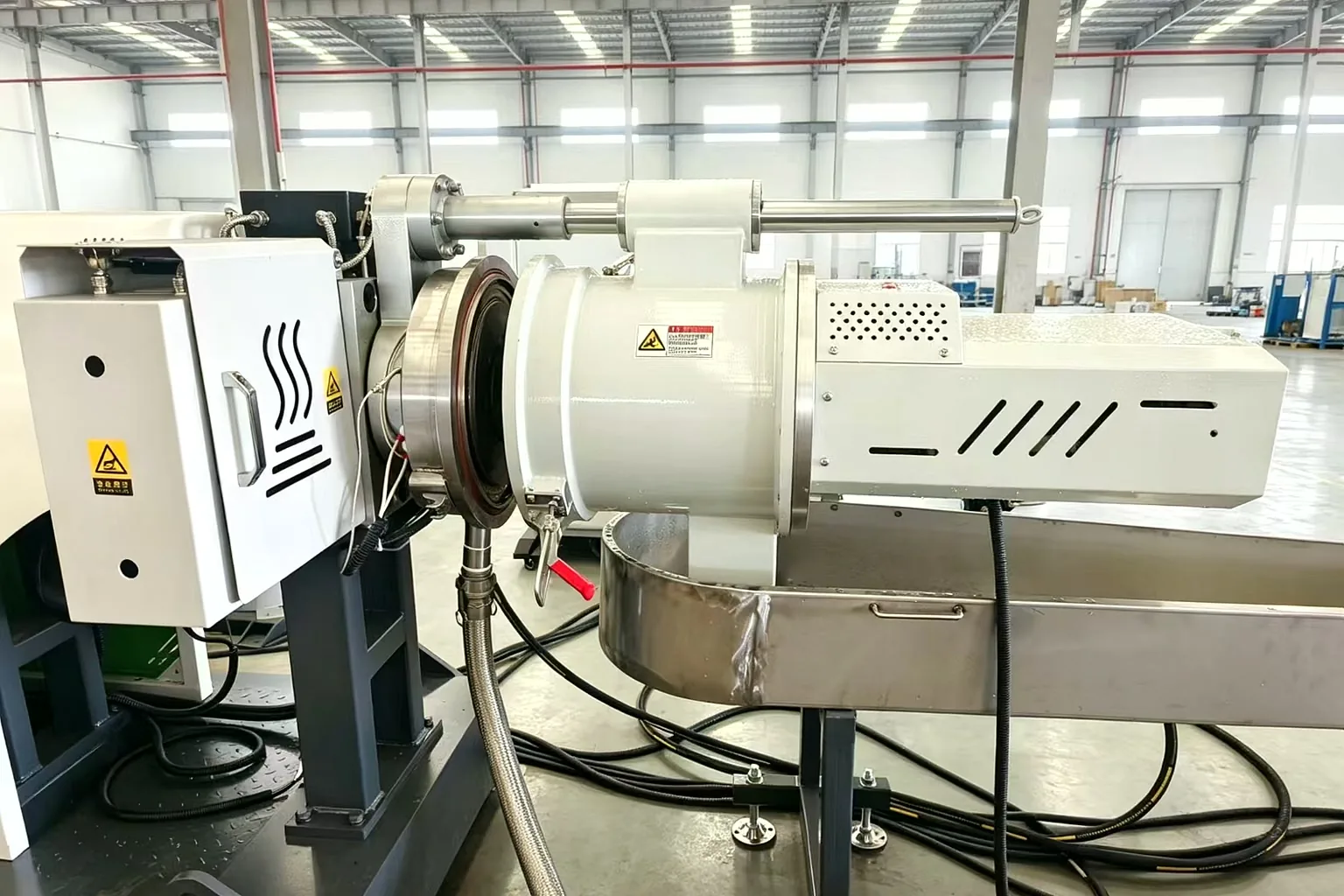
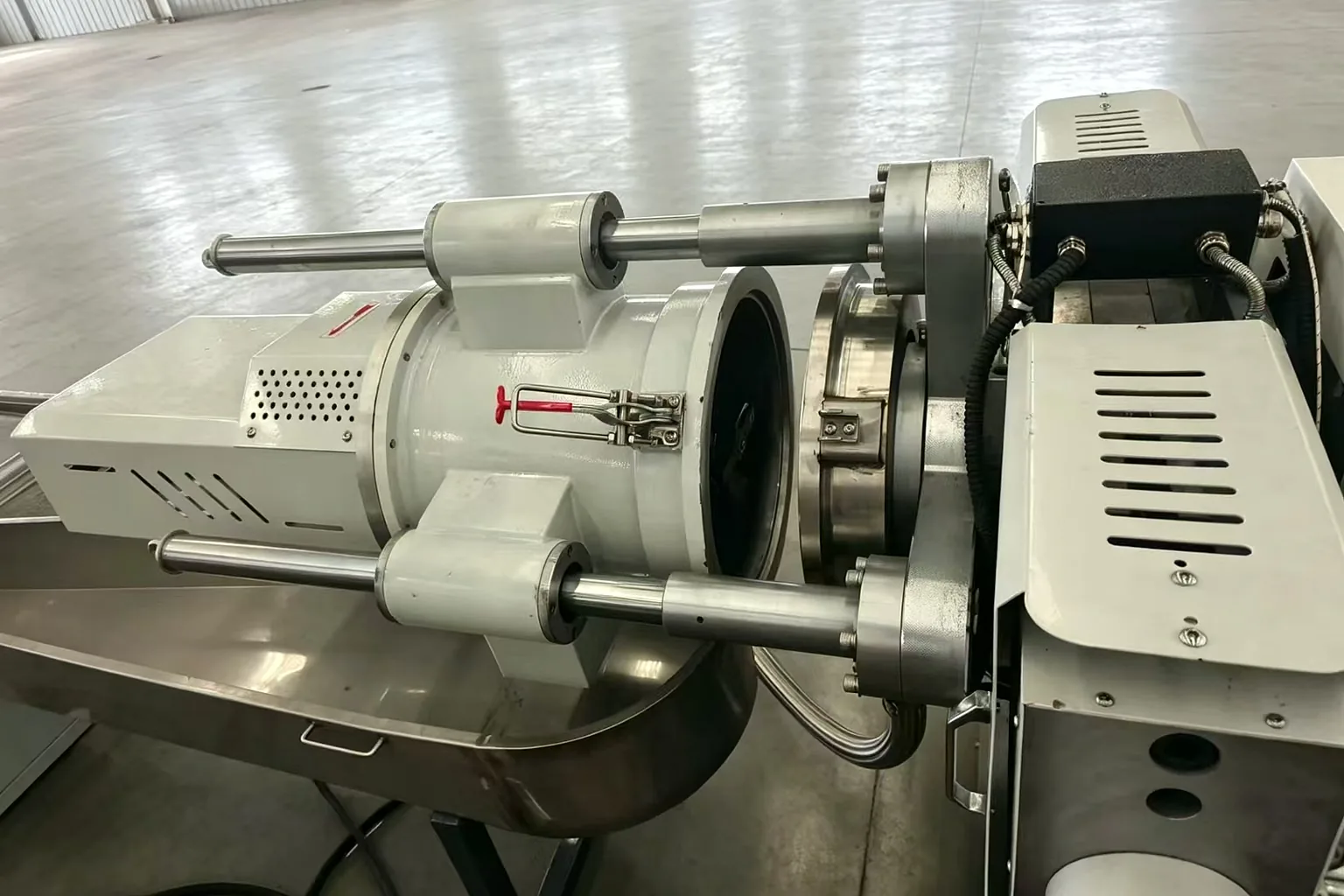
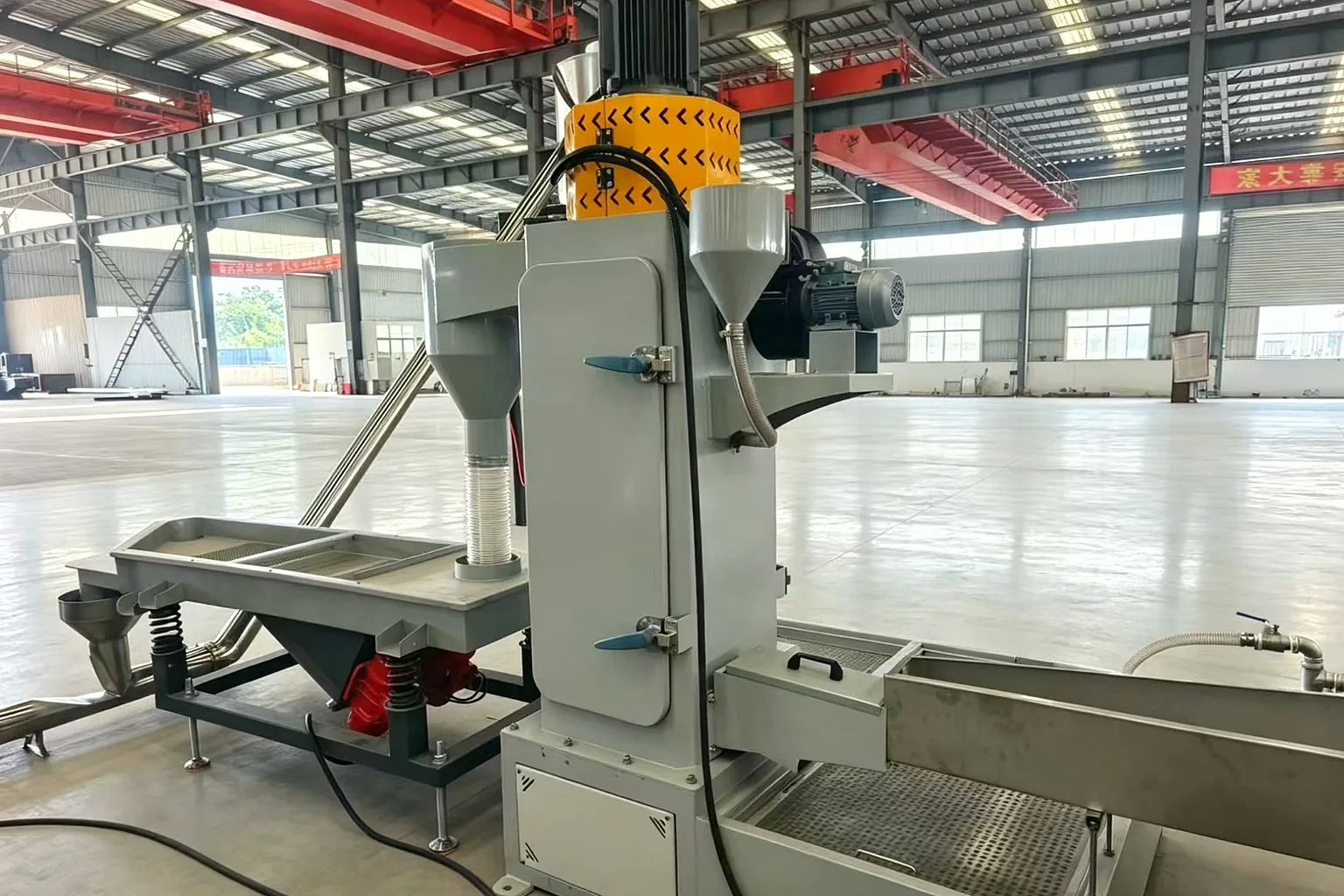
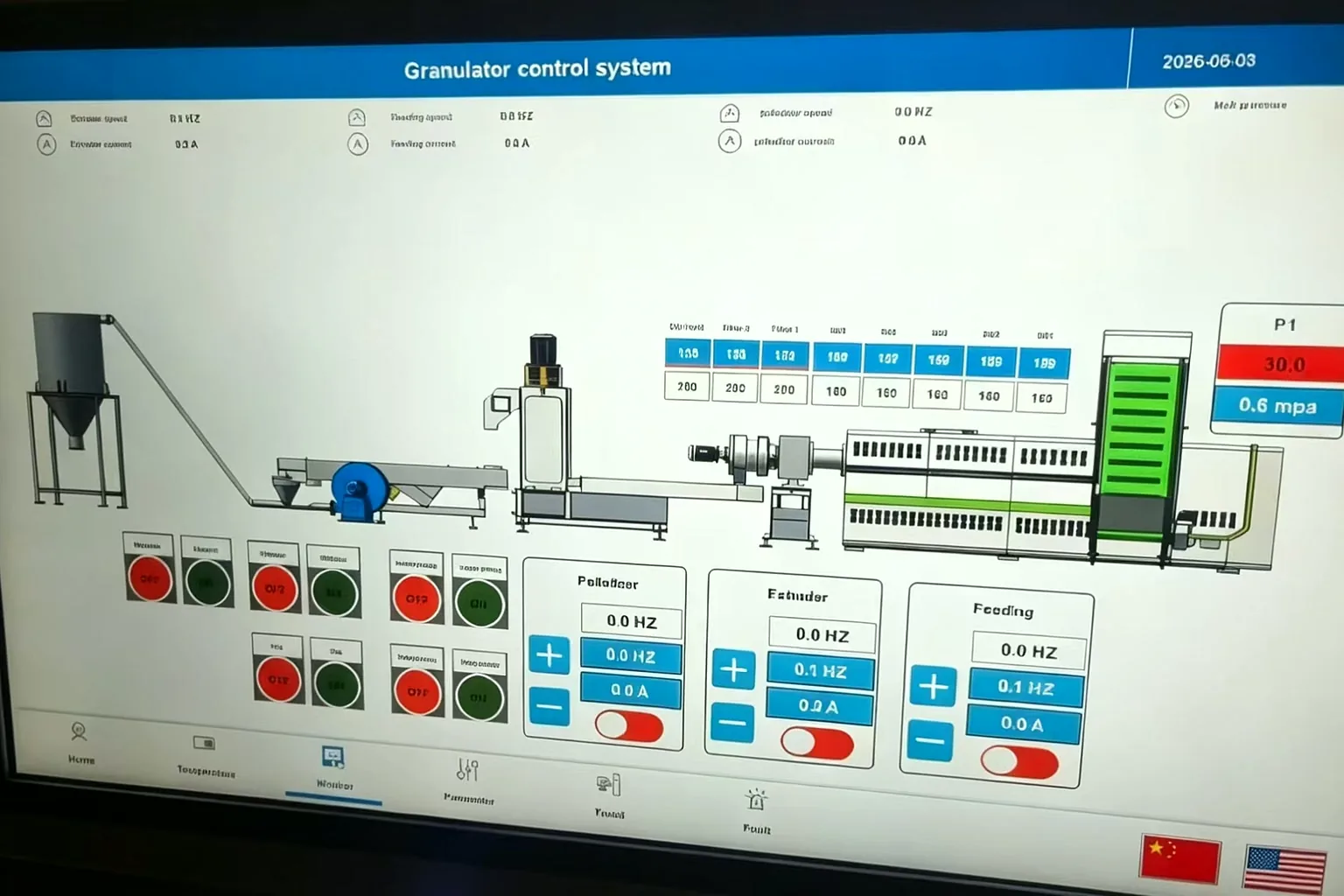
SUHUI workshop: extruder and feeding section, die head and melt filter, die-face pelletizer, dewatering screen and PLC control panel, assembled and test-run before delivery.
Key parameters of the standard SUHUI rigid plastic granulating pelletizing line configuration. Use them to size the plastic pelletizing equipment against your own feedstock before asking for a quotation:
| Parameter | Specification |
|---|---|
| Material | HDPE, PP, PS, ABS and mixed rigid plastics |
| Typical input | Post-industrial offcuts, post-consumer rigid packaging, crates, drums, moulding scrap |
| Input form | Crushed rigid regrind, 3–8 mm |
| Granulator | High-speed granulator, hardened alloy steel blades |
| Extruder type | High-torque twin-screw, co-rotating or counter-rotating |
| Melt filtration | Multi-stage, continuous or discontinuous screen changer |
| Pelletizing | Underwater or strand pelletizing |
| Pellet size | 2–5 mm |
| Output capacity | 300–3,000 kg/h |
| Cooling | Enclosed closed-loop water cooling with vacuum extraction |
| Control | PLC with touchscreen; barrel temperature, screw speed and melt pressure monitored per zone |
| Energy recovery | Heat exchangers recover extrusion heat to reduce consumption |
Exact extruder model, output capacity and total installed power are matched to each project and confirmed with the quotation. Capacity in particular is set by the material, not by the extruder alone — the same line runs noticeably slower on thin-wall mixed regrind than on clean thick-wall HDPE.
The line produces uniform 2–5 mm recycled pellets with consistent geometry and bulk density. Vibratory screening removes fines and oversized particles before bagging, which matters more for rigid than for film: downstream moulding machines meter by volume, and inconsistent bulk density shows up directly as shot-weight variation.
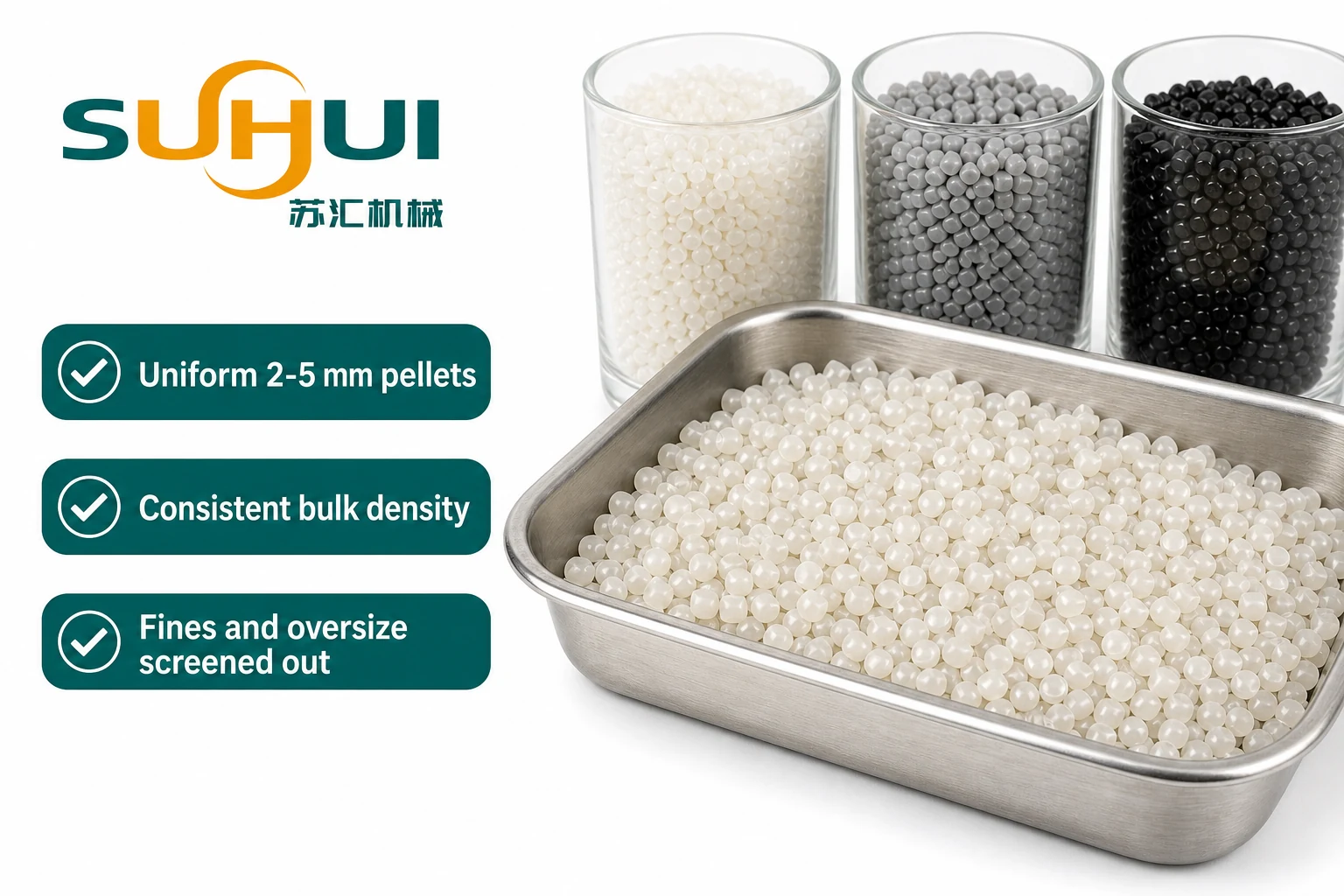
Uniform 2–5 mm recycled pellets with consistent bulk density, fines and oversize screened out before bagging.
Where the pellets can go depends mostly on how clean and how single-grade the input was:
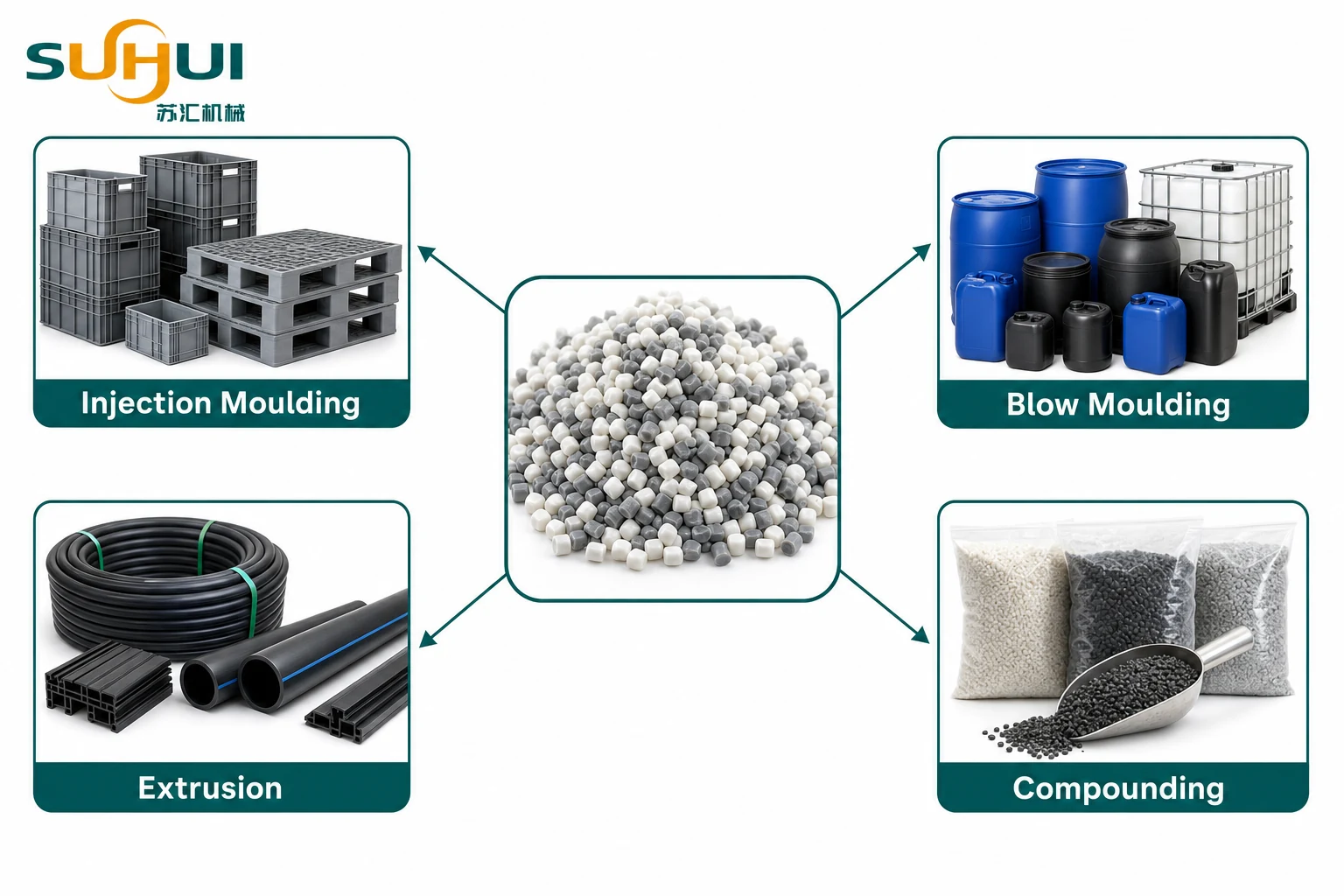
Recycled rigid pellets feed injection moulding, blow moulding, pipe and profile extrusion, and compounding.
If you already know the downstream process, tell us at enquiry stage. It changes the filtration specification and sometimes the pelletizing method — an underwater pelletizer gives rounder pellets that meter more consistently, while strand pelletizing is simpler to run and easier to maintain. Neither is universally better; it depends on what the pellets have to do next.
SUHUI rigid plastic pelletizing lines run at customer recycling plants processing HDPE and PP scrap. The photos below are from a customer installation: the extrusion and pelletizing sections, strand cooling trough, centrifugal pellet dryer and rotor detail, and the drying tower and storage silos in daily operation.
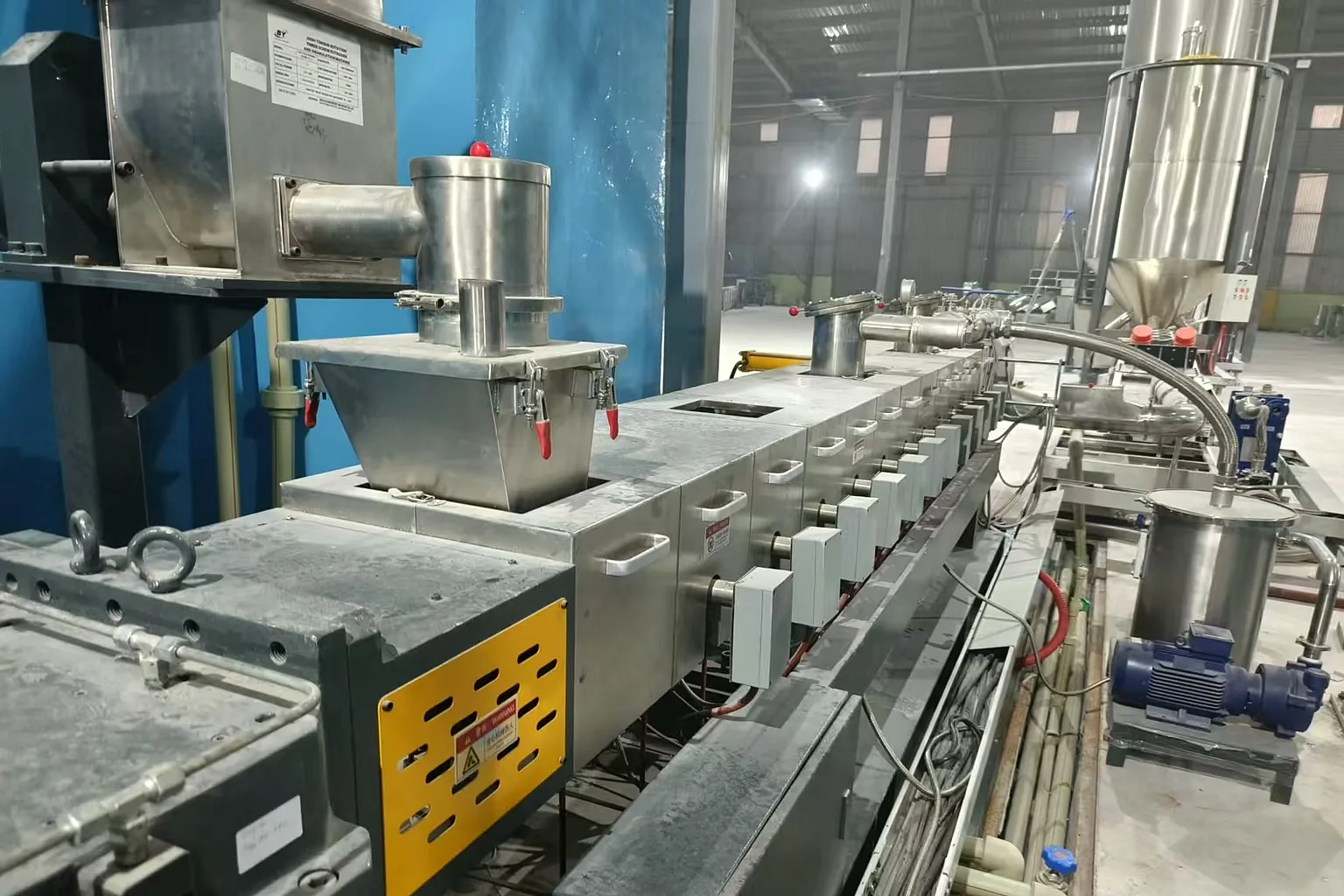
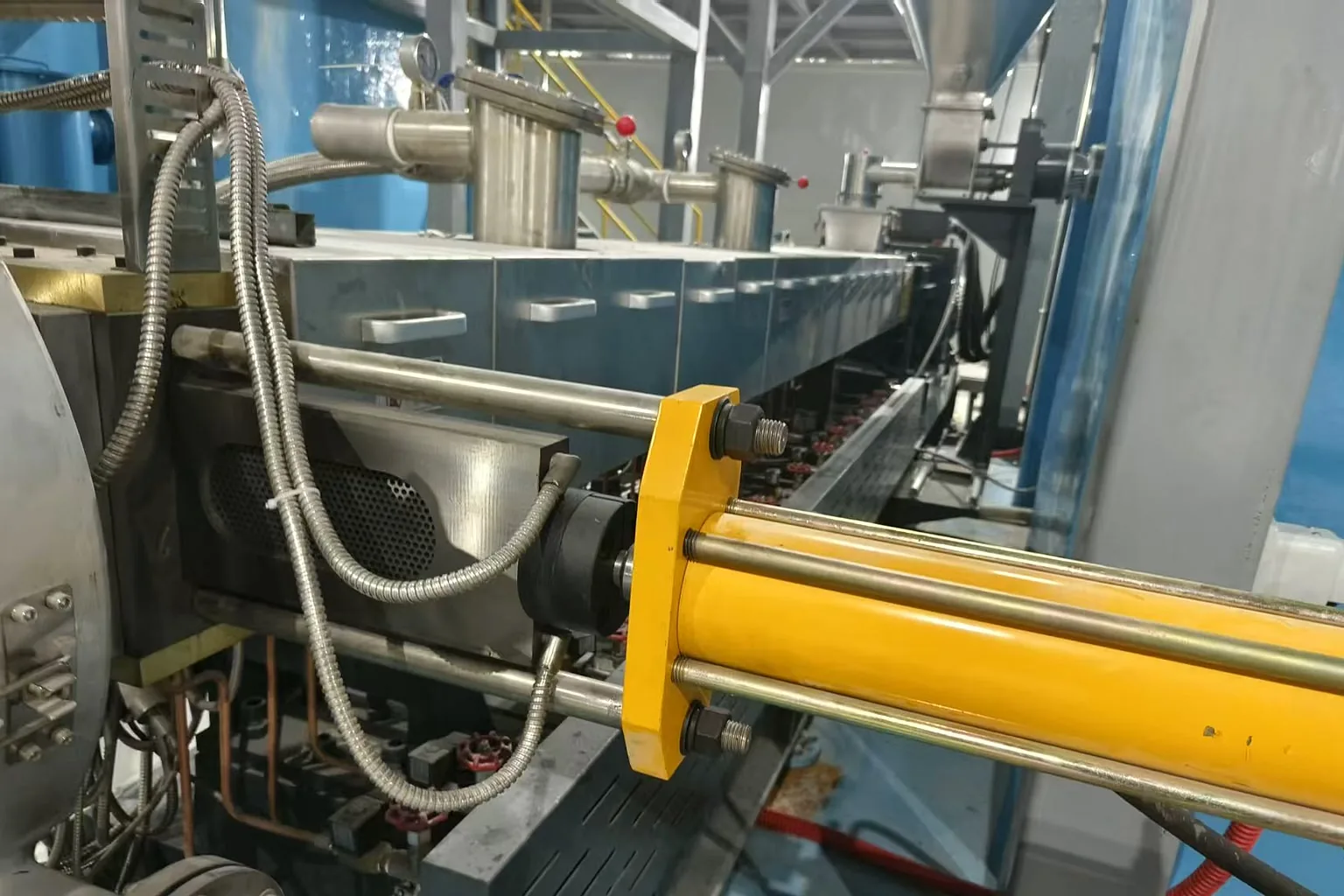
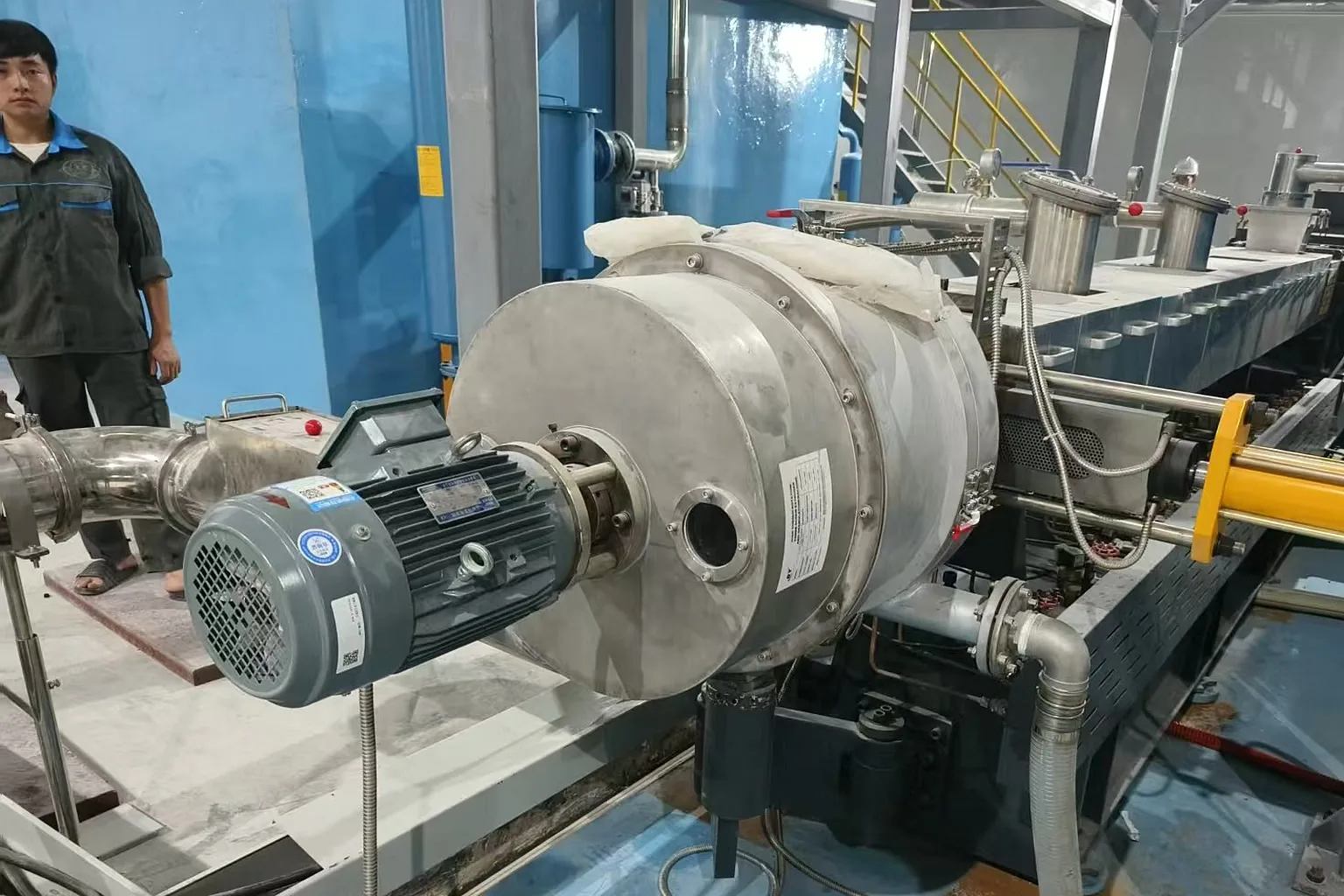
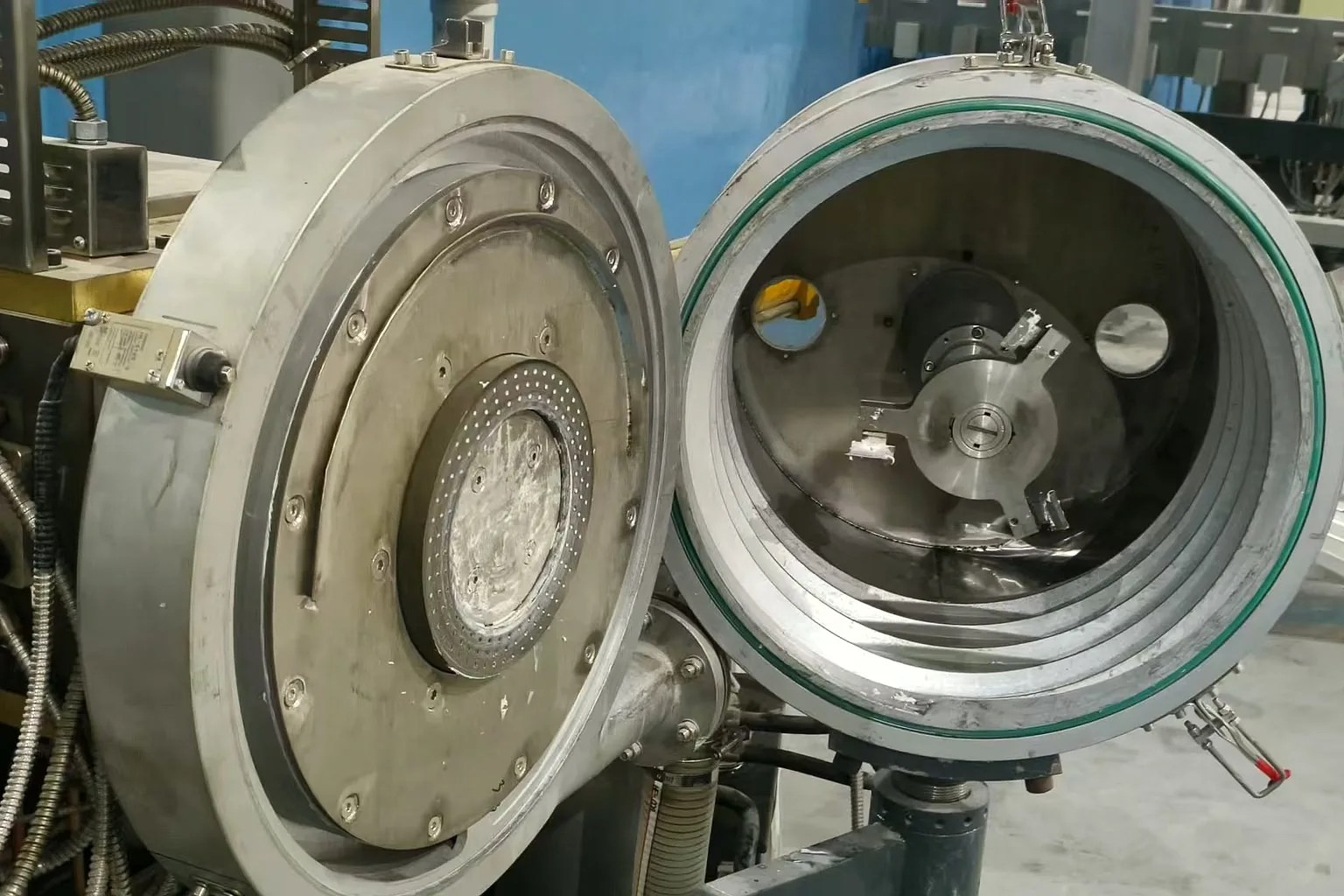
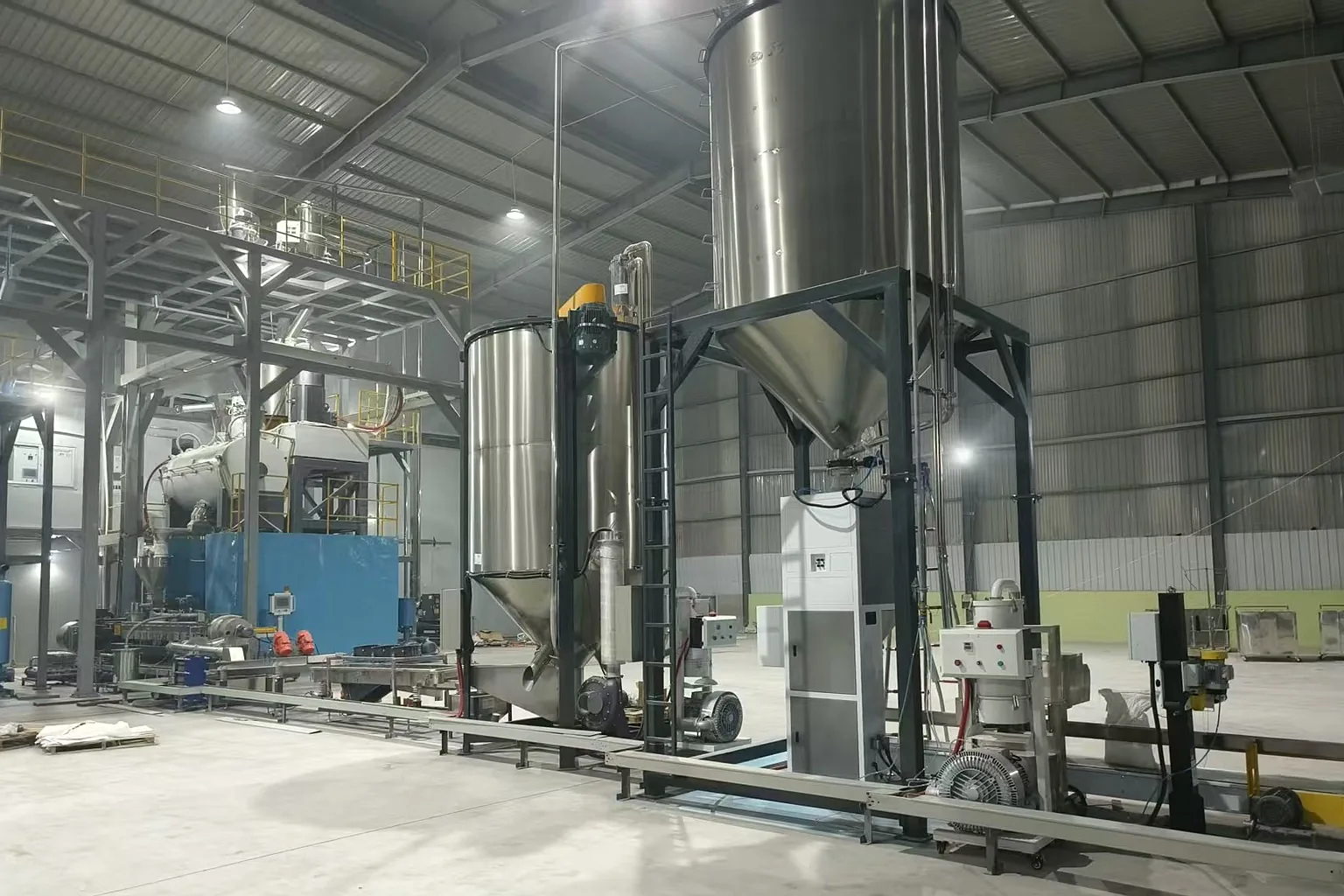
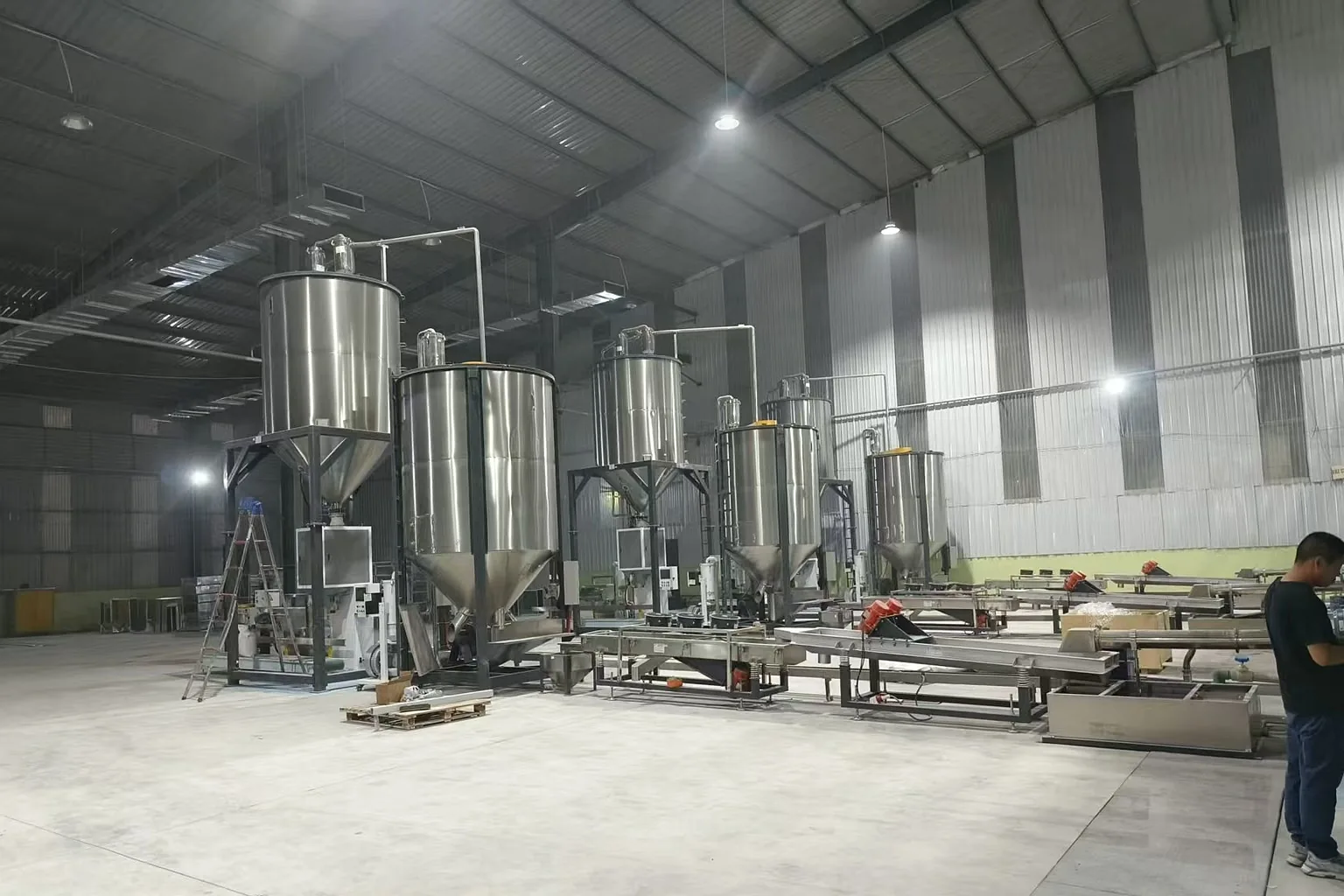
Customer site: SUHUI rigid plastic pelletizing line in daily production, from extrusion and strand cooling through centrifugal drying to pellet storage silos. For a step-by-step walkthrough of the plastic pelletizing process from feedstock to finished pellet, see our buyer’s guide.
Related lines in the same category: the PVC granulating pelletizing line for rigid uPVC and flexible PVC scrap, and the film compacting pelletizing line where the feed is soft film rather than rigid regrind. For the full range and how the stages fit together, see the plastic recycling machine overview, or browse delivered line projects for comparable output figures.
The line processes a wide range of rigid plastic waste including HDPE, PP, PS, ABS, and mixed rigid plastics sourced from industrial scrap, post-consumer packaging, and manufacturing offcuts. Quick parameter adjustments allow the same line to handle different material types and melt flow indices with minimal changeover time.
The SUHUI rigid plastic pelletizing line is available in configurations from 300 to 3,000 kg/h, serving small recycling operations through to large-scale industrial facilities. SUHUI engineers will recommend the appropriate model based on feedstock volume, material type, and contamination level.
The line produces uniform 2–5 mm recycled pellets using either underwater pelletizing or strand pelletizing systems. A vibratory screening stage removes fines and oversized pieces to ensure consistent particle size distribution suitable for injection molding, blow molding, and extrusion applications.
Pre-drying is optional and material-dependent. Moisture-sensitive plastics such as ABS or nylon-containing blends are pre-dried to below 0.5% moisture to prevent steam bubbles and surface defects in the final pellets. Standard HDPE and PP rigid plastics typically do not require pre-drying unless heavily contaminated or wet.
Granules melted in the twin-screw extruder pass through a continuous or discontinuous screen changer that removes fine metal particles, unmelted contamination, and other impurities from the melt stream. This filtration step ensures high pellet purity for demanding downstream applications including technical plastics compounding.
Recycled PP and HDPE pellets produced by this line are suitable for injection molding, blow molding, and extrusion applications including pipes, containers, packaging, and profile products. Pellet purity and geometry are maintained by the melt filtration and screening stages to meet the requirements of demanding manufacturing processes.
Tell us your material type, condition, required capacity and target output. Photos or videos help.
SUHUI reviews the feeding method, process route and machine configuration for your material.
You receive an equipment list and quotation, with capacity, layout, voltage and automation matched to the project.
Production, testing, export packing and installation guidance through to commissioning.
To receive a more accurate recommendation, please include your material type, material condition, required capacity, target output, plant space, local voltage and destination country in the message. Photos or videos of your raw material are also helpful.
The SUHUI PVC granulating pelletizing line converts rigid uPVC and flexible PVC scrap — offcuts, cable insulation, window profiles and post-consumer PVC — into uniform 2–4 mm recycled PVC pellets. Multi-zone temperature control in the stable 160–200°C window, corrosion-resistant twin-screw extrusion, in-line stabilizer dosing and integrated fume extraction protect PVC from degradation, while air-cooled die-face hot cut pelletizing delivers dry, uniform pellets for pipe, profile, cable and fitting production.
The SUHUI PET flakes glass fiber twin screw pelletizing line produces high-performance engineering plastic pellets by compounding recycled PET flakes with glass fiber reinforcement (10–40% loading). The resulting composite pellets deliver significantly enhanced tensile strength, flexural modulus, thermal stability, and dimensional rigidity compared to unreinforced recycled PET.
The SUHUI PP PE film compacting pelletizing line transforms post-industrial and post-consumer polypropylene (PP) and polyethylene (PE) film waste into high-quality recycled pellets. It processes a wide range of plastic film types including agricultural mulch film, greenhouse covers, LDPE packaging film, HDPE bags, and stretch wrap — removing contaminants such as dirt, sand, inks, and adhesives to produce clean, uniform output.