Understanding how plastic pellets are made is essential for anyone investing in a recycling pelletizing line or evaluating downstream processing options. Plastic pellets – also called plastic granules or plastic resin – are the universal raw material that feeds the global plastics manufacturing industry. Every plastic product you use, from a bottle cap to a car bumper, began as a batch of pellets. Recyclers make those pellets on material-specific lines — a PVC granulating pelletizing line for rigid uPVC and flexible PVC scrap, for example.
This guide explains the complete plastic pellet production process: how pellets are manufactured from recycled plastic flakes or virgin resin, what equipment is involved at each stage, the different types of pelletizing systems available, and how to choose the right configuration for your operation.
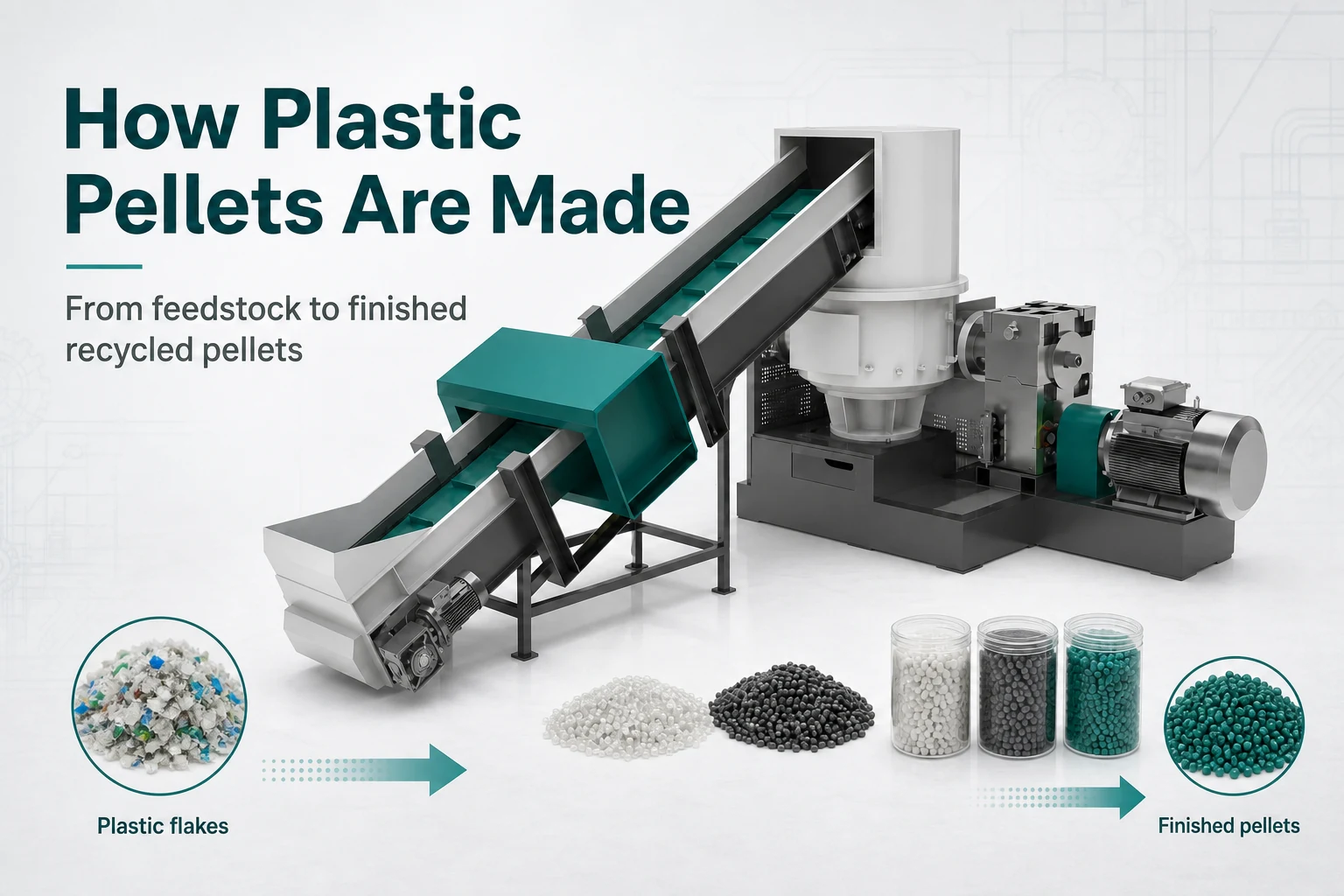
 Plastic flakes are converted into finished recycled pellets through a complete plastic recycling pelletizing line.
What Are Plastic Pellets?
Plastic pellets are small, uniform pieces of thermoplastic material – typically 2-5 mm in diameter – produced by melting plastic feedstock and cutting the extruded melt into consistent shapes. They are the standard raw material form used by manufacturers for:
- Injection molding – automotive parts, packaging, consumer goods
- Film blowing – plastic bags, agricultural film, packaging film
- Pipe extrusion – HDPE, PVC, and PPR pipes
- Sheet extrusion – food-grade packaging, thermoforming
- Blow molding – bottles, containers, drums
Pellets offer significant handling and processing advantages over flakes or regrind: they are free-flowing, dust-free, and feed into downstream manufacturing equipment with consistent bulk density and melt behavior. For recyclers, producing pellets rather than selling flakes directly usually commands a higher market price – particularly for high-purity, food-contact-grade output.
For an overview of where pelletizing fits within the full plastic recycling workflow, see: Plastic Recycling Line: Types, Process and How to Choose.
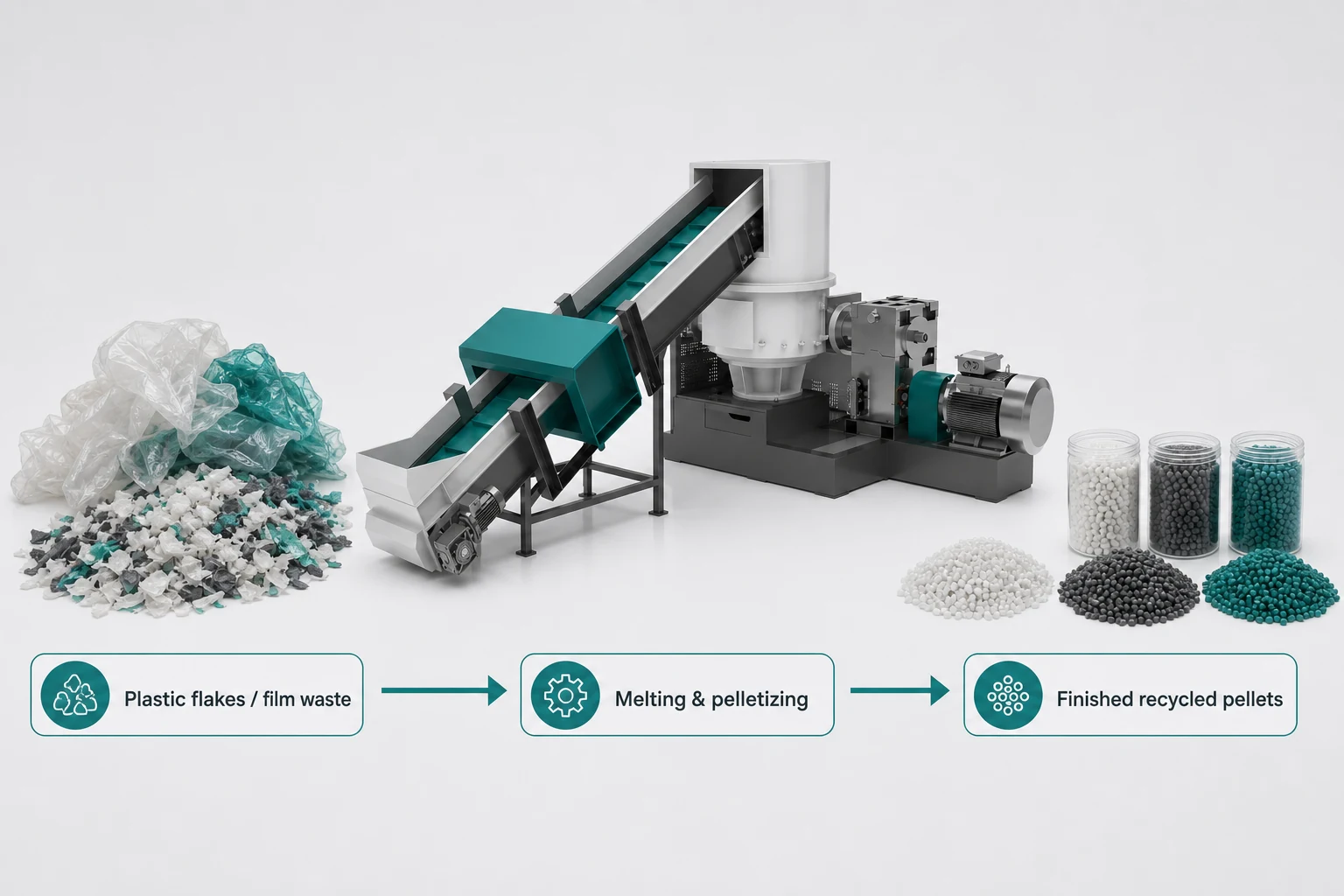 Plastic flakes and film waste are processed through a pelletizing line to produce uniform recycled plastic pellets.
Plastic Pellets vs Flakes vs Regrind
Buyers often compare plastic pellets, plastic flakes, and regrind because all three can be made from recycled plastic. The difference is the processing stage and how consistently the material feeds into downstream manufacturing equipment.
| Material Form | How It Is Made | Typical Use | Buyer Consideration |
|---|---|---|---|
| Plastic flakes | Washed plastic waste is shredded or crushed into irregular pieces | Feedstock for washing lines, pelletizing lines, fiber, sheet, or lower-grade reuse | Quality depends on washing, moisture, PVC or metal contamination, and flake size consistency |
| Regrind | Rigid plastic scrap is granulated into smaller reusable pieces | Injection molding, extrusion blending, or feeding into a pelletizing machine | More consistent than raw scrap, but usually less uniform than finished pellets |
| Plastic pellets / granules | Flakes or regrind are melted, filtered, extruded, cut, cooled, and screened | Injection molding, film blowing, pipe extrusion, sheet extrusion, and compounding | Highest handling consistency; usually higher value when purity and moisture are controlled |
In recycling projects, a plastic pelletizing machine or complete plastic pelletizing line is used when the goal is to upgrade flakes or regrind into a cleaner, denser, and easier-to-sell raw material.
How Plastic Pellets Are Made: Step-by-Step Process
The pelletizing process converts cleaned plastic flakes, film waste, or post-industrial regrind into uniform pellets through a sequence of controlled processing stages.
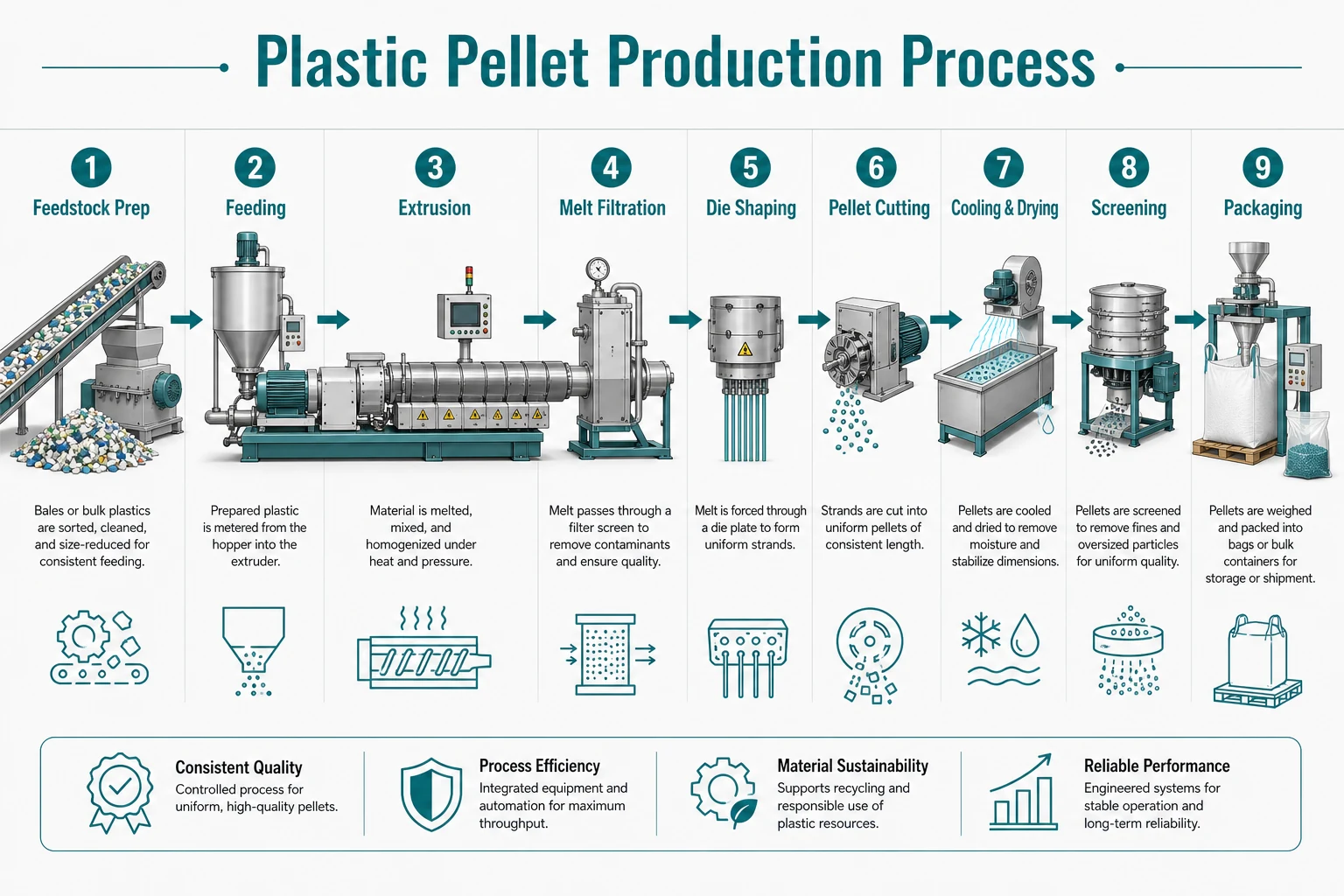 A 9-step overview of the plastic pellet production process, from feedstock preparation to packaging.
Stage 1 – Feedstock Preparation
Pelletizing begins with the input material. The feedstock can be:
- Washed and dried plastic flakes – output from a PET, HDPE, PP, or PE washing line
- Post-industrial film or trim waste – stretch wrap, agricultural film, manufacturing offcuts
- Regrind – rigid plastic scrap reduced to uniform pieces using a plastic crusher or granulator before feeding into the pelletizing line
The feedstock must meet minimum purity and moisture requirements before entering the pelletizing line. Excessive moisture causes hydrolytic degradation in the extruder, reducing molecular weight and producing off-spec pellets. Solid contaminants damage the extruder screw and produce gel defects in the output.
Stage 2 – Feeding and Conveying
Prepared feedstock is loaded into a hopper above the extruder. For low-bulk-density materials such as film flakes or fiber, a forced feeder – also called a side feeder, compactor feeder, or agglomerator feeder – is used to pre-compress the material before it enters the extruder barrel. This prevents bridging and air entrainment that would otherwise cause inconsistent feeding and output rate.
For dense, free-flowing flakes such as rigid PET or HDPE bottle flakes, a standard gravity-feed hopper is usually sufficient.
Stage 3 – Melting and Plasticizing (Extrusion)
The extruder is the core of any pelletizing line. A rotating screw inside a heated barrel melts and homogenizes the feedstock through a combination of mechanical shear and controlled heat. Key parameters include:
- Barrel temperature zones – typically 4-8 independently controlled zones, set according to the polymer’s melt temperature range
- Screw speed – controls throughput rate and shear intensity
- Melt pressure – monitored to detect screen blockage and ensure consistent output
Single-screw extruders are the standard choice for clean, homogeneous feedstock such as washed flakes or uniform film waste. Twin-screw extruders are required for mixed materials, compounding applications, glass-fiber reinforcement, or highly contaminated inputs because the twin-screw design provides stronger mixing and degassing capability.
Stage 4 – Melt Filtration
After melting, the polymer melt passes through a screen changer, also called a melt filter or breaker plate. The screen changer holds a fine metal mesh screen that captures remaining solid contaminants – undissolved particles, carbonized residue, and fine non-polymer fragments – before the melt reaches the die.
For continuous production, continuous or hydraulic screen changers allow the mesh screen to be replaced without stopping the line. Single-position manual screen changers require a brief production stop and are suitable for cleaner feedstock with lower contaminant loading.
Stage 5 – Die Head and Melt Shaping
The filtered melt is forced through a die head, which shapes the melt into the form required by the downstream cutting system:
- Strand die – extrudes multiple parallel strands of melt for strand pelletizing
- Underwater die plate – a perforated plate with holes facing a water flow chamber for underwater pelletizing
- Hot-face die plate – a perforated plate where cutting occurs in open air for hot-face or air-cooled pelletizing
Die design, hole count, and hole diameter determine pellet size and output capacity.
Stage 6 – Pellet Cutting
The extruded melt is cut into pellets by a rotating cutting head. The main cutting systems are strand pelletizing, water-ring pelletizing, underwater pelletizing, and hot-face or air-cooled pelletizing.
| Cutting System | How It Works | Best For | Typical Buyer Check |
|---|---|---|---|
| Strand pelletizing | Melt strands are cooled in a water bath, then fed through a strand cutter | Clean, rigid plastics such as PET, HDPE, and PP flakes | Check strand stability, water bath length, cutter speed, and operator handling requirements |
| Water-ring pelletizing | Blades cut pellets at the die face, and a circulating water ring cools and conveys the pellets | PP, PE, LDPE, film waste, and many polyolefin recycling applications | Check die-face stability, water flow, pellet shape, and dryer performance |
| Underwater pelletizing | Blades cut at the die face while surrounded by circulating water | High-output continuous production; soft or sticky polymers | Check startup stability, water temperature control, blade wear, and automation level |
| Hot-face / air-cooled pelletizing | Blades cut at the die face in open air; pellets are cooled by air circulation | Film, LDPE, and low-viscosity soft plastics | Check cooling efficiency, pellet shape, and whether the material is suitable for air cooling |
For many plastic recycling projects, strand pelletizing is simple and reliable for rigid flakes, while water-ring pelletizing is often preferred for PP/PE film and soft polyolefin materials. Underwater pelletizing is usually selected when higher automation, continuous output, or specific polymer behavior justifies the added system complexity.
Stage 7 – Pellet Cooling and Drying
Freshly cut pellets carry residual heat and surface moisture from the cutting environment. They are conveyed into a centrifugal pellet dryer or vibrating dewatering unit, which removes surface water and reduces pellet temperature to handling temperature.
Pellets that are too hot when bagged will deform or fuse together under the weight of the bag stack. Proper cooling before packaging is not optional.
Stage 8 – Classification and Quality Screening
A vibrating classifier screen separates pellets by size, removing fines from startup or blade wear and oversized pellets caused by clumping or production instability.
Consistent pellet size is a quality requirement for downstream manufacturing equipment. Off-spec pellets are usually returned to the feed hopper for reprocessing.
Stage 9 – Packaging and Storage
Screened, cooled pellets are conveyed to a bagging station and packed – typically in 25 kg woven polypropylene bags or 500-1,000 kg bulk bags (FIBCs) – for sale or internal use. Automated bagging and palletizing systems are standard on higher-capacity lines. For recycled pellet projects, final pellet value depends on polymer purity, moisture control, color consistency, odor level, and how well the upstream washing and filtration stages remove contamination.
Plastic Pelletizing Line in Operation
The following video shows a SUHUI rigid plastic flakes granulation pelletizing line running at full capacity, demonstrating the complete sequence from flake feeding through extrusion, strand cutting, and pellet output:
Feedstock Determines the Pelletizing Line Configuration
Pelletizing line configurations vary based on feedstock type, bulk density, moisture level, contamination level, required output quality, and throughput capacity. The same plastic pelletizing line should not be used for rigid flakes, soft film waste, and compounding-grade mixed inputs without changing the feeding, extrusion, filtration, and cutting configuration.
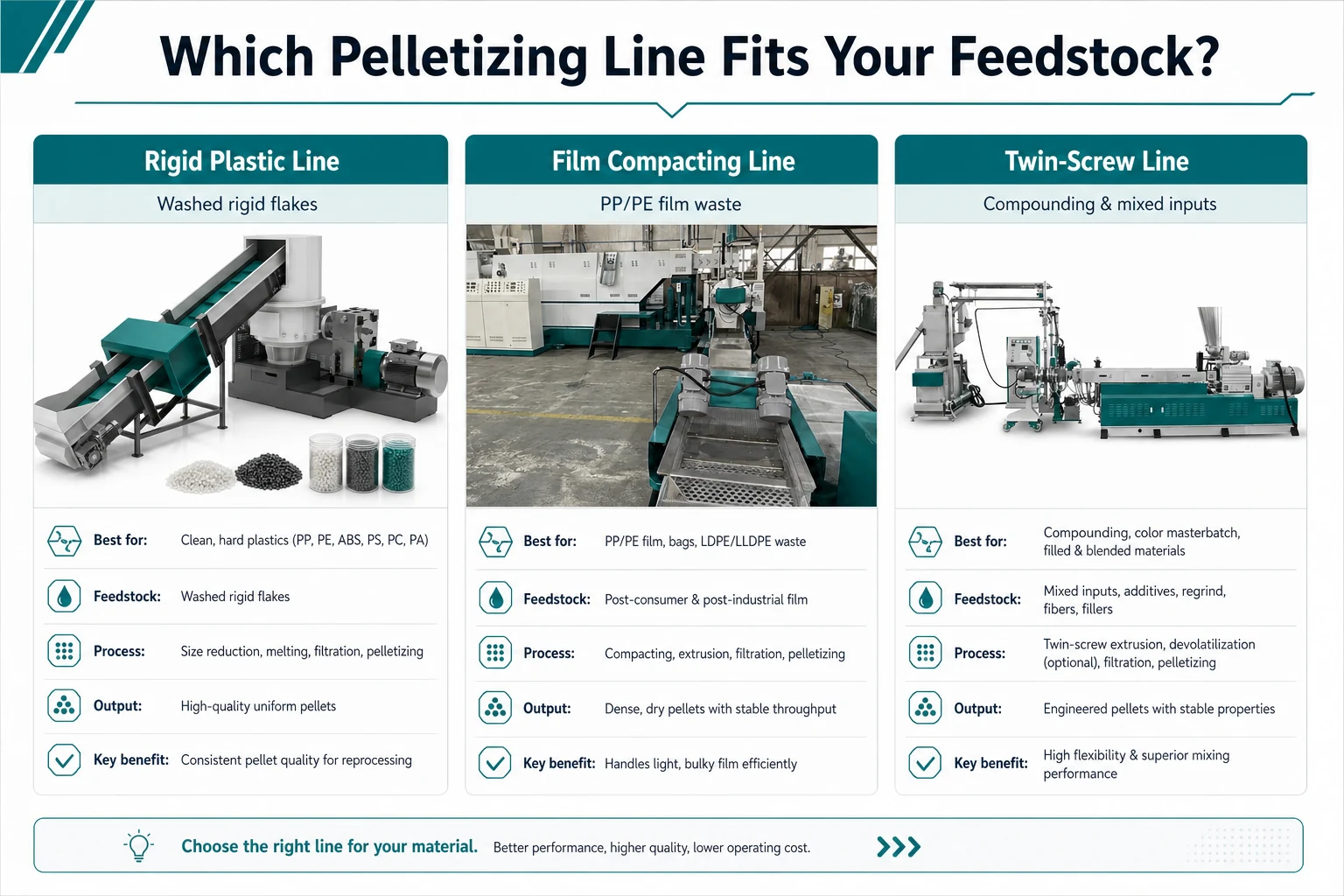 Comparison of three pelletizing line types for rigid flakes, PP/PE film waste, and compounding applications.
| Feedstock | Recommended Line | Why It Fits | Common Pelletizing Method |
|---|---|---|---|
| Washed PET, HDPE, PP, ABS, or PVC rigid flakes | Rigid plastic granulating pelletizing line | Free-flowing flakes can be fed into a single-screw extruder with stable throughput | Strand pelletizing or water-ring pelletizing depending on polymer and output requirement |
| PP / PE film, stretch wrap, agricultural film, woven bags | PP PE film compacting pelletizing line | Compactor or agglomerator feeder densifies low-bulk-density material before extrusion | Water-ring, hot-face, or air-cooled pelletizing |
| Mixed inputs, PET flakes with glass fiber, compounded plastics | Twin-screw pelletizing line | Twin screws provide stronger mixing, degassing, and additive dispersion | Strand or underwater pelletizing depending on formulation |
1. Rigid Plastic Granulating Pelletizing Line
A rigid plastic granulating pelletizing line is designed for clean, pre-washed rigid plastic flakes such as PET, HDPE, PP, ABS, and PVC. It usually uses a single-screw extruder with strand cutting and is one of the most common configurations for recyclers operating a washing line upstream.
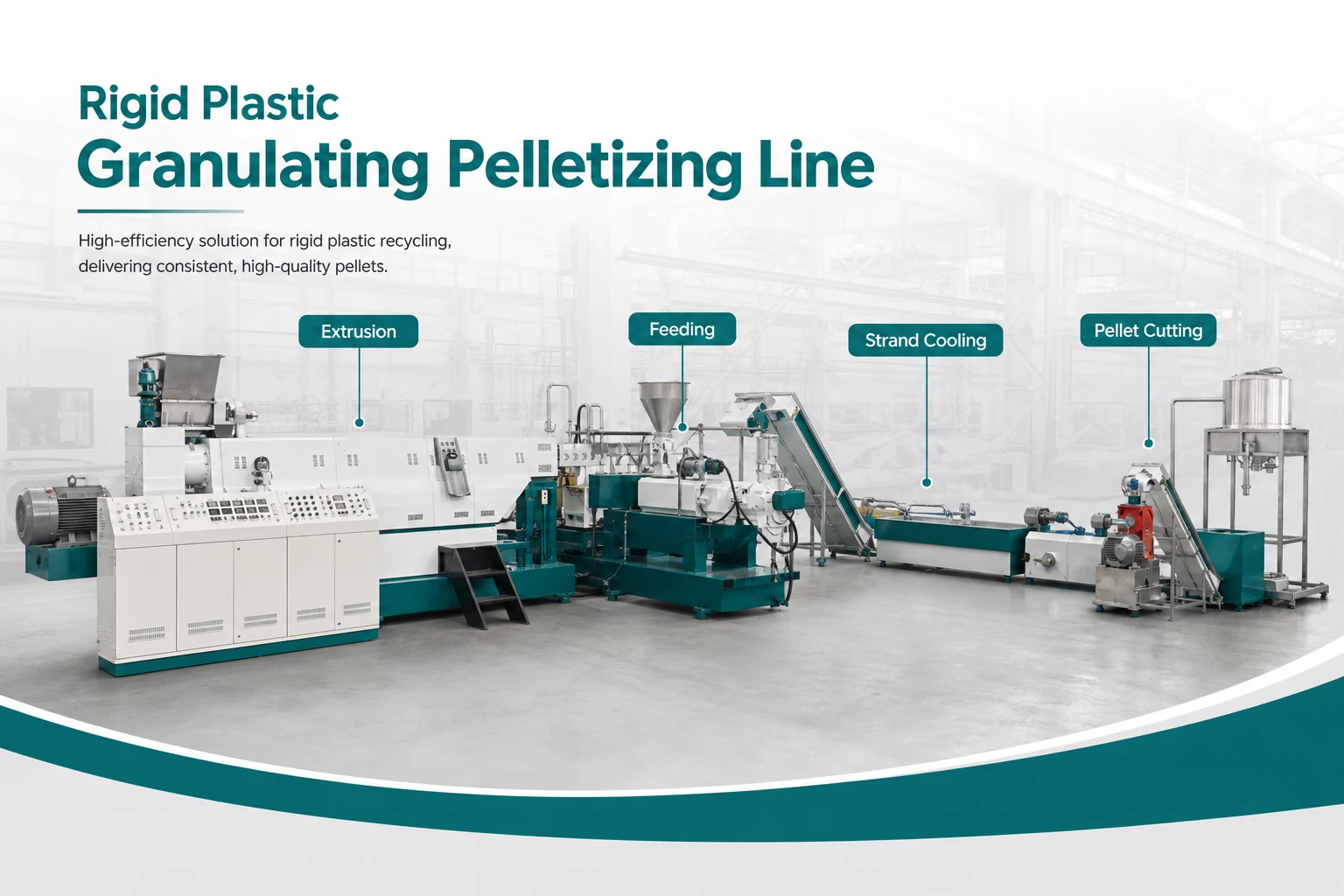 A rigid plastic granulating pelletizing line processes washed flakes into consistent recycled pellets.
Rigid Plastic Granulating Pelletizing Line – SUHUI
2. PP PE Film Compacting Pelletizing Line
A PP PE film compacting pelletizing line is designed specifically for low-bulk-density PP and PE film waste, including stretch wrap, agricultural film, packaging film, and woven bag material that cannot be fed efficiently into a standard gravity-fed extruder.
This configuration integrates a compactor, agglomerator, or forced feeding system to pre-densify the film before extrusion. If your input is washed PP/PE film, woven bags, or low-bulk-density soft plastic waste, SUHUI can configure the compactor, feeder, extruder, and pellet cutting system as a complete film pelletizing solution.
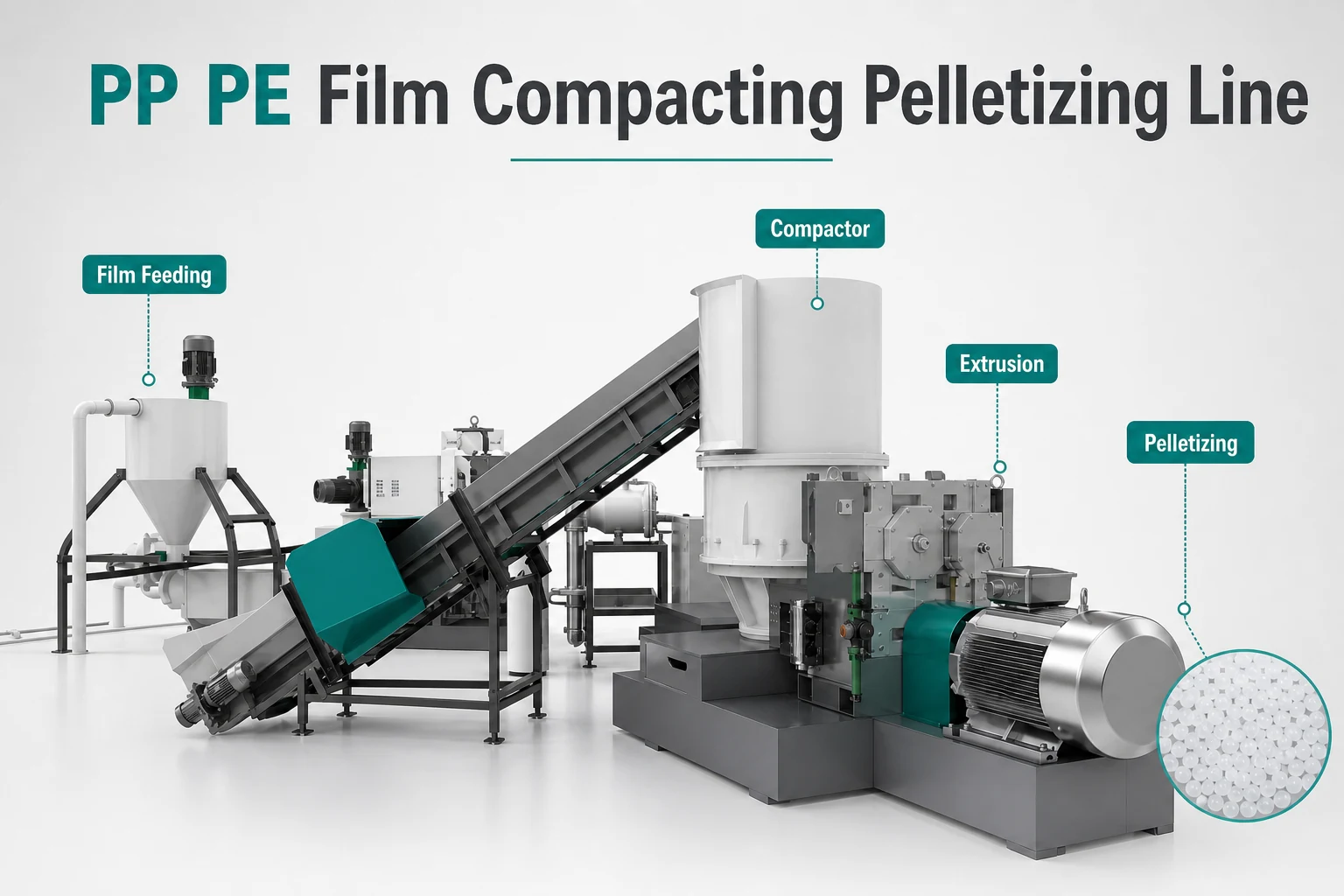 A PP PE film compacting pelletizing line handles low-bulk-density film, bags, and soft plastic waste.
For a detailed overview of the upstream film washing process, see: Plastic Film Recycling Line: How It Works, Key Stages and Equipment.
PP PE Film Compacting Pelletizing Line – SUHUI
3. Twin-Screw Pelletizing Line
A twin-screw pelletizing line is required for mixed materials, compounding applications, or feedstock with high residual contamination. The co-rotating twin-screw design provides intensive mixing, degassing, and the ability to incorporate additives such as glass fiber, calcium carbonate, or flame retardants into the melt.
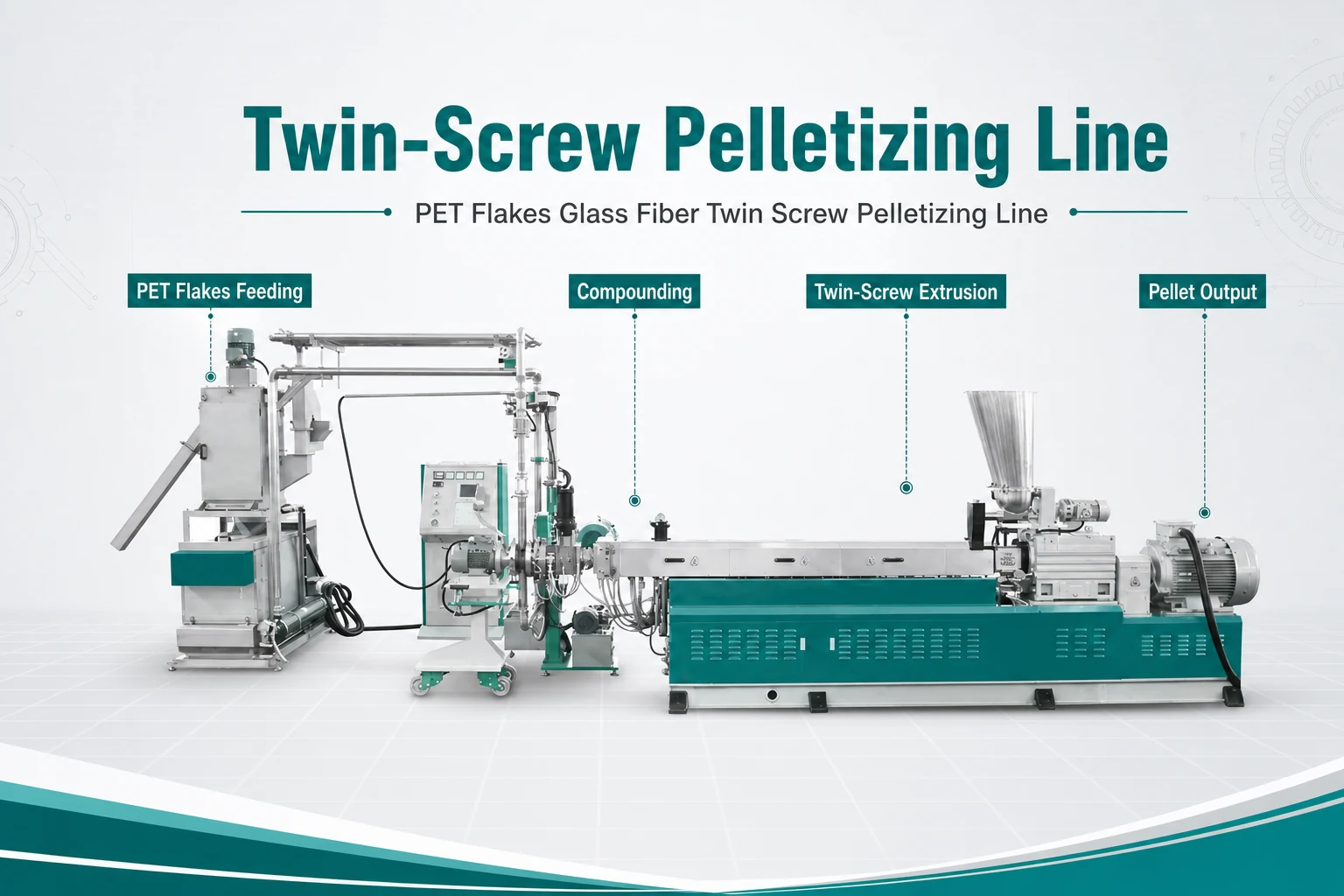 A twin-screw pelletizing line is used for PET flakes, compounding, mixed inputs, and reinforced plastic pellets.
PET Flakes Glass Fiber Twin Screw Pelletizing Line – SUHUI
Key Equipment in a Plastic Pelletizing Line
| Equipment | Function | Notes |
|---|---|---|
| Hopper / forced feeder | Loads and feeds feedstock | Forced feeder required for film and low-density material |
| Single-screw extruder | Melts and plasticizes feedstock | Standard for clean, homogeneous flakes |
| Twin-screw extruder | Melts, mixes, and degasses | Required for mixed or contaminated inputs |
| Screen changer / melt filter | Removes solid contaminants from melt | Continuous type for uninterrupted production |
| Die head | Shapes melt for cutting | Strand, underwater, or hot-face die |
| Pellet cutter | Cuts melt into uniform pellets | Blade speed controls pellet size |
| Centrifugal dryer | Removes surface moisture from pellets | Critical before bagging |
| Vibrating classifier | Screens pellets by size | Removes fines and oversized pieces |
| Conveying and bagging system | Transfers and packs pellets | Automated or manual depending on capacity |
How to Choose a Plastic Pelletizing Line
When evaluating a plastic recycling pelletizing line, four specifications are most critical:
1. Feedstock Type and Form
Rigid flakes, film waste, and regrind require different feeder configurations and screw designs. Define your primary feedstock type before selecting any equipment.
2. Extruder Type: Single-Screw vs Twin-Screw
For clean, uniform recycled flakes, a single-screw line offers lower capital cost and simpler operation. For mixed plastics, contaminated inputs, or compounding requirements, a twin-screw line is necessary despite its higher cost.
3. Output Capacity
Pelletizing lines are sized in kg/h of output. Match the capacity to your upstream washing line output – the two systems must be matched in throughput to avoid bottlenecks or idle time.
4. Pellet Quality Requirements
If your pellets will be used for food-contact applications or high-performance manufacturing, your feedstock must meet strict purity and moisture requirements before pelletizing. Document your end-market specifications and confirm that the proposed line can consistently meet them before signing the contract.
Conclusion
Understanding how plastic pellets are made – from feedstock preparation through extrusion, cutting, cooling, and screening – helps buyers match the right pelletizing line configuration to their operation.
For recyclers, a well-matched pelletizing line downstream of a washing line transforms low-value flakes into a higher-value pellet product with better handling, more consistent downstream processing, and stronger market potential.
SUHUI Machinery designs and manufactures complete plastic recycling pelletizing lines for major plastic types, from PP PE film waste to rigid PET and HDPE flakes. View our full pelletizing line range.
Frequently Asked Questions
What is the difference between plastic pellets and plastic flakes?
Plastic flakes are irregularly shaped pieces produced by shredding or granulating washed plastic waste. They vary in size and bulk density, and feed inconsistently into manufacturing equipment. Plastic pellets are uniform cylinders or spheres produced by melting and cutting flakes in a pelletizing line. Pellets feed consistently, are dust-free, and usually command a higher market price than equivalent-purity flakes.
What does a plastic pelletizing machine do?
A plastic pelletizing machine melts plastic flakes, film, or regrind in an extruder, filters the molten polymer, pushes it through a die, cuts the melt into pellets, and cools, dries, and screens the finished pellets. In recycling plants, it is usually installed after shredding, crushing, washing, and drying equipment.
What is the difference between a single-screw and twin-screw pelletizing line?
A single-screw extruder uses one rotating screw to convey, melt, and homogenize plastic. It is simpler, lower cost, and sufficient for clean, homogeneous feedstock.
A twin-screw extruder uses two intermeshing screws that provide stronger mixing, venting of volatiles, and the ability to process mixed or contaminated inputs. Twin-screw lines are required for compounding, glass-fiber reinforcement, or feedstock with high residual contamination. For most recycled rigid flake or film pelletizing applications, a single-screw line is the appropriate choice.
What is the difference between strand, water-ring, and underwater pelletizing?
Strand pelletizing cools melt strands in a water bath before cutting, making it simple and reliable for clean rigid flakes. Water-ring pelletizing cuts at the die face and uses circulating water to cool and convey pellets, which works well for many PP and PE recycling lines. Underwater pelletizing cuts directly in a water chamber and is used for higher-output or more automated systems.
What output capacity do SUHUI pelletizing lines offer?
SUHUI’s plastic recycling pelletizing line range covers output capacities from 100 kg/h for smaller operations to over 1,000 kg/h for industrial-scale recycling facilities, with configurations for rigid flakes, PP PE film waste, and glass-fiber-reinforced PET applications. Contact SUHUI Machinery to discuss the right capacity and configuration for your feedstock and production requirements.
How do I choose the right plastic pelletizing line?
Start with the feedstock form: rigid flakes, PP/PE film, woven bags, mixed inputs, or compounded material. Then confirm moisture level, contamination level, required output capacity, pellet quality target, extruder type, filtration system, and pellet cutting method. The line should match both the upstream washing capacity and the downstream pellet application.
Related Products
- Plastic Recycling Pelletizing Line – Full range for recycled plastic pellet production
- Rigid Plastic Granulating Pelletizing Line – For washed rigid flakes such as PET, HDPE, and PP
- PP PE Film Compacting Pelletizing Line – For film, stretch wrap, woven bags, and low-bulk-density waste
- PET Flakes Glass Fiber Twin Screw Pelletizing Line – For compounding and mixed-input applications
Have a Material You Need to Process?
Send the polymer, its form and your target output. We will come back with a line configuration and a realistic budget range.