
Plastic film waste — from agricultural mulch and greenhouse covers to industrial stretch wrap and LDPE packaging — is one of the most challenging materials to recycle. Unlike rigid plastics, film is lightweight, easily contaminated, and prone to tangling in standard machinery. Choosing the wrong washing line can mean chronic downtime, poor-quality output, and a return on investment that never materializes.
This buyer’s guide is written for recycling plant operators and equipment buyers evaluating a PP PE film washing line purchase: input material types, required capacity, contamination levels, output quality standards, and the right questions to ask any manufacturer. If you want a technical overview of how the equipment itself works, see: Plastic Film Recycling Line: How It Works, Stages and Equipment Overview.
1. Understand Your Input Material First
No two film washing lines are identical because no two waste streams are identical. Before comparing equipment, you need a clear picture of exactly what you are feeding into the machine.
Film Type
Polypropylene (PP) and polyethylene (PE) films are chemically distinct and may require different processing parameters — particularly melt temperatures during the downstream pelletizing stage. Confirm whether your feedstock is predominantly PP, LDPE, LLDPE, HDPE film, or a mixed blend, and specify this to any manufacturer you approach.
Contamination Profile
This is the single most important variable in sizing a film washing line. Common contaminants include:
- Soil, sand, and stones (agricultural film)
- Adhesive labels and printing inks (post-consumer packaging)
- Moisture and organic residue (food-contact film)
- Metal fragments (industrial scrap)
- Other plastic types (PET, PVC mixed in with PP/PE bales)
Heavy soil contamination — typical of agricultural mulch film — demands a more aggressive pre-washing and friction-washing stage compared to relatively clean post-industrial stretch wrap. A line designed for clean industrial film will underperform severely if fed with muddy agricultural film.
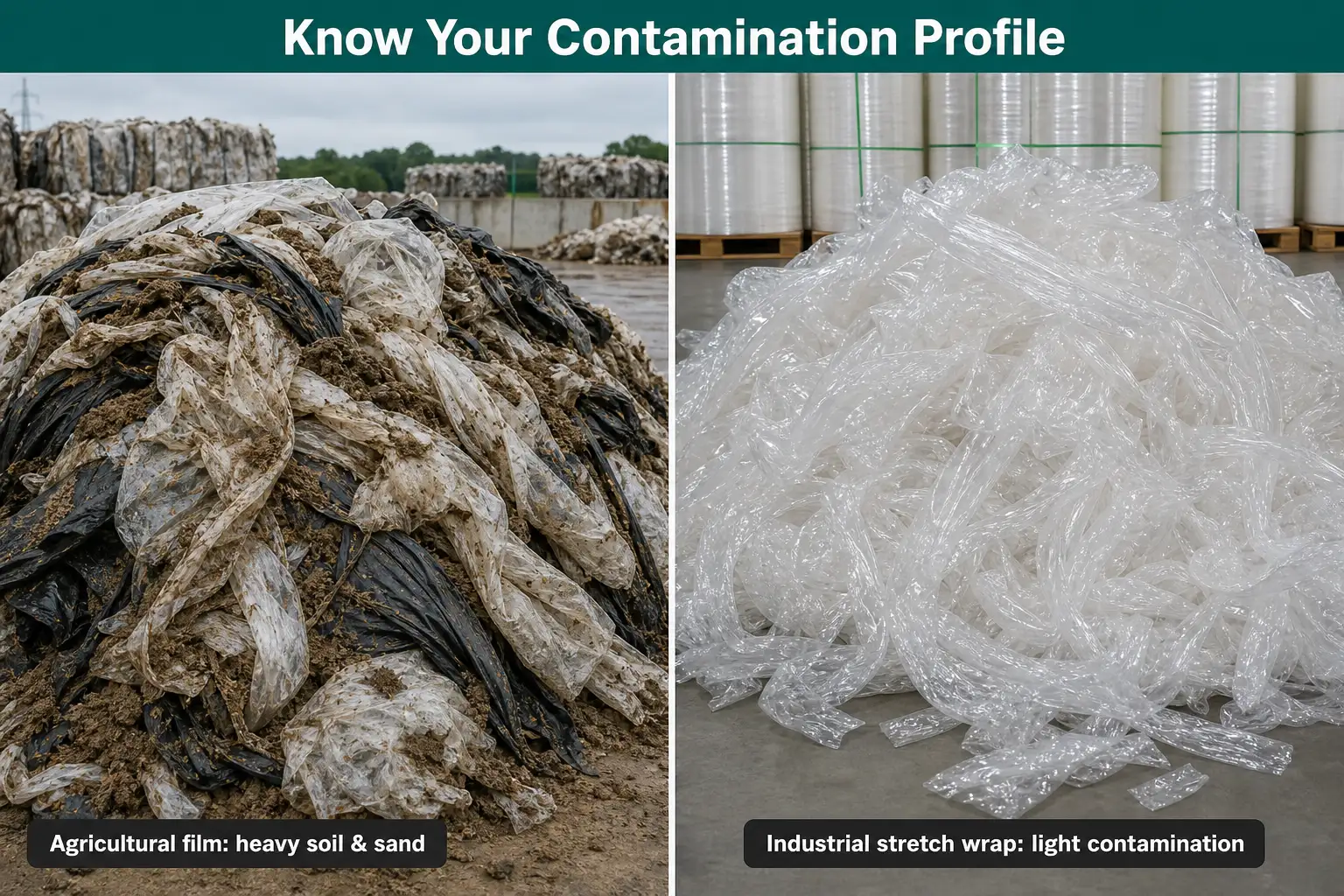
The same washing line cannot treat both extremes equally well: muddy agricultural film and clean stretch wrap need different washing intensity.
Form Factor: Loose vs. Baled
Is your input material loose and fluffy, or compressed into bales? Baled material requires a bale breaker or shredder as the first stage. Confirm whether the manufacturer includes this in the quoted line or whether it is a separate, additional cost.
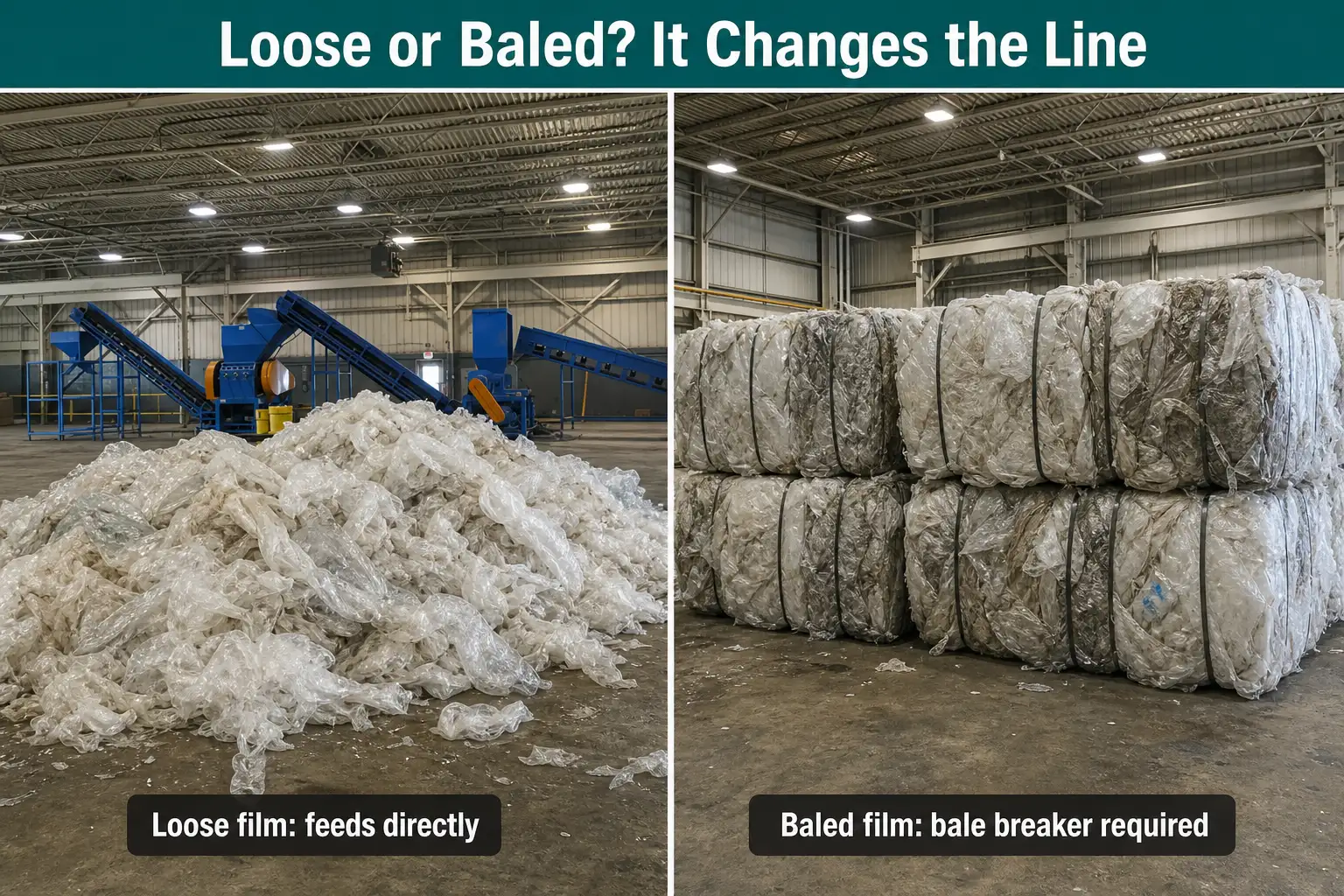
Loose film can feed the line directly; compressed bales need a bale breaker as the first stage — confirm whether it is included in the quotation.
2. Define Your Required Output Quality
What does your cleaned and dried film flake need to look like? Output quality requirements drive the entire line configuration.
For In-House Pelletizing
If you plan to feed the washed flake directly into a film compacting pelletizing line on the same site, the primary requirements are moisture content (typically below 3–5%) and the absence of hard contaminants that could damage the screw and barrel. A standard hot-wash and friction-drying system will generally meet these requirements.
For Sale to Third-Party Processors
If you intend to sell washed flake to a downstream buyer, you will likely need to meet stricter purity and moisture specifications — sometimes below 1% moisture and above 99% purity. This may require additional stages such as a centrifugal dryer, thermal dryer, or optical sorting unit.
For Food-Contact Recycled Content
Food-grade output demands hot caustic washing (typically at 80–90°C with sodium hydroxide solution), extended rinse cycles, and documented process validation. Not all manufacturers offer food-grade-compliant line designs; confirm this requirement from the outset.
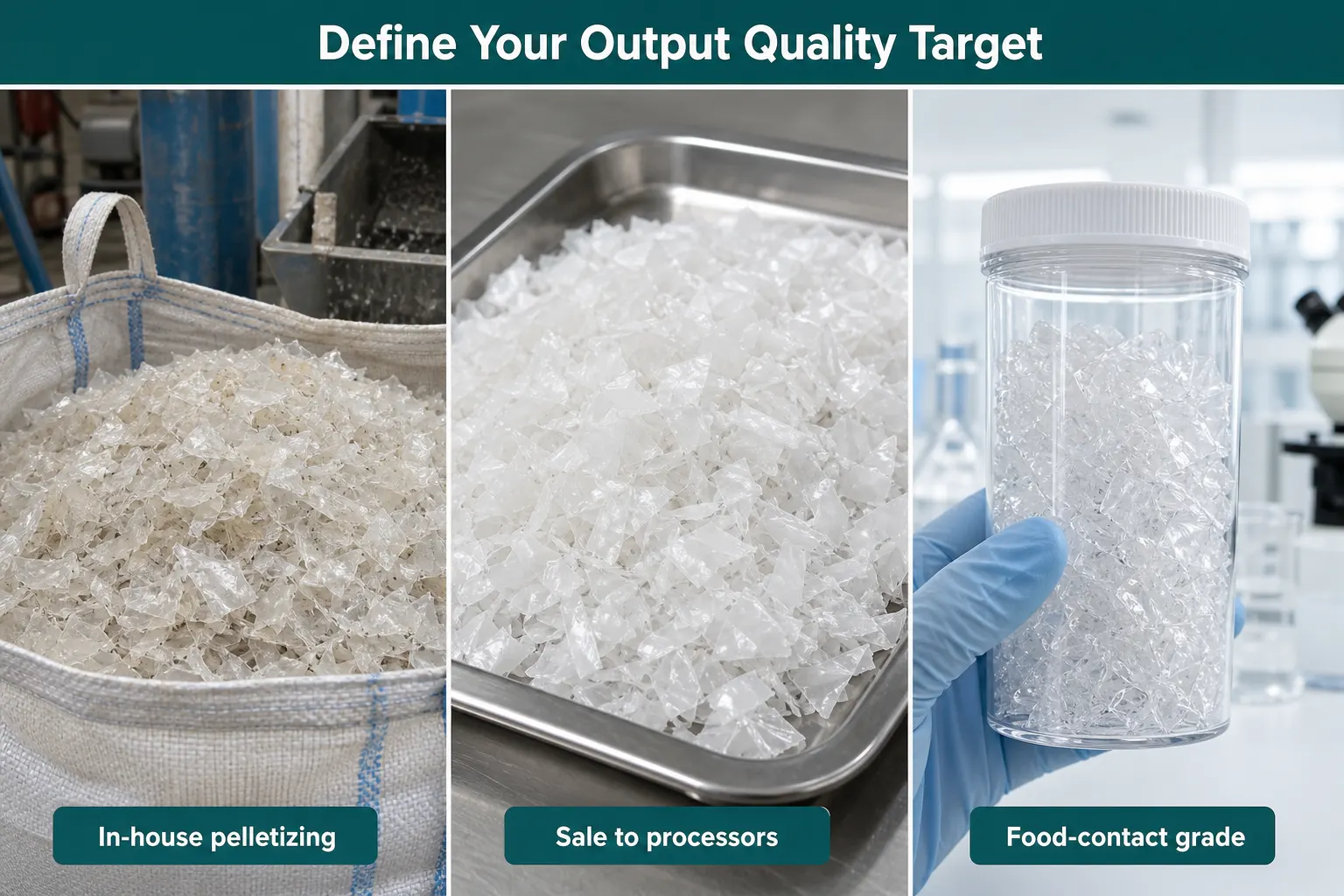
Three output quality tiers, three different line configurations: flakes for in-house pelletizing, flakes for sale, and food-contact grade material.
3. Match Capacity to Your Actual Throughput
Film washing line capacity is typically quoted in kilograms per hour (kg/h) of input material. Common commercial configurations range from 300 kg/h to 3,000 kg/h. Here is how to choose the right size:
Calculate Your Daily Input Volume
Start with how many tonnes of film waste you receive or collect per day, then back-calculate the hourly throughput needed based on your planned operating hours. Build in a 20–30% capacity buffer for peak loads, maintenance downtime, and future business growth.
Do Not Over-Size
A line running at 40% of rated capacity is inefficient — energy costs per kilogram of output increase, and some washing stages (particularly hot-water tanks) may not maintain optimal temperature and agitation levels at low throughput. Match the line closely to your realistic near-term volume.
Modular Expandability
If you expect volume growth, ask manufacturers whether the line is modular — can individual stages (pre-washing, friction washers, centrifugal dryers) be upgraded independently without replacing the entire system?
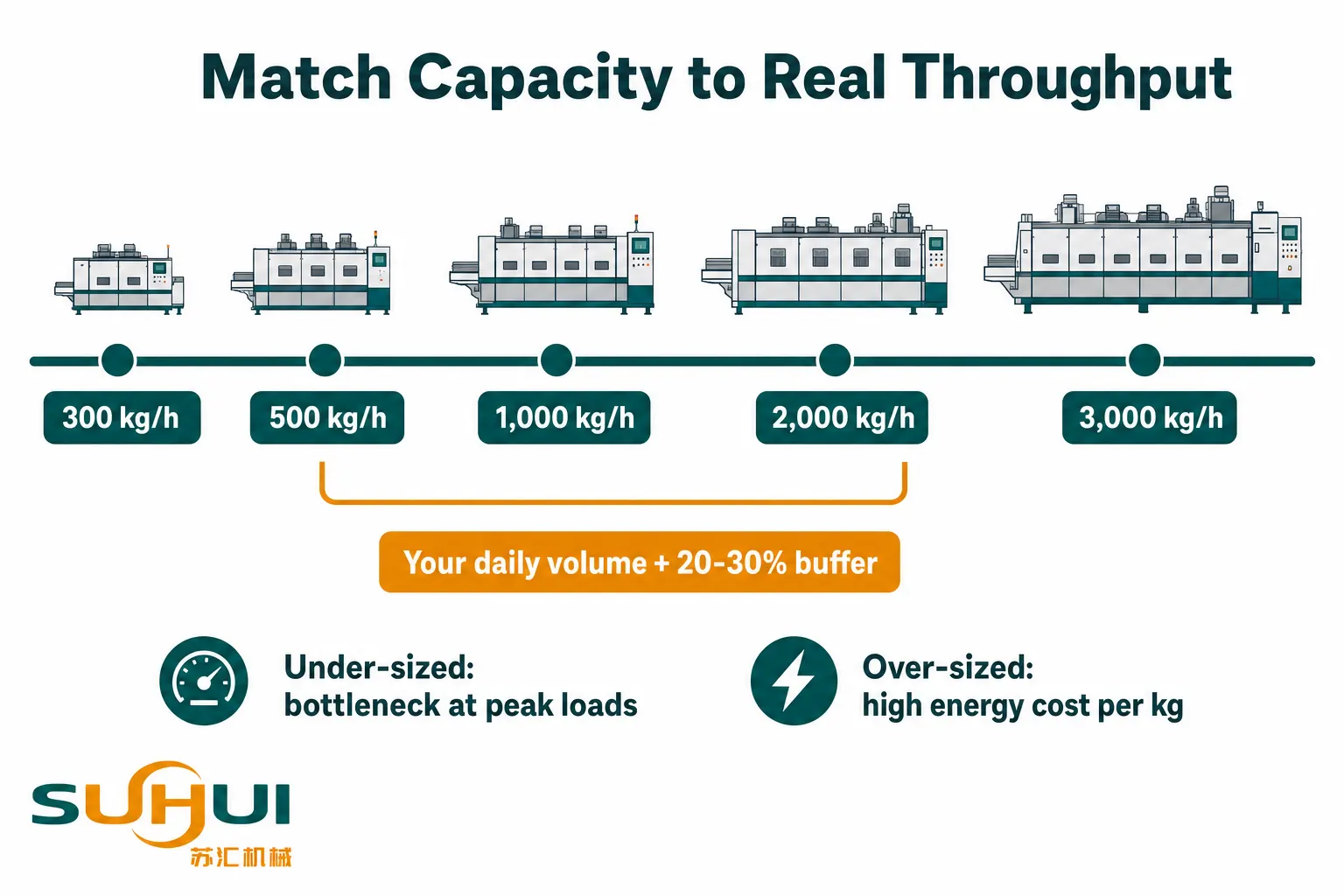
Size the line from your real daily volume plus a 20–30% buffer — both under-sizing and over-sizing cost money.
4. Evaluate the Key Processing Stages
A complete PP PE film washing line typically comprises the following stages. Evaluate each one carefully when comparing supplier quotations.
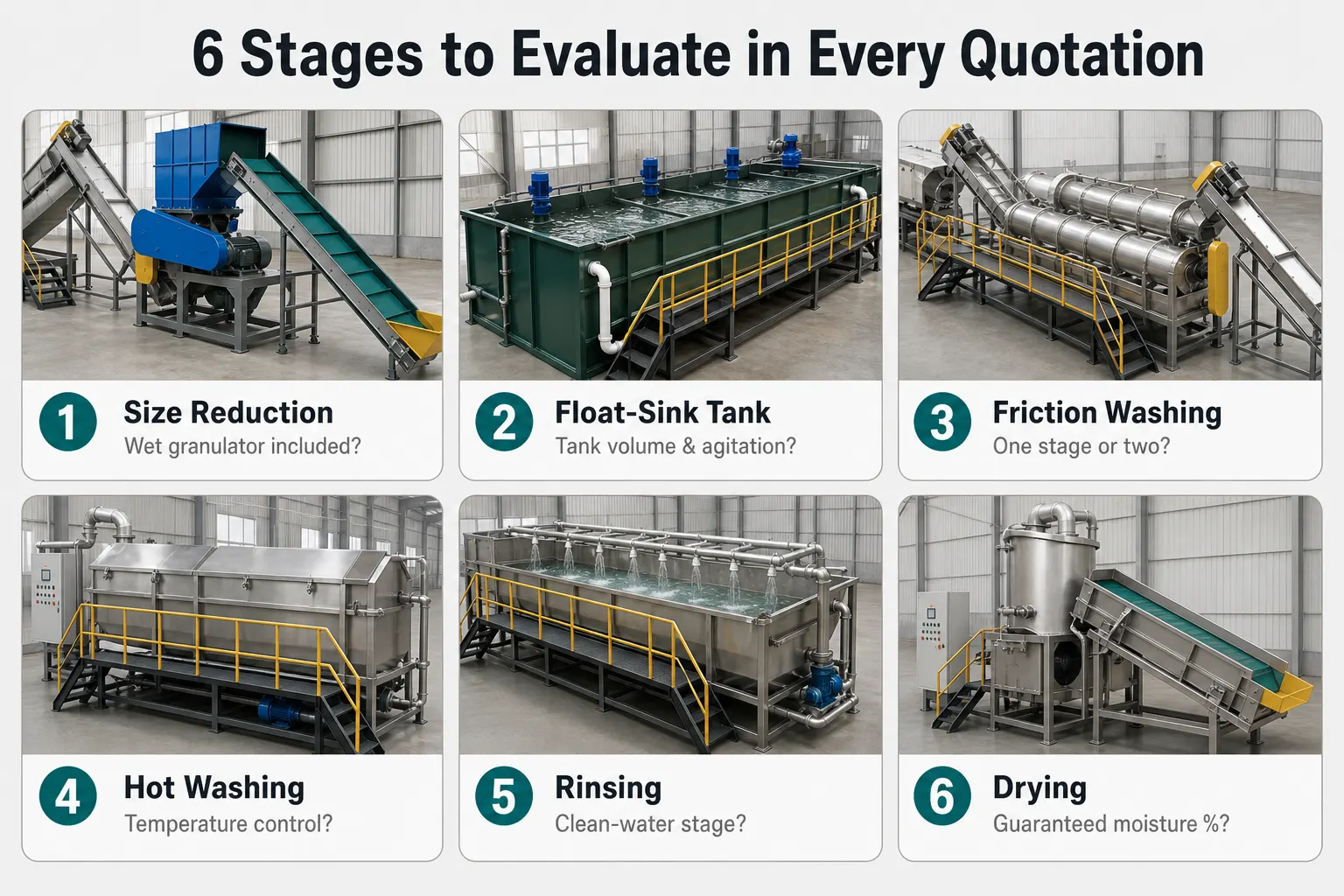
Six processing stages, six questions to put to every supplier before comparing prices.
Stage 1 – Pre-Sorting and Size Reduction
Bale breaker, wet granulator or crusher, and a trommel or vibrating screen to remove coarse contaminants (stones, glass, metal). The wet granulator simultaneously shreds and pre-washes film in a single step, which reduces downstream washing load significantly.
Stage 2 – Float-Sink Separation Tank
PP and PE films float; sand, stones, and most non-polyolefin plastics sink. This stage performs a fast, passive separation at low cost. Confirm the tank volume and agitation method — an under-agitated tank leads to carryover of heavy contaminants.
Stage 3 – Friction Washing
High-speed friction washers use mechanical scrubbing action to remove adhered dirt, labels, and organic residue from film surfaces. For heavily contaminated agricultural film, two friction-washing stages in series are standard. For cleaner industrial film, one stage may suffice.
Stage 4 – Hot Washing (Optional but Recommended)
A heated washing tank (60–90°C) with detergent or caustic solution dissolves adhesives, oils, and food residues that cold washing cannot remove. If your end market requires high-purity output, this stage is essential. Confirm the tank temperature control precision and detergent dosing system.
Stage 5 – Rinsing
At least one clean-water rinse stage after hot washing is required to remove residual detergent before drying.
Stage 6 – Mechanical Drying
A centrifugal dryer or film squeezer dryer reduces surface moisture to 10–15%. This is typically followed by a thermal (hot-air) dryer to bring moisture below 3–5% for pelletizing. Confirm the final moisture specification the manufacturer guarantees — not just the dryer type.
Watch a Complete Film Washing Line in Operation
The following video shows a complete SUHUI PP PE soft film recycling washing line running at full capacity, demonstrating the full sequence from shredding and pre-washing through to centrifugal drying:
5. Key Technical Specifications to Compare
When requesting quotations from film washing line manufacturers, ask for — and compare — the following specifications in writing:
- Throughput capacity (input kg/h at specified contamination rate)
- Output moisture content (% after final drying stage)
- Output purity (% polyolefin content in final flake)
- Total installed power (kW) and estimated energy consumption per tonne of output
- Fresh water consumption (m³/tonne of input)
- Wastewater treatment system: is a closed-loop water recycling system included or optional?
- Footprint dimensions and ceiling height requirements
- Control system: manual, semi-automatic, or fully automated PLC with remote monitoring?
SUHUI engineering note: The two specifications that cause the most disputes at acceptance testing are throughput and final moisture — because both depend on contamination level. A line rated for clean industrial film can fall well below its nameplate capacity when fed muddy agricultural film. Always ask for performance figures at your contamination percentage, in writing.
6. Assess Manufacturer Capability and After-Sales Support
Equipment performance on paper means little without reliable after-sales support. For a capital investment of this scale, evaluate the following:
Factory Audit and Reference Visits
Request the opportunity to visit an installed line in operation — ideally processing the same material type as your intended feedstock. Reputable manufacturers will facilitate this. Be cautious of any supplier who refuses reference visits.
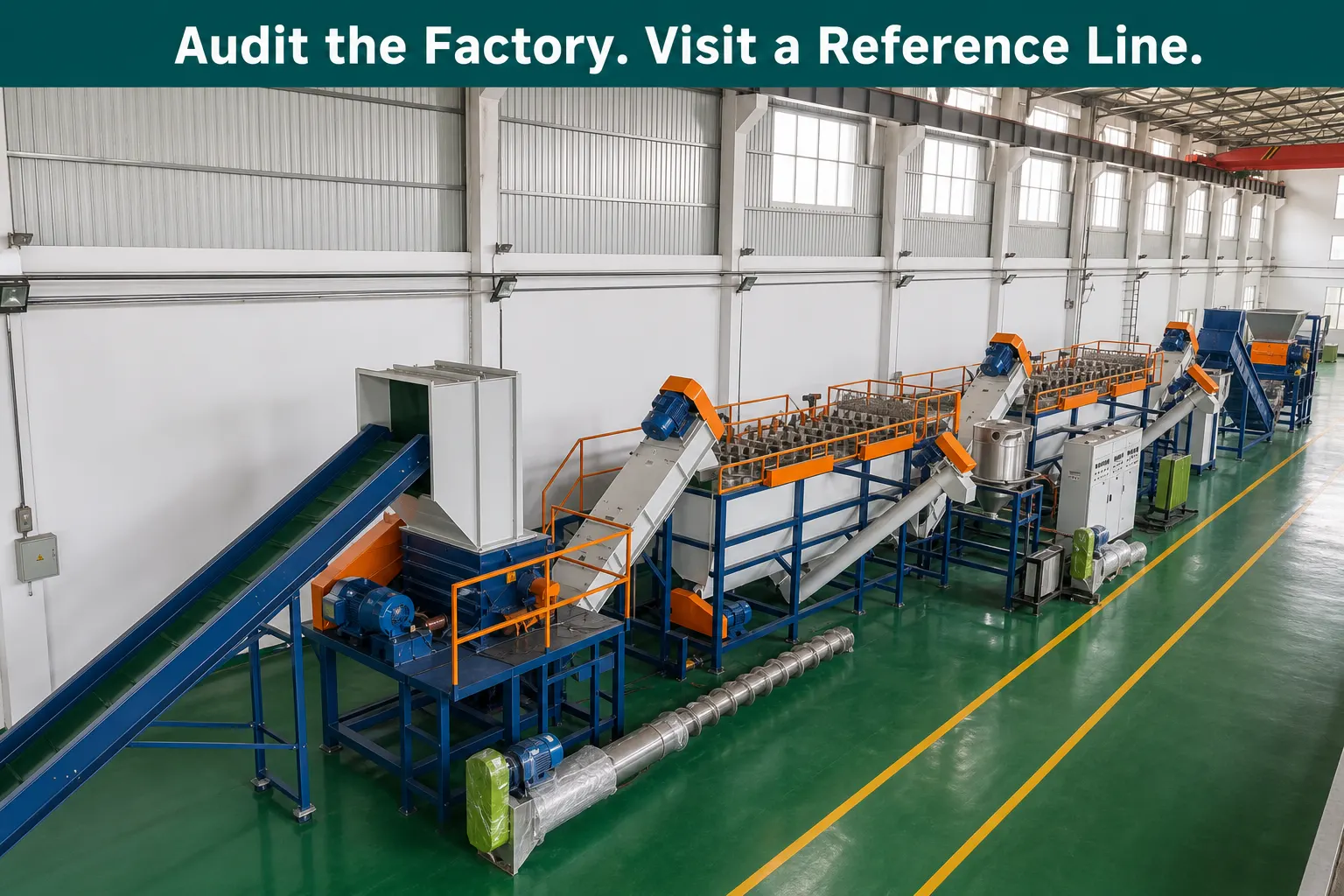
A factory audit and a reference installation visit tell you more than any brochure — reputable manufacturers welcome both.
Spare Parts Availability
High-wear components — friction washer blades, centrifugal dryer screens, granulator blades — need to be available quickly. Confirm the supplier holds common spare parts in stock and can ship within 48–72 hours.
Installation and Commissioning Support
Will the manufacturer send engineers for on-site installation and commissioning? What is the commissioning period, and what performance acceptance criteria will be used?
Warranty Terms
A standard warranty for industrial recycling equipment is 12 months on parts and workmanship. Clarify what is covered, what is excluded, and how warranty claims are processed across international shipments.
7. Questions to Ask Before You Sign the Contract
Use this checklist in your final supplier evaluation:
- What is the rated throughput at what specific contamination percentage?
- What is the guaranteed output moisture content and purity?
- Is a closed-loop water recycling system included, or is it extra cost?
- Can I visit a reference installation processing similar material?
- What is the lead time from order to delivery?
- Who handles customs clearance and freight — supplier or buyer?
- What training is provided to our operators?
- What is the typical availability of spare parts, and what is the annual spare-parts budget estimate?
The Decision Checklist in One Table
| Step | Key Question | Red Flag |
|---|---|---|
| 1. Input material | What film type, contamination level, loose or baled? | Quotation issued without asking about your feedstock |
| 2. Output quality | Flake for in-house pelletizing, sale, or food-contact? | No written moisture / purity specification |
| 3. Capacity | Daily volume + 20–30% buffer — which model fits? | Supplier pushes a larger line than your volume needs |
| 4. Processing stages | Does each stage match your contamination profile? | Single friction washer offered for muddy agricultural film |
| 5. Specifications | Throughput, power, water use confirmed in writing? | Verbal-only performance claims |
| 6. Manufacturer | Reference visits, spare parts, commissioning support? | Refuses factory audit or reference installation visit |
| 7. Contract terms | Guarantees, lead time, training, warranty scope clear? | No performance acceptance criteria in the contract |
Conclusion
Selecting a PP PE plastic film washing line is not a catalogue purchase. The right configuration depends on your specific material stream, output quality target, and production volume — and the right supplier is one who will work with you to engineer a solution to those exact parameters, not simply sell you a standard package. Industry guidance on recyclate quality standards is maintained by organizations such as the Association of Plastic Recyclers (APR), whose design-for-recyclability guidelines many downstream buyers reference when specifying minimum purity thresholds.
At SUHUI Machinery, we design and manufacture complete PP PE soft film recycling washing lines from 300 kg/h to 3,000 kg/h, with configurations for agricultural film, post-consumer packaging film, and post-industrial stretch wrap. Every line is engineered to the buyer’s specific contamination level and output quality requirements, with factory acceptance testing before shipment and on-site commissioning support. Contact our engineering team to discuss your project requirements.
Further Reading
- Plastic Film Recycling Line: How It Works, Stages and Equipment Overview — A technical walkthrough of the full film recycling process and equipment configuration.
- What Is a Plastic Recycling Line? Types, Process and How to Choose — An overview of washing lines, pelletizing lines, and shredding lines across all plastic types.
Frequently Asked Questions
What is the difference between a PP film washing line and a PE film washing line?
PP (polypropylene) and PE (polyethylene) films share similar densities and processing characteristics, so most modern washing lines are designed to process both in a single system. The primary difference lies in the downstream pelletizing stage, where melt temperatures differ slightly. A combined PP PE film washing line is the standard choice for facilities handling mixed polyolefin film waste streams.
How much does a plastic film washing line cost?
Pricing for a complete PP PE film washing line varies significantly based on throughput capacity, contamination tolerance, output quality requirements, and the level of automation. Entry-level lines for clean industrial film at 300–500 kg/h typically start in the range of USD 80,000–150,000, while fully automated lines for heavily contaminated agricultural film at 1,000–2,000 kg/h can range from USD 250,000 to over 500,000. Request itemized quotations so you can compare stage-by-stage configurations rather than headline prices.
Can a film washing line process heavily contaminated agricultural mulch film?
Yes, but the line configuration must be specifically designed for high-contamination input. Agricultural mulch film typically carries 20–40% soil and stone contamination by weight, requiring robust pre-sorting, wet granulation, multi-stage friction washing, and extended hot-wash treatment. Lines designed for cleaner post-industrial film are not suitable for agricultural film without significant modification.
What is the typical water consumption of a film washing line?
Fresh water consumption depends on whether a closed-loop water recycling system is installed. Without water recycling, consumption can reach 3–8 m³ per tonne of input material. With a properly designed sedimentation and recirculation system, fresh water consumption can be reduced to 0.5–1.5 m³ per tonne. Water recycling is increasingly a regulatory requirement in many markets and is strongly recommended.
How long does it take to install and commission a film washing line?
For a mid-sized film washing line (500–1,500 kg/h), on-site installation and commissioning typically takes 15–30 days following equipment delivery, assuming civil works (flooring, drainage, electrical supply) are complete. Larger or more complex lines may require 30–45 days. Factor this lead time into your project planning alongside the manufacturing and shipping period, which is typically 60–90 days for standard configurations.
Contact SUHUI to discuss a film washing line configuration based on your actual film waste, contamination level, capacity, and output target.
Have a Material You Need to Process?
Send the polymer, its form and your target output. We will come back with a line configuration and a realistic budget range.