PCR plastic has moved from a marketing preference to a purchasing specification in a few years. Brands now write recycled content into supply contracts, and in a growing number of jurisdictions the law writes it in for them.
That shift creates a question the packaging conversation usually skips. A drum of resin does not look recycled, and a percentage on a datasheet is a claim rather than a measurement. This article covers what PCR actually is, how the content gets verified, what records hold the claim up, and what a recycling line has to be capable of to supply it.
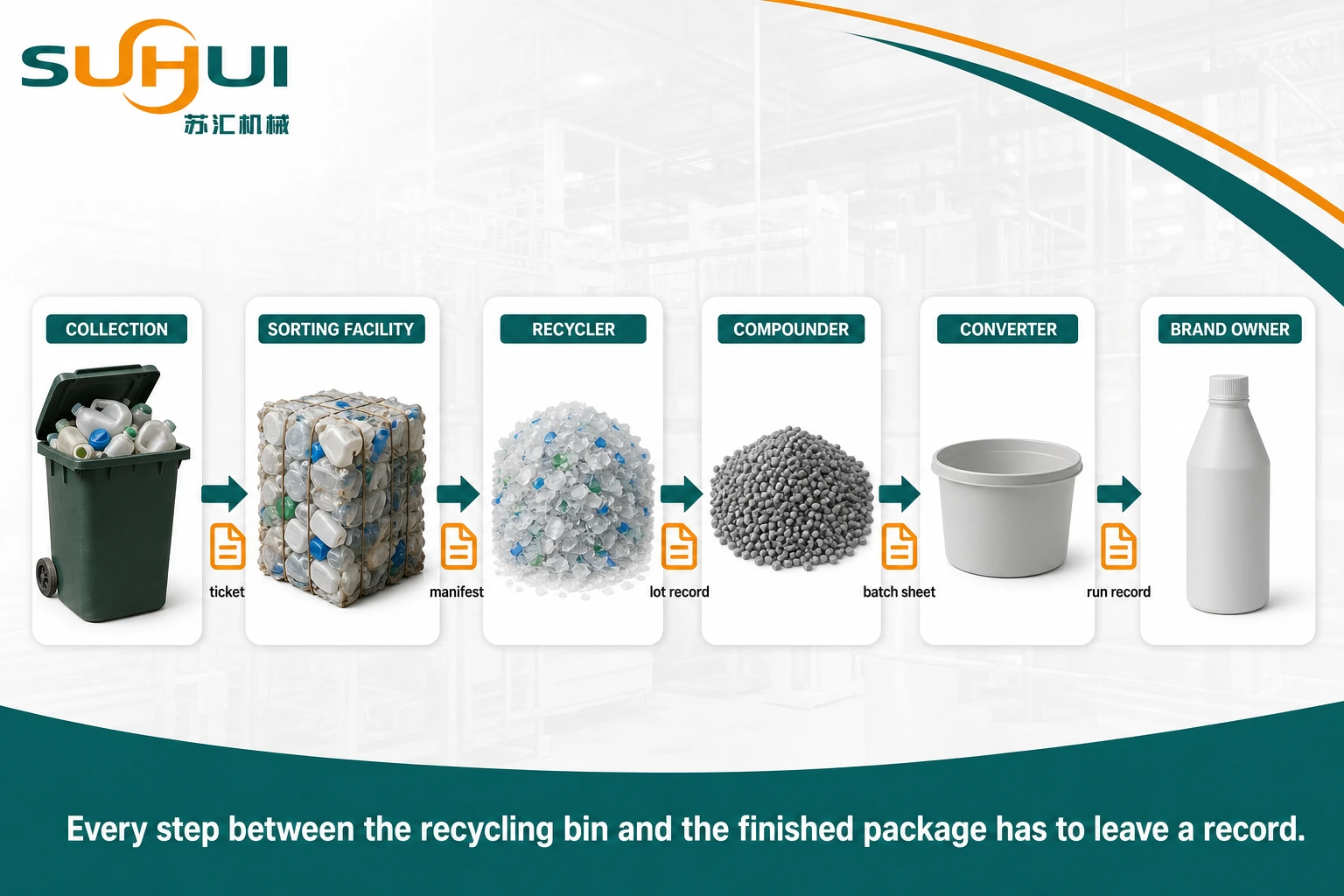
Every step between the recycling bin and the finished package has to leave a record.
What PCR Plastic Is and Where PIR Sits Beside It
PCR stands for post-consumer recycled. Under the ISO 14021 definition, post-consumer material is generated by households or by commercial and institutional facilities acting as end users, and can no longer be used for its purpose. PIR, post-industrial recycled, never reached a user at all.
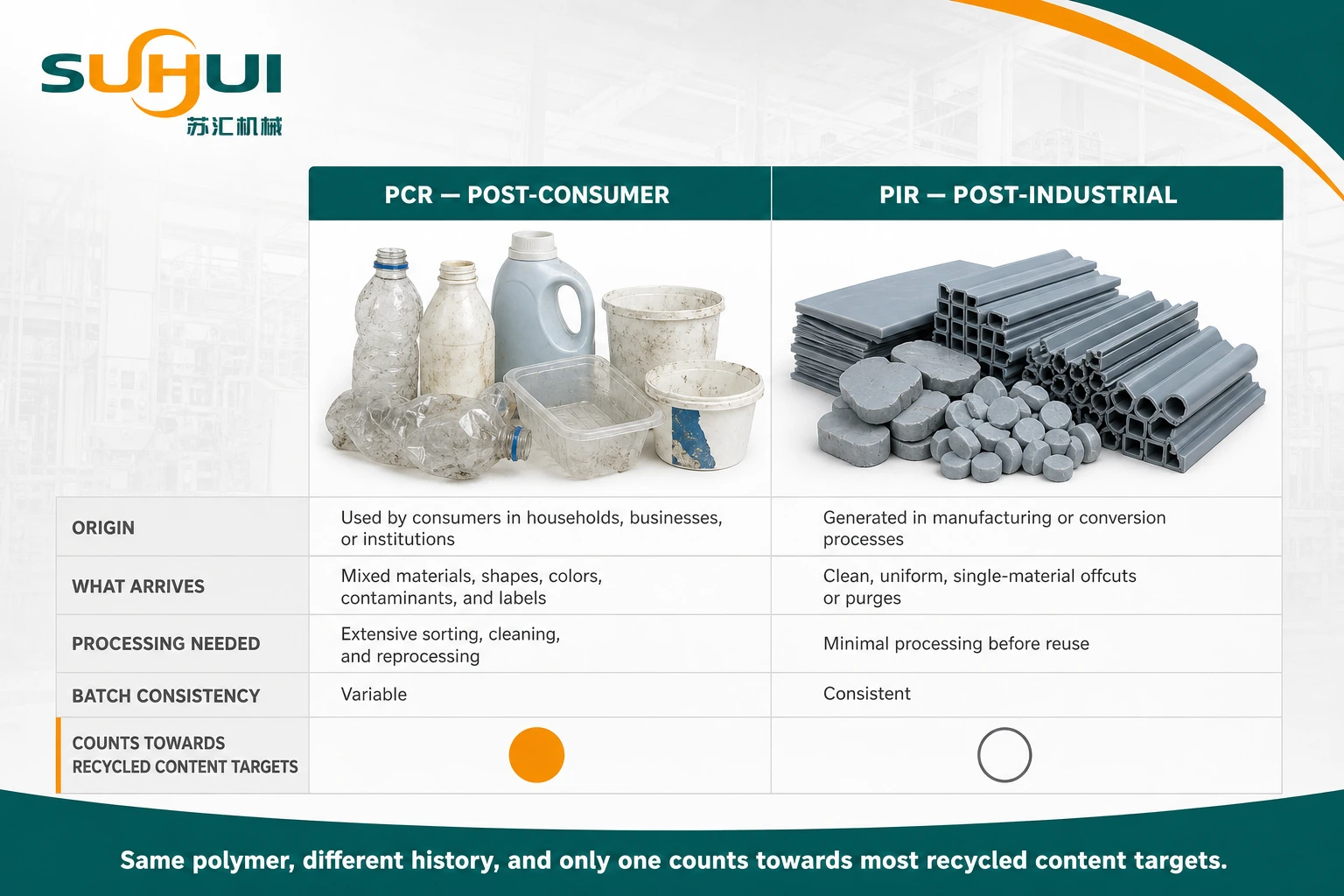
Same polymer, different history, and only one of them counts towards most recycled content targets.
| PCR — post-consumer | PIR — post-industrial | |
|---|---|---|
| Where it comes from | Kerbside collection, deposit return, commercial waste — material that was used and thrown away | Trim, purge, offcuts and rejects from a converter, collected before any consumer saw them |
| What arrives at the recycler | Mixed polymers and colours with food residue, labels, adhesives, dirt and the occasional wrong item | Usually one known grade, one colour, one supplier, with a specification sheet attached |
| Processing needed | Sorting, washing, separation, drying, filtration — the full line | Often granulation and pelletizing alone |
| Batch-to-batch consistency | Varies with the collection stream and the season | High, because the source barely changes |
| How claims treat it | Counts towards most recycled content targets and regulations | Frequently excluded, on the argument that factory scrap was always going to be reused |
The eligibility row is the one worth arguing about rather than treating as a technicality. PIR is easier to process and more consistent, which makes it the better material and the weaker claim. Buyers who ask only for “recycled content” without naming which one often get the easy version.
Why Brands Are Buying Recycled Content Rather Than Choosing To
Demand for PCR is no longer driven mainly by sustainability teams. Three forces now push it, and they operate on different timescales — regulation sets a floor, retailer requirements move faster than regulation, and label claims expose whatever the first two produce to public scrutiny.
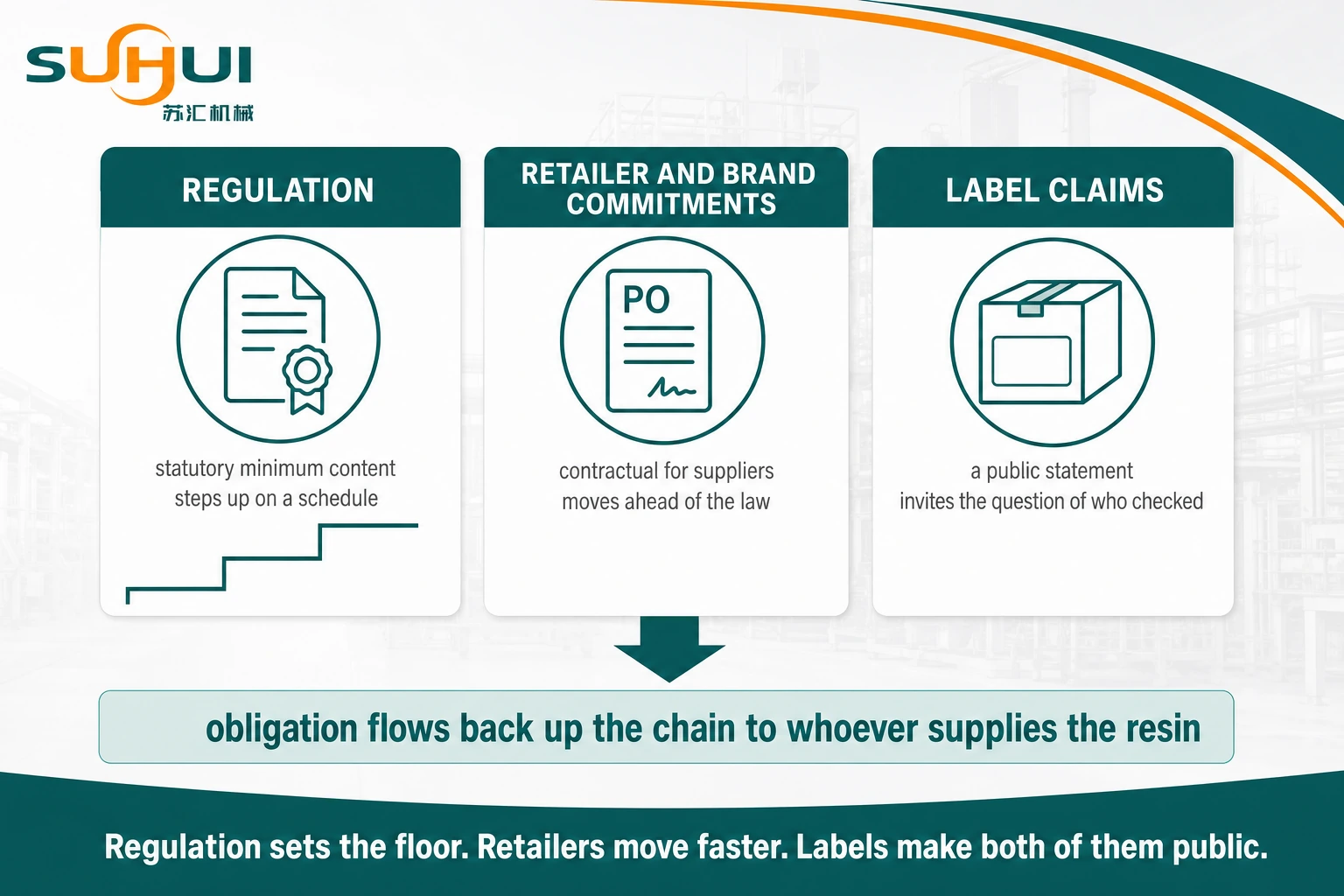
Regulation sets the floor. Retailers move faster. Labels make both of them public.
Regulation. Several US states now require minimum post-consumer recycled content in certain plastic packaging, with the requirements stepping up on a schedule; the Association of Plastic Recyclers maintains a current summary of these recycled plastic content requirements. The European Union has set recycled content obligations for packaging on a similar step pattern. Because the rules attach to the package rather than to the resin, obligation flows back up the chain to whoever supplies the material.
Retailer and brand commitments. Voluntary targets published by large brand owners and retailers are contractual for their suppliers, which is why a converter with no legal obligation still has a recycled content clause in its purchase orders.
Label claims. A percentage printed on a pack is a public statement, and it invites the question of who checked it. That is what turned verification from an internal quality matter into a third-party service.
How Recycled Content Is Actually Verified
Verification is less about testing the resin than about auditing the bookkeeping, because no laboratory test tells you whether a polymer chain came from a bottle or from a virgin reactor. What is audited instead is the chain of custody — the model by which recycled input is tracked to recycled output.
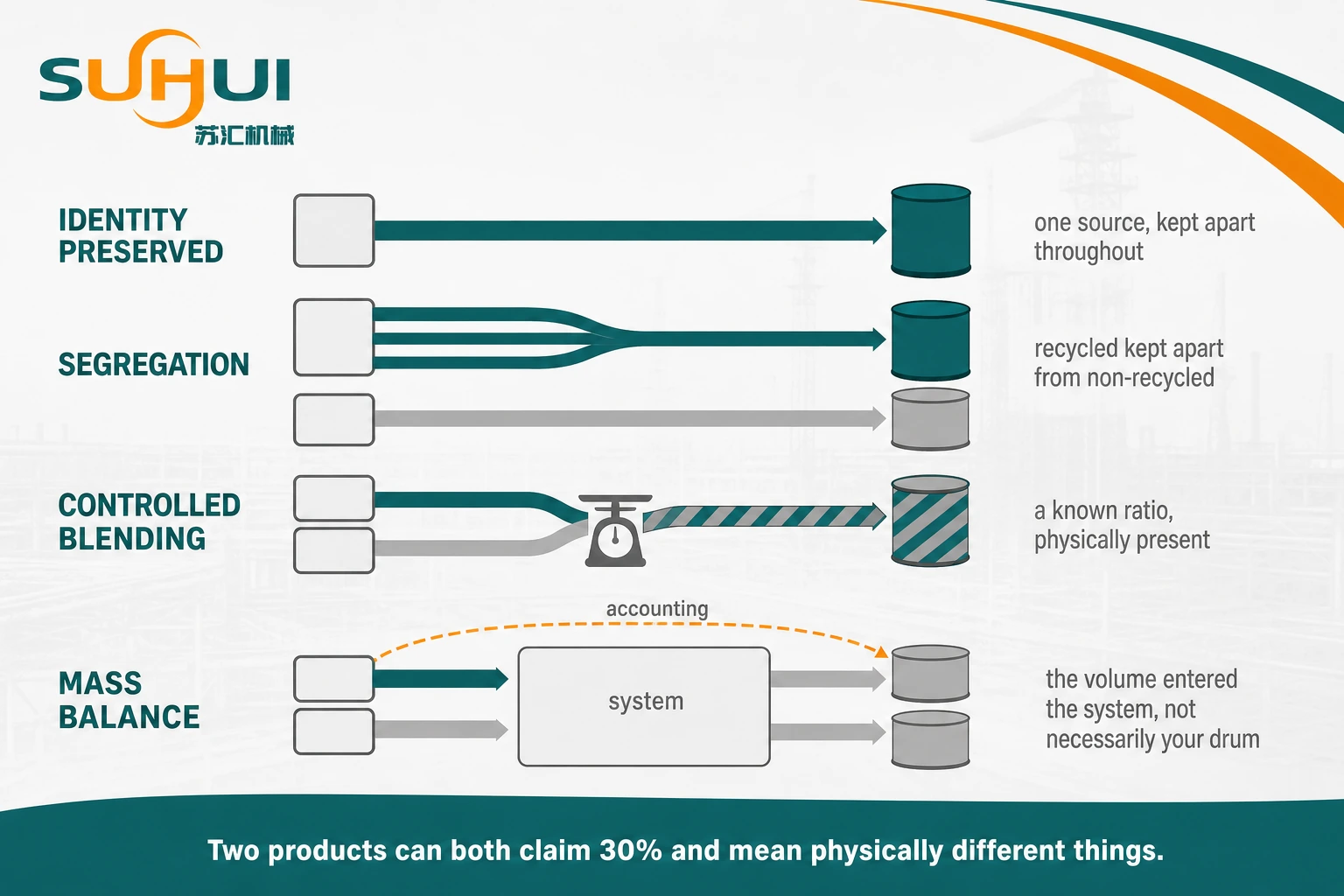
Two products can both claim 30% and mean physically different things.
ISO 22095 sets out the models used across industries, and four of them appear in recycled plastic supply.
| Model | What it means physically | What the claim guarantees |
|---|---|---|
| Identity preserved | Material from one specified source is kept separate all the way through | The strongest link between claim and material, and the hardest to operate at scale |
| Segregation | Certified recycled material is kept physically apart from non-certified, though sources may be mixed together | The material in the drum genuinely is recycled, but not from one identified origin |
| Controlled blending | Recycled and virgin are deliberately blended in a known, verified ratio | The stated percentage is physically present in that batch |
| Mass balance | Recycled input to a system is accounted against certified output, which may not contain the recycled molecules | That the recycled volume entered the system, not that it is in your drum |
Mechanical recycling generally supports the first three, because flakes and pellets stay physically distinct throughout and blending is a weighing exercise. Mass balance is used mainly where inputs are chemically converted and physical tracking stops being possible. Neither is dishonest, and both are widely accepted, but they answer different questions and a buyer should know which one a supplier is quoting.
Third-party validation sits on top of the model. Certification bodies such as UL Solutions offer recycled content certification covering total, post-consumer, pre-consumer and closed-loop content, and their value is that the auditor tests the records rather than accepting the summary. The practical instruction for a buyer is short — ask which model, ask who certified it, and ask to see the scope on the certificate.
What Records Each Link in the Chain Has to Keep
A recycled content claim survives an audit only if every handover between companies left a paper trail that reconciles. The chain typically has five links, and the claim is only as strong as the weakest one, which is almost always further upstream than the brand expects.
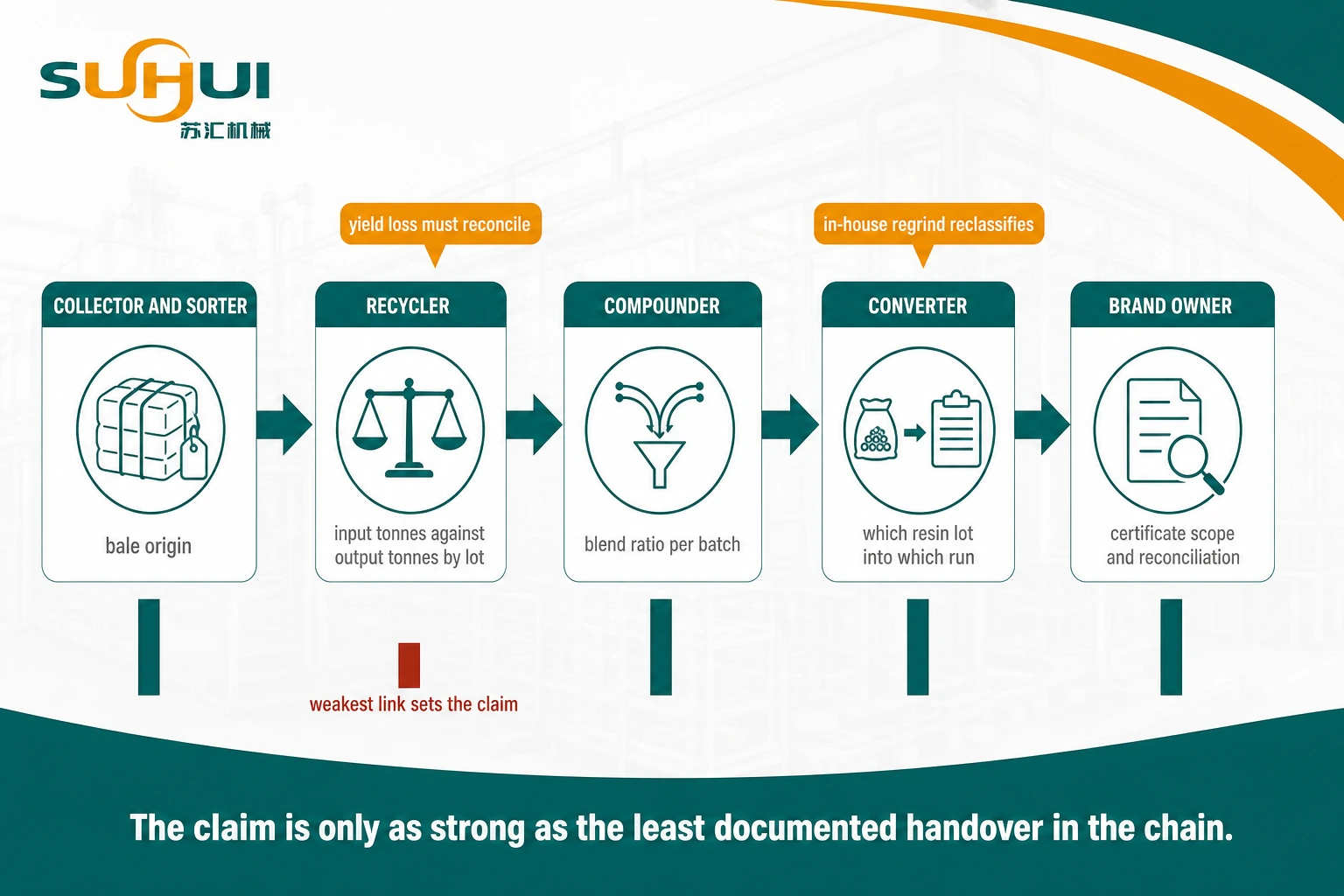
The claim is only as strong as the least documented handover in the chain.
| Link | What it has to be able to show | What a gap looks like |
|---|---|---|
| Collector and sorting facility | Where the bales came from and that the stream is post-consumer rather than commercial offcut | Bale tickets with no origin, or a stream described only by polymer |
| Recycler | Input tonnes against output tonnes by lot, with the yield loss accounted for | Output exceeding what the input could have produced, the classic audit failure |
| Compounder | Blend ratios per batch, with virgin and additive inputs recorded against the same lot | A nominal recipe applied to every batch regardless of what was actually dosed |
| Converter | Which resin lot went into which production run, and how in-house regrind was treated | Regrind fed back without being reclassified, which quietly changes the content figure |
| Brand owner | The certificate, its scope, and reconciliation of purchased volume against packs sold | A supplier certificate on file that covers a different site or a different product |
Two of these fail more often than the rest. The recycler’s mass balance fails when yield loss is not honestly recorded, because washing removes a great deal of weight and an output figure that ignores it will not reconcile. The converter’s regrind handling fails because scrap generated in-house is post-industrial by definition, so folding it back in dilutes the post-consumer percentage even though the total recycled figure looks unchanged.
Why Two Loads of PCR at the Same Percentage Are Not the Same Material
Recycled content is a bookkeeping figure. Processability is a material property, and the two are unrelated. Two suppliers can both deliver certified 50% post-consumer PP and give a moulder completely different results, because the percentage says nothing about what the recycling line actually did.
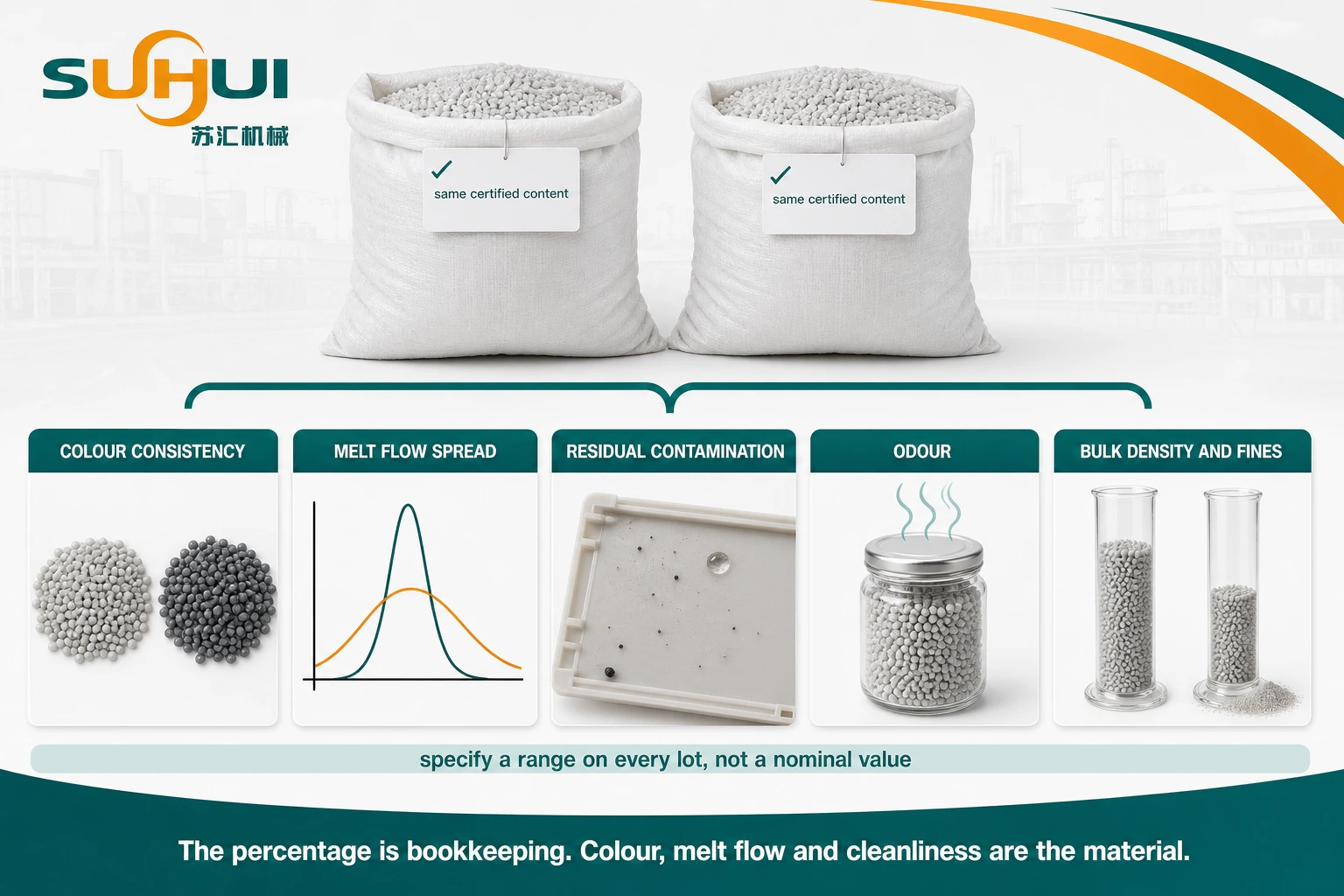
The percentage is bookkeeping. Colour, melt flow and cleanliness are the material.
Five properties vary independently of the content figure, and each maps to a specific stage of the line that produced the resin.
- Colour and its consistency — set by how tightly the input was sorted. Mixed-colour feed cannot be corrected downstream, only masked, which is why dark colours dominate high-PCR products.
- Melt flow spread — the same nominal grade sourced from mixed articles carries a wider distribution than virgin, and the spread matters more to a moulder than the average.
- Residual contamination — grit, metal fines, paper fibre and unmelted fragments that survived washing and filtration, showing up as gels, specks or die lines.
- Odour — carried in the polymer from residues, not removable by filtration, and the reason some PCR is barred from personal care packaging.
- Bulk density and fines — pellet geometry decides feeding behaviour, and moulding machines meter by volume, so inconsistent bulk density becomes shot-weight variation.
The useful conclusion for a buyer is to specify these as a range rather than accepting a single nominal figure, and to require the same measurements on every lot. The useful conclusion for a recycler is that these five properties, not the percentage, are what a customer renews a contract on.
What a Recycling Line Has to Do to Supply PCR Consistently
Producing PCR that a converter will buy twice is a processing problem before it is a paperwork problem. Every property in the previous section is set by a specific stage, which is why a line configured for the general case rarely holds a specification tightly enough to win repeat contracts.
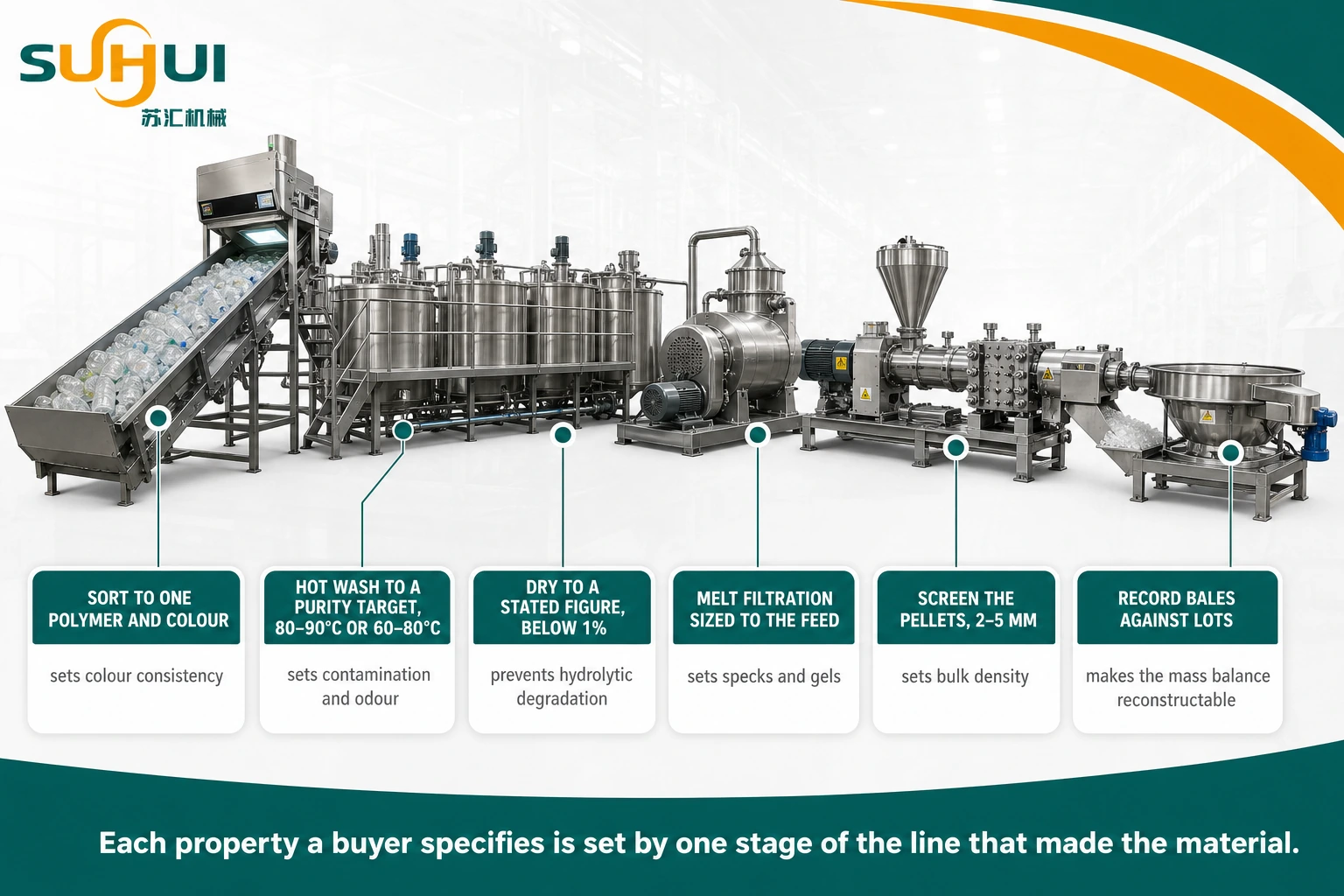
Each property a buyer specifies is set by one stage of the line that made the material.
Six capabilities decide whether a line can hold a PCR specification.
Sorting to one polymer and one colour. This is the ceiling on everything downstream. SUHUI’s PET bottle sorting washing line sorts optically twice — at bottle level to reject non-PET before crushing, and again at flake level to separate clear, light blue and green — because colour separation attempted after crushing is the last chance to protect the value of the output.
Washing to a purity target rather than to a process. Contamination that survives washing ends up in the melt filter and then in the pellet. Hot alkaline washing at controlled temperature removes adhesives and organic residue that cold washing leaves behind, which is why the PET line runs dual hot washing stages at 80–90°C and the HDPE rigid milk bottle recycling washing line runs hot caustic washing at 60–80°C.
Drying to a stated moisture figure. Moisture causes hydrolytic degradation and steam bubbles, both of which appear in the customer’s part rather than in yours. Both washing lines above specify final moisture below 1%.
Melt filtration sized for the contamination you actually have. On a virgin line the screen is insurance. On a rigid plastic granulating pelletizing line it is a working stage, which is why multi-stage filtration with a continuous or discontinuous screen changer is a configuration choice rather than a fixed part.
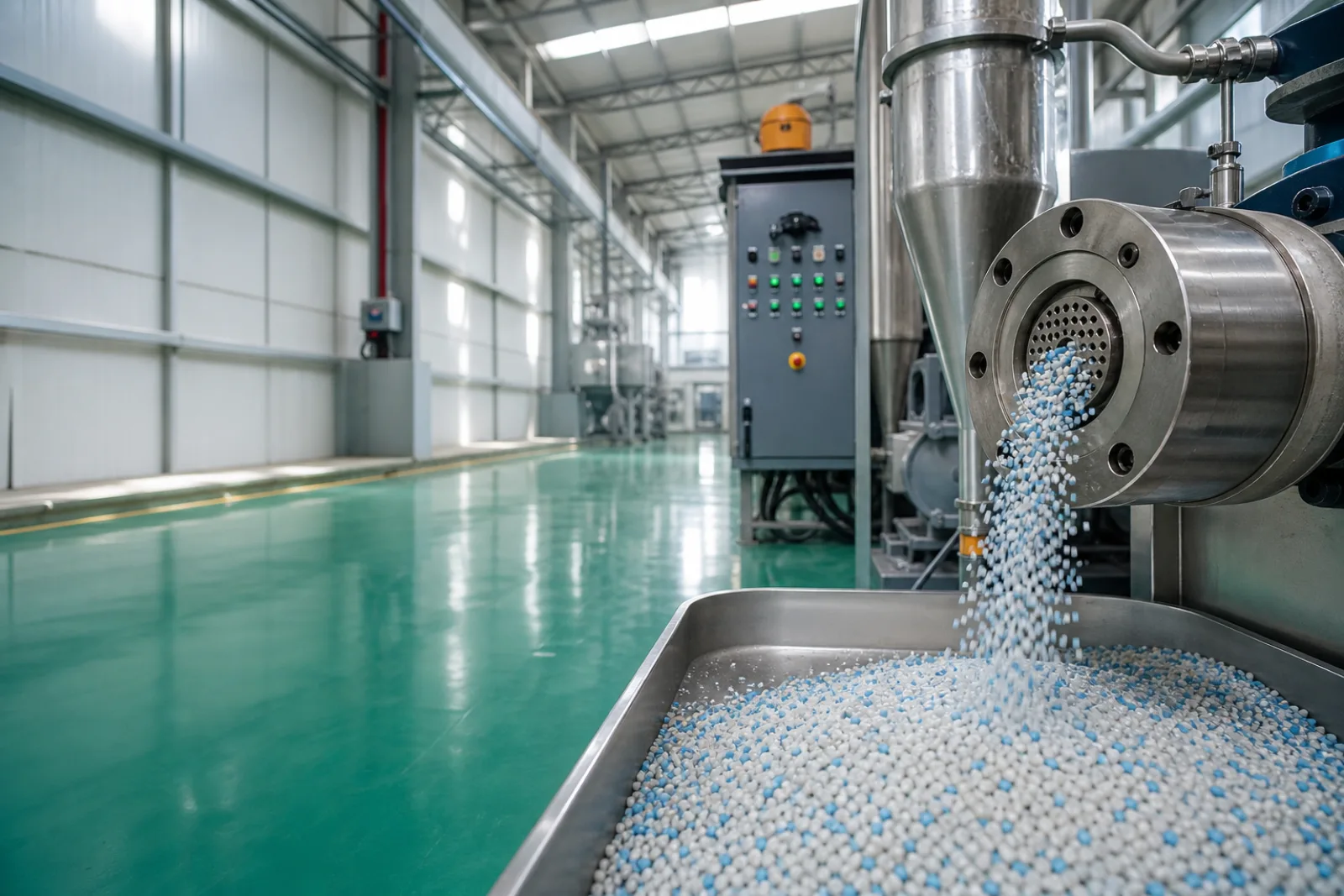
Pellet consistency, screened. Uniform 2–5 mm pellets with fines and oversize removed by vibrating sieve is what keeps bulk density stable, and stable bulk density is what keeps a moulder’s shot weight stable.
Lot traceability built into operation. The mass balance the auditor will ask for is only reconstructable if input bales and output lots were recorded against each other while the line was running. Retrofitting that record is not possible.
For PET aiming at bottle-to-bottle, one further stage applies. Washing and reprocessing lower intrinsic viscosity, and a PET solid state polymerization system raises it again by extending molecular chains below the melting point under circulating nitrogen, while removing moisture, acetaldehyde and ethylene glycol. Whether the result qualifies for food contact depends on feedstock control, decontamination and certification being managed together, not on the equipment alone.
How Reprocessing Changes What the Material Can Be Called
PCR can be mechanically recycled again, and most of it can go round several times. What changes with each pass is not only the polymer but the classification, and buyers are frequently surprised by which way that moves, because reprocessing can quietly convert post-consumer material into post-industrial material.
The rule follows the ISO definition. Material qualifies as post-consumer because an end user finished with it. Scrap that a converter generates while moulding PCR resin never reached an end user, so when it is reground and fed back it is post-industrial, whatever it was in a previous life.
That has a practical consequence worth knowing before an audit. Feeding in-house regrind back into a run raises total recycled content and can lower the post-consumer figure at the same time. If your contract or your regulatory obligation is written in post-consumer terms, the two numbers have to be tracked separately from the moment the regrind is generated.
Frequently Asked Questions
What is PCR in plastic?
PCR stands for post-consumer recycled. It is plastic that reached an end user, was discarded, then collected, sorted, washed and reprocessed into resin used to make something new. Under ISO 14021, post-consumer material is generated by households or by commercial and institutional facilities acting as end users of the product.
What is the difference between PCR and PIR plastic?
Origin. PCR was used and thrown away by a consumer or an end-using business. PIR is post-industrial — factory trim, purge and rejects that never left the supply chain. PIR is cleaner and more consistent, but it is excluded from many recycled content targets on the basis that it was always going to be reused.
Can PCR plastic be recycled again?
Yes, mechanically, and often several times. Two things change with each pass. Properties shift, so blending ratios and applications are usually revisited. And classification shifts, because scrap generated inside a factory while processing PCR is post-industrial by definition, even though the material was post-consumer before.
Is PCR plastic safe for food contact?
It can be, but the qualification belongs to the whole recycling process rather than to the material type. Food-contact recycled resin depends on controlled feedstock, a validated decontamination step and the applicable regulatory approval being held together. PET is the most established route, since washing plus solid state polymerization is a well-understood path to bottle-grade material.
Is PCR plastic more expensive than virgin resin?
Not always, and the relationship moves. PCR pricing tracks feedstock availability, sorting yield and the processing a grade needs, while virgin tracks petrochemical markets, so the gap opens and closes. What is consistently true is that clear, single-polymer, food-grade PCR commands a premium over dark mixed-colour material from the same line.
How is post consumer recycled plastic content verified?
By auditing the chain of custody rather than testing the resin, since no laboratory test distinguishes a recycled polymer chain from a virgin one. Ask which ISO 22095 model applies — identity preserved, segregation, controlled blending or mass balance — who certified it, and whether the certificate scope covers the specific site and product you are buying.
The Plant Side of a Recycled Content Claim
- Plastic Recycling Machine Range — which line configuration a supplier needs before recycled content becomes a specification
- Plastic Recycling Washing Line — four material-specific wash routes behind a consistent post-consumer feedstock
- What Are PET Flakes — how a post-consumer lot is accepted or rejected on five numbers
- What Is PET Plastic — where rPET sits against virgin PET and PETG on the same resin
- Contact SUHUI — send your target recycled content percentage and end use for a line proposal
Have a Material You Need to Process?
Send the polymer, its form and your target output. We will come back with a line configuration and a realistic budget range.