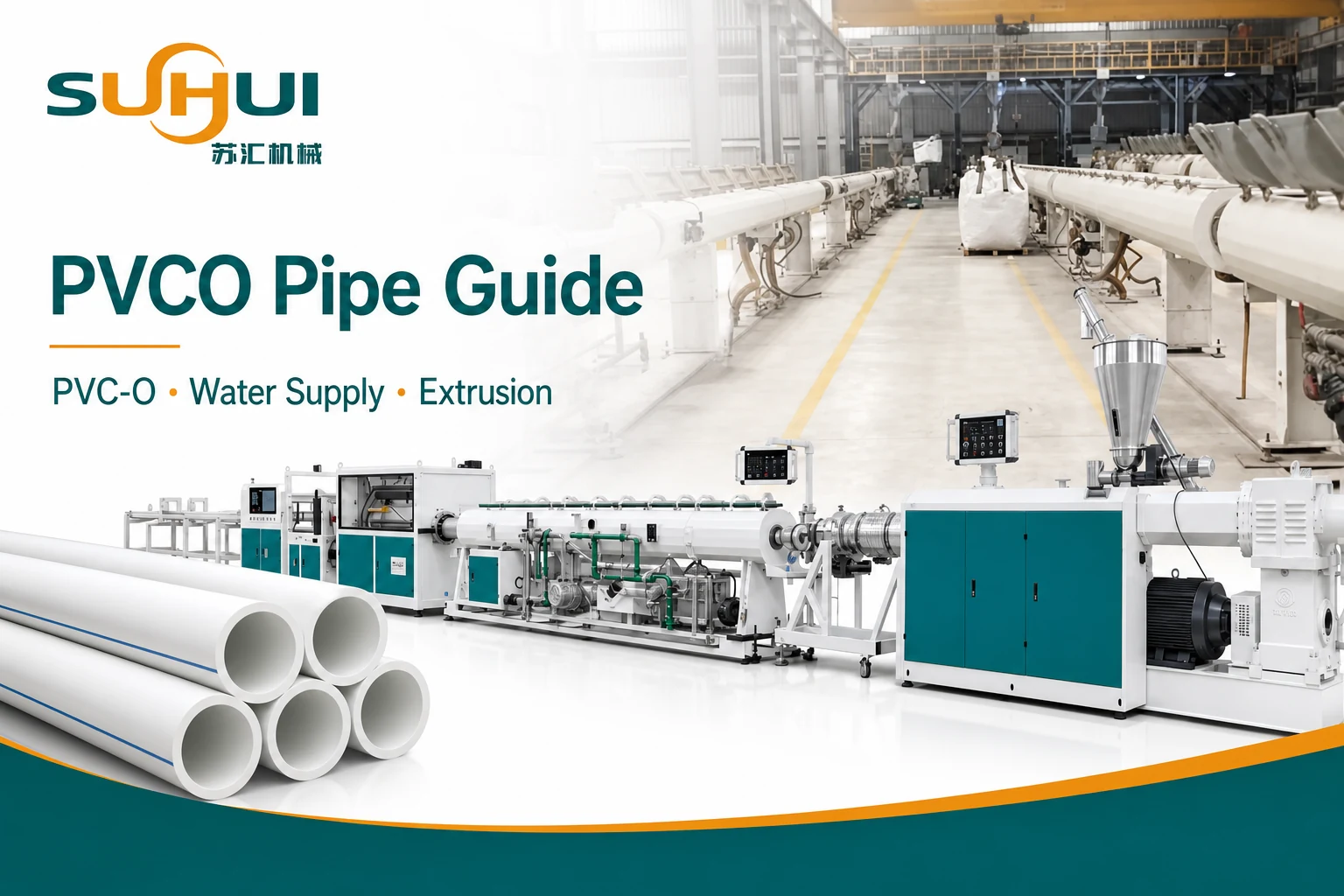
PVCO pipe is often confused with PVC, CPVC, or other types of plastic pipes, but it is a different pipe technology. PVCO stands for molecularly oriented polyvinyl chloride. Instead of relying only on thicker pipe walls, PVC-O pipe improves mechanical performance by reorienting the PVC molecular structure during manufacturing. The result is a lightweight plastic pressure pipe with strong resistance to impact, cracking, surge pressure, and long-term stress.
For buyers comparing types of plastic pipes, PVCO is usually evaluated alongside PVC pipe, HDPE pipe, PPR pipe, CPVC pipe, and other plastic water pipe materials. It is most commonly used for potable water distribution, irrigation mains, pressure sewer lines, and buried water supply networks. It is not the same as CPVC chemical pipe, and it should not be described mainly as a chemical-resistant pipe for aggressive industrial fluids.
SUHUI Machinery manufactures plastic pipe extrusion lines for PVC, HDPE, PPR, and related pipe production applications. PVCO pipe production requires additional molecular orientation equipment after the basic extrusion stage, so this guide explains both what PVCO pipe is and how it relates to standard plastic pipe extrusion, water pipe manufacturing, and equipment selection.
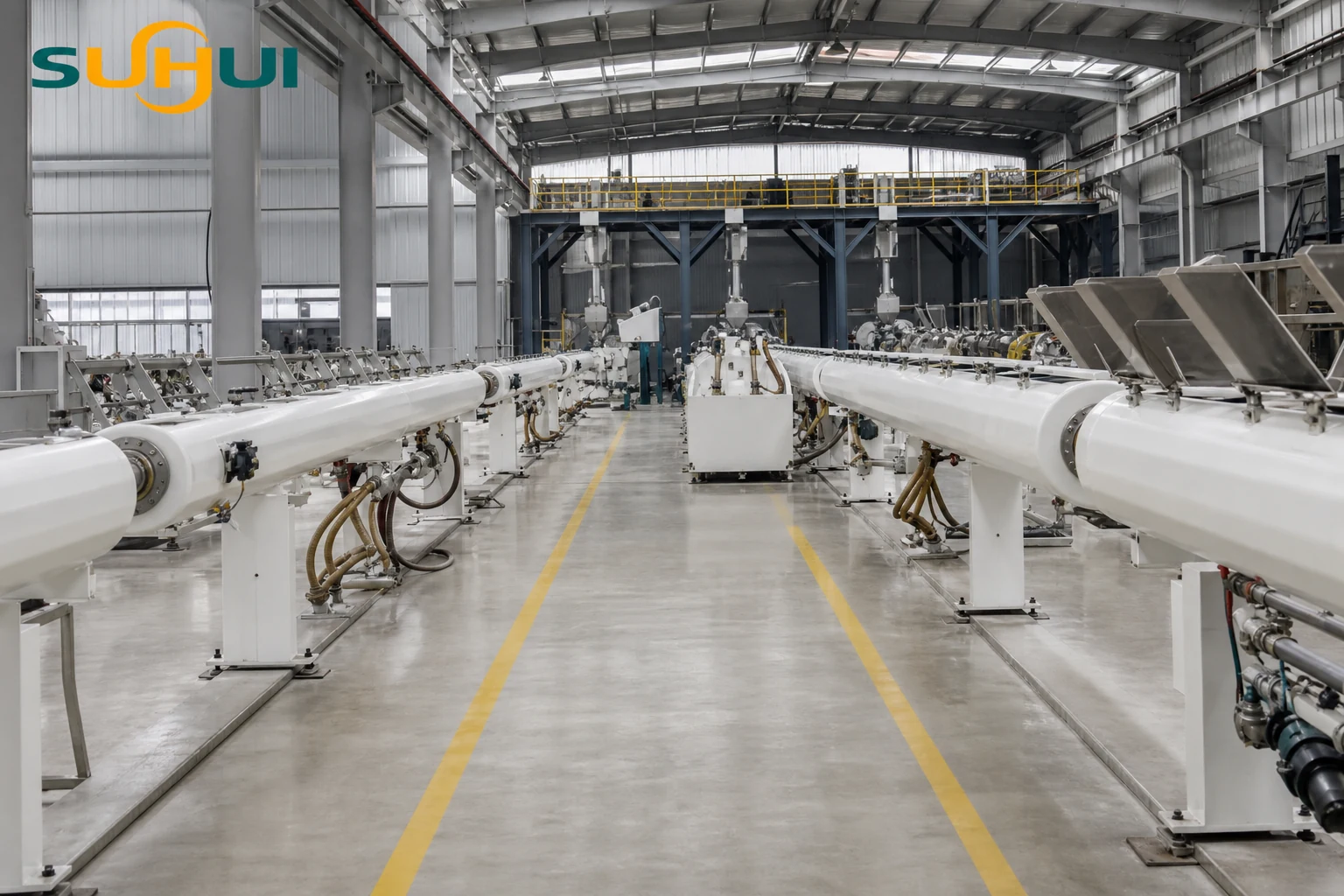 PVCO pipe starts with stable PVC pipe extrusion before the additional orientation process improves pressure performance and impact strength.
What Is PVCO Pipe?
PVCO pipe is a type of oriented PVC pressure pipe. It begins as a PVC pipe or preform, then undergoes a controlled stretching process that aligns the PVC molecules in two directions: around the pipe circumference and along the pipe length. This is why PVCO is also called PVC-O pipe, oriented PVC pipe, or molecularly oriented PVC pipe.
The purpose of orientation is to improve the strength-to-weight ratio of the pipe. Compared with standard PVC pressure pipe, PVCO can provide high pressure performance with a lighter wall structure. Compared with many traditional plastic pipe types, it can also offer strong resistance to crack propagation, impact damage, fatigue, and water hammer when properly designed and installed.
In the United States, PVCO pipe is often associated with AWWA C909 pressure pipe applications. In other markets, it may appear under terms such as OPVC pipe, PVC-O pressure pipe, oriented PVC water pipe, or molecularly oriented PVC piping. The exact standard, diameter range, pressure class, and joining system depend on the manufacturer and local water infrastructure requirements.
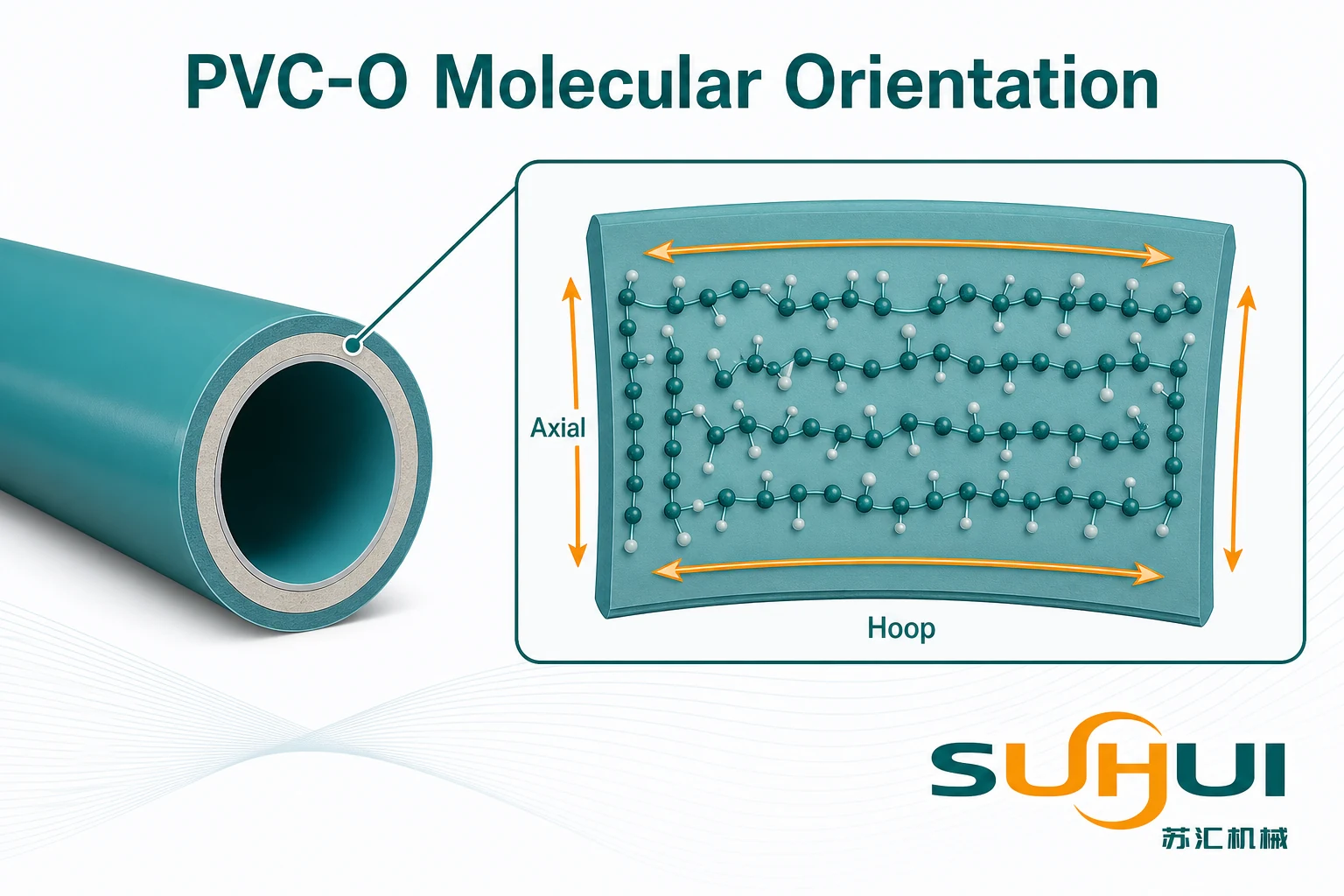 PVC-O pipe performance comes from molecular orientation in both axial and hoop directions, not simply from thicker pipe walls.
PVCO Pipe vs PVC Pipe: What Is the Difference?
Standard PVC pipe and PVCO pipe both use polyvinyl chloride as the base material, but they are not produced in the same way. A conventional PVC pipe is extruded, calibrated, cooled, cut, and finished. A PVCO pipe goes through extrusion first, then an orientation process that stretches the pipe under controlled temperature and pressure conditions.
| Comparison Point | Standard PVC Pipe | PVCO / PVC-O Pipe |
|---|---|---|
| Core material | Polyvinyl chloride | Polyvinyl chloride with molecular orientation |
| Manufacturing process | Extrusion, sizing, cooling, cutting | Extrusion plus controlled biaxial orientation |
| Main performance goal | General pressure, drainage, conduit, or water applications | Higher strength-to-weight ratio and improved pressure performance |
| Typical application | Water supply, drainage, irrigation, conduit, industrial pipework | Municipal water mains, pressure pipelines, irrigation mains, reclaimed water |
| Equipment requirement | PVC pipe extrusion line | PVC pipe extrusion plus orientation system |
The key difference is not simply the raw material. It is the structure created during manufacturing. In standard PVC pipe production, performance depends on formulation, wall thickness, extrusion quality, cooling, and pipe design. In PVCO pipe production, the orientation stage changes how the material carries stress, allowing the pipe to perform differently under pressure.
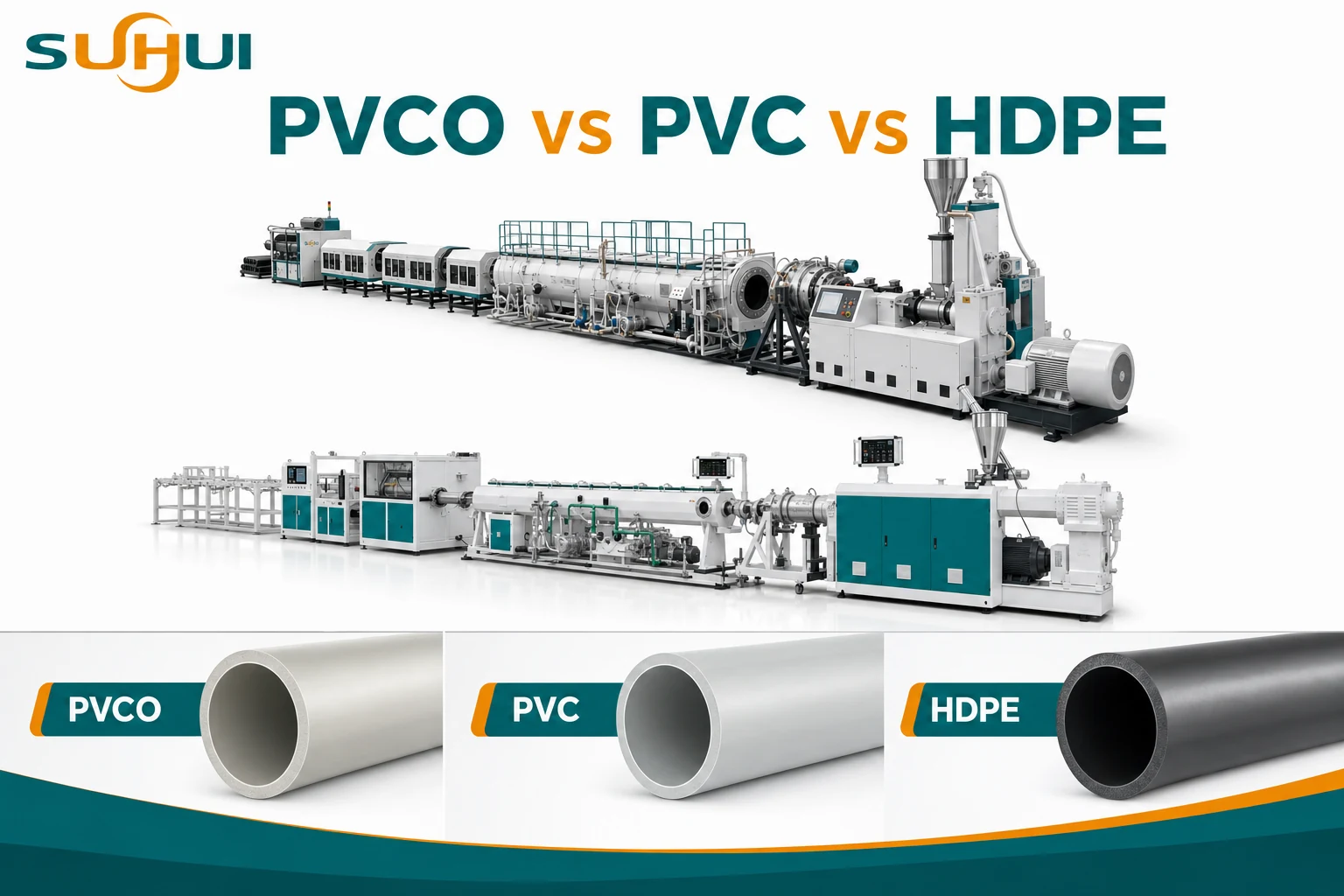 PVCO, PVC and HDPE pipes can all serve water infrastructure projects, but their materials, joining methods and production requirements are different.
PVCO Pipe vs HDPE Pipe vs PVC Pipe
Buyers searching for HDPE pipe vs PVC pipe, PVC pipe types, or plastic water pipe usually want to understand which material fits a specific pipeline project. PVCO is one option in the broader family of plastic pressure pipes, but it is not always the best choice for every application.
| Pipe Type | Strengths | Common Use | Manufacturing Note |
|---|---|---|---|
| PVCO / PVC-O pipe | Lightweight, high pressure performance, impact resistance, hydraulic efficiency | Water supply, irrigation, municipal pressure networks | Requires PVC extrusion and orientation process |
| PVC pipe | Cost-effective, rigid, widely used, easy to process | Water supply, drainage, conduit, irrigation, building systems | Produced by a standard PVC pipe extrusion line |
| HDPE pipe | Flexible, strong weldability, corrosion resistance, good impact performance | Water supply, gas, mining, drainage, industrial transfer | Produced by an HDPE pipe extrusion line with suitable cooling and haul-off |
| PPR pipe | Heat resistance, clean water applications, stable hot and cold water service | Building water supply and plumbing systems | Produced by a PPR pipe extrusion line |
| CPVC pipe | Higher heat and chemical resistance than standard PVC | Hot water, industrial chemical handling, fire sprinkler systems | Requires formulation and extrusion control suitable for CPVC processing |
This comparison matters because the original application should determine the pipe material. If the project is a buried water pressure line, PVCO, HDPE, and PVC may all be considered. If the project involves high-temperature chemical service, CPVC or other industrial plastic pipe materials may be more relevant. If the project is about manufacturing equipment, the required line configuration depends on material, diameter range, wall thickness, pressure class, output target, and downstream process.
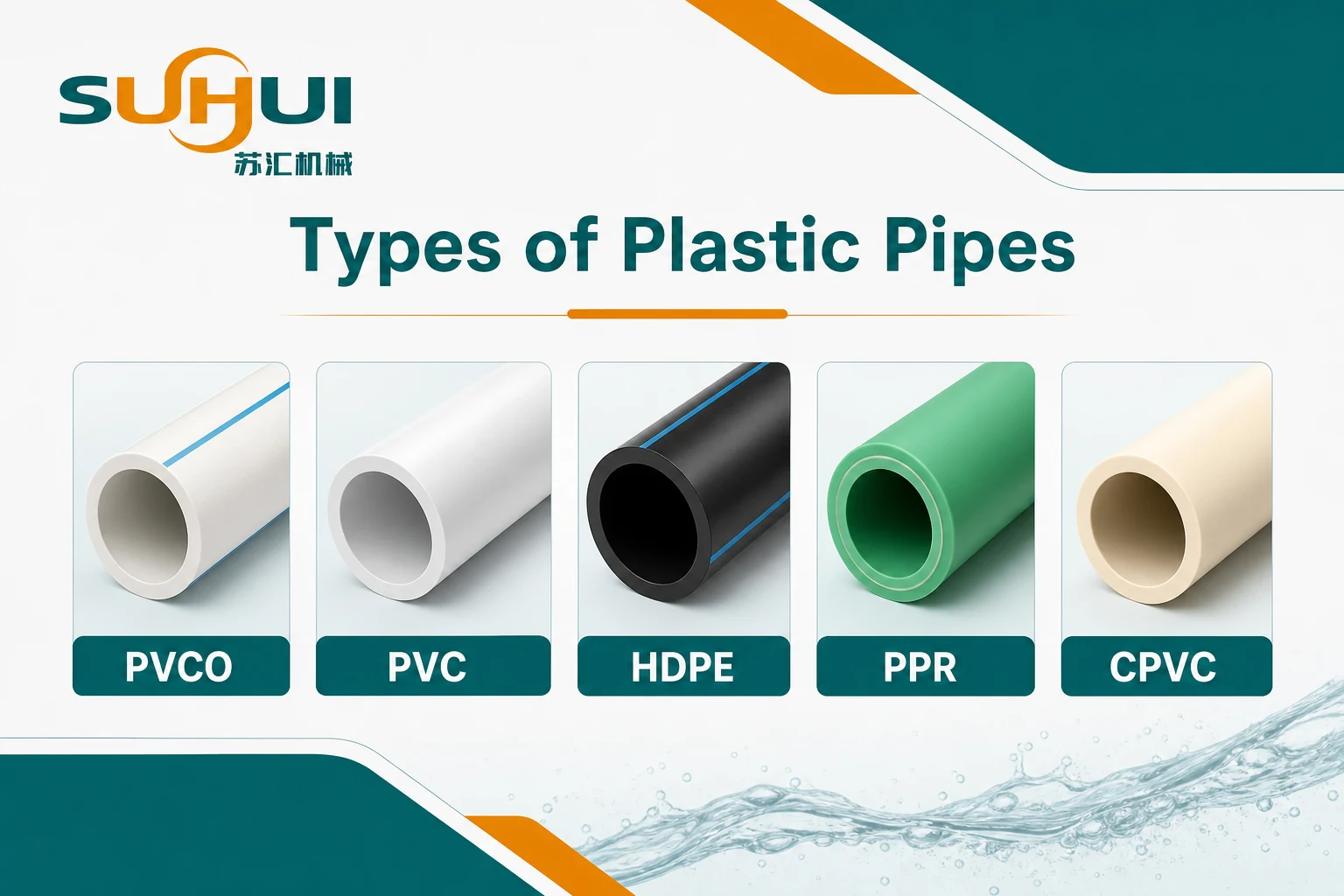 PVCO is one option among several plastic pipe types used for water supply, pressure pipe and industrial piping projects.
How PVCO Pipe Is Manufactured
The PVCO pipe manufacturing process includes more steps than standard PVC pipe production. Although equipment designs vary by manufacturer, the general process can be understood in five stages.
1. PVC Compound Preparation
PVCO pipe starts with a PVC compound formulated for pressure pipe performance. The compound may include PVC resin, stabilizers, lubricants, processing aids, impact modifiers, pigments, and other additives. The formulation must support extrusion stability and the later molecular orientation process.
2. Initial Pipe Extrusion
The material is plasticized in an extruder and formed through a pipe die. At this stage, the line functions similarly to a PVC pipe extrusion line. The extruder, die head, vacuum calibration tank, cooling tank, haul-off, and control system must produce a stable pipe preform with consistent wall thickness and surface quality. Those are the same core sections found on any plastic extrusion machine, tuned here for the tighter tolerances PVC-O demands.
3. Controlled Heating
Before orientation, the pipe must be brought to a precise temperature range. If the temperature is too low, the pipe may not stretch properly. If it is too high, the structure may become unstable. Temperature uniformity is critical because uneven heating can cause wall thickness variation, ovality, or weak spots.
4. Molecular Orientation
The pipe is stretched in the circumferential and axial directions. This biaxial orientation aligns the PVC molecular chains and improves mechanical performance. This is the step that separates PVCO pipe from standard PVC pipe. A regular plastic pipe extrusion line alone does not produce true PVCO pipe unless it is paired with the correct orientation system.
5. Cooling, Stabilization, Cutting and Testing
After orientation, the pipe must be cooled and stabilized so the oriented structure is retained. The finished pipe is then cut, inspected, and tested according to pressure, dimensional, and application requirements. Quality checks may include diameter, wall thickness, ovality, impact resistance, hydrostatic pressure performance, and visual surface inspection.
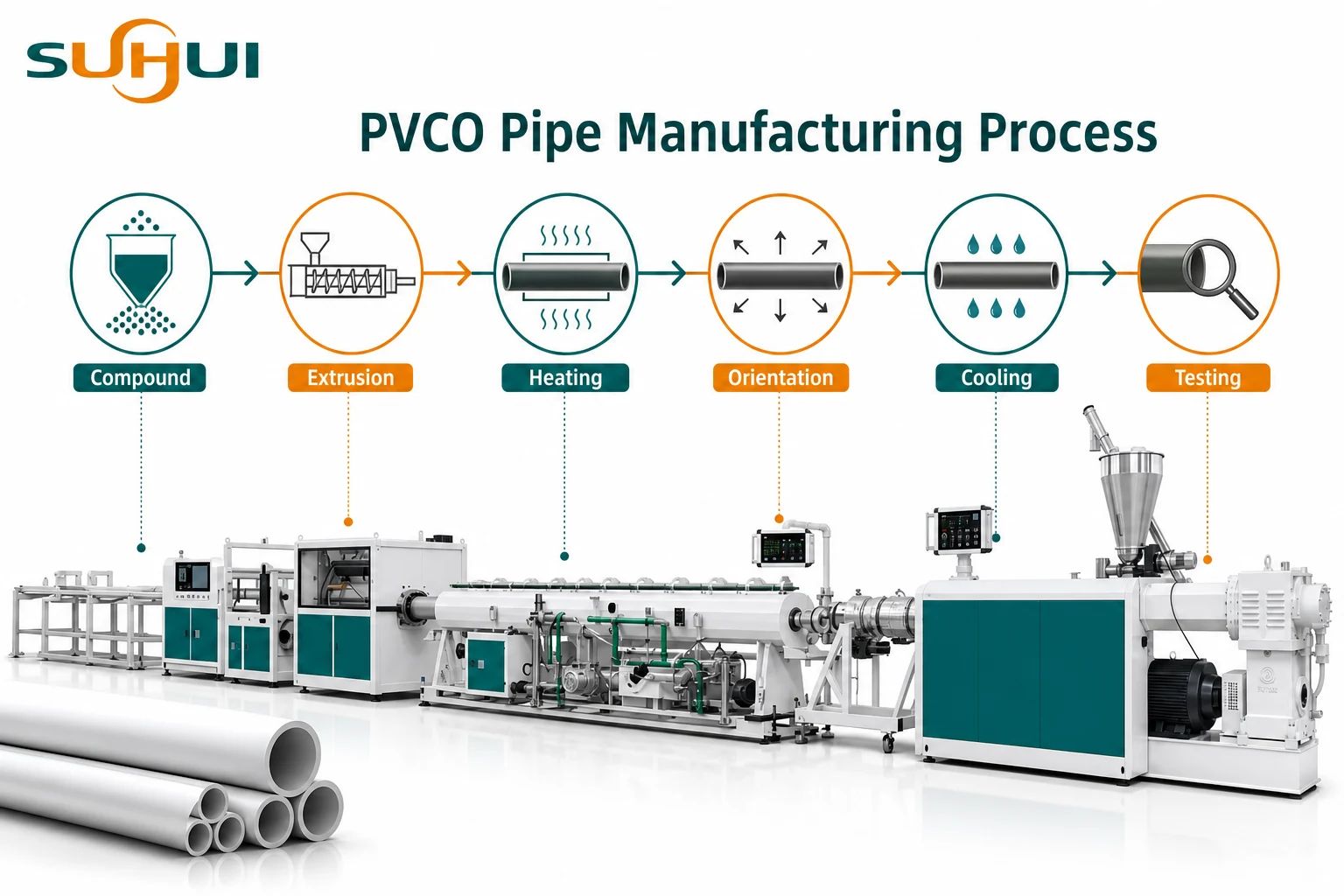 PVCO pipe manufacturing starts with PVC extrusion and adds controlled heating, molecular orientation, cooling and testing.
Key Benefits of PVCO Pipes
High Strength-to-Weight Ratio
PVCO pipes are valued because they can deliver strong pressure performance with a relatively lightweight structure. This can reduce handling effort, transportation load, and installation difficulty compared with heavier pipe alternatives.
Impact and Crack Resistance
The oriented molecular structure helps improve resistance to impact and crack growth. For buried water supply pipe and pressure networks, this is important because pipes can face soil movement, handling impact, pressure cycles, and installation stress.
Hydraulic Efficiency
PVCO pipe usually has a smooth internal surface, which helps reduce friction loss in water transmission. In long pressure pipelines, hydraulic efficiency can affect pump energy consumption and system performance.
Pressure and Surge Performance
Water supply systems may experience pressure changes, surge events, and water hammer. PVCO pipe is designed for pressure applications and can be selected for municipal water mains, irrigation pressure systems, and distribution networks when it meets the required standard and pressure class.
Corrosion Resistance
Like many plastic pipe types, PVCO does not corrode like metal pipe. This makes it useful in water distribution environments where corrosion, scale formation, or internal surface degradation would affect service life.
Common Applications of PVCO Pipe
PVCO pipe is mainly used in pressure water applications rather than general chemical piping. Typical applications include:
- Municipal water supply: pressure water mains, distribution pipelines, and utility infrastructure.
- Irrigation systems: agricultural water transfer, main lines, and pressurized irrigation networks.
- Reclaimed water: non-potable water distribution where pressure performance is required.
- Pressure sewer systems: selected sewer pressure applications depending on local standards and project requirements.
- Infrastructure replacement: projects seeking lighter plastic pressure pipe alternatives to older metal or conventional pipe systems.
If the application is hot water, aggressive chemicals, solvents, or high-temperature industrial fluids, PVCO may not be the right first comparison. In those cases, CPVC pipe, PP pipe, PE pipe, PVDF pipe, or other industrial plastic pipe materials should be evaluated based on chemical compatibility and operating temperature.
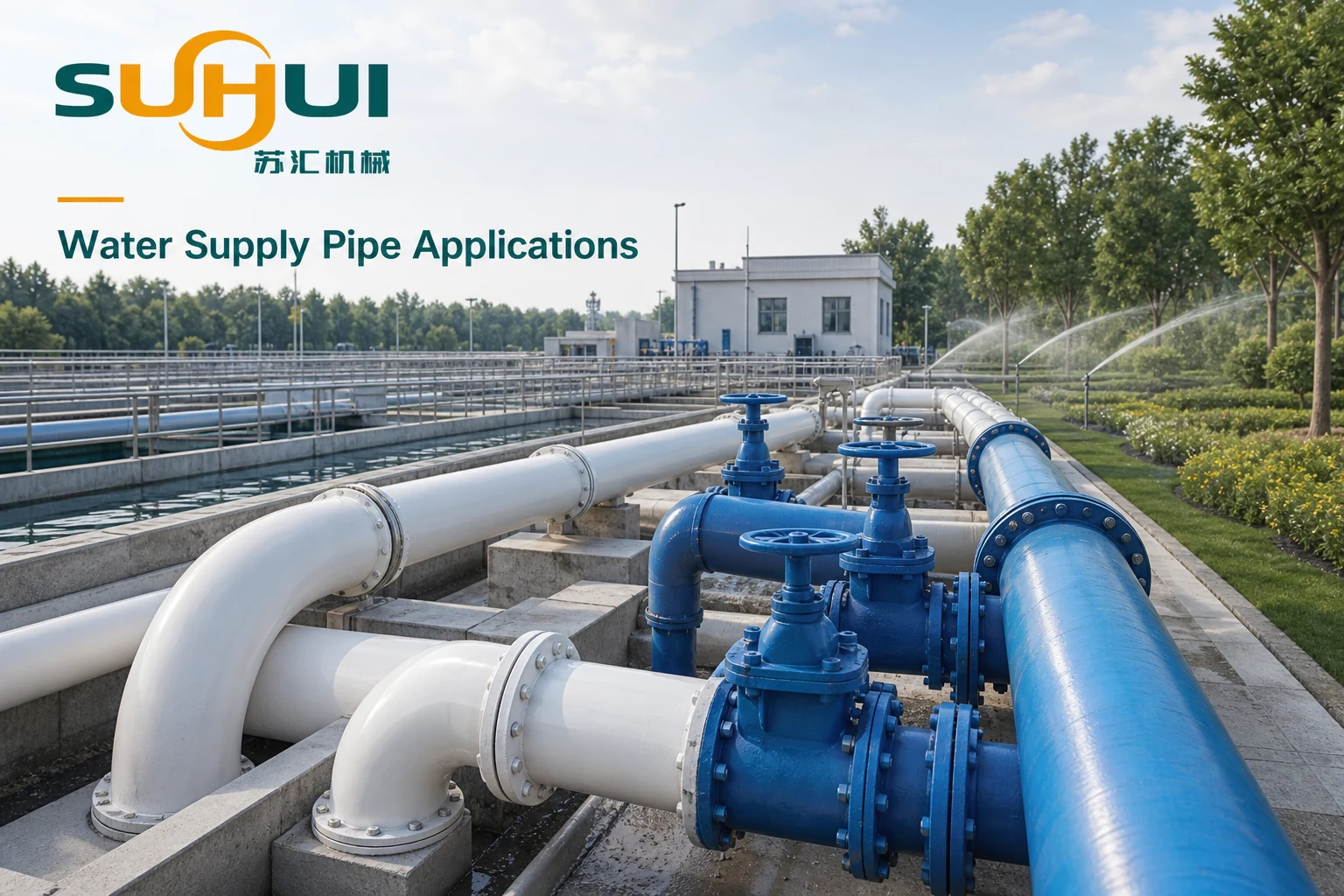 PVCO pipe is mainly discussed in pressure water applications such as municipal water supply, reclaimed water and irrigation networks.
What Are the Main Types of Plastic Pipes?
Because PVCO is only one category, many buyers begin with broader searches such as types of plastic pipes, plastic pipe types, or PVC pipe types. The following overview helps place PVCO in the correct context.
| Plastic Pipe Type | Main Use | Why Buyers Choose It |
|---|---|---|
| PVC pipe | Water supply, drainage, irrigation, conduit | Rigid, economical, widely available, stable extrusion process |
| PVCO / PVC-O pipe | Pressure water supply, irrigation, municipal pipelines | High pressure performance, lightweight structure, impact resistance |
| HDPE pipe | Water, gas, mining, drainage, industrial transfer | Flexible, fusion weldable, impact resistant, corrosion resistant |
| PPR pipe | Hot and cold water supply in buildings | Heat resistance, clean water applications, stable plumbing performance |
| CPVC pipe | Hot water, industrial piping, fire sprinkler systems | Better heat and chemical resistance than standard PVC |
| PP / PE industrial pipe | Chemical transfer, ventilation, industrial fluid handling | Chemical resistance and processing flexibility depending on grade |
For pipe manufacturers, these material differences affect not only the finished pipe application but also the extrusion equipment. A PVC pipe extrusion line, HDPE pipe extrusion line, and PPR pipe extrusion line use different screw designs, temperature settings, calibration methods, cooling lengths, haul-off systems, and cutting requirements.
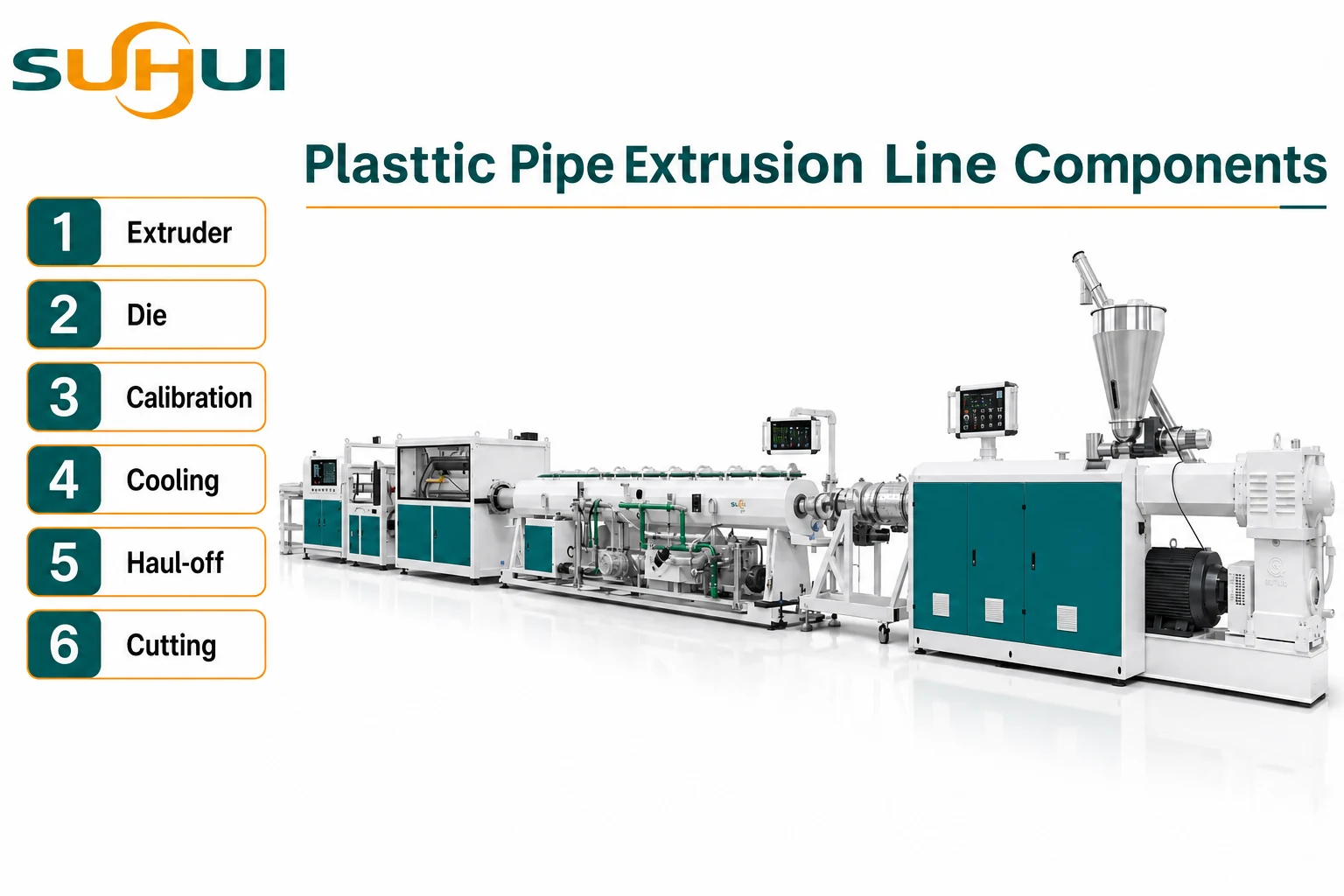 A standard plastic pipe extrusion line includes the extruder, die, vacuum calibration, cooling, haul-off, cutting and control systems.
How Plastic Pipe Extrusion Equipment Relates to PVCO Pipe
PVCO production cannot be reduced to ordinary PVC extrusion. However, extrusion is still the foundation of the process. If the initial pipe preform is unstable, the later orientation stage cannot fully correct problems such as uneven wall thickness, poor melt quality, dimensional drift, surface defects, or inconsistent cooling.
A stable plastic pipe extrusion line supports pipe quality through:
- consistent material feeding and plasticizing;
- accurate temperature control across extruder zones and die head;
- proper pipe die design for wall thickness and melt flow balance;
- vacuum calibration for diameter and roundness control;
- sufficient cooling length for dimensional stability;
- stable haul-off speed to prevent wall thickness fluctuation;
- accurate cutting and downstream handling.
For manufacturers that produce standard PVC, HDPE, or PPR pipe, the goal is usually to build a reliable extrusion line first. For PVCO pipe, the manufacturer must then evaluate whether dedicated orientation technology, pressure standards, testing systems, and application demand justify the additional investment.
Should a Pipe Manufacturer Produce PVCO Pipe?
PVCO pipe can be attractive in water infrastructure markets, but it is not automatically the right direction for every pipe manufacturer. Before investing in PVCO, manufacturers should evaluate the local demand for pressure water pipe, municipal standards, certification requirements, pipe diameter range, expected production volume, raw material availability, and competition from PVC, HDPE, and ductile iron pipe.
For many manufacturers, standard PVC pipe, HDPE pipe, and PPR pipe production may be a more practical starting point because the equipment is more common and the market applications are broader. PVCO becomes more relevant when the target market specifically demands lightweight high-pressure water pipe and when the manufacturer can support the required testing, quality control, and certification process.
SUHUI can support buyers in evaluating standard plastic pipe extrusion line configuration for PVC, HDPE, PPR, and related pipe production. If your project involves ordinary PVC pipe, HDPE water pipe, PPR pipe, or plastic pipe for water supply, the right extrusion line setup should be selected according to material, pipe diameter, wall thickness, output capacity, pressure class, cooling length, workshop layout, and automation requirements.
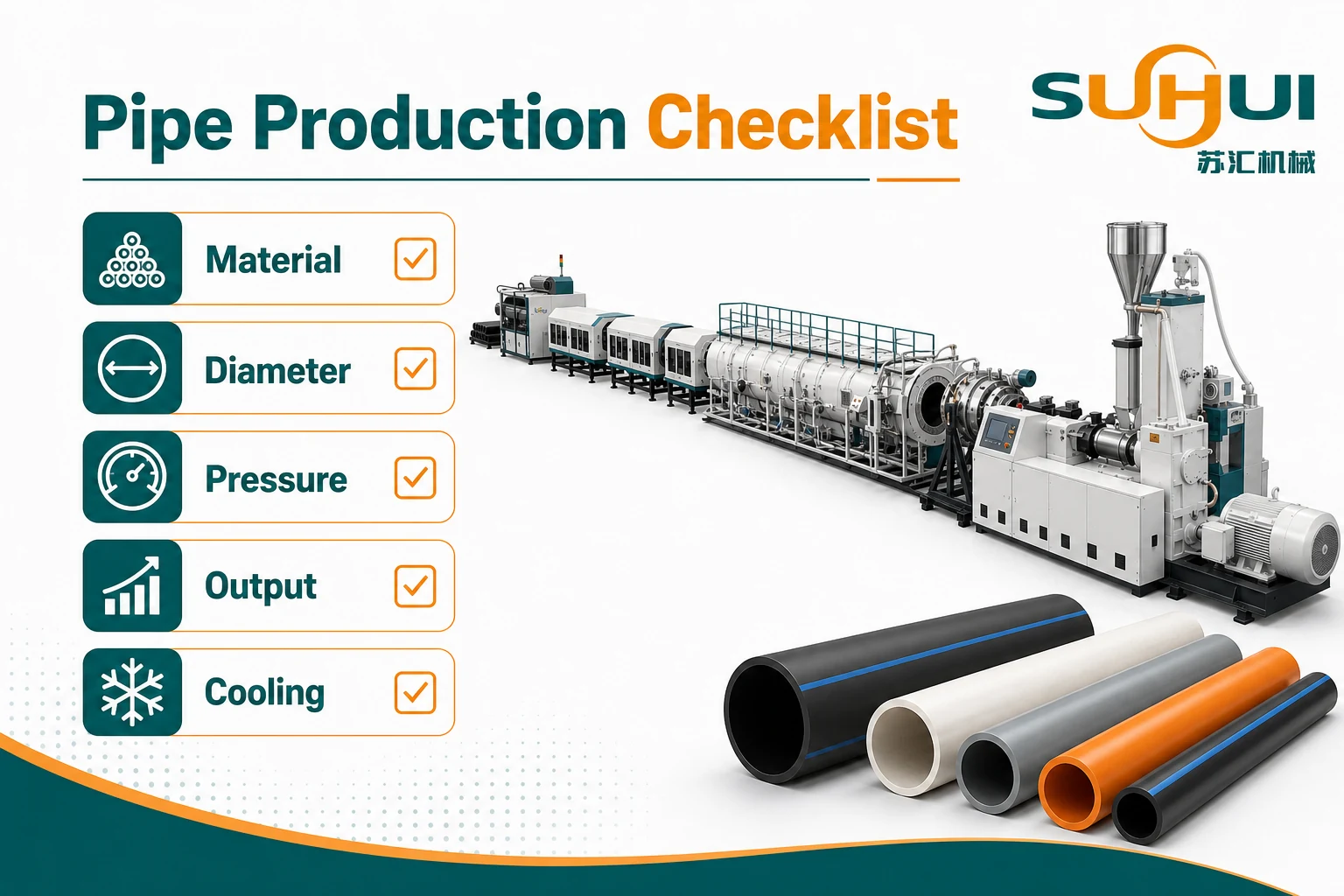 Before choosing plastic pipe production equipment, confirm material, diameter, pressure class, output target, cooling length and downstream layout.
Related Video: Plastic Pipe Extrusion Line in Operation
The following SUHUI video shows a PVC pipe extrusion line in operation. While PVCO pipe requires an additional molecular orientation process, the video helps explain the basic extrusion, forming, calibration, cooling and downstream handling stages that support plastic pressure pipe production.
FAQ About PVCO Pipe and Plastic Pipe Manufacturing
What does PVCO pipe mean?
PVCO pipe means molecularly oriented PVC pipe. It is also called PVC-O pipe or oriented PVC pipe. The pipe is made by orienting PVC molecules after extrusion to improve pressure performance, impact resistance, and strength-to-weight ratio.
Is PVCO the same as PVC pipe?
No. PVCO uses PVC as the base material, but it goes through an additional orientation process. Standard PVC pipe is extruded and cooled, while PVCO pipe is extruded and then stretched under controlled conditions to create a stronger oriented molecular structure.
What is PVCO pipe used for?
PVCO pipe is mainly used for pressure water applications such as municipal water supply, irrigation mains, reclaimed water, and some pressure sewer systems. It is not mainly a chemical pipe; chemical applications should be evaluated with CPVC, PP, PE, PVDF, or other materials depending on the fluid.
What is the difference between PVCO pipe and HDPE pipe?
PVCO pipe is a rigid oriented PVC pressure pipe, while HDPE pipe is a flexible polyethylene pipe that can be joined by heat fusion. PVCO is often selected for lightweight pressure water mains, while HDPE is widely used for water, gas, mining, drainage, and industrial transfer systems.
Can a standard PVC pipe extrusion line make PVCO pipe?
A standard PVC pipe extrusion line can produce the initial PVC pipe or preform, but true PVCO pipe requires an additional molecular orientation process. Without the orientation stage, the product is standard PVC pipe rather than PVC-O pipe.
Which plastic pipe is used for water supply?
Common plastic pipes for water supply include PVC pipe, HDPE pipe, PPR pipe, and PVCO pipe. The best choice depends on pressure, temperature, installation method, local standards, pipe diameter, and whether the system is for municipal water, building plumbing, irrigation, or industrial water transfer.
How do I choose equipment for plastic pipe production?
Start with the target material and application. PVC, HDPE, PPR, and PVCO pipes require different processing conditions. For standard pipe production, evaluate extruder type, pipe die, vacuum calibration, cooling, haul-off, cutting, automation, and output capacity. For PVCO pipe, also evaluate orientation equipment and pressure testing requirements.
Conclusion
PVCO pipe is a specialized PVC-O pressure pipe designed for water supply and infrastructure applications. Its value comes from molecular orientation, not simply from being another PVC pipe type. Compared with standard PVC pipe, it offers a stronger lightweight structure and improved performance for pressure water systems. Compared with HDPE, PPR, and CPVC, it serves a more specific role in plastic pressure pipe applications.
For pipe manufacturers, the most important point is to match the product goal with the right production process. Standard PVC, HDPE, and PPR pipe production can be handled through suitable plastic pipe extrusion line configurations. PVCO pipe production requires extra orientation technology and stricter process control. If you are planning a plastic pipe production project, SUHUI can help evaluate extrusion line configuration for PVC, HDPE, PPR, and related pipe applications. Contact SUHUI to discuss material, pipe size, output capacity, and line layout requirements.
Have a Material You Need to Process?
Send the polymer, its form and your target output. We will come back with a line configuration and a realistic budget range.