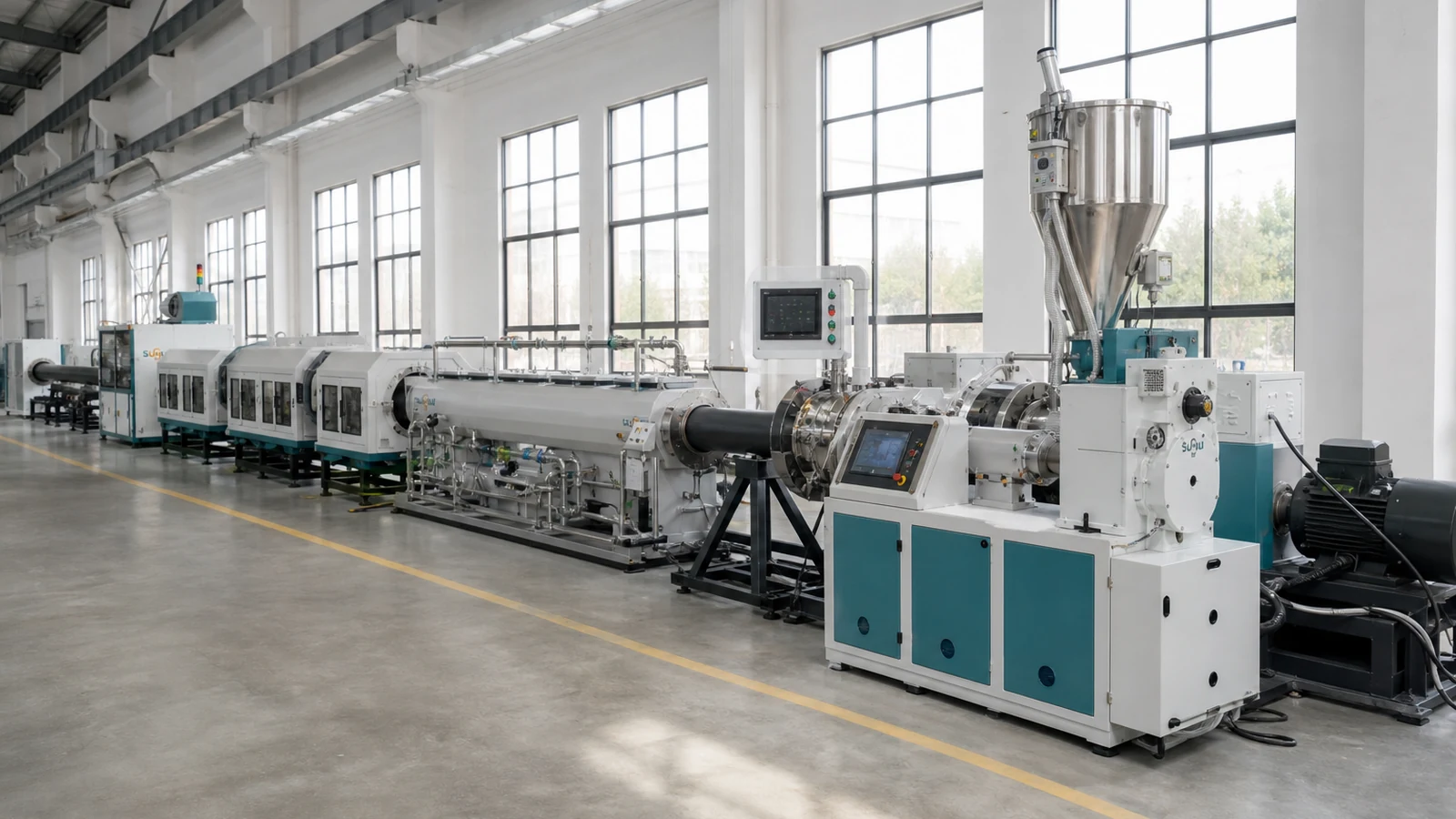
A plastic pipe extrusion machine is a production line of eight units — feeding, extruder, die head, vacuum calibration, cooling, haul-off, cutting and stacking — that forms HDPE, PPR or PVC pipe continuously from 16 to 800 mm diameter.
A plastic pipe extrusion machine is never one machine. A working pipe production line is eight units in a fixed sequence, and the quotation you compare is really a bill of eight decisions — extruder type, die head, calibration, cooling length, haul-off capacity, cutting method, downstream handling and control system. SUHUI builds these lines for HDPE, PPR and PVC pipe used in water supply, gas, drainage, plumbing and industrial service. Two inputs set almost everything: pipe material and diameter range. Material decides the extruder — a conical twin screw for PVC dry blend, a single screw with a grooved feed for HDPE and PPR. Diameter decides the physical size of every unit after the die, which is why a Φ20–110 mm line and a Φ315–800 mm line share a name but almost no components. As a factory-direct manufacturer we quote the line against your product standard rather than a catalogue model. Pipe plants also generate a steady stream of start-up purge, off-spec lengths and cut-off ends; PVC producers recover that scrap in-house with a PVC granulating pelletizing line instead of selling it as waste. Comparing pipe against profile or straw production? The plastic extrusion machine overview sets the three side by side.
Machine Range
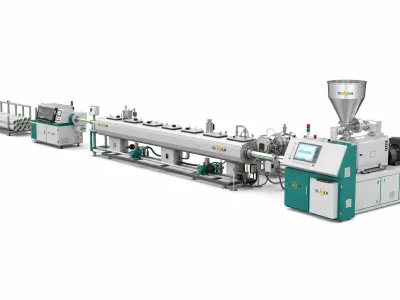
The SUHUI PPR pipe extrusion line produces single-layer and 3-5 layer PPR pipes for hot and cold water supply, heating systems, building plumbing and industrial fluid transport. Configurations support Φ20-250...
Read More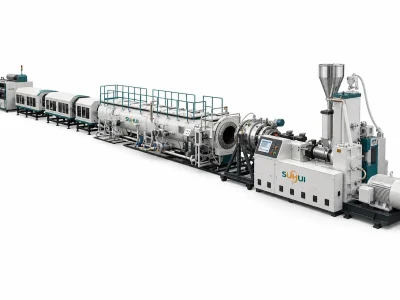
The SUHUI HDPE pipe extrusion line produces high-density polyethylene pipes for water supply, gas distribution, sewage, drainage, and industrial pipelines. The complete system integrates material feeding, single-screw extrusion, die forming,...
Read More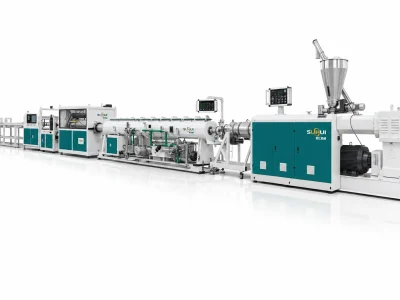
The SUHUI PVC pipe extrusion line produces rigid PVC and UPVC pipes for water supply, drainage, sewage, irrigation, electrical conduit, air conditioning condensate and industrial pipelines. The complete line integrates...
Read MoreSelection Guide
| Material / project situation | Recommended machine | Why it fits |
|---|---|---|
| Water supply, gas, sewage and industrial pipe | HDPE Pipe Extrusion Line | A grooved-feed single screw with high output per rpm, and the longest cooling section of the three because HDPE holds heat. Large diameters need vacuum tanks in series rather than one longer tank, which is the main reason big-bore HDPE lines take so much floor length. |
| Hot and cold water plumbing, multi-layer and fibre-reinforced pipe | PPR Pipe Extrusion Line | Mechanically close to an HDPE line, but usually specified with co-extrusion for a middle glass-fibre or colour layer. If you plan to make PE-RT or PB pipe on the same line, say so at the quotation stage — it changes the screw and the temperature control, not just the recipe. |
| Drainage, electrical conduit and rigid pressure PVC pipe | PVC Pipe Extrusion Line | A conical twin screw is standard because PVC is fed as dry blend powder, not pellets, and needs shear plus a short residence time. Small-diameter conduit is normally run twin-cavity, so one line produces two pipes at once and the economics change completely. |
| You have a drawing or sample but no fixed material yet | Send the specification first | Wall thickness and pressure rating decide material as often as the other way round. Send the standard you are producing to, the diameter range and the target output per hour, and the material choice usually resolves itself. |
Machine and line configuration is decided by these project factors. Confirming them early makes the recommendation faster and more accurate.
Send your project factorsThe three share a process and very little hardware. These are the differences that change the quotation rather than the brochure.
Line type
Extruder
HDPEGrooved-feed single screw, high output per rpm.
PPRSingle screw, often with a co-extruder for the middle layer.
PVCConical twin screw, because the feed is dry blend powder.
Typical use
HDPEWater mains, gas, sewage, cable duct, industrial service.
PPRHot and cold plumbing inside buildings.
PVCDrainage, electrical conduit, rigid pressure pipe.
Diameter range
HDPEΦ20–800 mm, coiled below Φ110 mm.
PPRΦ20–800 mm, though most demand sits under Φ160 mm.
PVCΦ16–630 mm, twin-cavity below Φ40 mm.
Cooling demand
HDPEHighest. HDPE holds heat, so the tank series is long.
PPRHigh, and uneven across layers on co-extruded pipe.
PVCLowest of the three at the same wall thickness.
Watch for
HDPEFloor length. Large-bore lines need tanks in series, not one long tank.
PPRConfirm at quotation whether PE-RT or PB will run on the same line.
PVCDry blend consistency upstream decides pipe quality downstream.
If you produce more than one of the three, do not assume one line covers them. The extruder is the part that does not transfer. Downstream equipment can sometimes be shared across materials in the same diameter band; the extruder almost never can.
Material-specific configurations are set out on the HDPE pipe extrusion line, PPR pipe extrusion line and PVC pipe extrusion line pages.
Diameter is the single variable that resizes every machine after the die. Output falls as diameter rises, because wall thickness rises with it.
| Diameter band | Typical output | Extruder class | What changes at this size |
|---|---|---|---|
| Φ16–63 mm | 120–250 kg/h | Small | Twin-cavity dies are viable, so one line can run two pipes at once. Coiling replaces cutting on flexible materials. |
| Φ50–160 mm | 250–450 kg/h | Medium | The most common band worldwide. Single-cavity die, cut lengths, tipping table. Everything is standard and lead times are shortest. |
| Φ110–315 mm | 400–700 kg/h | Large | Vacuum tanks go into series and the haul-off gains tracks. Floor length starts to drive the plant layout rather than the other way round. |
| Φ315–800 mm | 600–1,200 kg/h | Extra large | Planetary cutting, multiple cooling tanks, heavy handling. Output per hour is high but metres per minute is low, so wall thickness eats the throughput. |
Read the two right-hand columns together. A line quoted at 1,000 kg/h for Φ630 mm pipe is slower in metres per minute than a 250 kg/h line making Φ32 mm conduit. If your business is priced per metre rather than per kilogram, specify from line speed, not from kg/h.
Lines are normally built to cover two adjacent bands. Asking one line to span Φ20–630 mm means tooling for every size in between and a compromise on all of them.
This is what you are actually buying. Each unit is quoted separately and each one can be the bottleneck.
When you compare two quotations, compare them unit by unit. A cheaper line is usually cheaper at the far end — a shorter cooling section, fewer haul-off tracks or manual stacking. Those three are exactly where a line loses the output it was sold on.
Diameter range moves the price more than any other variable, because it resizes seven of the eight units at once.
PVC line
$25,000–85,000
HDPE / PPR line
$35,000–150,000
Factory-direct FOB for budgeting. Excludes sea freight, duties and on-site installation.
| PVC pipe line by diameter | Reference FOB | HDPE / PPR pipe line by diameter | Reference FOB |
|---|---|---|---|
| Φ16–40 mm (twin-cavity) | $25,000–30,000 | Φ20–110 mm | $35,000–40,000 |
| Φ50–160 mm | $30,000–35,000 | Φ50–250 mm | $40,000–50,000 |
| Φ75–250 mm | $35,000–40,000 | Φ160–450 mm | $65,000–75,000 |
| Φ110–315 mm | $45,000–50,000 | Φ280–630 mm | $85,000–100,000 |
| Φ160–450 mm | $50,000–60,000 | Φ315–800 mm | $90,000–150,000 |
| Φ315–630 mm | $75,000–85,000 | — | PPR is priced in line with HDPE |
Inside a diameter band, three options account for most of the spread: co-extrusion layers, online wall-thickness gauging and the level of automation at the stacking end. None of them changes the pipe you can make; all three change how many operators the line needs and how much scrap it produces.
Cross-category ranges for profile and straw lines are on the plastic extrusion machine overview. A firm quotation is issued after reviewing your product standard, output target and plant conditions.
Before You Ask
To receive a more accurate recommendation, send your material type, material form, contamination level, required capacity, target output, plant space, local voltage and destination country. Material photos or videos are also helpful.
Tell us your material and target output. We reply with practical recommendations, not generic sales replies.
Send SUHUI your material type, target capacity, final output, plant space, voltage and destination country. Material photos or videos help our team recommend a suitable machine or complete line configuration.