Ask how plants recycle plastic bottles and most answers give you a list of machines in sequence. That is a description of a factory, not an explanation of a process. It tells you what happens next without telling you why anything happens at all.
A more useful way to read a bottle washing line is backwards, from the contamination. A used bottle is PET plus about seven things that are not PET, and every stage exists to take one of them off. Once you know which stage owns which contaminant, a quality problem becomes traceable to a specific stage rather than to the line in general.
What follows covers what is being removed at each point, what controls whether the removal works, and what the failure looks like when it does not. It stops at dried flake. The equipment and capacity side of the same subject is in our guide to the PET bottle recycling machine, and the acceptance specification the flake is sold against is in what are PET flakes.
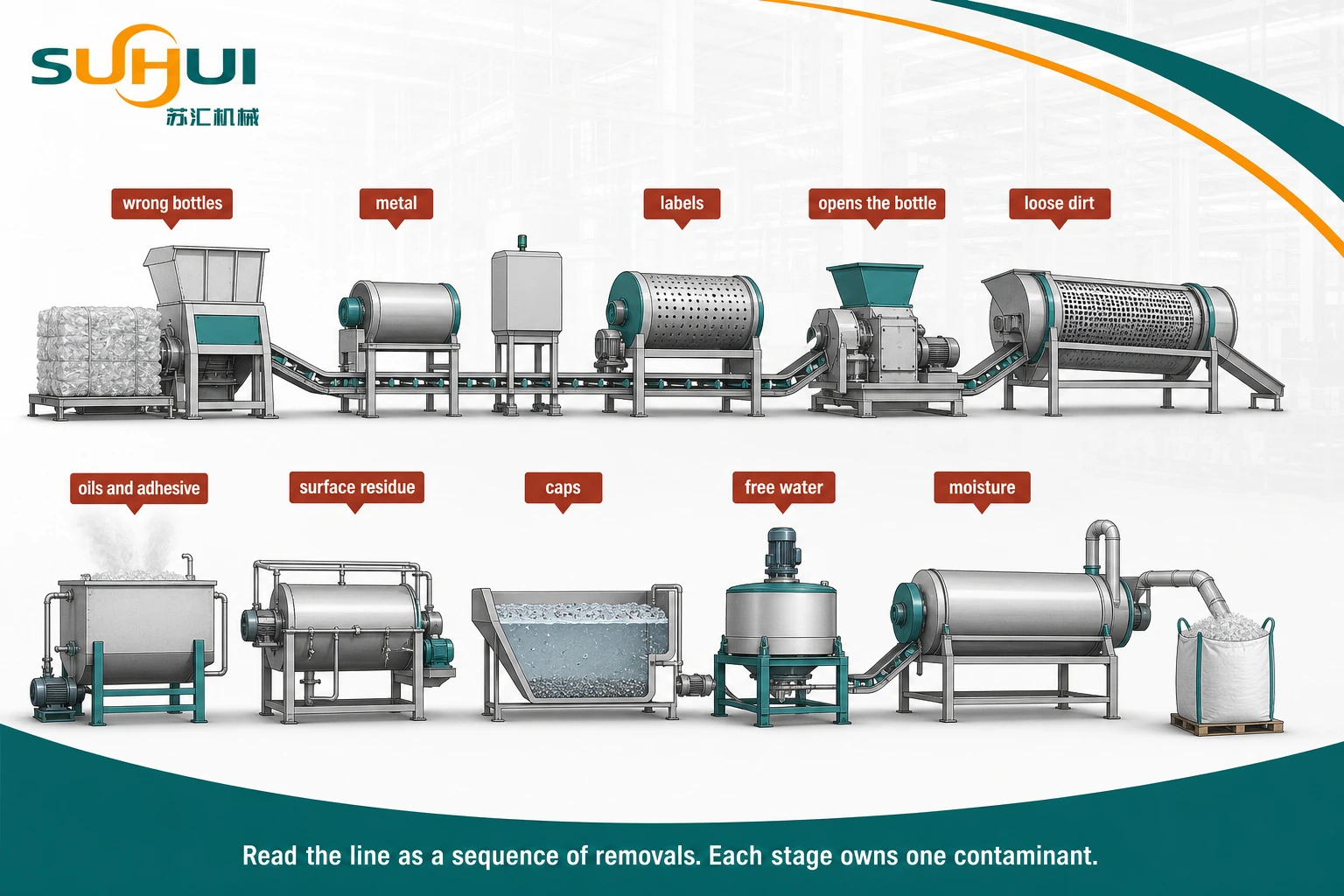
Read the line as a sequence of removals. Each stage owns one contaminant.
What Is Actually Attached to a Bottle
A used beverage bottle arrives carrying seven things that are not PET. Label, adhesive, cap, tamper ring, residual drink, road dirt, and whichever wrong bottles travelled in the same bale. Every stage of a washing line exists to remove one of them, and the order is not arbitrary.
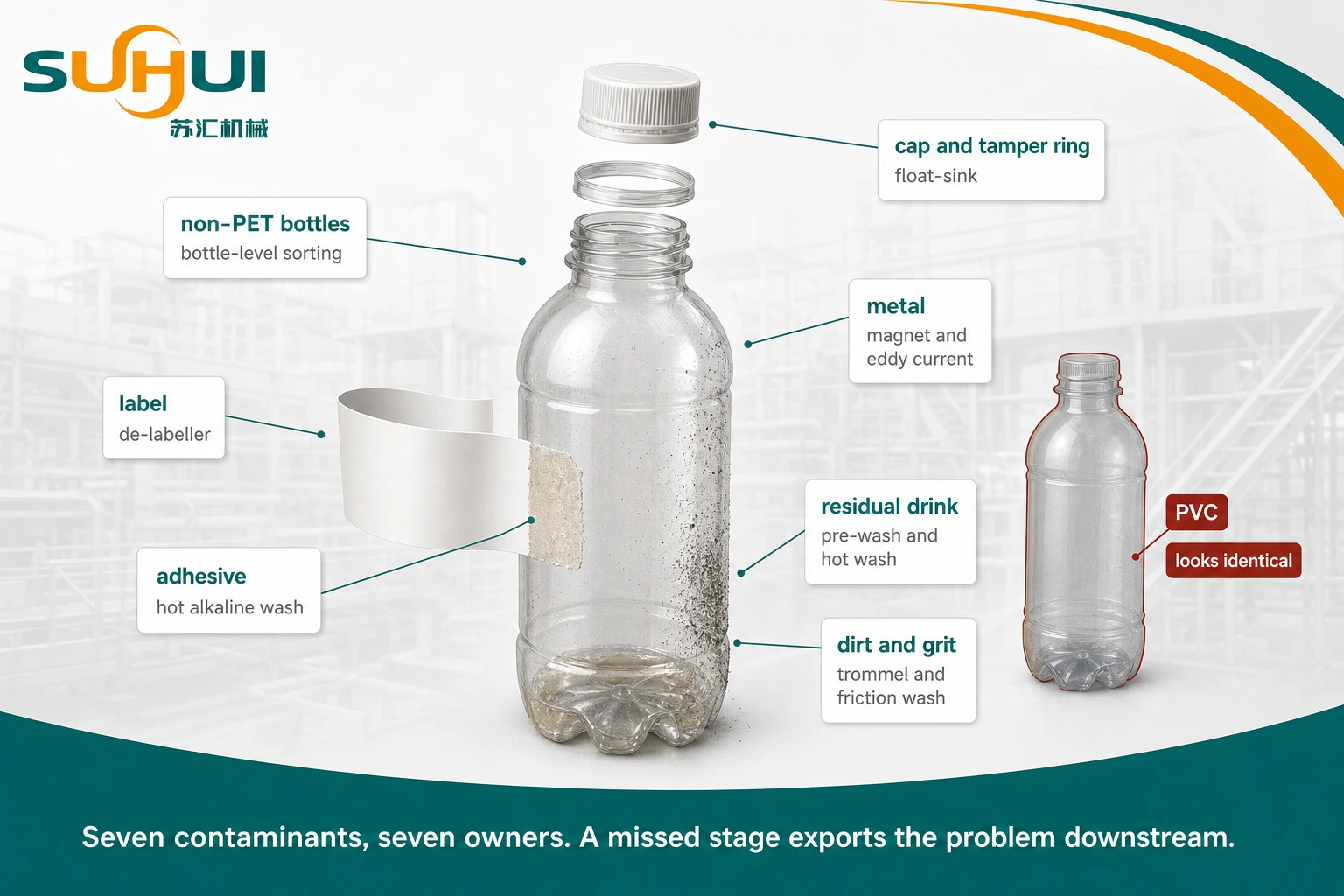
Seven contaminants, seven owners. A stage that misses its own contaminant exports the problem downstream.
| What is on the bottle | What removes it | What controls whether it works | What it looks like if it survives |
|---|---|---|---|
| Non-PET bottles, mainly PVC | Bottle-level sorting, before anything is cut | How evenly the bale is spread across the belt | Yellowing and black specks in the customer’s melt, weeks later |
| Metal — aluminium closures, foil seals, tramp steel | Magnetic drum for ferrous, eddy current for non-ferrous | Burden depth over the separator, which must stay thin | Damaged crusher blades and destroyed melt filters downstream |
| Labels, paper and full-body sleeves | Mechanical de-labeller before crushing, then air separation after | Whether the label is a wrap or a shrink sleeve, and how tightly it grips | Label fragments embedded among the flake, and fibre load in the wash water |
| Label adhesive | Hot alkaline wash | Temperature, caustic concentration, residence time, mechanical energy | Tacky flake that agglomerates in the dryer and gels in the melt |
| Caps and tamper rings, PP or HDPE | Float-sink separation, after crushing | Water density stability and whether flake is properly wetted | Polyolefin inclusions that will not melt with the PET |
| Residual drink, sugars, oils, mould | Pre-wash for the loose fraction, hot alkaline wash for the rest | How long the bales sat before processing, and wash water cleanliness | Odour that survives into the finished product and cannot be washed out later |
| Road dirt, sand and grit | Trommel and pre-wash, then friction washing | Screen aperture and water flow through the pre-wash | Abrasive wear through the whole line and grit in the melt filter |
The fourth column is the one worth reading twice. Almost none of these failures show up where they are caused — a PVC bottle missed at the sorting belt causes no visible problem for the next nine stages, then appears as black specks in a customer’s extruded sheet. That delay is why washing line problems get misattributed so consistently, and why the useful diagnostic question is never “what is wrong with the line” but “which contaminant is this, and which stage owned it”.
Why the Bottle Is Sorted Before It Is Cut
Removing a PVC bottle whole takes one ejection. Removing the same material after crushing means finding several hundred fragments dispersed through tonnes of correct flake, which nothing downstream can do. Sorting position is therefore an economic decision before it is a technical one.
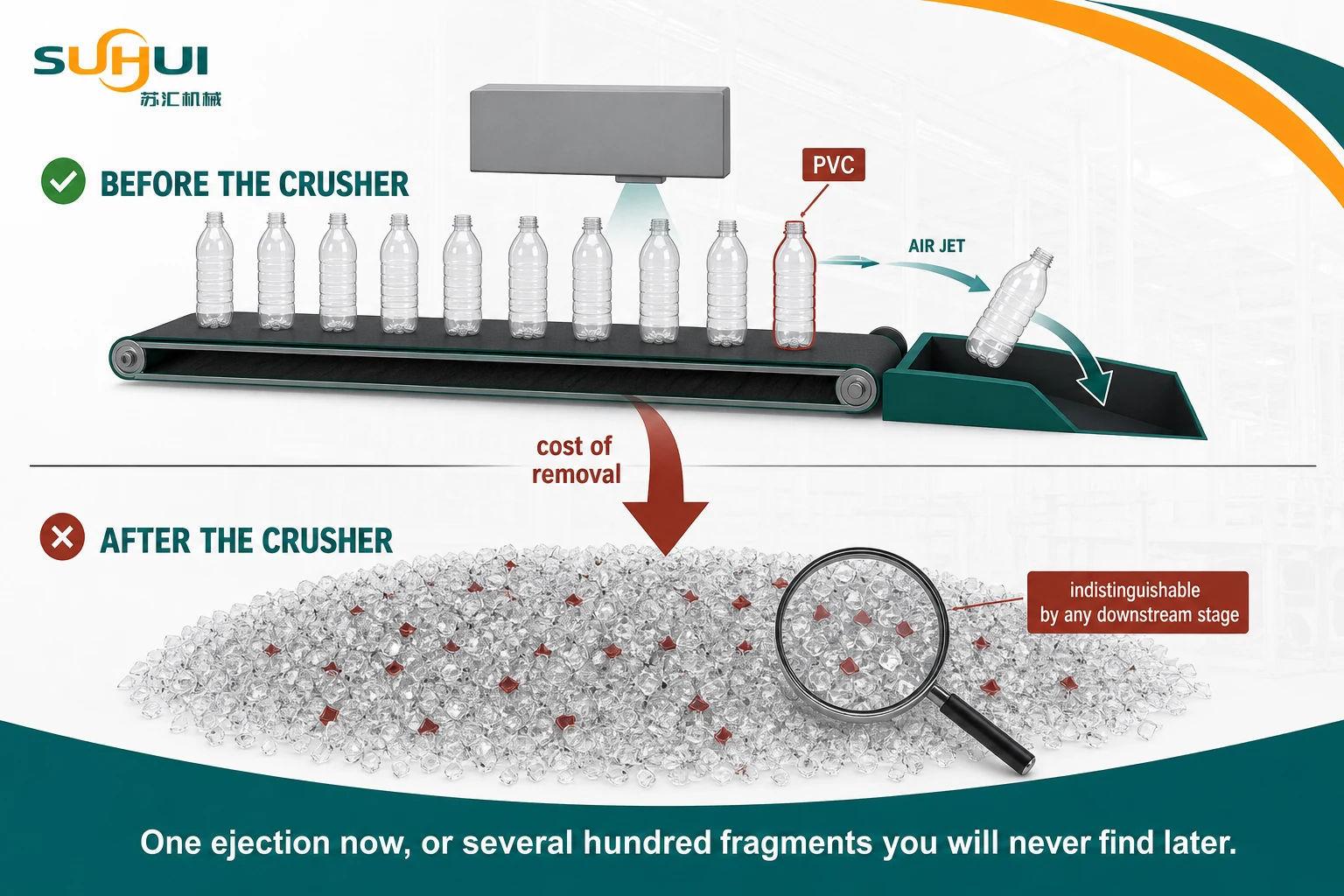
One ejection now, or several hundred fragments you will never find later.
The first machine simply opens the bale, which sounds trivial and is not. A bale breaker that discharges unevenly sends surges down the belt, and a surge is where sorting accuracy collapses — items ride on top of each other, the ones underneath are never seen, and the crusher downstream is alternately starved and flooded. Feed evenness here sets a ceiling on the accuracy of everything after it. Ferrous metal then leaves on a magnetic drum and non-ferrous on an eddy current separator, both of which need a thin, even burden to work.
PVC is the case the whole stage is built around, because it is the only contaminant with no second chance. Its density overlaps PET’s, so the float-sink tank later in the line keeps it with the good material rather than removing it. It decomposes at PET processing temperatures instead of melting, releasing acidic degradation products that discolour the batch. And a PVC bottle looks like a PET bottle. The one point at which they can be told apart cheaply is while both are still whole objects on a belt, which is why the PET bottle sorting washing line specification places optical sorting at bottle level and again at flake level across its 500 to 3,000 kg/h range.
Flake Size Is the Decision Everything Downstream Inherits
Crushing to 10 to 15 millimetres is not a rounding choice. It is the point where washing chemistry gains enough surface area to work, before the fraction lost as fines through the screens becomes unacceptable, and it sets how the material behaves in every stage after it.
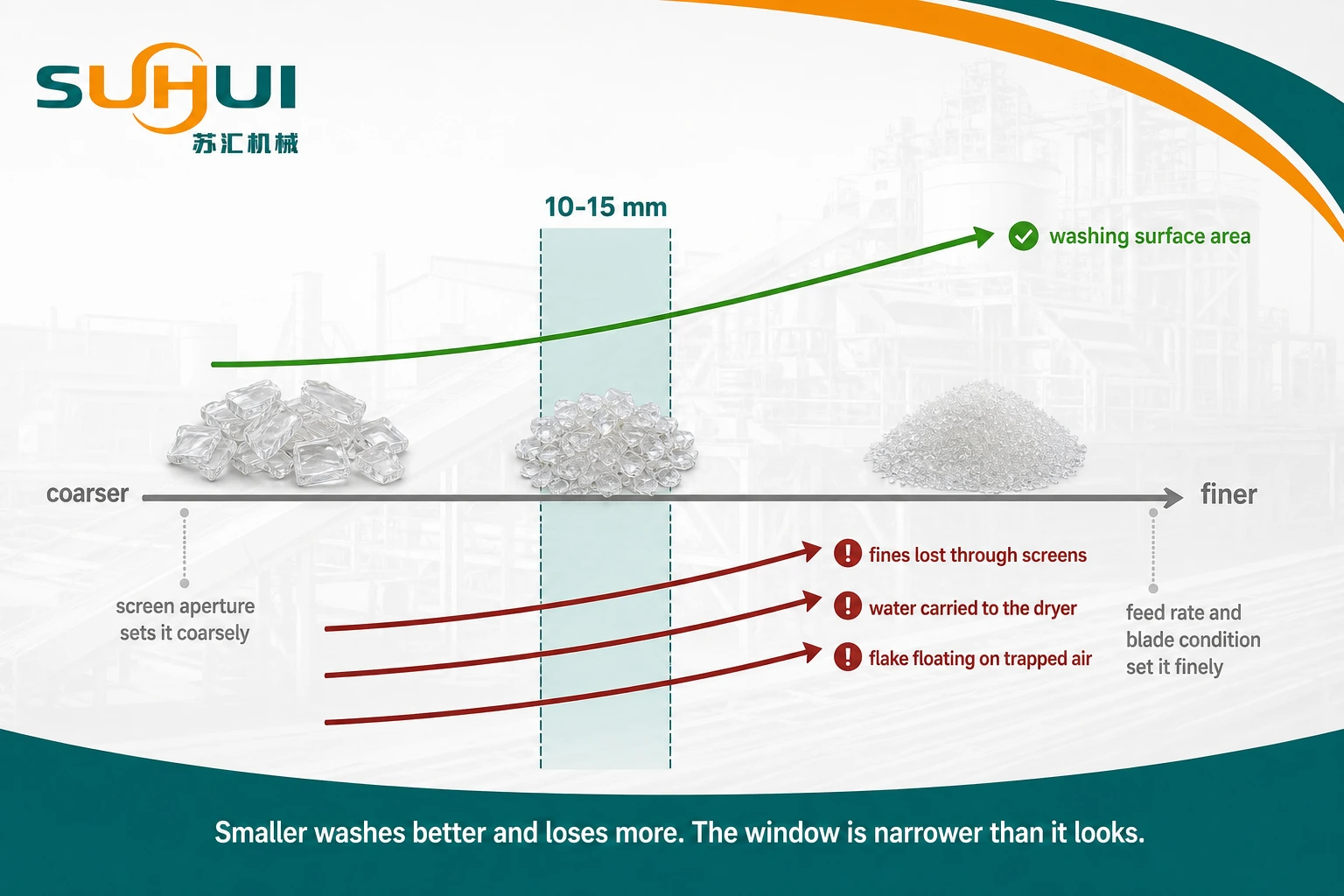
Smaller washes better and loses more. The window is narrower than it looks.
A whole bottle cannot be washed, for a reason obvious once stated — a sealed container traps air and floats regardless of what it is made of, and the inside surface never meets the wash solution. Cutting the bottle open is what makes both washing and density separation physically possible, which is why crushing sits between them.
Four things move in opposite directions as flake gets smaller. Surface area per kilogram rises, so wash chemistry reaches more of the material. Fines generation also rises, and fines leave through the dewatering screens as yield loss rather than product. Small flake carries proportionally more surface water into the dryer. And very small flake behaves badly in the float-sink tank, where a fragment with an attached air bubble floats whether it is PET or not.
Screen aperture is the coarse control on where you land in that window; feed rate is the fine one, and it is the one people get wrong. Overfeeding keeps material in the cutting chamber longer than intended, which produces fines rather than throughput. A dull blade does the same, tearing rather than cutting and shedding fines through the rest of the line. Configuration detail sits under plastic crusher.
One thing deliberately does not happen here. Caps and tamper rings go through the crusher still attached, because removing a tamper ring intact is slow, removing it as flake in water is trivial, and a PP cap survives a PET crusher without trouble. Deferring that removal is the correct decision, and it is the exception to the general rule about taking things off while they are whole.
What Hot Caustic Washing Actually Dissolves
Hot alkaline washing at 80 to 90 degrees does two chemical jobs. It saponifies fats and oils into water-soluble soaps, and it breaks down the label adhesives that cold water only softens. Four variables control it, and within limits each one can substitute for another.
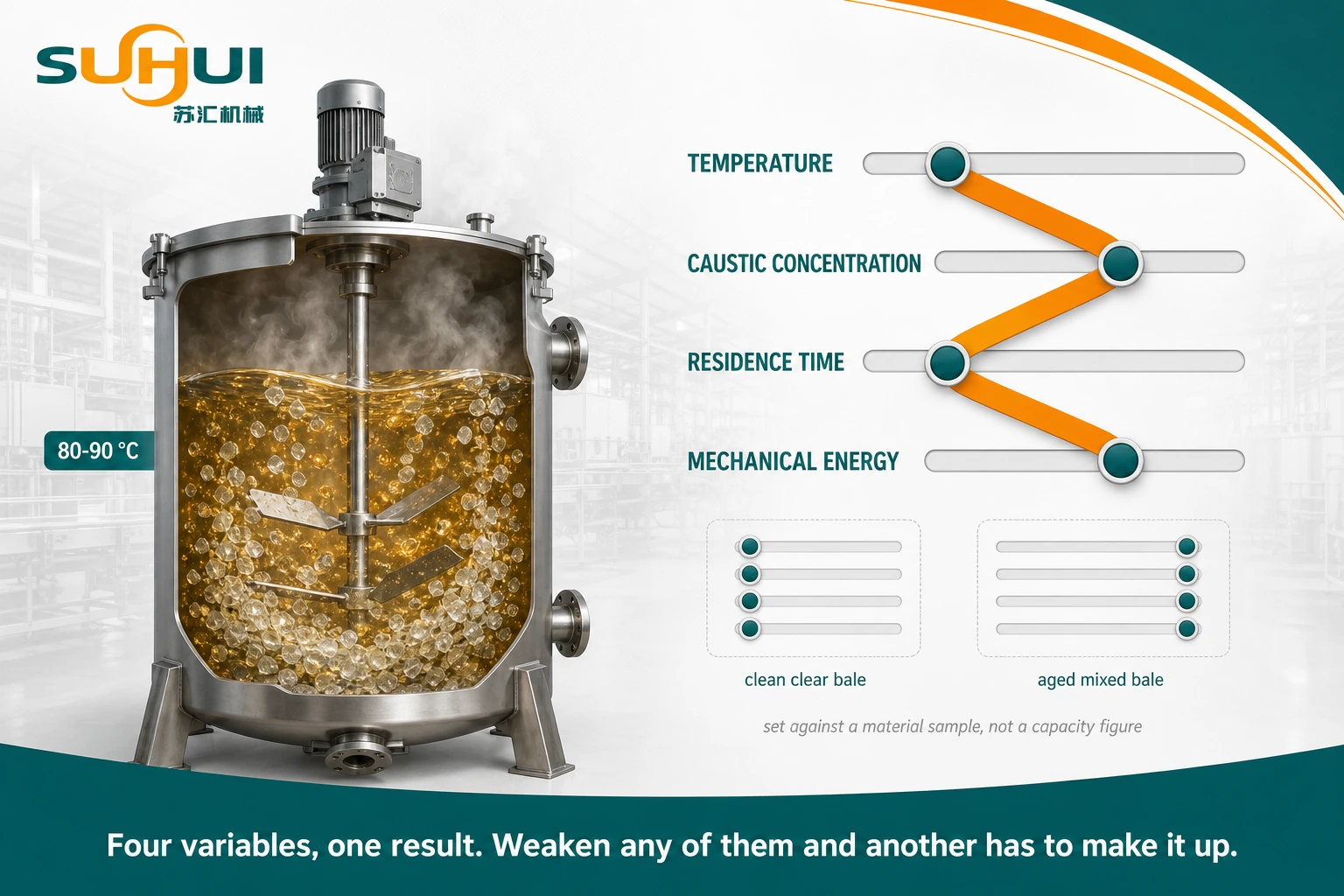
Four variables, one result. Weaken any of them and one of the others has to make it up.
| Variable | What raising it does | What it costs | What happens if it is set too low |
|---|---|---|---|
| Temperature, 80–90°C | Accelerates saponification and softens adhesive faster than anything else on the list | Steam and heat loss, the largest single energy line on the plant | Adhesive survives as tacky residue that only shows up in the dryer |
| Caustic concentration | Drives the reaction that converts fats and oils into removable soaps | Chemical consumption, plus a heavier rinsing and neutralisation duty afterwards | Oil and grease remain, and the flake carries odour into the finished product |
| Residence time | Gives the chemistry time to act on material that arrived heavily contaminated | Tank volume, floor space and the working inventory of hot solution | Contamination is partly loosened rather than removed, so it redeposits in the rinse |
| Mechanical energy | Physically strips loosened material off the flake surface instead of waiting for chemistry | Installed power, wear on rotors and paddles, and generation of fines | Loosened residue rides through with the flake and reports as surface contamination |
That substitution explains why two lines with completely different published settings can both produce acceptable flake. Lightly contaminated clear bale can be run at the bottom of the band with short residence time; mixed post-consumer bale that sat in a yard through a summer needs the top of the band on all four. It is also why chemical consumption on the SUHUI PET line is published as a range rather than a number.
Two mechanical stages sit around the hot tank and get confused with it. Pre-washing ahead of it removes loose dirt, sand and free liquid, so hot solution is not spent on material plain water would have taken. High-speed friction scrubbing after it strips residue the chemistry has already loosened, and has its own control variables, covered under friction washer. Rinsing then removes the caustic itself.
Float-Sink Is a Density Decision and Not a Cleaning One
The tank does one thing. PET at about 1.38 sinks, polypropylene and polyethylene caps float, and the two leave by different routes. It removes nothing that is stuck to a flake, and it cannot remove PVC, because PVC sinks alongside the material you are keeping.
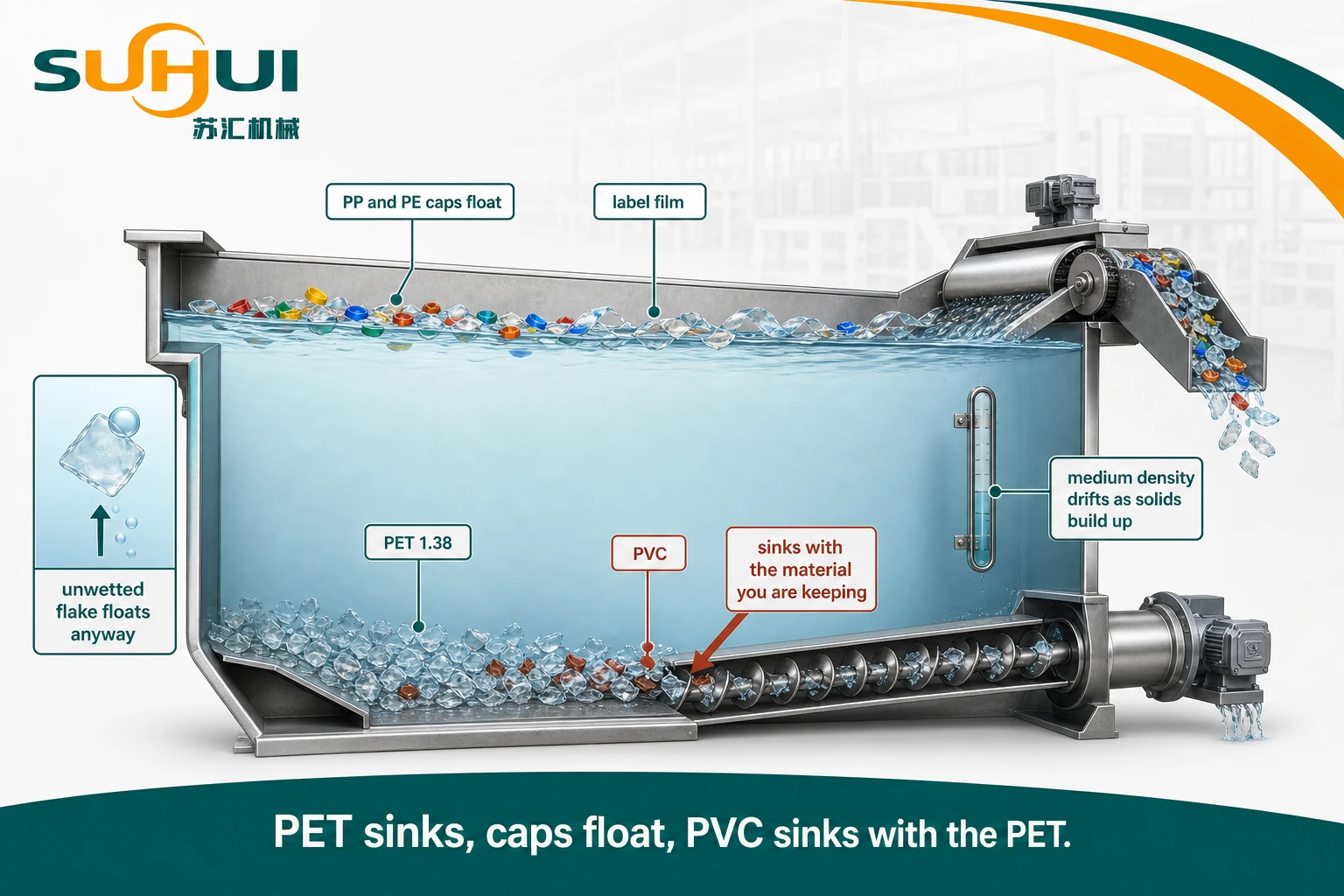
PET sinks, caps float, PVC sinks with the PET. That last one is the whole reason bottle-level sorting exists.
The physics is the simplest on the line and the operating discipline is not. Three conditions have to hold, and each of them drifts during a shift.
Flake has to be wetted. A dry PET fragment entering water carries an air film, and a fragment with attached air floats regardless of density. Agitation, a wetting stage and adequate residence time defeat that; a tank short on any of them sends good PET out with the floating fraction as a silent yield loss.
The water has to stay water. Separation depends on the density of the medium, and process water accumulates dissolved solids, caustic carryover and suspended fines as it recirculates. As the medium gets denser, the margin against the light fraction narrows. Tank water is therefore monitored, bled and made up rather than simply looped — a live control point, not a commissioning setting.
Residence time has to match the flake. Settling takes time proportional to particle size. Push throughput up without adding tank volume and the fine end of the distribution leaves before it has finished sinking.
After the tank the problem becomes light-fraction handling rather than separation. Cap flake, label film and sleeve material come off the surface together and need their own route, and a zig-zag air classifier lifts remaining film out of the sinking fraction where water alone did not. The flake then goes through mechanical dewatering and thermal drying to below 1% moisture — a shipping figure rather than a processing one.
Why Water Is the Real Operating Constraint
A PET line consumes between 0.7 and 4.5 tonnes of water an hour depending on capacity, and almost none of it leaves as effluent on a well-designed plant. It is filtered, adjusted and recirculated, which makes water chemistry a live process variable rather than a utility.
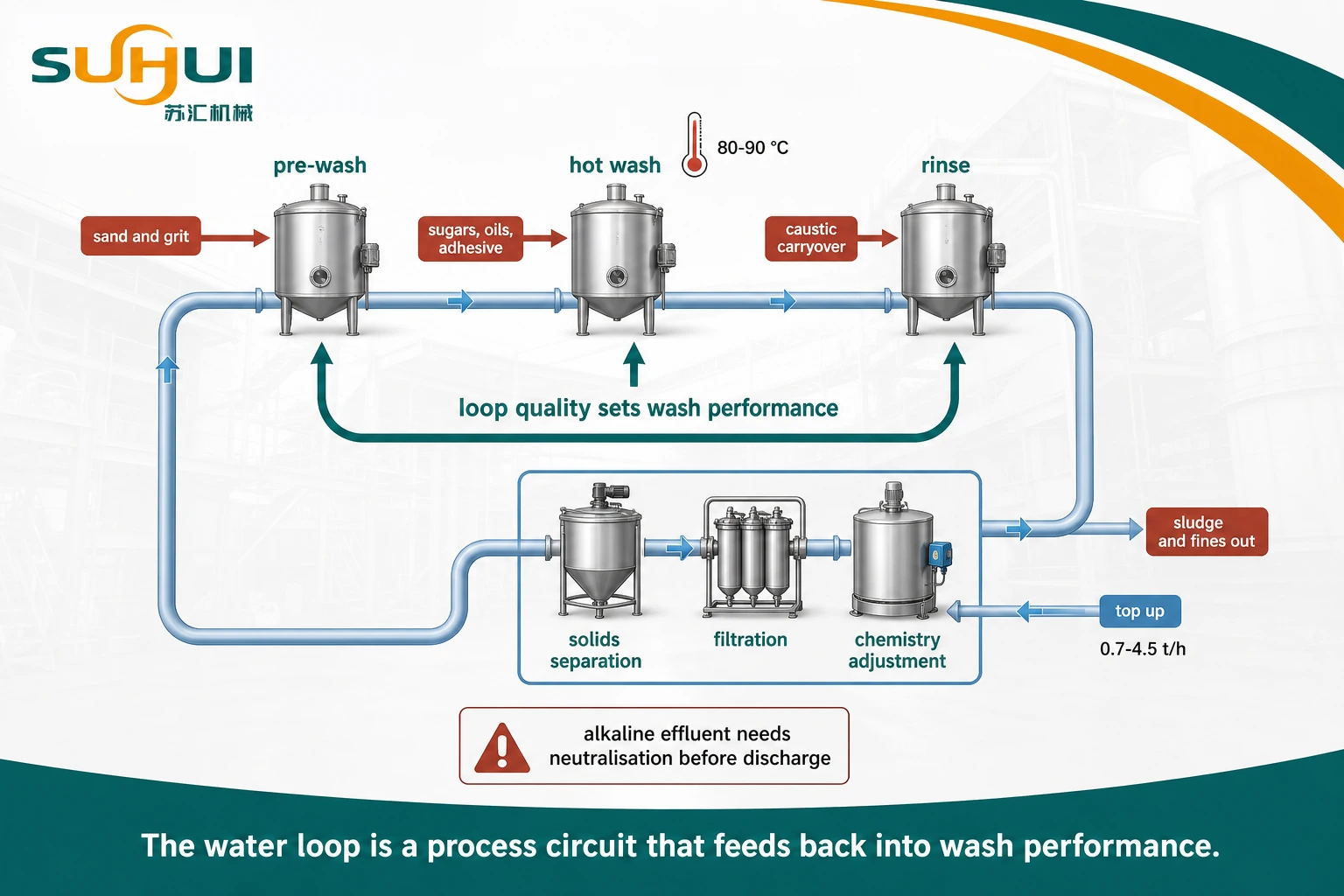
The water loop is a process circuit that feeds back into wash performance, not a service connection.
Follow what the water carries and the reason becomes obvious. It picks up sand and grit at the pre-wash, dissolved sugars and organics through the hot tank, saponified oils as soaps, adhesive residue, paper fibre from labels, and PET fines from every mechanical stage. All of that stays in the loop unless something takes it out, and a circuit without adequate solids removal returns progressively dirtier water to the wash stages — where it redeposits onto the flake exactly what the previous tank removed.
Three consequences follow. Wash performance degrades gradually rather than failing outright, so flake quality drifts down over days in a way that reads as a chemistry problem and is actually a water treatment problem. Heating is the dominant energy cost, and recirculating hot water rather than heating fresh is most of the reason a closed loop pays for itself — the same principle behind the up-to-70-percent reduction in fresh water demand published for the rigid HDPE line. And alkaline, organic-loaded effluent needs neutralisation before discharge in essentially every jurisdiction, so a line specified without that system is not cheaper, it is unpermittable.
Water is also where capacity decisions bite hardest. Doubling throughput roughly doubles the water circulating, the heat load and the solids arriving per hour, and none of those scale by fitting a bigger pump. Across the SUHUI plastic recycling washing line range, water and steam figures are published per capacity band for that reason.
Where a Bale Loses Weight Between Intake and Flake
A tonne of baled bottles does not produce a tonne of flake, and the gap is larger than most first projections allow. Seven separate losses account for it, and only one of them is avoidable by better operation. The rest are decided by what was in the bale.
| Where the weight goes | Which stage it leaves at | Is it avoidable |
|---|---|---|
| Water and residual drink held in the bale on arrival | Bale breaking and pre-wash | No — it was never PET, and it was weighed on the weighbridge |
| Labels, sleeves and paper | De-labelling and air separation | No — determined by packaging design, not by the line |
| Caps, tamper rings and closure liners | Float-sink | No, though the floating fraction has value of its own if kept separate |
| Dirt, sand, grit and general debris | Trommel and pre-wash | No — and higher when bales are stored outdoors before processing |
| Non-PET bottles present in the bale | Bottle-level sorting | No — it is a bale purity question, settled at purchase |
| PET fines below screen aperture | Dewatering screens, and everywhere with a screen | Partly — this is the one line item that crusher setup and blade condition genuinely control |
| Colour-rejected and off-specification flake | Flake-level optical sorting | No — set by the colour mix of the incoming bale |
Two conclusions come out of that table, both commercial rather than technical. Yield is a property of the bale far more than of the equipment, so no supplier can quote it off a specification sheet — the figure exists only once a real load has been through the line. And the single controllable loss is fines, which puts unexpected weight on crusher screen selection, feed rate discipline and blade maintenance. There is a related trap in how capacity is quoted — a line rated at 1,000 kg/h is rated on input, not on flake out.
What a Washing Line Cannot Fix
Washing removes what sits on the surface of a flake. Colour, intrinsic viscosity, absorbed flavour compounds and any PVC that survived bottle-level sorting are all either inside the polymer or chemically indistinguishable from it, and no amount of additional wash capacity reaches them.
| What washing cannot address | Why the wash cannot reach it | Where it is actually decided |
|---|---|---|
| Colour | Pigment is dissolved in the polymer, not deposited on it | Bale purchase, then flake-level optical sorting, which separates rather than removes |
| Intrinsic viscosity | Chain length is a property of the molecule and falls with heat and hydrolysis | Handling discipline, and a solid state polymerization stage where it has to be rebuilt |
| PVC that reached the crusher | It sinks with PET, so the density stage keeps it deliberately | Bottle-level sorting, several stages earlier and for a fraction of the cost |
| Absorbed flavour and odour compounds | They have diffused into the polymer over the life of the container | Bale source selection, and a validated decontamination stage for food-contact routes |
| Full-body shrink sleeves that do not release | The sleeve grips mechanically and may match PET closely in density | Packaging design, before the container is ever filled |
| Metallised and paper-laminated labels | The laminate fragments rather than releasing as a whole label | Packaging design, and de-labelling before the fragments are made |
| Adhesive formulated not to release in alkali | The chemistry the wash relies on simply does not act on it | Packaging design, which is why recyclability guidance targets adhesives specifically |
The last three rows are outside a plant operator’s control entirely, and they are why design-for-recycling guidance exists. The Association of Plastic Recyclers design guidance is written against exactly these failure modes, assessing sleeve material, sleeve coverage, adhesive release and ink migration on whether a standard washing line can deal with them. A bottle that fails those criteria fails on every washing line, not only on a badly specified one.
What that leaves is a defined and fairly narrow job, done well. Dried sorted flake is a traded commodity with a specification behind it, and what happens to it next — which product it can enter, and what quality gate stands in front of each option — is a separate question decided by markets rather than by machinery.
Frequently Asked Questions
How are plastic bottles recycled industrially?
Bales are opened, metal and non-PET bottles are removed while items are whole, labels are stripped, and the bottles are crushed to 10 to 15 millimetre flake. The flake is pre-washed, hot washed in alkaline solution at 80 to 90 degrees, friction scrubbed, separated from floating cap material in a water tank, rinsed, dewatered and dried below 1% moisture.
Why is PVC such a problem in PET bottle recycling?
Because its density overlaps PET, so the float-sink tank keeps it with the good material rather than removing it, and because it decomposes at PET processing temperatures instead of melting. The result is yellowing and black specks. The only cheap place to remove it is at bottle-level sorting, before anything is crushed.
Do labels and caps have to be removed before recycling plastic bottles?
Not by the consumer. Labels are stripped mechanically on the line before crushing, and caps go through the crusher still attached, then separate in the water tank because polypropylene floats and PET sinks. Removing a tamper ring by hand is slow; removing it as flake in water is effectively free.
Why are plastic bottles crushed before they are washed?
A whole bottle traps air, so it floats regardless of what it is made of, and the wash solution never reaches the inside surface. Cutting the bottle open is what makes both washing and density separation physically possible, which is why size reduction sits between sorting and washing rather than anywhere else.
What temperature is used to wash PET bottle flake?
Hot alkaline washing runs at 80 to 90 degrees Celsius. That band is where saponification of fats and oils proceeds quickly and where label adhesives break down rather than merely softening. Temperature trades against caustic concentration, residence time and mechanical energy, so heavily contaminated bale needs the top of the band on all four.
How much water does a PET bottle washing line use?
Between 0.7 and 4.5 tonnes an hour across the 500 to 3,000 kg/h capacity range, but almost none of that leaves as effluent on a properly designed plant. The water is filtered, adjusted and recirculated, and the quality of that loop feeds directly back into how well the wash stages perform.
Does a tonne of baled bottles produce a tonne of flake?
No, and the gap is usually larger than first projections assume. Moisture, labels, caps, dirt, non-PET bottles, fines below screen size and colour rejects all leave along the way. Only the fines fraction is genuinely controllable, and the overall figure emerges only after a real bale has been through the line.
Which Machine Removes Which Contaminant
- Plastic Recycling Machine Range — how the bottle wash route compares with film, rigid and PVC lines
- Crusher and Shredder Machines — where the cutting stage happens and how output size is controlled
- PET Bottle Recycling Machine — the same line specified as equipment, with flake grades and selection criteria
- What Is PET Plastic — why PVC, PP and HDPE behave differently once they enter a PET stream
Tem um material que precisa processar?
Envie o polímero, em que forma ele chega e a produção desejada. Retornamos com uma configuração de linha e uma faixa de orçamento realista.