The PET bottle waste pathway is usually drawn as a circle with an arrow returning to a new bottle. That picture is a target rather than a description. What actually happens is a one-way ladder with several exits, and the material’s position on that ladder is fixed much earlier than most people expect.
This article follows the material rather than the machinery — where a bottle physically is at each point, what form it has taken, who owns it, what it is worth, and which destinations are still available to it. How a washing plant does its part of that work is a separate subject, covered under what are PET flakes and in our guide to the PET bottle recycling machine. Here the washing plant is one stop out of six.
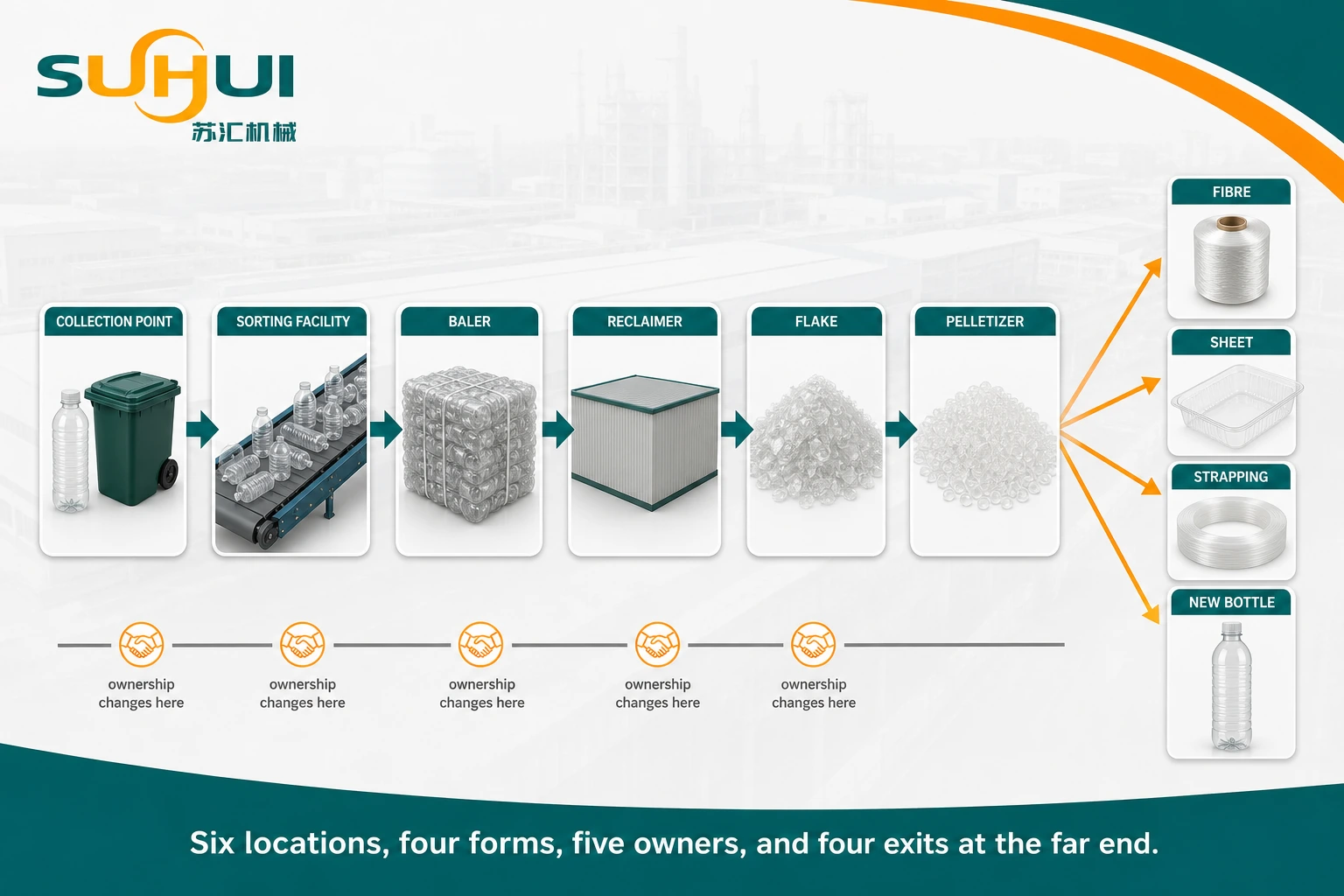
Six locations, four forms, five owners, and four possible exits at the far end.
The Six Places a PET Bottle Physically Exists
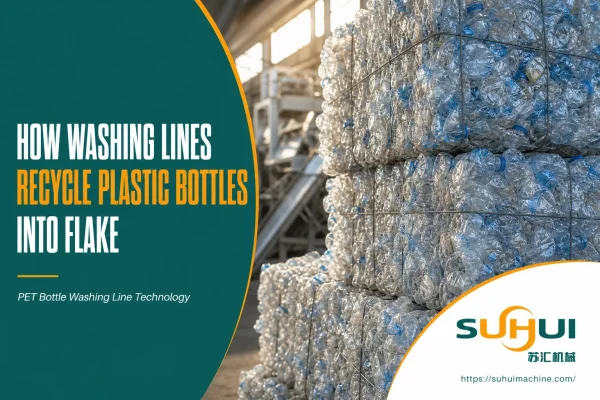
Between a collection bin and a new product a bottle changes hands about five times and changes physical form four times. It is a whole container, then part of a mixed bale, then part of a sorted bale, then washed flake, then in most cases pellet. Ownership changes at every one of those boundaries.
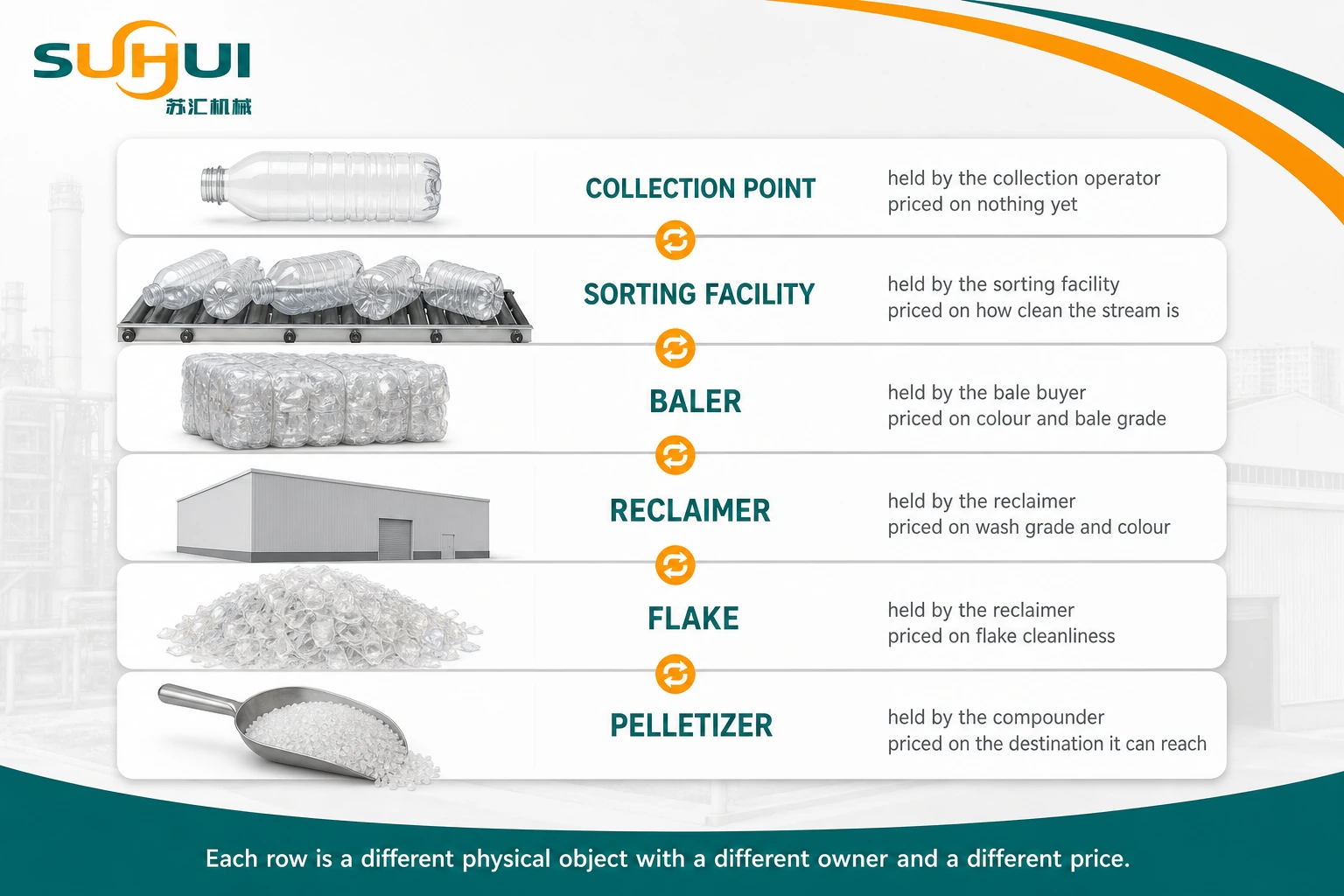
Each row below is a different physical object with a different owner and a different price.
| Where it is | What form it is in | Who holds it | What sets its value there |
|---|---|---|---|
| Collection point | Whole container, often still holding residue | Householder, then the collection operator | Nothing yet — it is a cost item until it is aggregated |
| Sorting facility | Loose mixed recyclables, then a PET-sorted stream | Material recovery facility | How cleanly PET can be separated from the incoming mix |
| Baler and warehouse | Compressed bale, sold by colour grade and purity spec | MRF, broker, or a deposit return scheme operator | Colour grade, non-PET content, moisture, bale weight and density |
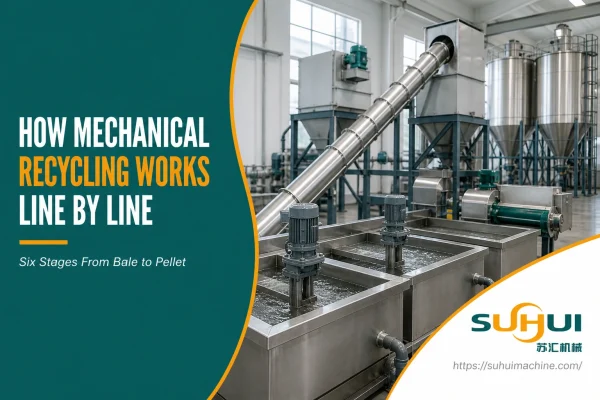
| Reclaimer, the washing plant | Washed dried flake, colour separated | Reclaimer | Wash grade and colour stream, against the bale price paid |
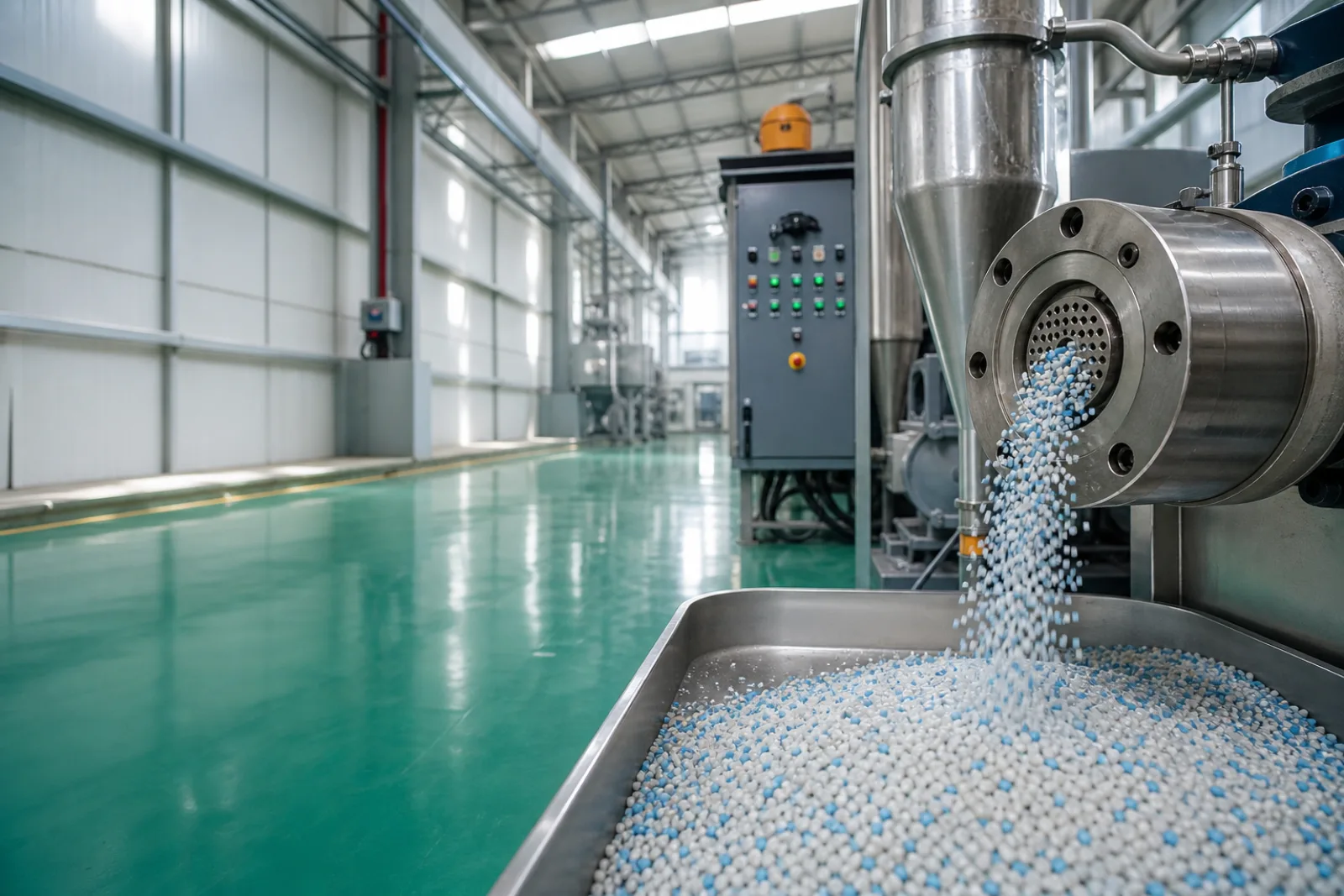
| Pelletizing or compounding | rPET pellet, or a compounded engineering grade | Reclaimer or a separate compounder | Consistency of feeding and melting in the buyer’s process |
| Converter | Fibre, sheet, strap or preform | The end manufacturer | The finished product market, which is where the loop finally closes or does not |
Two features of that table matter more than the sequence itself. The first is that nobody owns the material end to end. Five separate businesses each buy it, add something, and sell it on, and each one optimises its own margin rather than the eventual destination. The second is that a bottle can stop at any row. Material that is baled and never sold, or washed and never bought, has been collected and processed but has not been recycled.
One more location deserves naming because it sits outside the table. A deposit return scheme collects bottles separately from mixed household waste, which means the material skips the mixed-recyclables row entirely and arrives at the baler already segregated by polymer and often by colour. That is not a small administrative difference — it changes which destinations are reachable at the far end, for reasons the next two sections make concrete.
How Value Moves Along the Pathway
Price per tonne rises at every handoff, but the ceiling on what the material can eventually be worth is set at the very first one. Colour is fixed when the bale is made, and no later stage adds it back. Everything downstream either preserves that ceiling or loses ground against it.
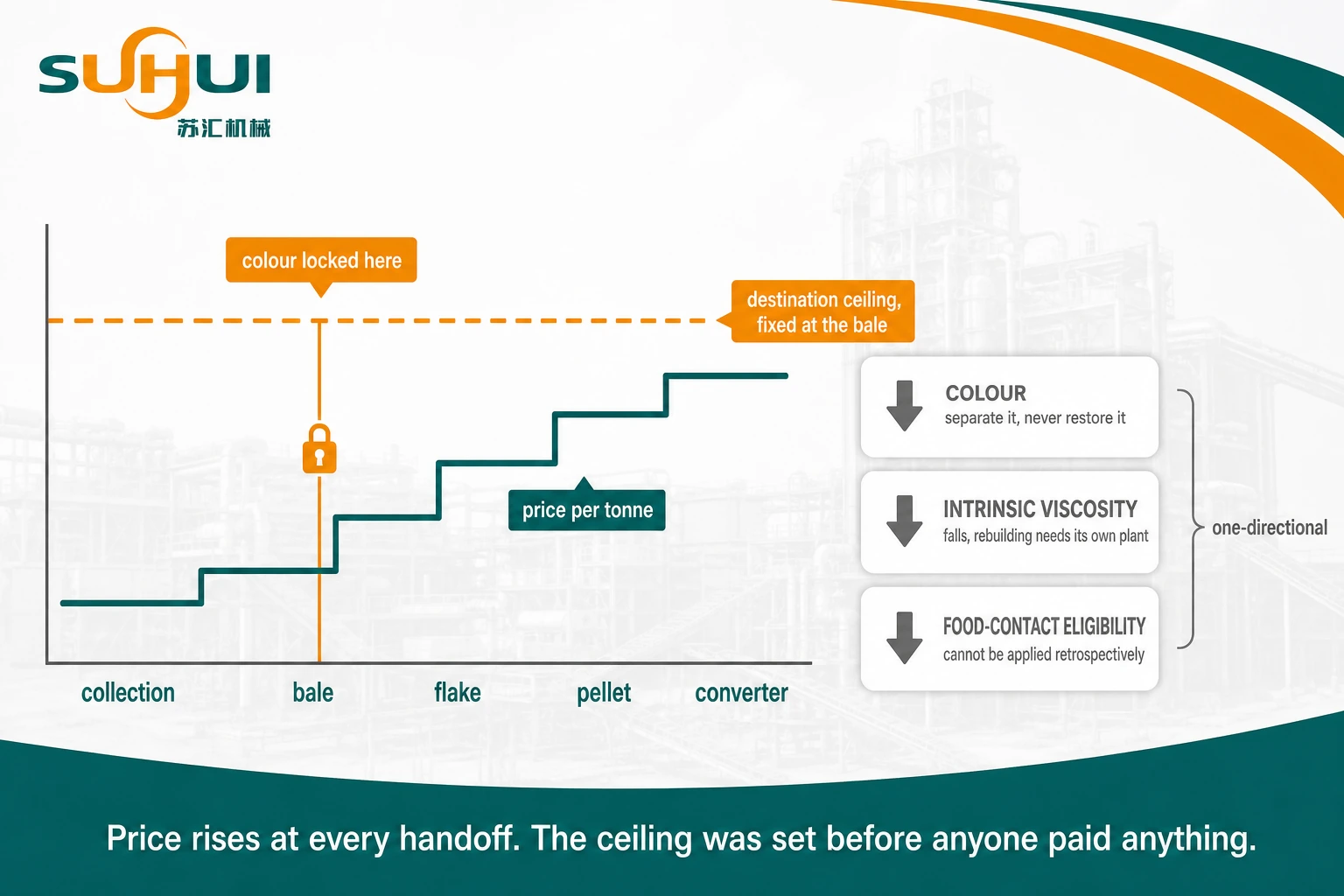
The line going up is price. The line going across is the ceiling, and it was set before anyone paid anything.
It is worth being precise about what each stage adds, because the two are frequently confused. A washing plant adds value by removing contamination, and that is a real transformation with a real cost behind it. What it does not do is raise the ceiling. Clear flake made from a clear bale can go anywhere the specification allows. Clear flake cannot be made from a mixed-colour bale at any price.
Three properties behave the same way. Each is decided at a specific point and is one-directional afterwards.
| Property | Where it is decided | What later stages can do about it |
|---|---|---|
| Colour | At the bale, by what was collected and how it was sorted | Separate colours from each other, which changes the mix rather than the colour |
| Intrinsic viscosity | Falls at every heat and moisture exposure from the original bottle onwards | Rebuild it, but only with a dedicated solid state polymerization stage |
| Food-contact eligibility | At the source of the bale and the validation status of the process | Nothing retrospectively — an unvalidated batch cannot be qualified after the fact |
Read that table alongside the ownership point and an uncomfortable structural fact appears. The party that fixes the ceiling — whoever makes the bale — is usually not the party whose margin depends on it. A MRF is paid for tonnes moved and bale purity against a written spec. Whether the material eventually reaches a bottle or a carpet fibre is somebody else’s revenue line entirely, which is a large part of why deposit return schemes produce material that behaves differently from kerbside material of nominally similar purity.
Four Destinations and the Gate in Front of Each
Recovered PET goes to four places in commercial volume. Polyester fibre, thermoformed sheet, strapping and new bottles. They are not four grades of the same thing — each has a different gate in front of it, and the gates are not ranked in the order most people assume.
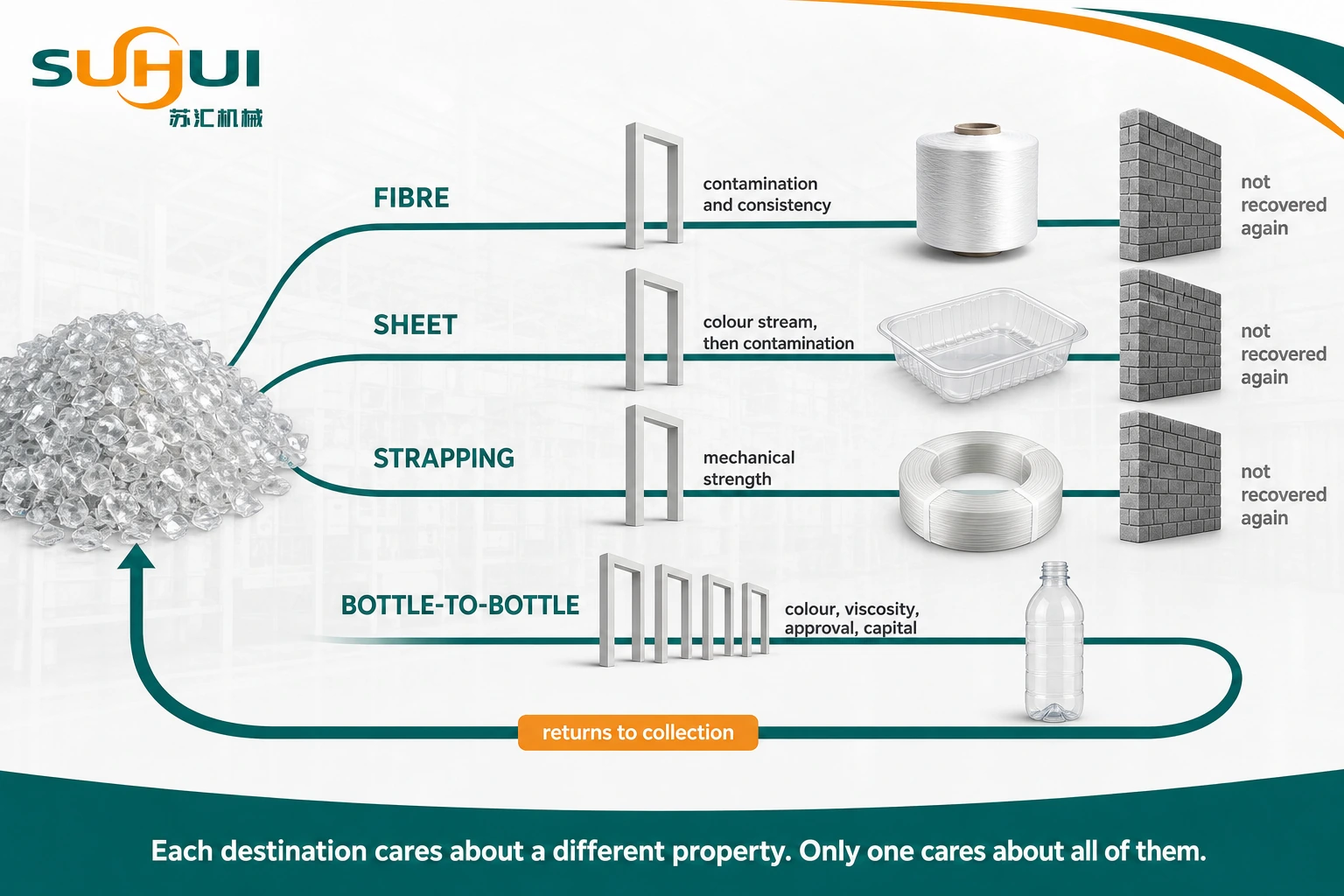
Each destination cares about a different property. Only one of them cares about all of them.
| Destination | What it needs from the material | The gate that decides acceptance | Can the material be recovered again afterwards |
|---|---|---|---|
| Polyester staple fibre and filament | Consistent melting behaviour and low hard-contaminant content; colour tolerance is wide because fibre can be dyed or used dark | Contamination and consistency rather than colour or viscosity | Rarely — fibre in textiles and non-wovens is not collected as a PET stream |
| Thermoformed sheet and trays | Clear or lightly tinted flake, low PVC, low opaque content, stable viscosity for extrusion | Colour stream first, then contamination limits | Sometimes — tray collection exists but is far behind bottle collection |
| Strapping | Mechanical strength and predictable melt behaviour; colour largely irrelevant | The most tolerant of the four on colour and appearance | Occasionally, in closed industrial loops where the strap is recovered on site |
| New bottles, bottle-to-bottle | Clear or light blue only, bottle-grade viscosity, validated decontamination, full traceability | All four gates in the next section, simultaneously | Yes — the only destination that returns the material to a collected format |
The last column is the one that turns this from a price table into a strategy question. Fibre is the largest destination by volume and it is a terminal one — polyester textile is not collected back as PET anywhere at scale, so material that goes to fibre has left the loop even though it was genuinely recycled. Bottle-to-bottle is the only route on the list that puts the polymer back into a container format that existing collection systems already recover.
Strapping deserves a note because it is routinely mislabelled. It is often described as downcycling, and by the usual definition it is not — the material has moved to a lower-visibility application but not necessarily to a lower-performance one, since strapping is a demanding mechanical duty. What it is, is terminal. The honest framing is not high grade against low grade but whether the destination is recoverable, and on that axis only one of the four qualifies.
Why Most Bottles Never Reach Bottle to Bottle
Four independent gates stand between a collected bottle and a new bottle, and a batch has to clear all of them. Colour stream, intrinsic viscosity, food-contact approval and the capital behind a decontamination and viscosity-rebuild stage. Failing any one of them sends the material to a different destination permanently.
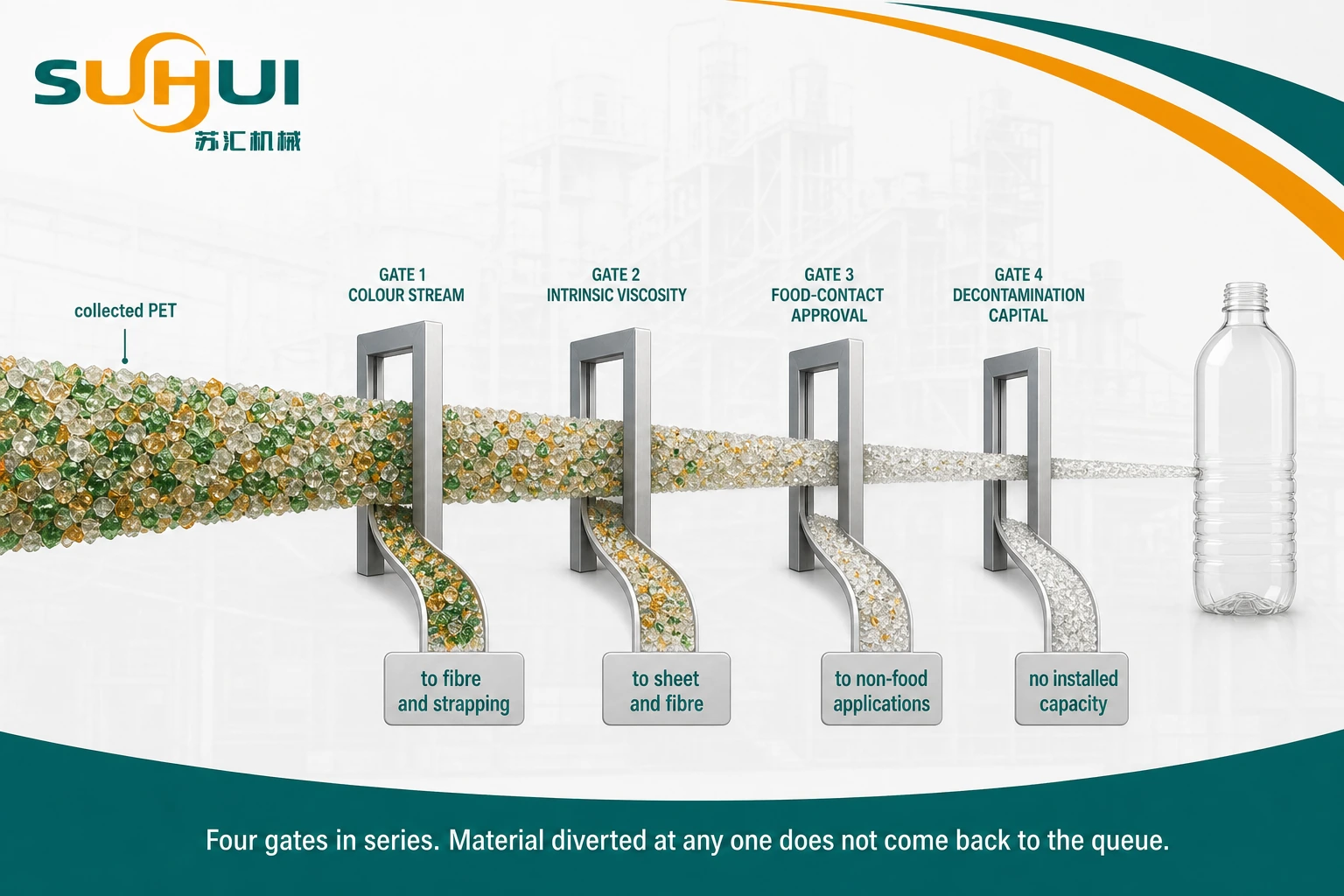
Four gates in series. Material diverted at any one of them does not come back to the queue.
Gate one is colour, and it removes the largest share. Only clear and light blue flake is a candidate. Green, amber and opaque white PET are all perfectly recyclable and none of them can go into a clear bottle, because there is no industrial process that removes pigment from a polymer. Since colour is set at the bale, this gate operates before the material has even reached a washing plant.
Gate two is intrinsic viscosity. IV tracks how long the polymer chains are, and a preform demands a higher figure than fibre or sheet does. Every thermal cycle shortens those chains, and because PET is hygroscopic, moisture present at melt temperature cuts them further by hydrolysis. Flake reaching a converter therefore sits below the bottle it came from, and that deficit has to be made up before it can be blown.
Gate three is food-contact approval, and it is regulatory rather than technical. A recycled material entering food packaging has to come from a process that has been assessed and accepted in the jurisdiction where the product will be sold. That approval attaches to the process and the feedstock source, not to the equipment, it varies between markets, and it cannot be applied retrospectively to a batch already produced.
Gate four is capital, and it is the one that limits total volume. Clearing gates two and three needs a decontamination and viscosity-rebuild stage that a conventional washing and pelletizing line does not include. That is separate plant with its own capital and running cost, and there is far less of it installed worldwide than there are bottles collected. The constraint on bottle-to-bottle is not that the technology is unproven; it is that the throughput exists in far smaller quantity than the feedstock does.
Against all four gates, it is worth keeping the scale of the first problem in view. The US Environmental Protection Agency put the recycling rate for PET bottles and jars at 29.1 percent in 2018, against 8.7 percent for plastics overall. PET bottles are among the best-performing plastic streams there is, and roughly seven out of ten of them still never enter this pathway at all. Everything in this article concerns the minority that does.
What Solid State Polymerization Does in That Route
Solid state polymerization raises intrinsic viscosity back to bottle grade by holding dried chips below their melting point, under vacuum or circulating nitrogen, for hours. Chain ends keep reacting and molecular weight climbs. The same conditions strip out residual moisture, acetaldehyde and ethylene glycol at the same time.
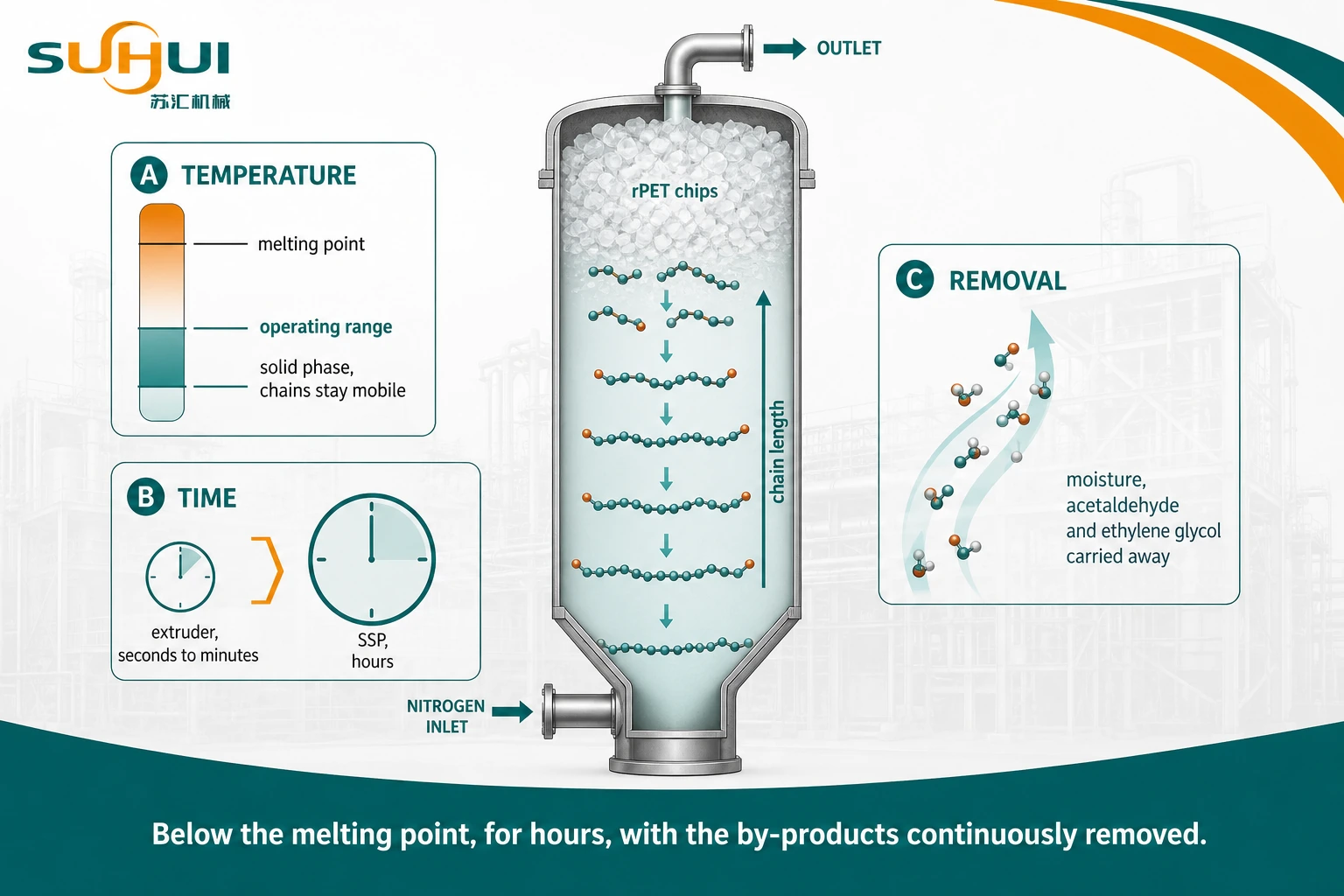
Below the melting point, for hours, with the reaction products continuously removed. An extruder can provide none of those three conditions.
The reason this needs its own machine rather than a setting on an existing one comes down to three physical requirements that an extruder cannot meet at the same time.
It has to happen below the melting point. In the solid phase the polymer keeps its shape while chain ends remain mobile enough to react. Above the melting point the competing degradation reactions run faster than the chain-building ones, so melting the material works against the objective.
It needs hours of residence time. Chain extension in the solid state is slow. An extruder holds material for seconds to minutes, which is three orders of magnitude short of what the reaction requires.
The reaction products have to be removed continuously. Chain extension is a condensation reaction, and it stalls unless the small molecules it releases are carried away. That is the job of the vacuum or the circulating nitrogen stream, and it is also what removes the acetaldehyde that would otherwise taint water and soft drinks in the finished bottle.
The SUHUI PET solid state polymerization system is built around those three requirements together, with the nitrogen circuit doing double duty as both the reaction driver and the carrier that takes the volatile by-products away. How much viscosity any given reactor recovers depends on where the feedstock starts, the temperature it runs at and how long the material sits in it, so the reactor is sized against the grade it has to hit rather than offered with a standard viscosity gain. A supplier quoting a universal IV gain has not seen the feedstock.
A fifth destination sits outside the four-way table because it moves in the opposite direction. Reinforcing washed flake with glass fibre on a PET flakes twin screw pelletizing line yields an engineering compound with mechanical performance above the container resin it started from. That route is terminal in the same way fibre is, so it does not close any loop — but the material has climbed rather than descended, and the usual vocabulary for recycling outcomes has no word for that.
Where Material Leaves the Pathway
Every handoff has a leak, and the leaks are not evenly sized. Material leaves as uncollected waste, as residue rejected at the sorting plant, as the non-PET fraction of a bale, as fines and colour rejects at the wash plant, and as export to a market with a different destination mix.
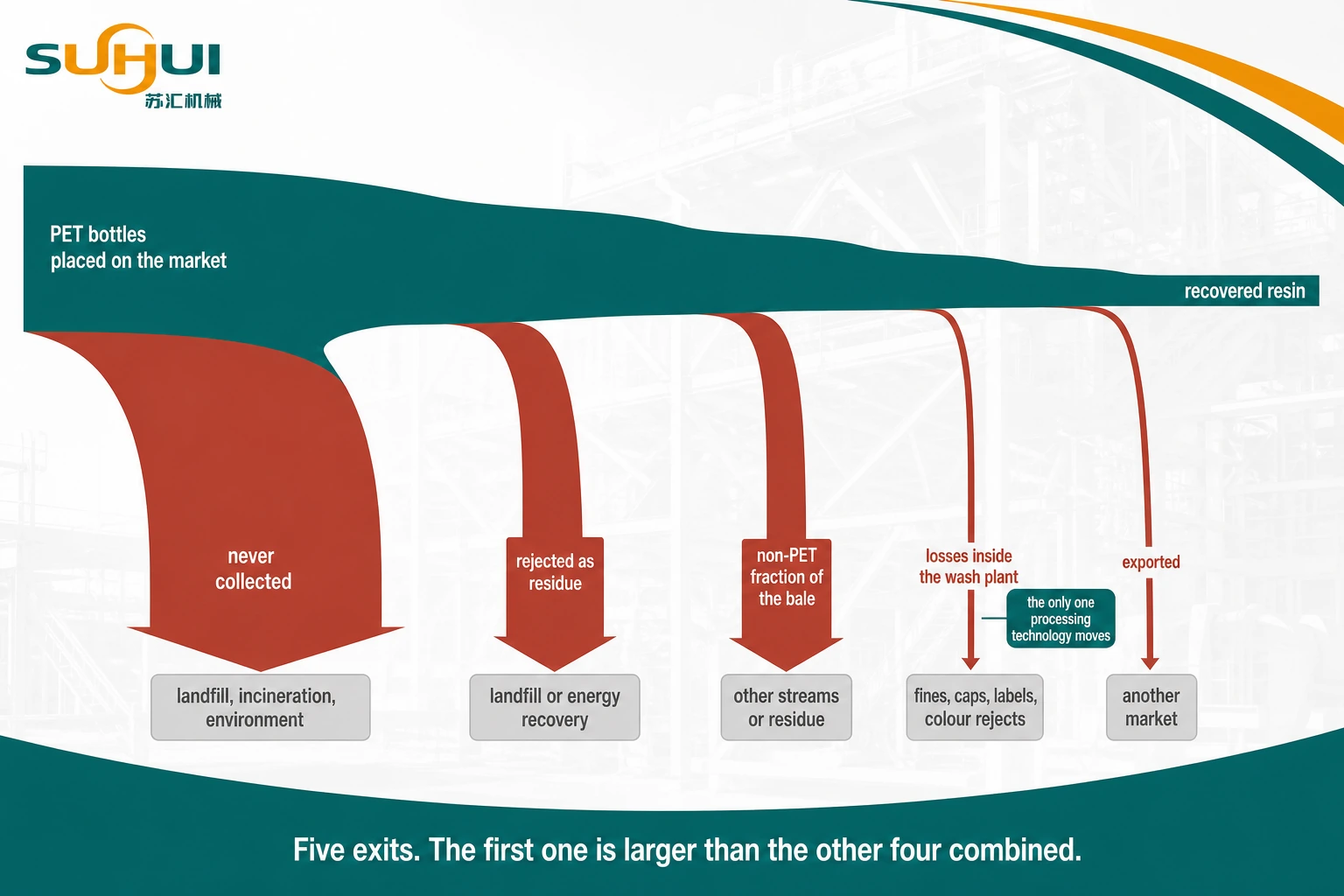
Five exits. The first one is larger than the other four combined.
| Exit point | Where the material goes | What causes it | Who can change it |
|---|---|---|---|
| Never collected | Landfill, incineration, or the environment | No collection service, no deposit incentive, or disposal away from home | Policy and collection design, not any equipment supplier |
| Rejected as residue at the sorting facility | Landfill or energy recovery | Contamination in the mixed stream, items below screen size, wrong format | Collection quality upstream, and sorting capability at the facility |
| Non-PET fraction of the bale | Other polymer streams if segregated, residue if not | The bale purity specification that was bought and paid for | The reclaimer, at the point of purchase rather than in the plant |
| Losses inside the wash plant | Fines to filtration, caps and labels to their own streams, colour rejects to lower grades | Physical yield, most of which is decided by what was in the bale | Partly the plant, mainly the bale |
| Exported as bale or flake | Another market, entering that market’s destination mix | Regional price differences and local processing capacity | Trade conditions and the balance of local reprocessing capacity |
Reading that table from the perspective of an equipment supplier produces a conclusion worth stating plainly. Only one row is meaningfully affected by processing technology, and it is the smallest. The dominant losses happen before any machine touches the material, in collection and in the purity of the bale that gets written into a purchase contract. Ongoing measurement of these flows for the North American PET stream is published by NAPCOR, whose annual reporting tracks bale composition and end-market split rather than headline recycling rates.
What Decides Which Destination Your Output Can Reach
Three things about a plant decide which destinations are open to it, and only one of them is equipment. The colour mix of the bale it buys, the contamination ceiling its wash section can hold, and whether it stops at flake or invests in pelletizing and a viscosity-rebuild stage.
Those three combine into a small number of practical positions rather than a continuum. A plant on clear deposit-return bale with a full wash section and downstream viscosity rebuild can address every destination in the table above. A plant on mixed-colour kerbside bale addresses fibre and strapping regardless of how good its washing is, because gate one closed before the material arrived. Most plants sit between those, and the useful question is not how to reach the top of the ladder but which single constraint is currently binding.
The order in which those constraints should be attacked runs backwards from the usual instinct. Bale source is first, because it sets the ceiling and it is a commercial decision rather than a capital one. Wash capability is second, since it decides how much of that ceiling survives. Pelletizing and viscosity rebuild come last, because they only pay when the first two are already good enough to justify them — a solid state polymerization reactor fed mixed-colour flake rebuilds the viscosity of material that still cannot go into a clear bottle.
Configuring backwards from the destination is the whole discipline. Across the SUHUI plastic recycling machine range, the PET bottle sorting washing line covers 500 to 3,000 kg/h with two stages of optical sorting, the pelletizing line range converts flake to pellet, and the auxiliary machine range carries the solid state polymerization stage. Which of those a project needs is decided by which destination its output has to reach, not the other way round.
Frequently Asked Questions
Where does a plastic bottle go after the recycling bin?
To a sorting facility, where PET is separated from the mixed stream and baled by colour grade. The bale is sold to a reclaimer who washes it into flake, and the flake is either sold directly to a converter or pelletized first. From there it becomes fibre, sheet, strapping or, in a minority of cases, a new bottle.
What is PET recycled into?
Four destinations account for almost all of it. Polyester staple fibre and filament take the largest share, thermoformed sheet and trays the next, then strapping, then bottle-to-bottle. Only the last of those returns the material to a format that existing collection systems recover again, which is why it is treated separately from the other three.
Why can green PET bottles not become clear bottles?
Because no industrial process removes pigment from a polymer. Colour is dissolved into the material rather than deposited on its surface, so washing cannot reach it and melting carries it through. Green and amber PET are fully recyclable into fibre, strapping and dark products, but the clear route closed when the bottle was made.
How many times can PET be recycled?
There is no fixed number. Each thermal cycle and each exposure to moisture at melt temperature shortens the polymer chains and lowers intrinsic viscosity. Where that viscosity is rebuilt by solid state polymerization the material can go round repeatedly; where it is not, it steps down to a less demanding application each time.
What is solid state polymerization used for in PET recycling?
Rebuilding intrinsic viscosity to bottle grade. Dried chips are held below the melting point under vacuum or circulating nitrogen for hours, during which chain ends keep reacting and molecular weight climbs. The same conditions strip out residual moisture, acetaldehyde and ethylene glycol, which is why one reactor handles both the viscosity and the decontamination duty.
Why is bottle-to-bottle recycling capacity so limited?
Four gates have to be cleared at once — clear or light blue colour stream, bottle-grade viscosity, validated food-contact approval in the selling market, and the capital behind a decontamination and viscosity-rebuild plant. Each gate diverts material permanently, and installed capacity for the last one is far smaller than the volume of bottles collected.
Is recycled PET turned into fibre still recycling?
Yes, and it is the largest genuine destination by volume. What it is not is a loop. Polyester textile and non-woven products are not collected back as a PET stream anywhere at scale, so material that goes to fibre has been recycled once and then leaves the system. That distinction matters for planning, not for whether it counts.
What Sets the Ceiling on Each PET Route
- PET Solid State Polymerization System — the IV rebuild step that opens the bottle-to-bottle route, in machine terms
- PET Flakes Twin Screw Pelletizing Line — where flake exits into glass-fibre compounds for automotive and electronics parts
- PET Bottle Recycling Machine — which flake grade fibre, sheet, strapping and bottle buyers each require
- What Is PET Plastic — what affects rPET quality before it ever reaches a destination
Tem um material que precisa processar?
Envie o polímero, em que forma ele chega e a produção desejada. Retornamos com uma configuração de linha e uma faixa de orçamento realista.