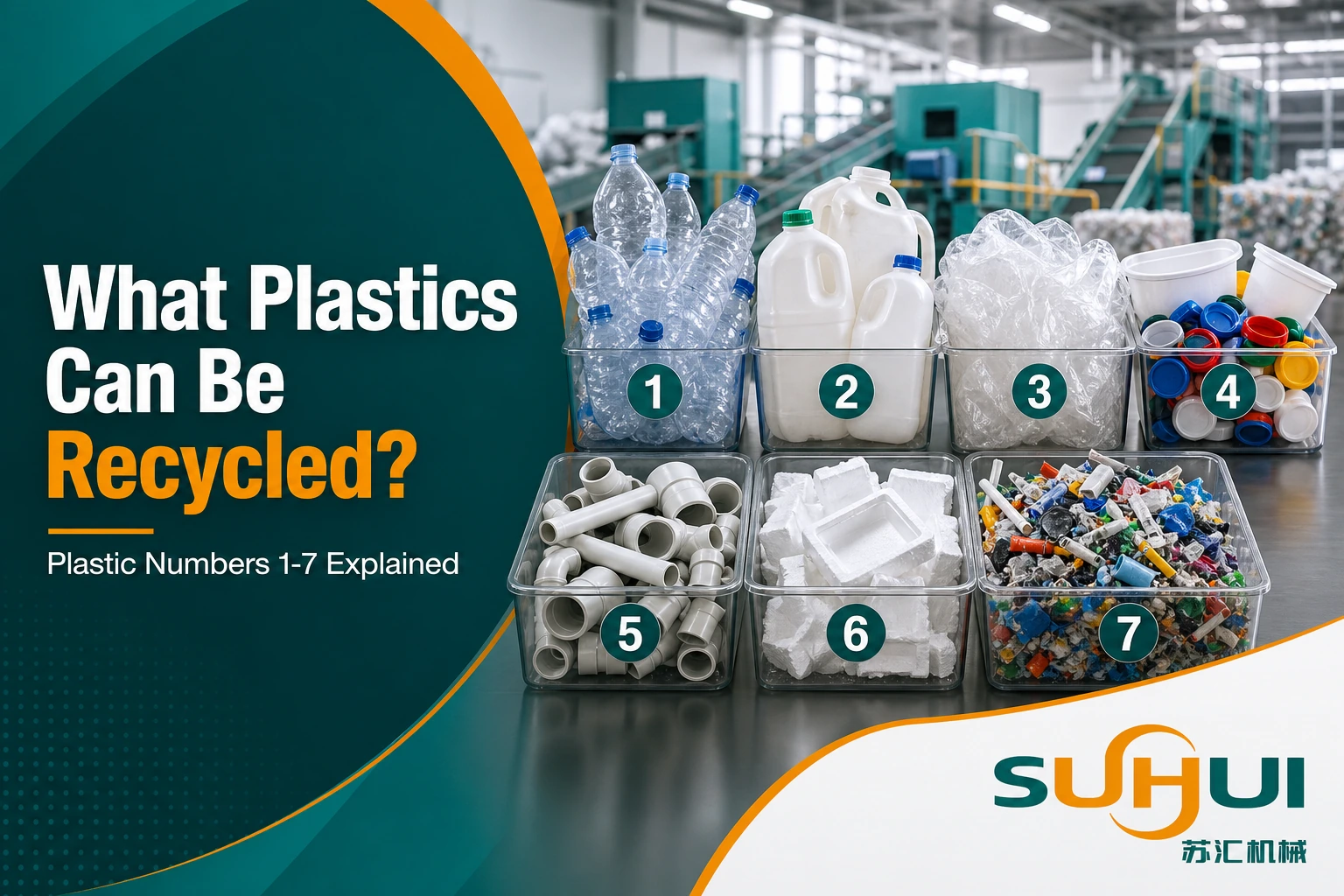
When people ask what plastics can be recycled, the most useful answer is not just “look for the recycling symbol.” Plastic recycling depends on resin type, local collection rules, contamination, product design, and whether there is an industrial process that can turn the material into usable flakes, pellets, fiber, sheet, lumber, or other recycled products.
This guide explains plastic numbers 1-7, which plastics are commonly recyclable, why some plastics are difficult to recycle, and how different materials connect to industrial recycling equipment such as washing lines, crushers, shredders, dryers, and pelletizing lines.
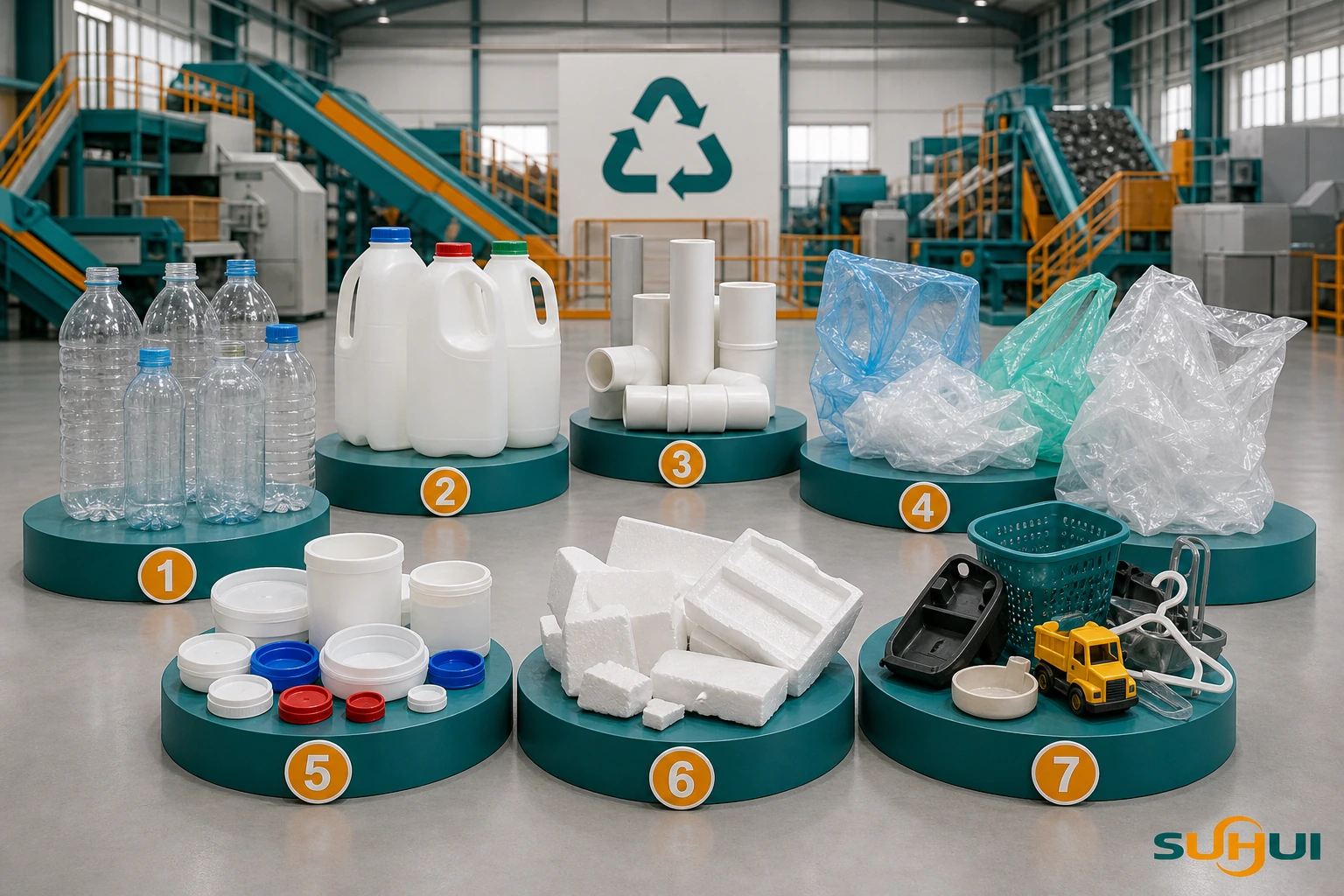
PET #1 and HDPE #2 are widely recycled, while PP, LDPE, PVC, PS, and mixed plastics depend more on collection systems and processing methods. Which polymer you run also decides the line: see how a plastic recycling machine is configured differently for bottles, film and rigid scrap.
What Plastics Can Be Recycled?
The most commonly recycled plastics are PET #1 and HDPE #2 because they have strong collection streams, clear sorting categories, and established industrial recycling markets.
Other plastics can sometimes be recycled, but the answer depends on the product form. For example, PP #5 rigid containers may be accepted in some systems, while dirty PP film or mixed multilayer packaging may not be practical to recycle.
LDPE #4 plastic film can be recycled through specialized film collection and washing systems, but it is often not accepted in curbside bins because film can tangle in sorting equipment.
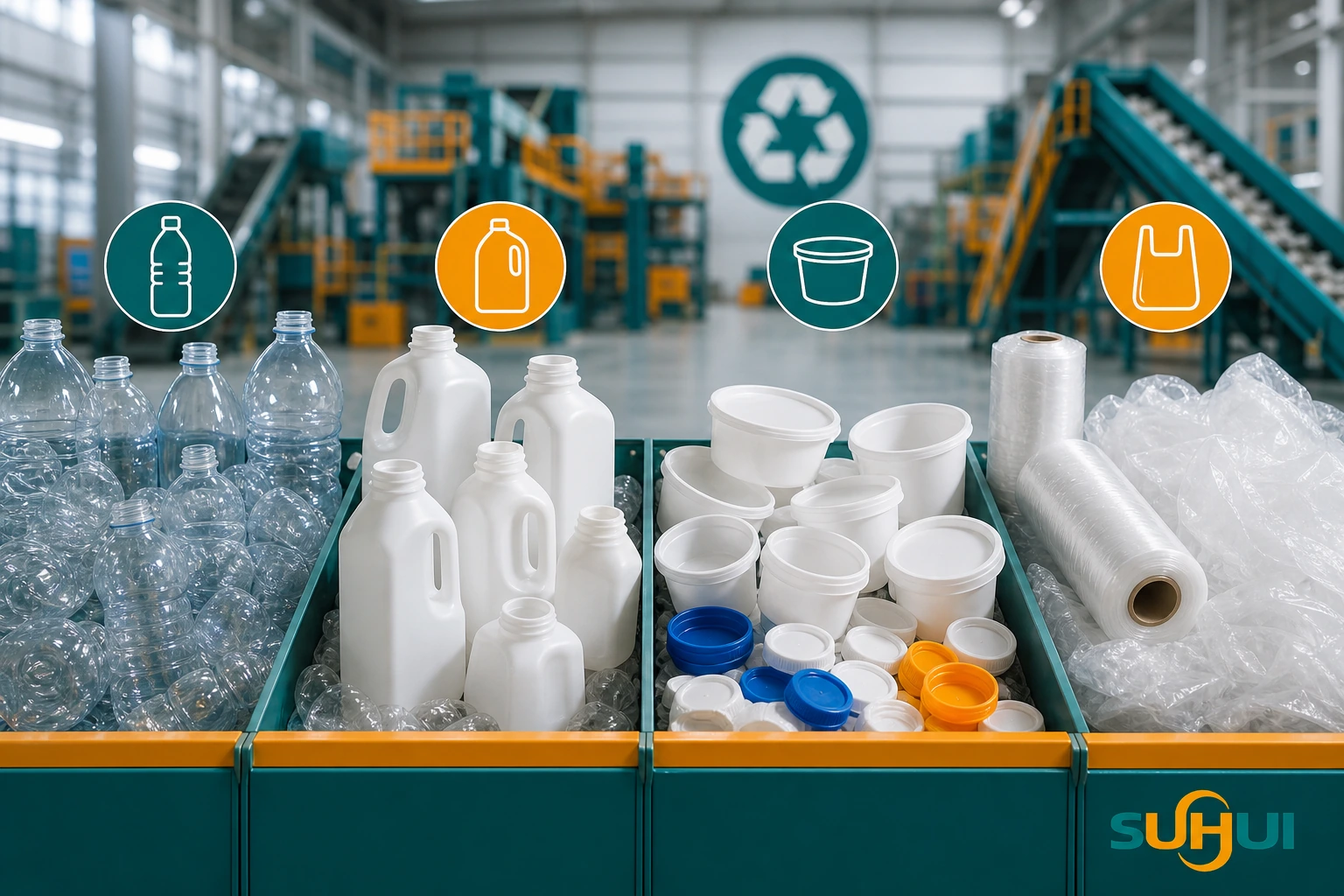
PET, HDPE, PP, and LDPE are recyclable in the right collection and processing conditions, but each material needs a different recycling path.
Plastic Recycling Symbols 1-7 Explained
Plastic recycling symbols are resin identification codes. They identify the plastic family, but they do not automatically mean the item will be accepted in every recycling program.
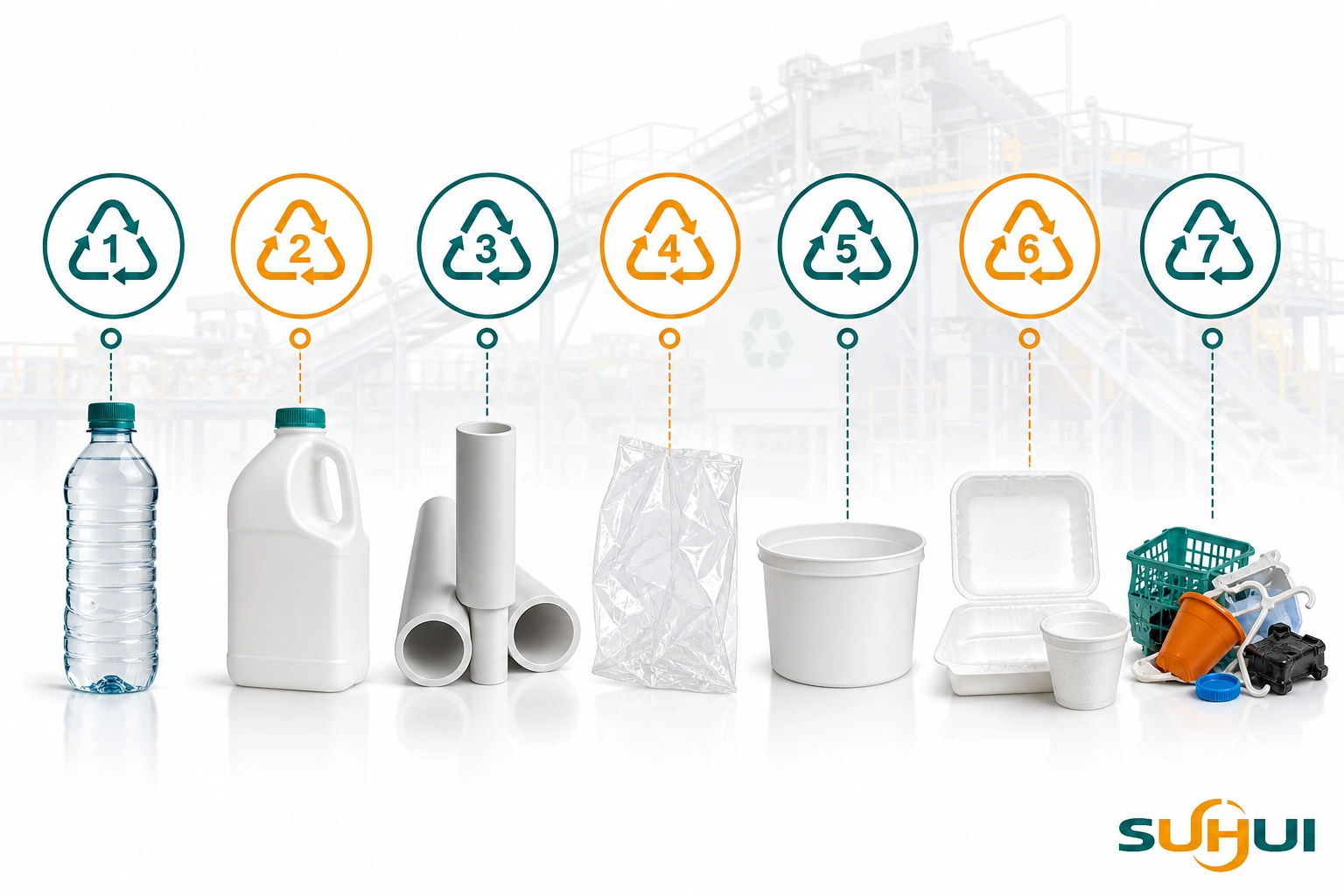
Plastic numbers 1-7 identify resin types, but recyclability still depends on collection, contamination, and processing capability.
| Number | Plastic Type | Common Products | Practical Recyclability |
|---|---|---|---|
| #1 | PET or PETE | Water bottles, soda bottles, food containers, trays | Widely recycled, especially bottles |
| #2 | HDPE | Milk bottles, detergent bottles, rigid containers, pipes | Widely recycled in rigid form |
| #3 | PVC | Pipes, profiles, flooring, some packaging | Difficult in general recycling; requires specialized handling |
| #4 | LDPE | Plastic bags, films, wraps, flexible packaging | Recyclable through specialized film streams |
| #5 | PP | Caps, tubs, buckets, containers, woven bags, automotive parts | Recyclable in some systems; growing market demand |
| #6 | PS | Foam packaging, disposable food containers, rigid polystyrene | Difficult because of low density, contamination, and economics |
| #7 | Other / mixed plastics | Multilayer packaging, engineering plastics, mixed resins | Usually difficult unless separated into a specific recyclable stream |
For broader recycling process context, see the Association of Plastic Recyclers guide to how plastic recycling works.
Which Plastic Numbers Are Usually Recyclable?
As a practical rule, #1 PET and #2 HDPE are the safest answers for broad recyclability. #5 PP is increasingly recyclable, and #4 LDPE can be recycled when collected as a clean film stream. #3 PVC, #6 PS, and #7 mixed plastics usually require more specialized handling or are not accepted in many general programs.
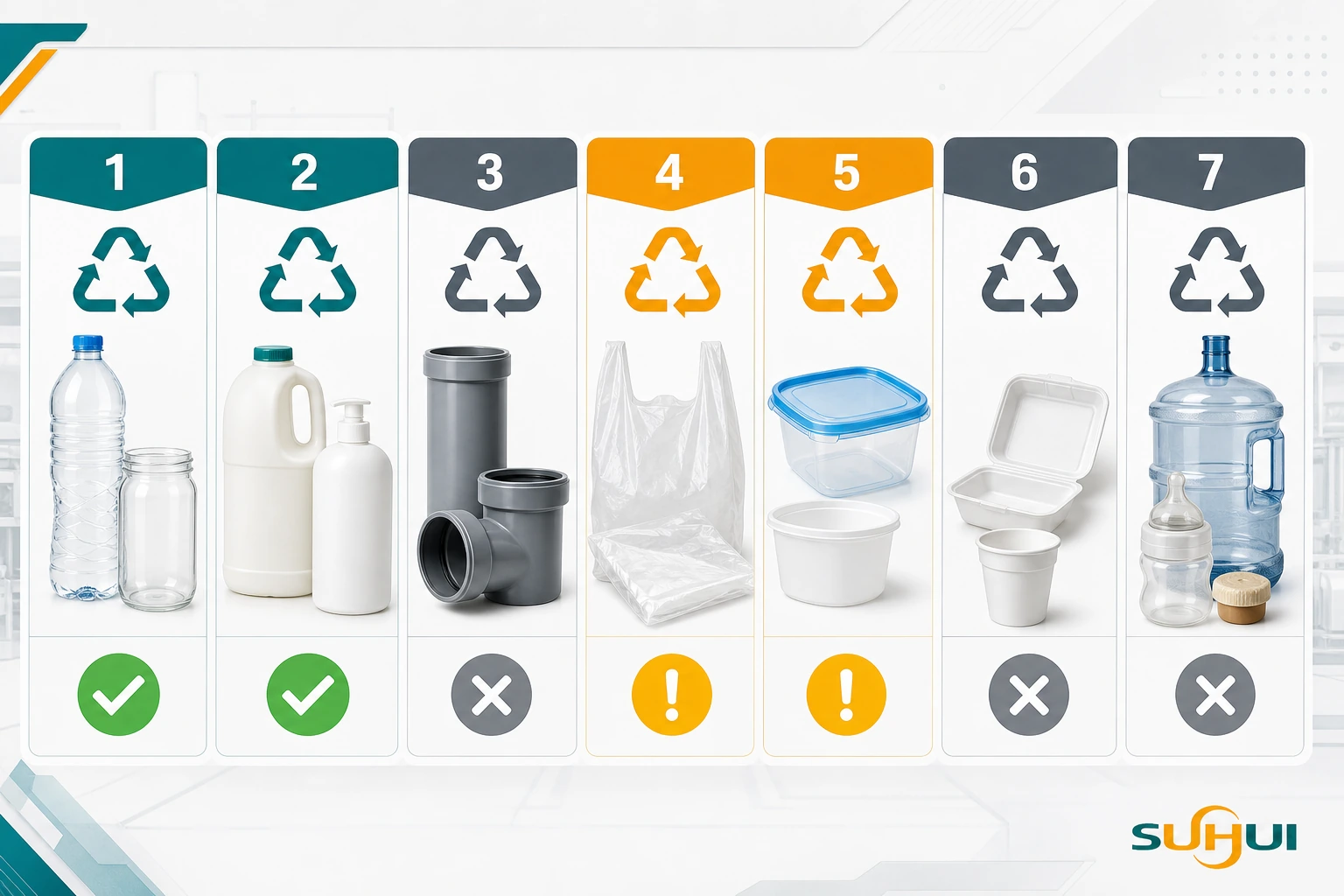
Recyclability is strongest for PET #1 and HDPE #2, while other resin codes depend on product form and local recycling capability.
| Plastic Number | General Answer | Important Condition |
|---|---|---|
| #1 PET | Usually recyclable | Best when bottles are clean, sorted, and separated from PVC and labels |
| #2 HDPE | Usually recyclable | Rigid bottles and containers are easier than mixed contaminated materials |
| #3 PVC | Usually difficult | Needs specialized recycling because additives and chlorine content can create processing issues |
| #4 LDPE | Sometimes recyclable | Works best as clean film, bag, or soft packaging streams collected separately |
| #5 PP | Sometimes recyclable | Rigid PP containers, caps, buckets, and woven bags need suitable sorting and washing |
| #6 PS | Usually difficult | Foam is bulky, lightweight, and often contaminated |
| #7 Other | Usually difficult | Mixed or multilayer materials are hard to sort into a stable recycled resin |
Why Product Form Matters More Than the Number Alone
The resin code is only the first screening step. In industrial recycling, the same plastic number can require different equipment depending on whether it appears as a bottle, film, pipe, woven bag, sheet, foam, or mixed rigid scrap.
| Product Form | Typical Challenge | Equipment Implication |
|---|---|---|
| Bottles and rigid containers | Labels, caps, liquids, color mix, and dirty surfaces | Sorting, crushing, washing, float-sink separation, drying |
| Plastic film and bags | Low bulk density, dirt, moisture, and wrapping around machinery | Film washing, friction cleaning, squeezing, compacting pelletizing |
| Pipes, profiles, and thick rigid scrap | Large size, heavy wall thickness, and mixed additives | Heavy-duty shredding, granulation, and dedicated washing or pelletizing |
| Mixed multilayer packaging | Different materials bonded together and difficult separation | Often unsuitable for standard mechanical recycling unless pre-sorted or specialized |
Why Some Plastics Cannot Be Recycled Easily
In theory, many plastics can be reprocessed. In practice, recycling only works when the material can be collected, sorted, cleaned, processed, and sold at a reasonable cost.
A recyclable resin can still become non-practical if the product is contaminated, mixed with other materials, or too expensive to separate.
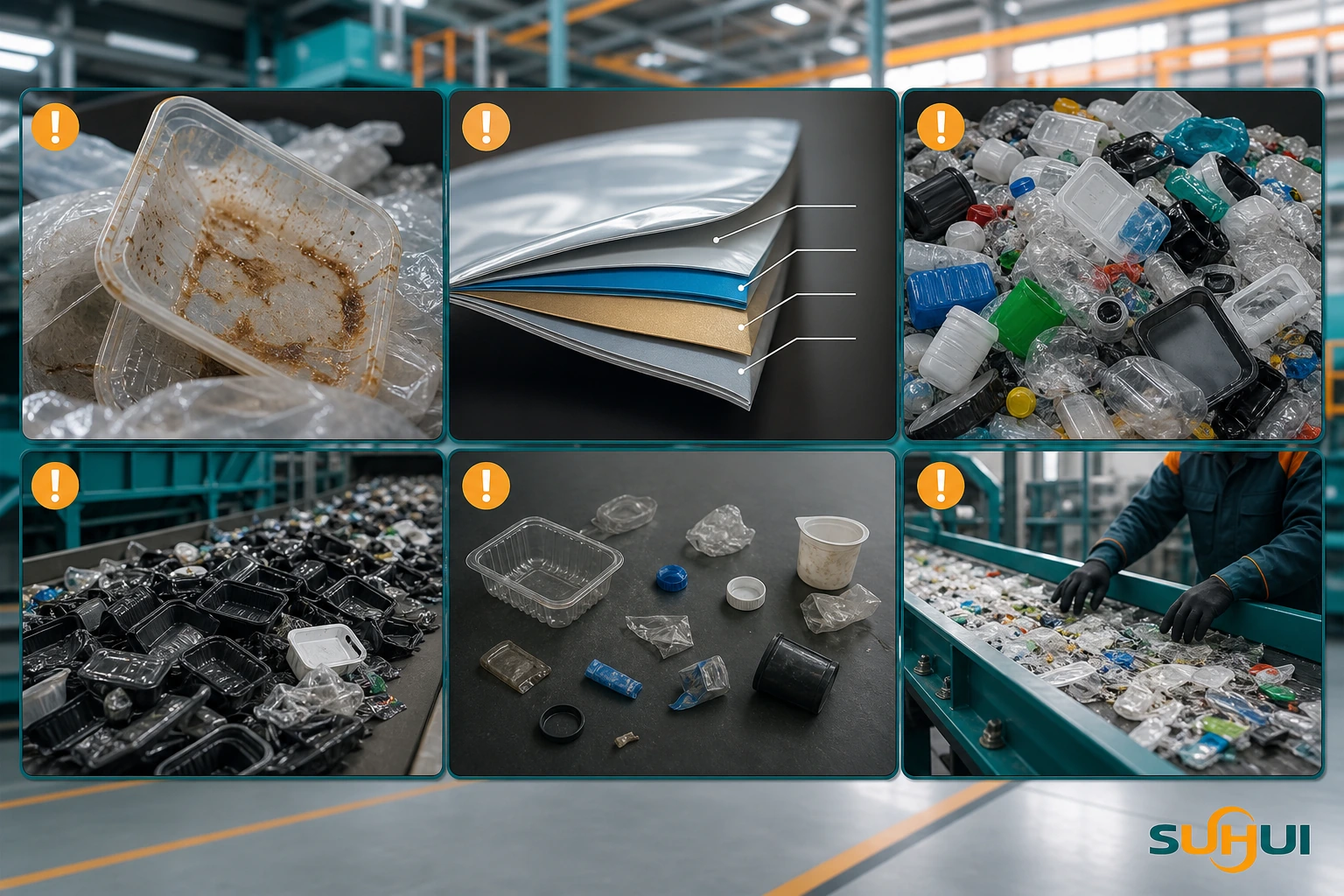
Contamination, mixed materials, labels, additives, low collection volume, and weak end markets can make plastic recycling difficult.
| Barrier | What It Means | Example |
|---|---|---|
| Contamination | Food, oil, dirt, labels, glue, or chemicals reduce recycled material quality | Unwashed food packaging or oily containers |
| Mixed layers | Different materials are laminated together and hard to separate | Multilayer pouches and composite packaging |
| Sorting difficulty | The system cannot separate the resin accurately or economically | Black plastics, small items, mixed caps, non-standard packaging |
| Low volume | There is not enough collected material to justify processing | Rare plastic types or fragmented local collection |
| Weak end market | The recycled output has limited buyers or lower value than processing cost | Dirty mixed plastics with inconsistent composition |
SUHUI engineering note: Before selecting recycling equipment, confirm both the resin type and the product form. A clean HDPE bottle stream, a dirty PP woven bag stream, and a mixed rigid plastic stream may all be recyclable, but they need different feeding, size reduction, washing, drying, and pelletizing configurations.
How Recyclable Plastics Are Processed Industrially
Industrial plastic recycling usually starts with material identification and size reduction. It then moves through washing, separation, drying, and pelletizing when the output needs to become reusable pellets.
The line configuration changes by material type, product form, contamination level, and target output.
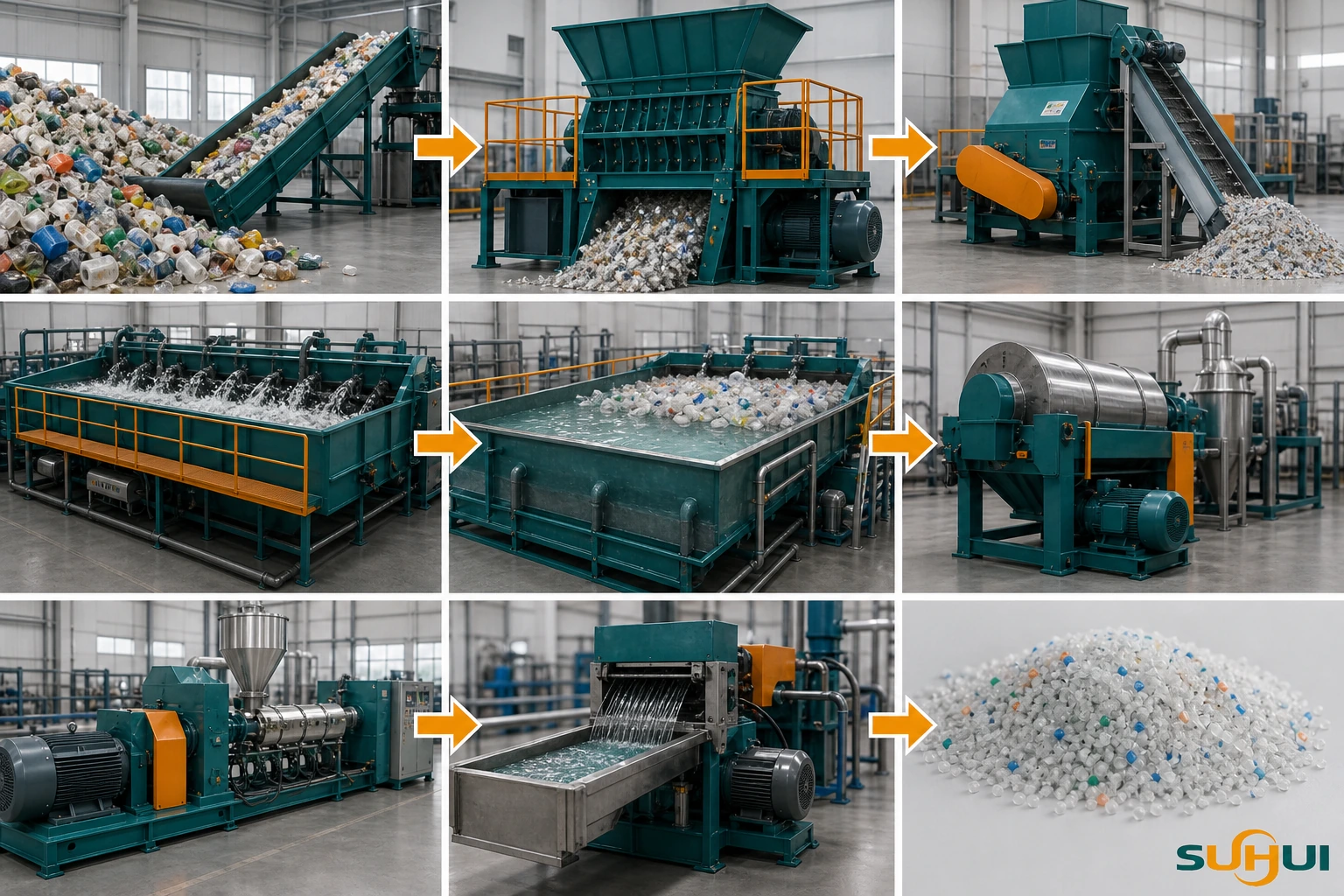
Industrial plastic recycling can include sorting, shredding, crushing, washing, separation, drying, extrusion, filtration, and pelletizing.
- Sorting: Separate plastics by resin type, color, product form, and contamination level.
- Size reduction: Use a shredder or crusher to reduce bottles, containers, film, or rigid scrap into manageable pieces.
- Washing: Remove dirt, labels, glue, food residue, sand, oil, and other contaminants.
- Separation: Use density, water, air, screening, or other methods to separate plastics and impurities.
- Drying: Reduce moisture before storage, extrusion, or pelletizing.
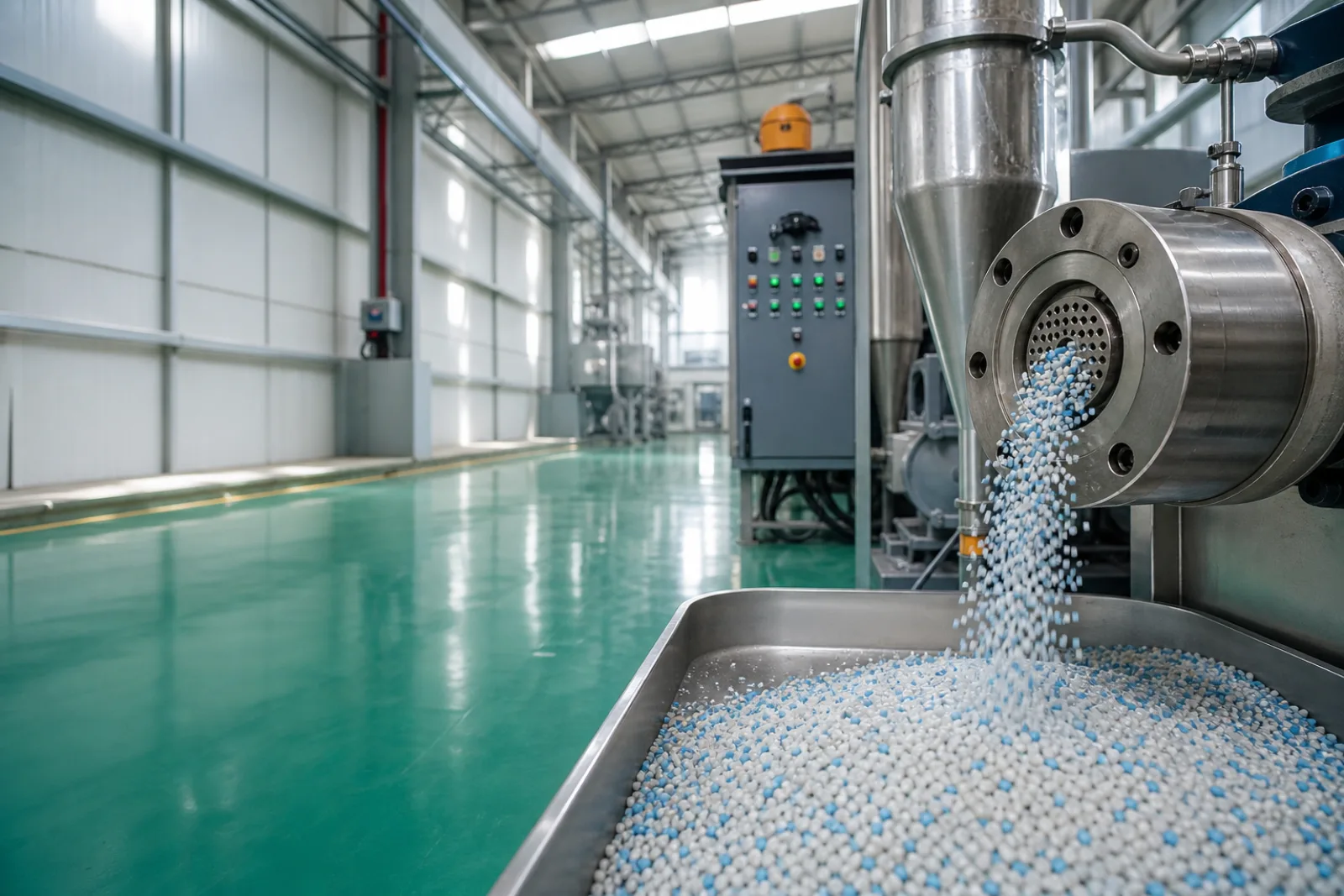
- Pelletizing: Convert washed flakes or regrind into pellets for reuse in manufacturing.
Material-to-Machine Recycling Map
Different plastics need different equipment. A PET bottle line is not the same as a PP/PE film washing line, and a rigid HDPE container project is different from a mixed plastic size-reduction project.
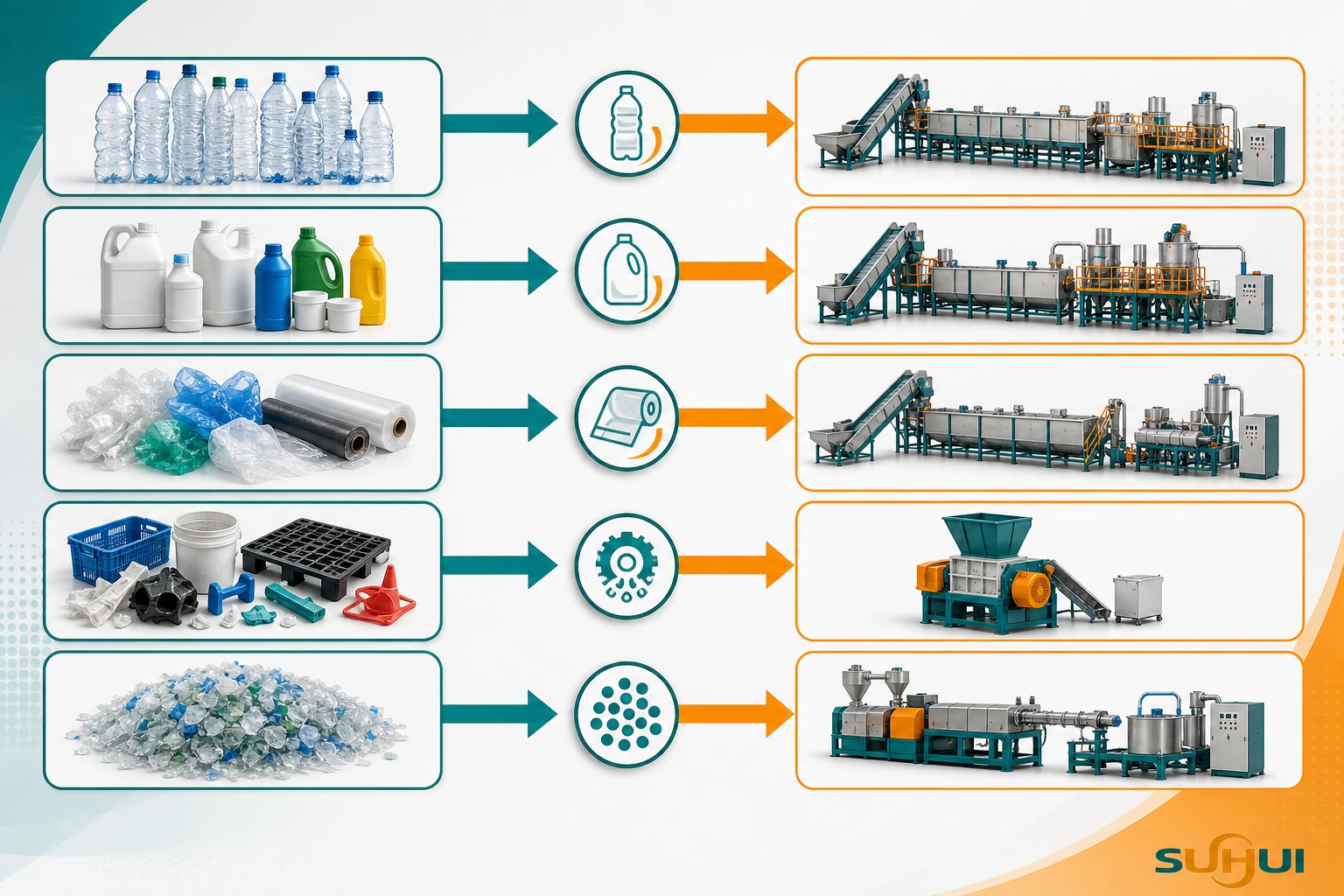
Recycling equipment should be selected according to material type, product form, contamination level, and target output.
| Material Stream | Typical Recycling Method | Relevant SUHUI Equipment |
|---|---|---|
| PET bottles | Sorting, label removal, crushing, hot washing, drying, flakes or pelletizing | PET Bottle Sorting Washing Line |
| HDPE rigid bottles and containers | Crushing, washing, float-sink separation, drying, pelletizing | HDPE Rigid Milk Bottle Recycling Washing Line |
| PP and PE soft film | Film crushing, friction washing, dewatering, squeezing, pelletizing | PP PE Soft Film Recycling Washing Line |
| Large rigid plastics | Shredding, crushing, washing, drying, granulating or pelletizing | Crusher / Shredder Equipment |
| Washed flakes or regrind | Extrusion, filtration, degassing, pelletizing, cooling | Plastic Recycling Pelletizing Line |
How to Decide If a Plastic Waste Stream Is Worth Recycling
A plastic waste stream is worth recycling when it has enough volume, stable composition, manageable contamination, a practical processing route, and a buyer for the recycled output.
This is why recycling projects usually begin with material testing and layout planning instead of machine selection alone.
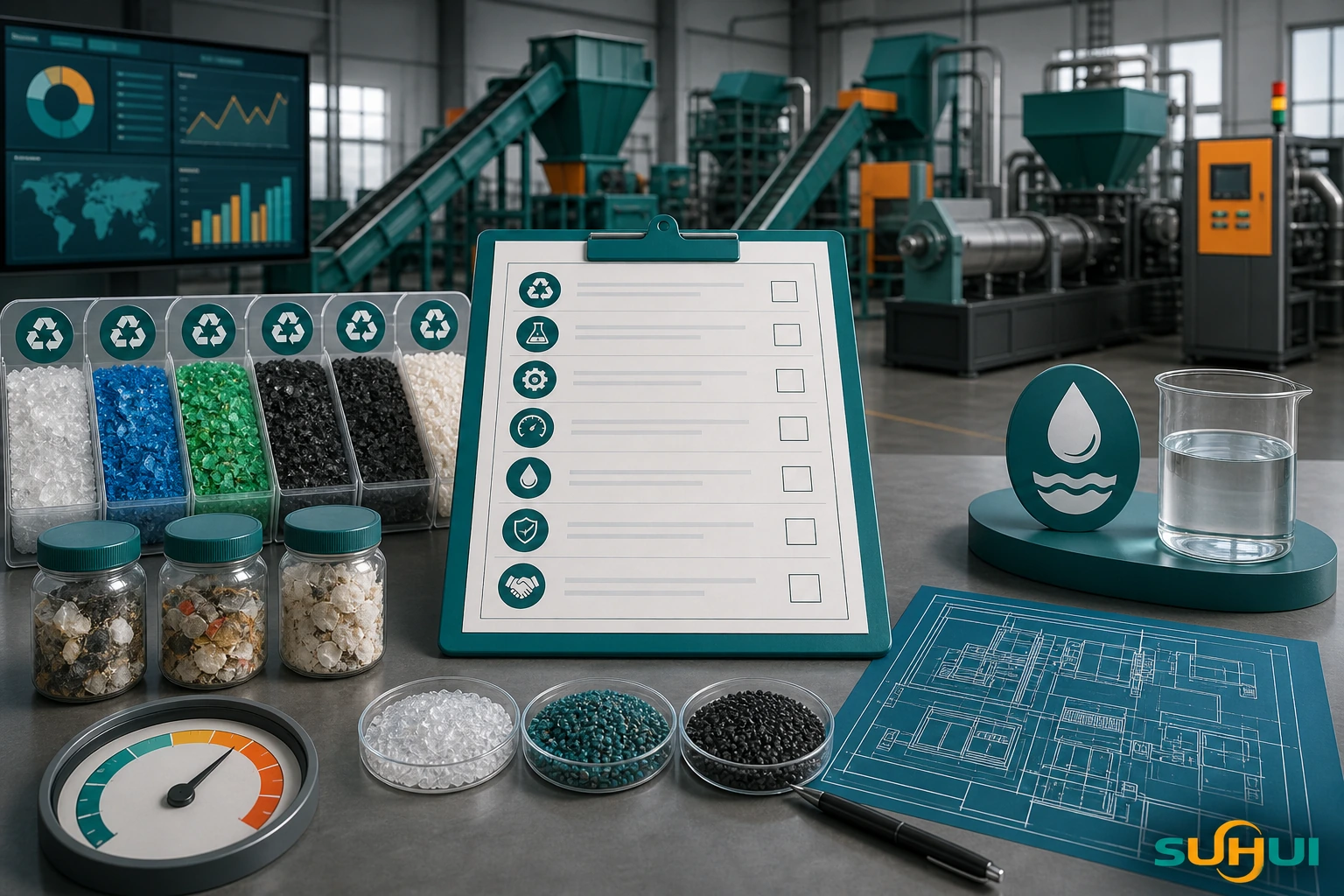
Evaluate resin type, contamination, collection volume, target output, and equipment route before investing in a plastic recycling line.
Before asking for a recycling machine quote, prepare the resin type, material form, contamination level, moisture level, approximate capacity, target output, available factory space, water treatment needs, and final product requirement.
This helps equipment suppliers recommend a line that matches the material instead of a generic process.
If your project includes PET bottles, HDPE containers, PP/PE film, or mixed rigid plastics, compare the relevant Plastic Recycling Washing Line, Crusher / Shredder Equipment, and Plastic Recycling Pelletizing Line options before finalizing the equipment layout.
FAQ
What number plastics can be recycled?
PET #1 and HDPE #2 are usually the most widely recycled plastics. PP #5 and LDPE #4 may be recyclable in some systems, while PVC #3, PS #6, and mixed #7 plastics are often harder to recycle.
What types of plastic can be recycled?
PET, HDPE, PP, and LDPE can be recycled when collected and processed correctly. Recyclability depends on resin type, product form, contamination, sorting capability, and whether there is a market for the recycled output.
Is number 5 plastic recyclable?
Number 5 plastic is PP, or polypropylene. It can be recycled in some programs, especially as rigid containers, caps, tubs, buckets, woven bags, or sorted PP scrap, but acceptance varies by collection system.
Is plastic wrap recyclable?
Plastic wrap is often LDPE or similar film. It is not always accepted in curbside recycling, but clean film can be recycled through specialized film collection, washing, dewatering, and pelletizing systems.
Can you recycle plastic without the symbol?
Plastic without a symbol can sometimes be recycled if the resin is identified by testing or process knowledge. For consumer recycling, unmarked plastic is often rejected because sorting systems cannot confirm the material type.
Conclusion
The most recyclable plastics in general collection systems are usually PET #1 and HDPE #2. LDPE #4 and PP #5 can also be recycled when the stream is clean and properly sorted. PVC #3, PS #6, and mixed #7 plastics are more difficult because of separation, contamination, additives, low volume, or weak end markets.
For industrial recycling projects, the key question is not only which plastic number is recyclable. The better question is: what is the material stream, what output do you want, and which process route can produce a stable recycled product?
If you are planning a plastic recycling line, contact SUHUI Machinery with your material type, capacity, and target output for a practical configuration recommendation.
Have a Material You Need to Process?
Send the polymer, its form and your target output. We will come back with a line configuration and a realistic budget range.