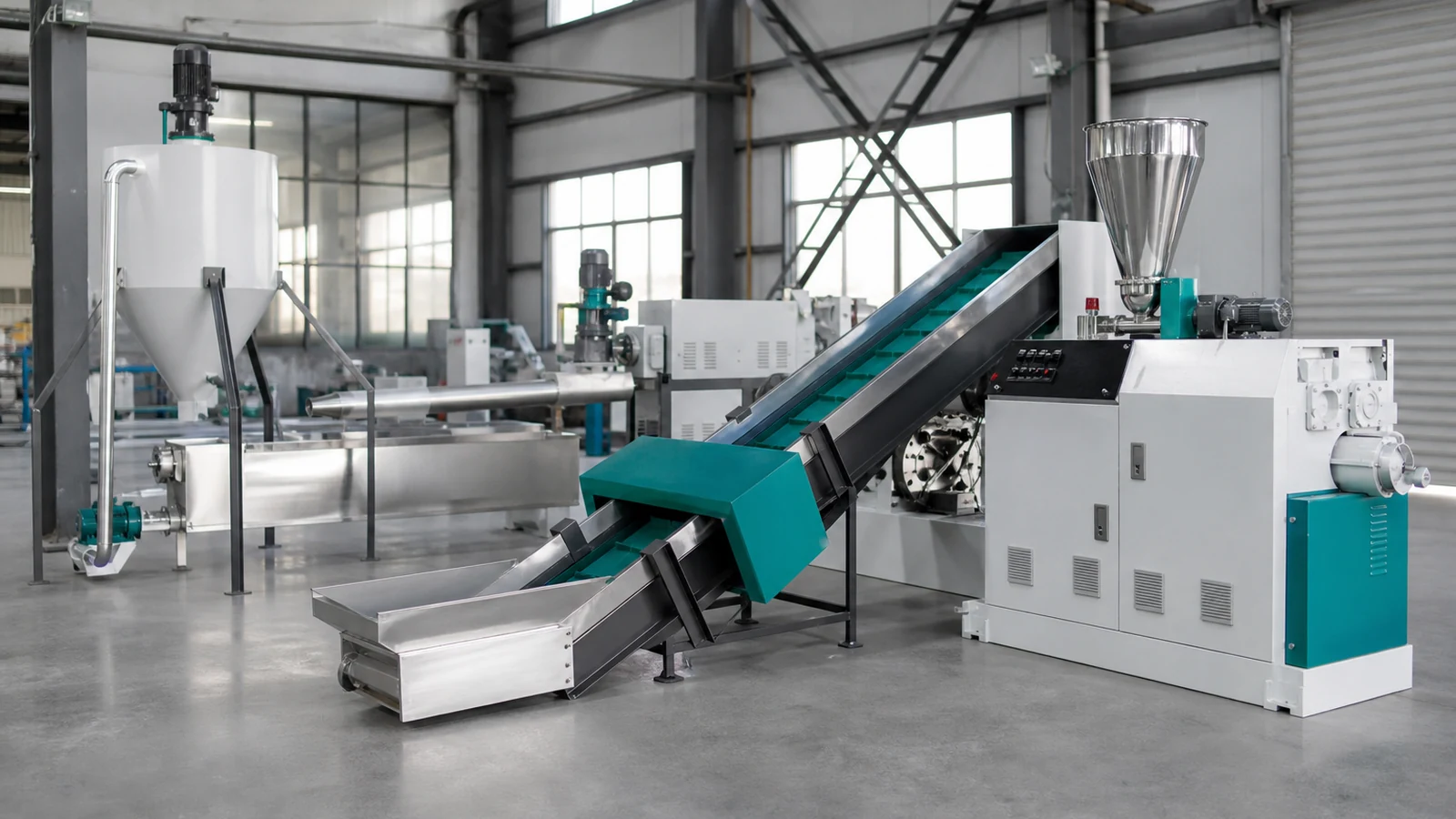
A plastic recycling pelletizing line converts clean plastic flakes, film scrap or rigid regrind into reusable pellets through feeding, extrusion, filtration, cooling and pellet cutting.
A plastic pelletizing line is the last stage of recycling: it turns clean flakes, film scrap or rigid regrind back into pellets a moulder or extruder will actually buy. SUHUI builds single screw and twin screw configurations covering PE and PP film, rigid HDPE, PP, PS and ABS regrind, PET flakes and PVC scrap, with extrusion, filtration, cutting and cooling matched to the feed rather than to a headline capacity figure. Feed form decides most of the specification. For PVC the PVC granulating pelletizing line handles rigid uPVC and flexible PVC at 2–4 mm pellet size, with fume extraction fitted as standard because PVC releases HCl at melt temperature. Film scrap still carrying dirt or moisture goes through a PP PE film washing line first, then to the film compacting pelletizing line, because loose film will not feed a screw without densification. As a factory-direct manufacturer we size the plastic pelletizing system against the stages in front of it. Bulk density of the incoming material, residual moisture and contamination level all move the screw, the filter and the cutting method, and those three inputs matter more to pellet quality than any single number on a datasheet.
Machine Range
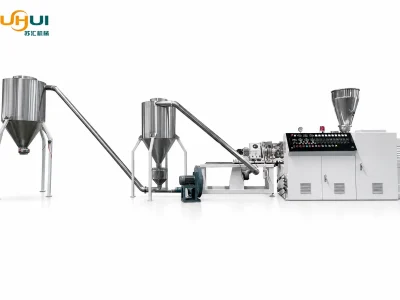
The SUHUI PVC granulating pelletizing line converts rigid uPVC and flexible PVC scrap — offcuts, cable insulation, window profiles and post-consumer PVC — into uniform 2–4 mm recycled PVC pellets....
Read More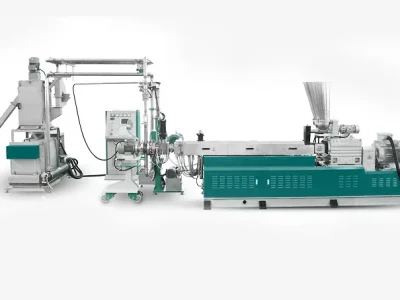
The SUHUI PET flakes glass fiber twin screw pelletizing line produces high-performance engineering plastic pellets by compounding recycled PET flakes with glass fiber reinforcement (10–40% loading). The resulting composite pellets...
Read More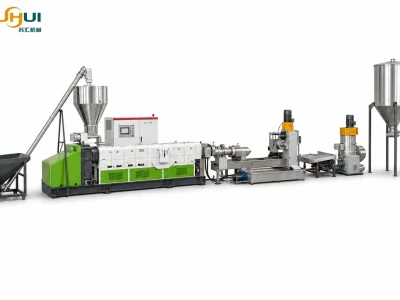
The SUHUI rigid plastic granulating pelletizing line processes HDPE, PP, PS, ABS and mixed rigid plastic waste into uniform 2–5 mm recycled pellets. Heavy-duty granulating, high-torque twin-screw extrusion, multi-stage melt...
Read More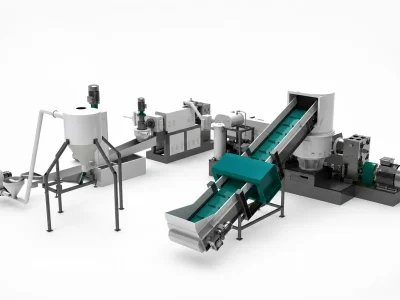
The SUHUI PP PE film compacting pelletizing line transforms post-industrial and post-consumer polypropylene (PP) and polyethylene (PE) film waste into high-quality recycled pellets. It processes a wide range of plastic...
Read MoreSelection Guide
| Material / project situation | Recommended machine | Why it fits |
|---|---|---|
| PVC scrap, cable compound and profile offcuts | PVC Granulating Pelletizing Line | PVC degrades and releases HCl if it sits too long at melt temperature, so screw geometry, temperature profile and residence time are set conservatively and fume extraction is standard, not an option. Rigid uPVC and flexible PVC run on the same line with different profiles. |
| PET flakes, glass fiber compounding and filled formulations | PET Flakes & Glass Fiber Twin Screw Pelletizing Line | Twin screw is specified here for mixing and devolatilization, not for output. PET carries moisture that must leave the melt through vacuum venting, and glass fiber has to be fed downstream so the fibres are wetted without being shredded by the screw. |
| HDPE, PP, PS and ABS rigid regrind from crushers | Rigid Plastic Granulating Pelletizing Line | Rigid regrind has high bulk density and feeds a single screw without help, so this is the simplest and cheapest lane. What decides pellet quality is filtration: regrind from post-consumer sources carries labels, paper and fines that blind a screen changer faster than most buyers expect. |
| LDPE, HDPE and PP film, raffia and woven bag scrap | PP PE Film Compacting Pelletizing Line | Loose film has almost no bulk density and simply bridges over a feed screw. A compactor densifies and part-dries the material before extrusion, which is why film lines cost more than rigid lines at the same nominal output. |
| Mixed or unsorted plastic waste | Sort first, then choose | No pelletizing line resolves mixed polymers. PP and PE tolerate each other in limited ratios; PVC or PET in a PE stream will scorch or degrade and show up as black specks and inconsistent melt flow. Sorting and washing come before this stage, not after it. |
Machine and line configuration is decided by these project factors. Confirming them early makes the recommendation faster and more accurate.
Send your project factorsTwo plants running the same polymer can need entirely different equipment. What separates them is the physical form the material arrives in.
| Feed form | Bulk density | What it forces into the specification |
|---|---|---|
| Rigid regrind (crushed bottles, containers, purge) | High | Feeds a single screw unaided. Simplest lane, lowest cost per kg/h. Budget goes into filtration rather than feeding. |
| Film and raffia | Very low | Bridges over a feed screw. Needs a compactor or force feeder ahead of extrusion, which raises both cost and footprint at the same nominal output. |
| PVC scrap | Varies | Thermal limits dominate. Conservative temperature profile, short residence time and fume extraction, regardless of what form the scrap is in. |
| PET flakes and compounds | Medium | Moisture must leave the melt. Vacuum venting and usually twin screw, because the requirement is devolatilization rather than throughput. |
Send bulk density and moisture content with your enquiry, not just the polymer name. A PE film line and a PE rigid regrind line at 500 kg/h are different machines at different prices, and the difference is decided entirely by how the material behaves at the feed throat.
Material that is still dirty belongs on a plastic washing line before this stage, and anything too large to feed needs a pass through a crusher or shredder first.
Cutting method is the most consequential choice inside a pelletizing line and the one buyers ask about least. It sets pellet shape, residual moisture and how much operator attention the line needs.
| Method | How it works | Pellet character | Best for / watch for |
|---|---|---|---|
| Strand | Melt is drawn into strands through a water bath, then chopped by a rotating cutter. | Cylindrical, very uniform | Clean, well-filtered material. Strands break if the melt is contaminated or unstable, and restringing costs production time. |
| Water-ring | Die-face cutter throws pellets into a rotating water ring that cools and carries them away. | Slightly irregular, teardrop | The general-purpose choice for recycled PE and PP. Tolerant of variable melt; pellets carry more surface water, so drying capacity matters. |
| Underwater | Cutting happens fully submerged at the die face. | Round and the most uniform | Highest pellet quality and highest cost. Justified when the buyer pays a premium for uniformity or when output is continuous and high. |
| Die-face (air) | Cut dry at the die, cooled by air. | Coarse, irregular | Materials that must not touch water. Simple and cheap, but pellet appearance limits what the output can be sold as. |
The practical split for recycled material is narrow. Strand buys uniformity and demands clean melt; water-ring tolerates real-world scrap and demands drying. Underwater is worth it when a customer pays for round pellets, and die-face only when water is unacceptable.
For a step-by-step walk-through of the whole sequence from flake to bagged pellet, see how plastic pellets are made.
A second extrusion stage is not an upgrade for its own sake. It buys filtration and degassing capacity, and it is worth paying for only when the feed actually needs them.
Configuration
How it works
Single-stageOne extruder melts, filters and feeds the cutter directly.
Two-stageA second extruder takes the melt from the first, adding another filtration point and a degassing zone.
Best for
Single-stageClean in-house scrap, washed rigid regrind, single-polymer streams with known history.
Two-stagePost-consumer film, printed or laminated material, anything with high volatile or fines content.
Filtration
Single-stageOne screen changer. Mesh is limited by how much pressure the single screw can build.
Two-stageTwo filtration points, so a finer final mesh is achievable without stalling the first stage.
Degassing
Single-stageLimited to one vent. Printed film and damp feed will show bubbles and voids.
Two-stageDedicated degassing between stages, which is the main reason printed film lines are specified this way.
Watch for
Single-stageCheaper and simpler to run, but it exposes every weakness in the upstream washing stage.
Two-stageHigher cost, more floor space and a second drive to maintain. Over-specified for clean feed.
The question to answer first is not output but feed history. If the material has been printed, laminated or collected post-consumer, budget for two stages. If it is your own washed production scrap, a single-stage rigid plastic granulating line will hold pellet quality at a lower price.
The reference range spans a factor of ten, which is why a single number is meaningless without knowing the feed. Where a project lands is set mostly by the form the material arrives in.
Reference budget
$10,000–100,000
Throughput
100–1,000 kg/h
FOB, line only. Washing, drying and material handling upstream are quoted separately.
| Feed lane | Where it sits in the range | What moves the number |
|---|---|---|
| Clean rigid regrind, single stage | Lower third | Simplest feeding, one extruder, manual or hydraulic screen changer. Throughput class is the main variable. |
| PVC scrap | Lower to middle | Fume extraction and conservative temperature control are mandatory, but the machine itself stays relatively simple. |
| Film with compactor | Middle to upper | The compactor is a second major machine. Add degassing and a continuous screen changer for printed film and the line moves up again. |
| PET or compounding, twin screw | Upper third | Twin screw, vacuum system and side feeders. Cost is driven by mixing and devolatilization requirements, not by kg/h. |
Two options account for most of the spread inside any one lane: the screen changer and the cutting method. A continuous backflush changer and an underwater cutter can together cost more than the extruder they are attached to, and both are specified from feed cleanliness rather than from output.
Cross-category price ranges for shredding, washing and complete lines are on the plastic recycling machine overview. Exact figures depend on material and output and are confirmed with the quotation.
Before You Ask
To receive a more accurate recommendation, send your material type, material form, contamination level, required capacity, target output, plant space, local voltage and destination country. Material photos or videos are also helpful.
Tell us your material and target output. We reply with practical recommendations, not generic sales replies.
Send SUHUI your material type, target capacity, final output, plant space, voltage and destination country. Material photos or videos help our team recommend a suitable machine or complete line configuration.