Recyclers comparing pelletizing quotations often notice that two lines with similar rated capacity carry very different prices. The difference is usually not the brand — it is the number of extrusion stages and the degassing and filtration hardware behind them. Pick a configuration that is too light for your material and the cost shows up later: porous pellets, unstable output, odor complaints, and recycled material that sells below market price.
This guide explains what single-stage and double-stage systems actually do in plastic recycling pelletizing, which feedstock each one suits, and how to read common pellet defects before deciding. It applies to the full range of plastic pelletizing lines, whether the input is rigid regrind, film, raffia or washed post-consumer flakes.
What Stage Actually Means in Plastic Recycling Pelletizing
The “stage” in a pelletizing line counts how many times the material passes through melt extrusion. It is not a marketing tier — it changes the machine layout, the footprint, and what the line can tolerate in the feedstock.
- Single-stage flow: material → extruder (melting, venting, pressure build-up) → melt filtration → pelletizing.
- Double-stage flow: material → first extruder (melting, homogenizing, main degassing) → filtration → second extruder (pressure stabilizing, final degassing) → filtration → pelletizing.
A double-stage system is, in practice, a controlled way of processing the melt twice. That second pass exists for one reason: some materials carry more moisture, ink and volatiles than a single vent and a single screen can remove.
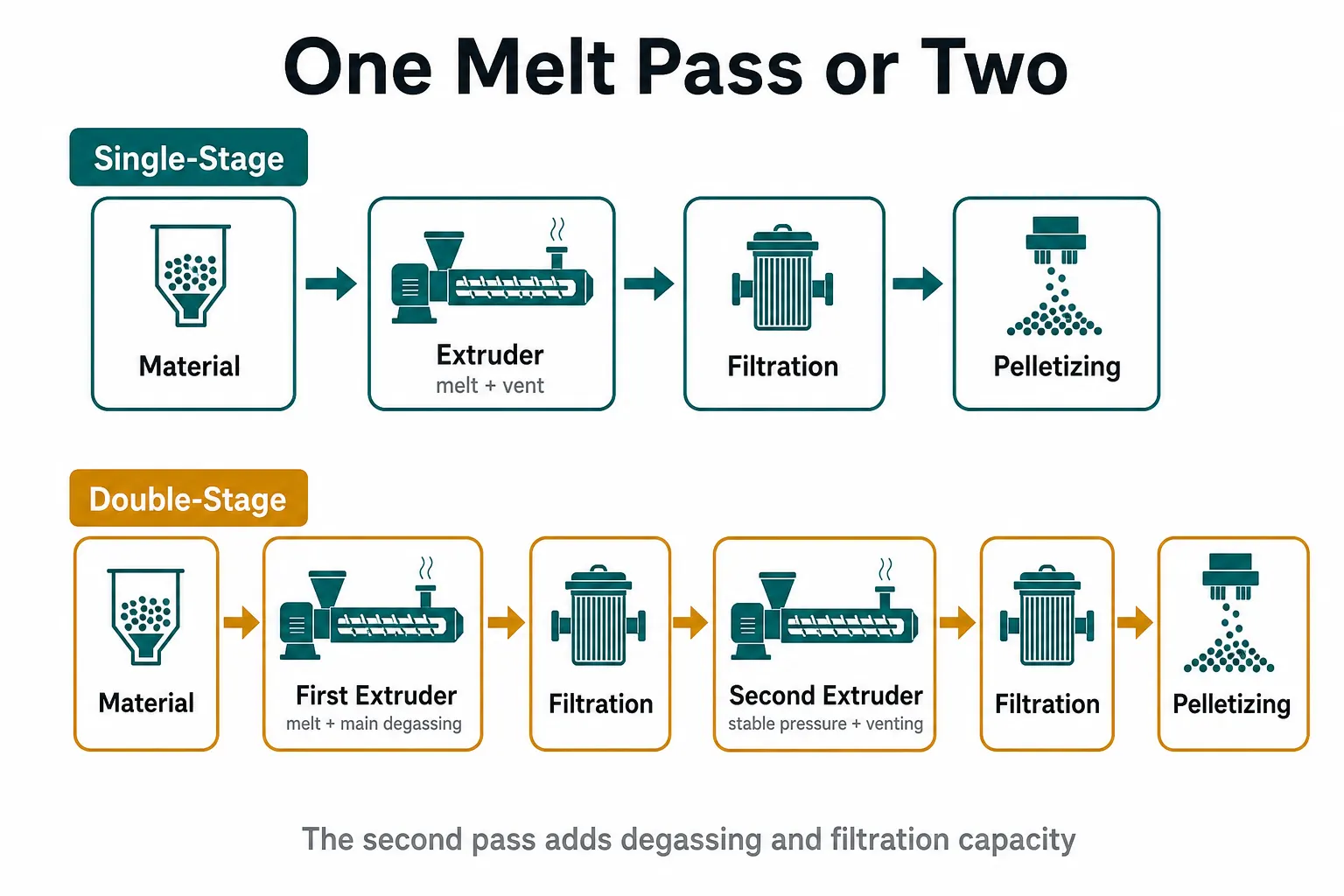
The same material takes one melt pass in a single-stage line and two in a double-stage line — the extra pass buys degassing and filtration capacity.
Inside a Single-Stage Pelletizing Line
A single-stage line asks one extruder to do every job: feed, melt, mix, vent moisture and volatiles through one degassing zone, and build stable pressure for the filter screen and die head. When the input material is clean and dry, this is exactly as much machine as you need. Where the feedstock is dirtier, a full plastic recycling machine line adds washing and drying ahead of the extruder.
Its strengths are practical: lower investment, smaller footprint, fewer drive motors and wear parts, and simpler operation. The limits are just as practical. One venting zone can only remove so much gas, and one filtration point carries the entire contamination load. Feed it damp flakes or heavily printed film, and the melt reaches the die still carrying moisture and volatiles — which is where porous, lightweight pellets come from.
Typical single-stage feedstock: clean edge trims and rolls from film production, sprues and rejects from molding, and dry rigid regrind from a single known source.
Inside a Double-Stage Pelletizing Line
A double-stage line — often called a mother-baby or two-stage extruder system — splits the work between two machines connected in series.
The first extruder concentrates on melting, homogenizing and aggressive degassing. Because it does not need to build final die pressure, it can run with a generous venting section that pulls moisture, ink carriers and other volatiles out of the melt. The second extruder receives clean molten material and does the opposite job: running slower, it rebuilds stable, consistent pressure for the final filtration screen and the die, without churning new air into the melt.
The result is a system that tolerates what single-stage lines struggle with: printed and laminated film, washed post-consumer flakes with residual moisture, and mixed feedstock whose contamination varies bale to bale. On the SUHUI PP PE film compacting pelletizing line, the second extruder is available as an optional upgrade for exactly this reason — it adds two-stage filtration and additional degassing when the output pellets have to meet demanding quality requirements.
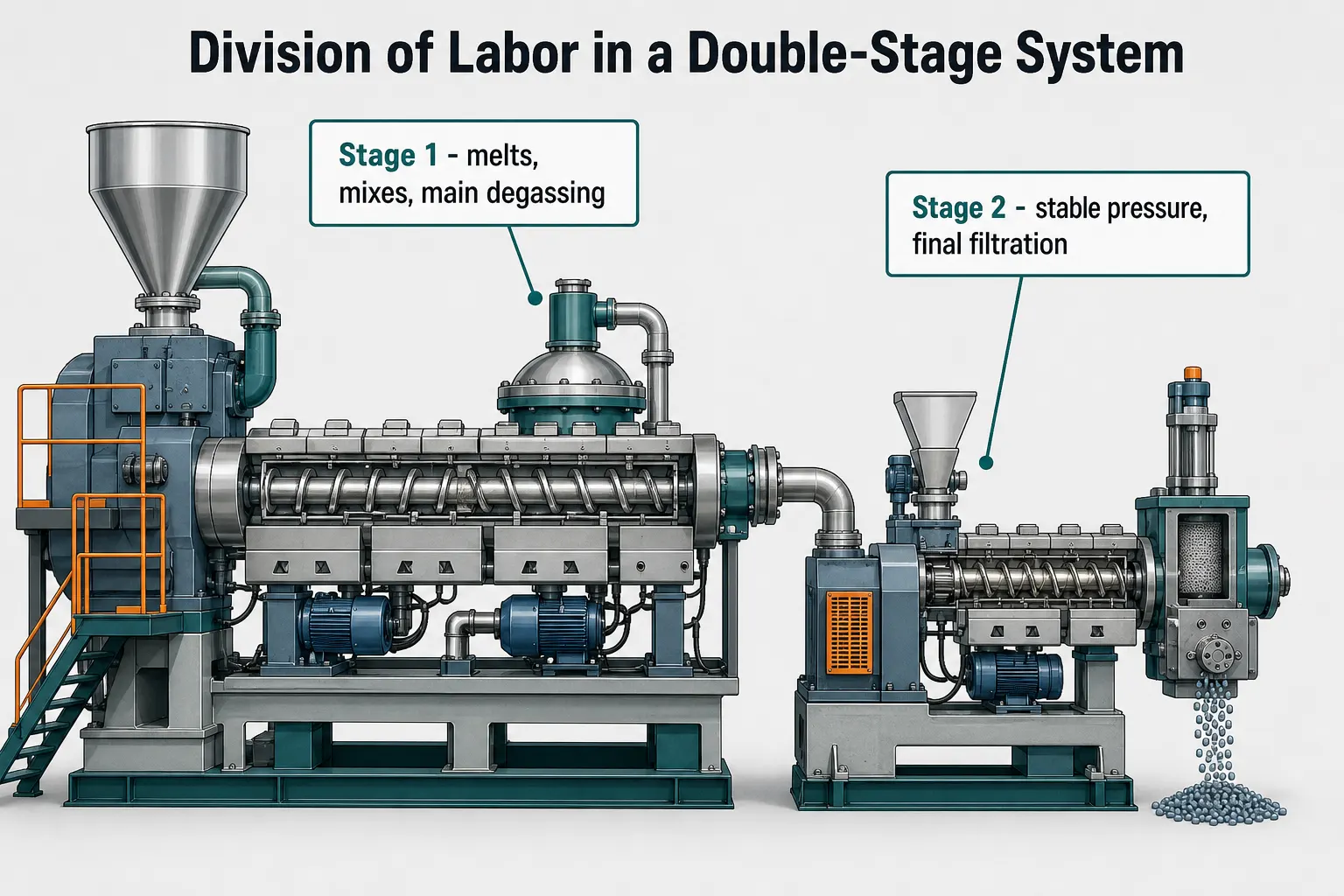
Division of labor in a double-stage system: the first extruder melts and degasses, the second stabilizes pressure for final filtration and pelletizing.
Single-Stage vs Double-Stage at a Glance
Here is how the two configurations compare on the points that drive both the quotation price and the pellet quality.
| Aspect | Single-Stage Line | Double-Stage Line |
|---|---|---|
| Structure | One extruder does melting, venting, filtration and pressure | Two extruders in series, each specialized |
| Investment and footprint | Lower cost, more compact | Higher cost, longer layout |
| Degassing | One venting zone, limited capacity | Main degassing in stage one plus additional venting in stage two |
| Filtration | Single filtration point, pressure fluctuates with contamination | Two filtration points with stable pressure from the second extruder |
| Suitable input | Clean, dry, single-source industrial scrap | Printed, laminated, damp or mixed post-consumer material |
| Pellet quality risk | Porosity and odor if material is moist or printed | Denser, more uniform pellets from difficult feedstock |
| Operation | Simpler, fewer wear parts | Second extruder to power and maintain |
Match the Line to Your Material
Configuration should follow the feedstock, not the other way around. The table below maps common recycled plastic streams to the route that normally fits them — and to the SUHUI equipment page that covers that route.
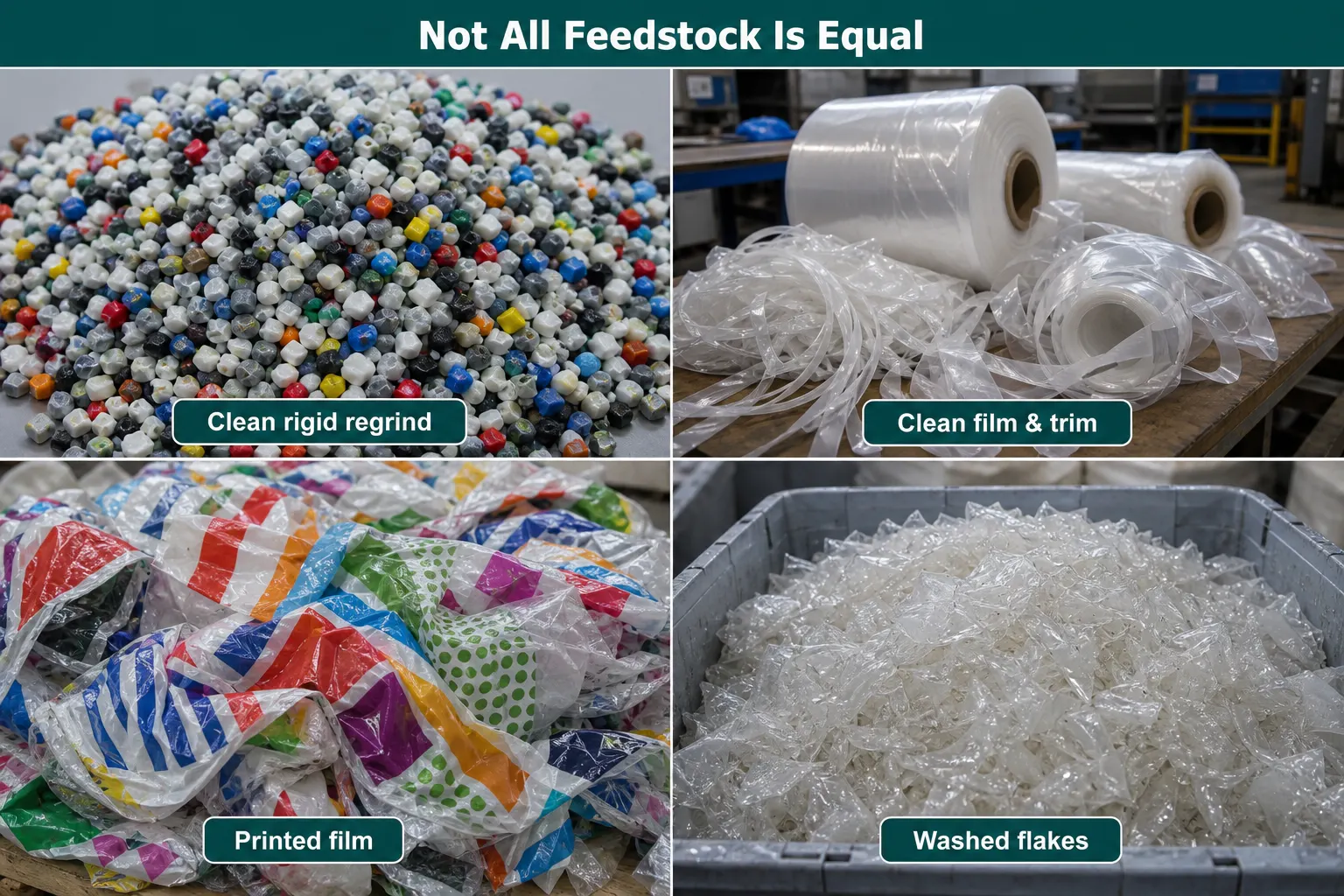
Four very different feedstocks — clean regrind, clean film, printed film and washed flakes — and they do not belong on the same pelletizing configuration.
| Feedstock Condition | Recommended Route | Relevant SUHUI Page |
|---|---|---|
| Clean, dry rigid regrind (HDPE, PP, PS, ABS) | Single-stage granulating and pelletizing with multi-stage melt filtration | Rigid Plastic Granulating Pelletizing Line (300–3,000 kg/h) |
| Clean PP/PE film, raffia, woven bag offcuts | Compactor-fed single-stage pelletizing | PP PE Film Compacting Pelletizing Line |
| Printed or laminated film, demanding pellet spec | Double-stage — add the optional second extruder for two-stage filtration and extra degassing | PP PE Film Compacting Pelletizing Line with second extruder option |
| Washed film flakes straight from a washing line | Dry to spec first, or use a squeezer-dryer route that combines squeezing and pelletizing | Plastic Film Squeezer Granulating Machine (300–750 kg/h); upstream PP PE film washing line delivers flakes below 5% moisture |
| Agricultural film after washing | Double-stage with strong vacuum degassing — residual moisture and organics are the norm | Film compacting pelletizing line, double-stage configuration |
| PVC scrap | Dedicated PVC route — never mixed into PP/PE pelletizing | PVC Granulating Pelletizing Line |
| PET flakes, glass fiber compounding | Twin screw system with dedicated degassing and filtration | PET Flakes & Glass Fiber Twin Screw Pelletizing Line |
Cutting method is a separate choice from stage count: strand pelletizing is the versatile standard, a water ring pelletizing line suits soft or sticky materials, and underwater pelletizing gives the highest pellet uniformity and surface finish. All three are available on SUHUI pelletizing systems and are selected to match the polymer, not the stage configuration.
Pellet Defects That Point to the Wrong Configuration
Pellet problems are diagnostic. Before upgrading or blaming the extruder, read the defect — it usually tells you which part of the chain is undersized for the material.
| Defect | Most Likely Cause | What to Check First |
|---|---|---|
| Bubbles, porous or hollow pellets | Residual moisture or trapped volatiles expanding as pellets cool | Flake moisture before the extruder, then vacuum degassing capacity and vent blockages |
| Black specks in pellets | Contaminants passing filtration, or degraded material from overheating | Filtration fineness, screen changer condition, barrel temperature settings |
| Odor in pellets | Volatiles from inks, organics or washing residue not extracted from the melt | Degassing zones — single-vent systems often cannot strip heavily printed material |
| Fluctuating output or pellet size | Unstable die pressure as contamination loads the single filtration point | Whether the line is running material beyond its stage configuration |
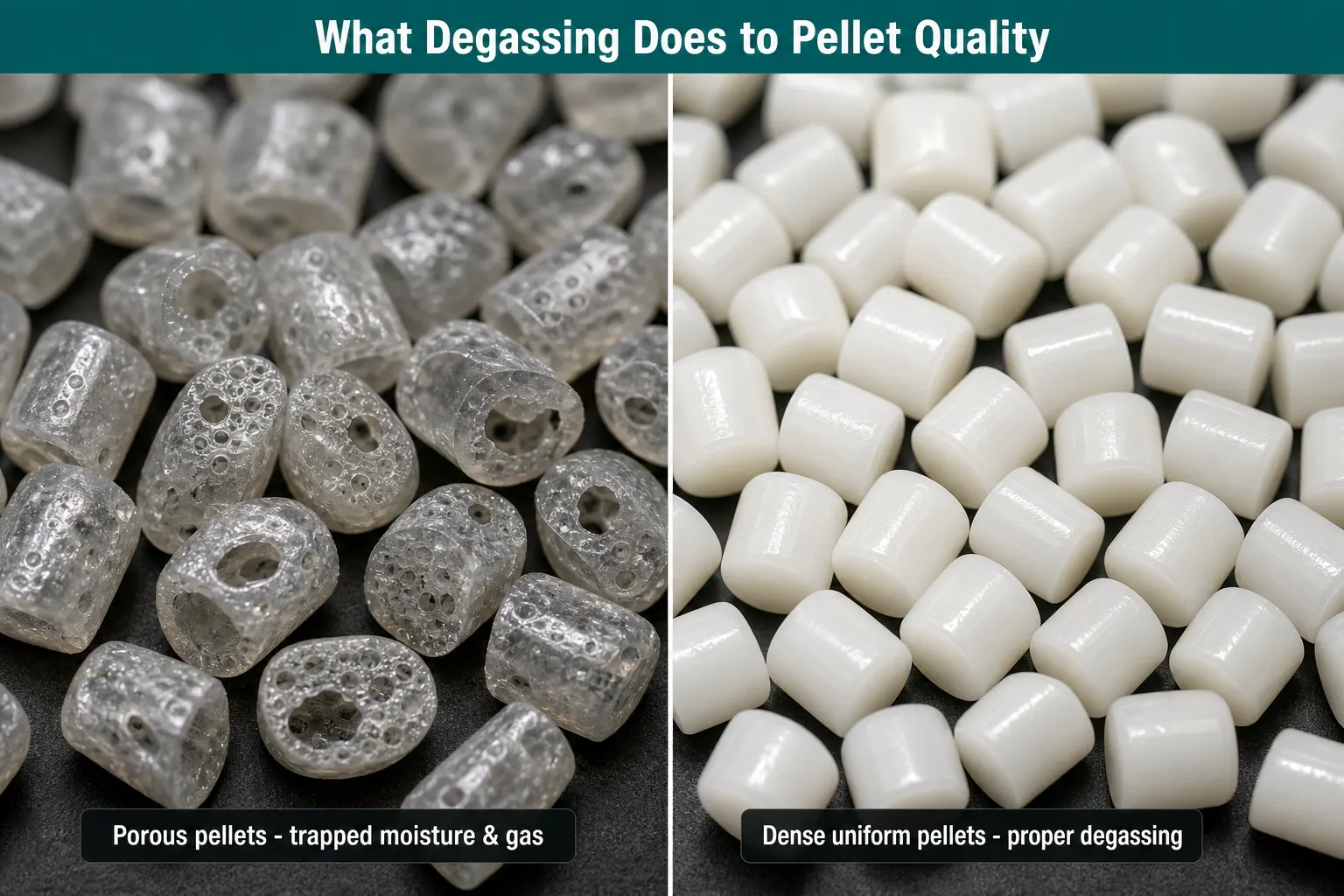
The same polymer, two outcomes: porous pellets from moisture and trapped gas, dense uniform pellets when degassing and filtration match the material.
Five Questions to Answer Before You Decide
- What exactly is the material, and where does it come from? Single-source industrial scrap behaves predictably; post-consumer bales change from delivery to delivery.
- How much moisture reaches the extruder? Not how dry the material looks — what a moisture test says after your real drying step.
- How much ink, lamination or residue does it carry? Printing load is the single most common reason a single-stage line disappoints.
- What must the pellets do downstream? Feeding your own extrusion line is a different requirement from selling to a buyer with density and appearance specs.
- What capacity do you need now, and in two years? A configuration that is upgradeable — such as adding a second extruder later — protects the budget on both ends.
SUHUI engineering note: A surprising share of “single-stage quality problems” we are asked to solve turn out to be drying problems. If washed flakes reach the extruder wet, adding a second stage treats the symptom at a high price — while better dewatering, or a film squeezer that removes moisture and compacts the film in one step, often fixes it upstream for less. Measure moisture first. Then decide how many stages you are really paying for.
The Decision at a Glance
A single-stage line fits when:
- the material is clean, dry, single-source industrial scrap;
- printing and lamination are minimal;
- pellets feed your own production rather than an external spec buyer;
- budget and floor space are tight.
A double-stage line fits when:
- the feedstock is printed, laminated or coated film;
- flakes arrive from washing with residual moisture;
- sources are mixed and contamination varies;
- buyers demand dense, uniform, low-odor pellets.
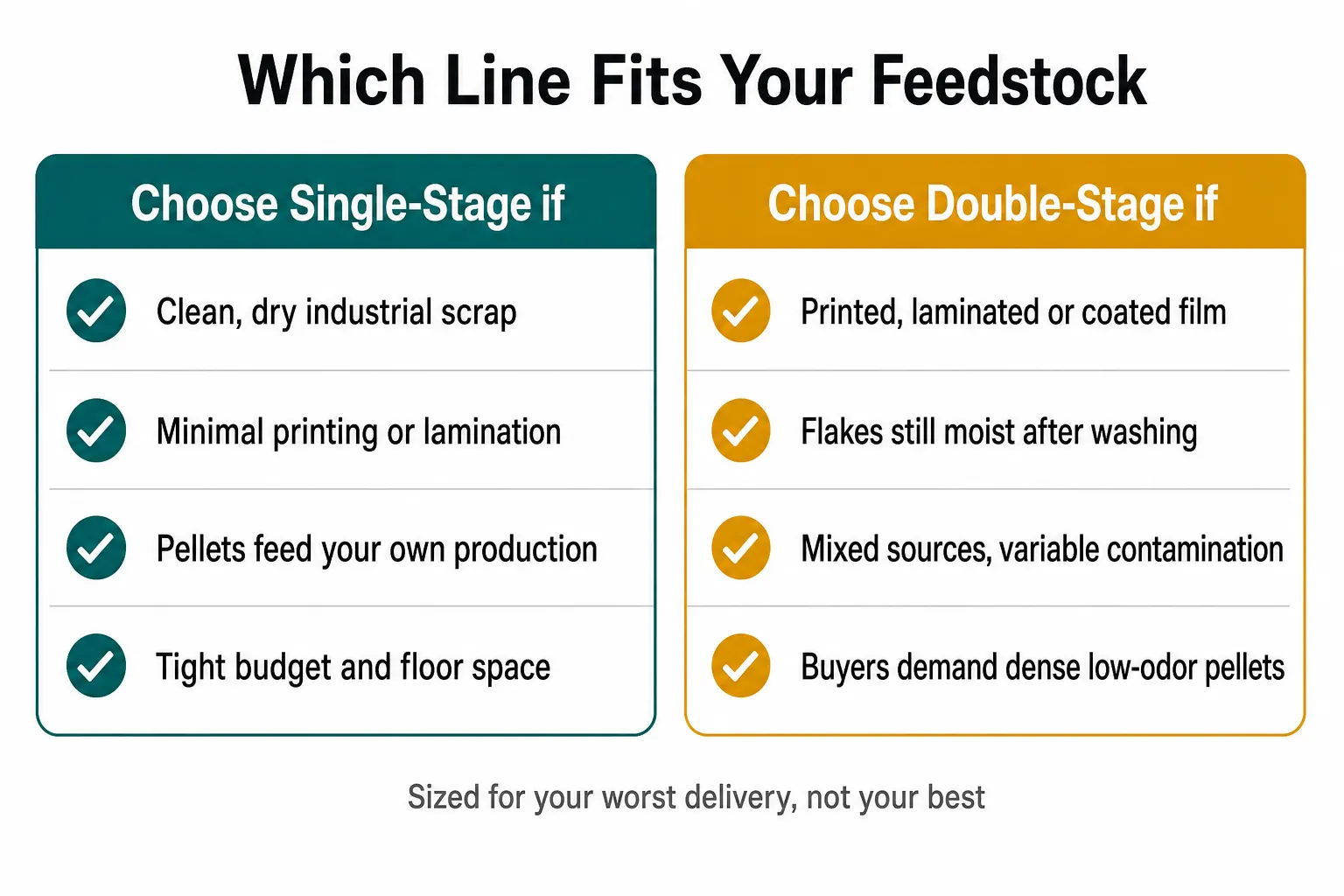
Read the two lists against your own feedstock — most pelletizing decisions resolve in these eight lines.
Conclusion
Single-stage and double-stage pelletizing are not quality tiers — they are answers to different feedstock. Clean, dry scrap does not need a second extrusion pass, and paying for one adds cost without adding value. Printed, moist or mixed post-consumer material does need it, and forcing it through a single vent and a single screen produces pellets that undersell the effort spent washing them. Pellet buyers increasingly reference recyclate quality guidance from organizations such as the Association of Plastic Recyclers (APR) when setting specifications — and the line that earns money is the one matched to the material you actually process, with degassing and filtration sized for its worst deliveries, not its best.
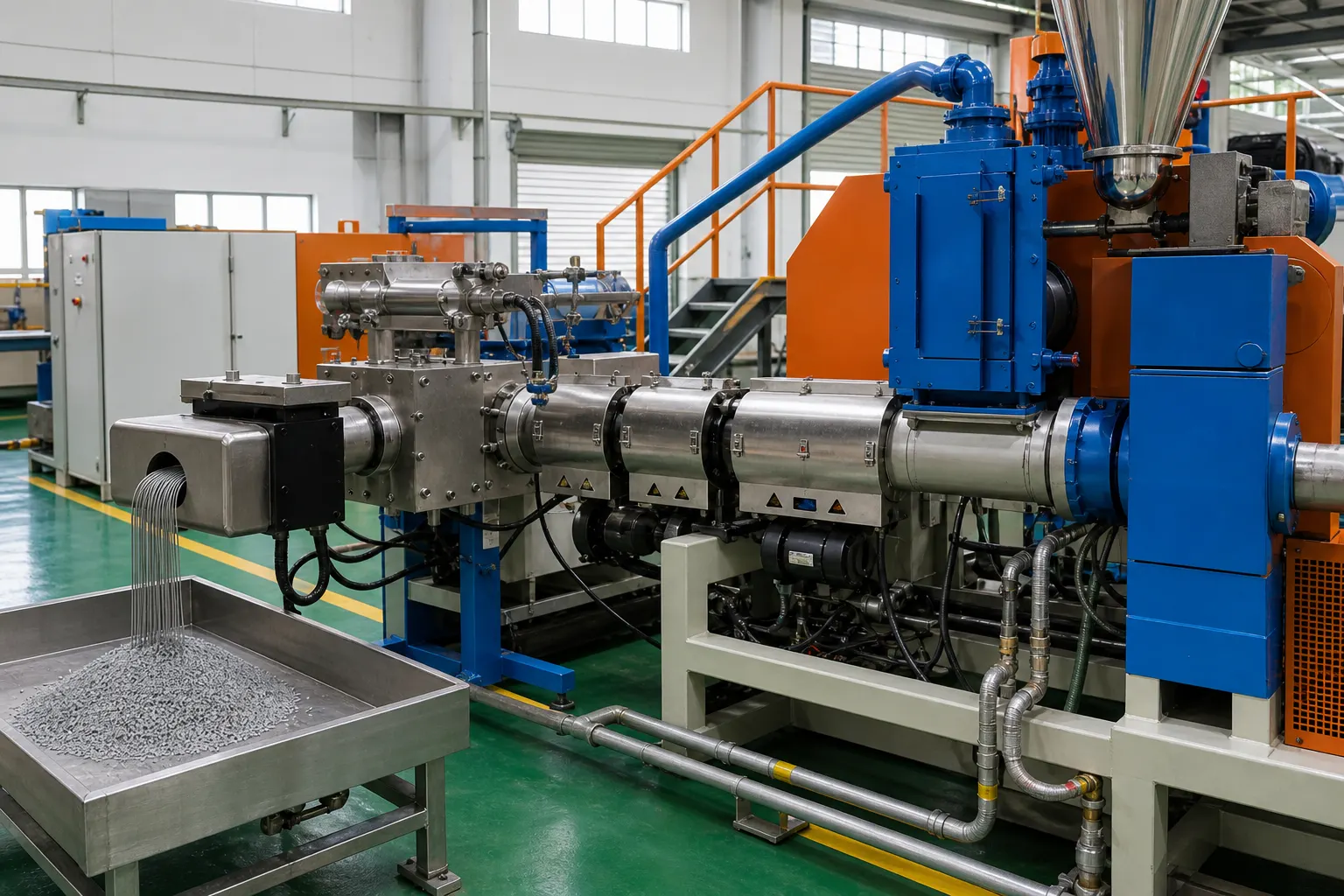
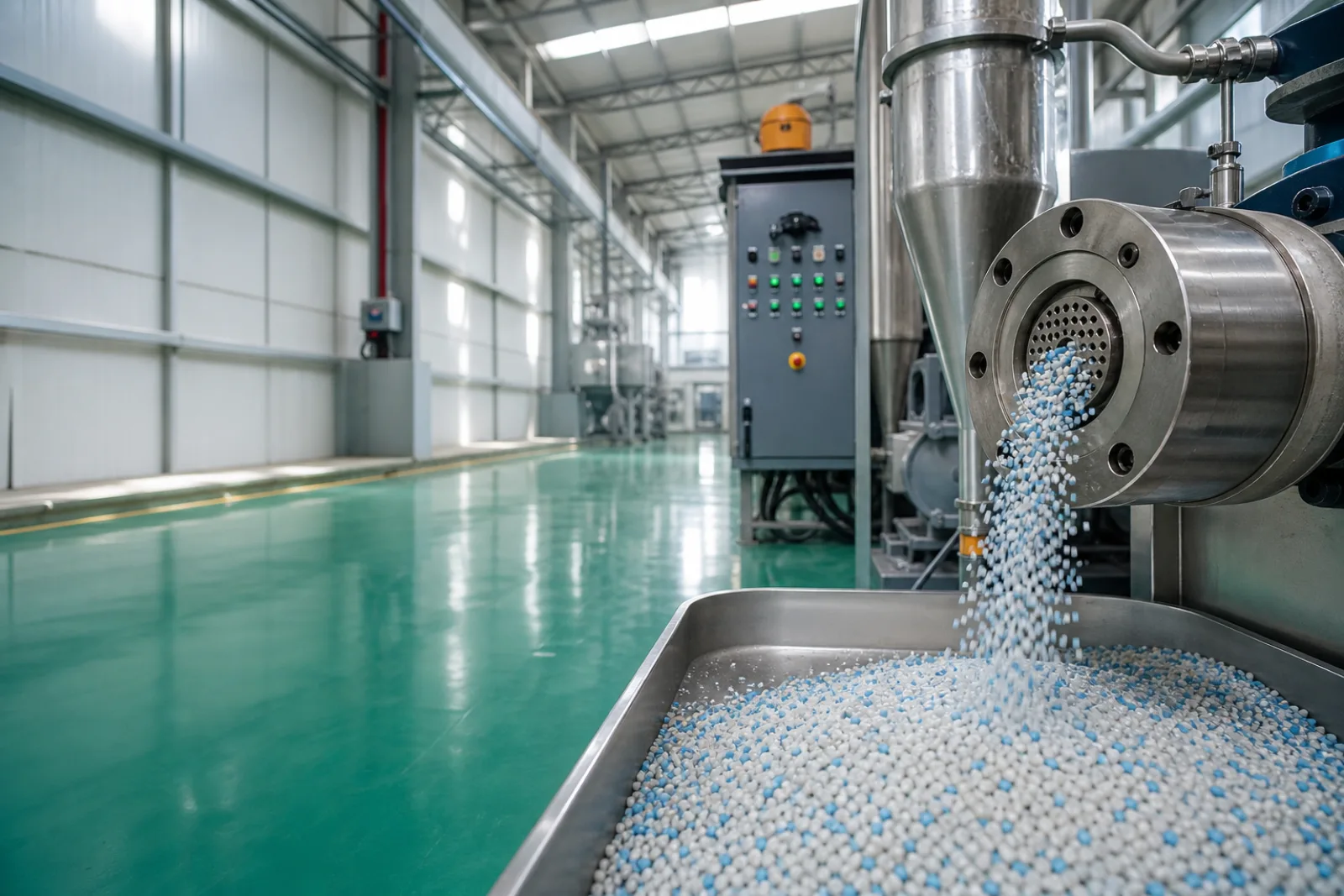
SUHUI pelletizing equipment in production — configuration, degassing and filtration are specified per project against the customer’s feedstock.
Further Reading
- How Plastic Pellets Are Made: Process, Equipment & Pelletizing Lines — The full pelletizing process from feedstock preparation to pellet cutting.
- Twin Screw Extruder: How It Works in PVC and Plastic Recycling Lines — Where twin screw systems fit, including PET and glass fiber compounding.
Frequently Asked Questions
What is the difference between a single-stage and a double-stage pelletizing line?
A single-stage pelletizing line completes melting, degassing, filtration and pelletizing in one extrusion pass. A double-stage line runs two extruders in series: the first melts, homogenizes and removes most gases, and the second rebuilds stable pressure for final filtration and pelletizing. In plastic recycling pelletizing, the second pass adds the degassing and filtration capacity that printed, moist or contaminated plastics require.
When do I need a double-stage pelletizing line?
When the feedstock carries ink, lamination, residual moisture or variable contamination — typical for washed post-consumer film and agricultural film — and when buyers require dense, uniform, low-odor pellets. Clean, dry, single-source industrial scrap rarely justifies the second stage.
Can a single-stage line process printed or washed film?
It can run the material, but one venting zone has limited capacity to strip ink carriers and residual moisture from the melt. With light printing and properly dried flakes the result can be acceptable; with heavy printing or damp flakes, expect porosity, odor and unstable output. That is the point where a second extrusion stage, or better upstream drying, pays for itself.
Why do recycled plastic pellets have bubbles?
Bubbles and porous pellets are almost always residual moisture or trapped volatiles that expand as the pellets cool. Check flake moisture before blaming the extruder, then verify vacuum degassing capacity, vent blockages and filtration condition. Double-stage systems reduce bubbles because gases are removed between the two extrusion passes.
Does a double-stage line cost more to run?
It has a second extruder to power and maintain, so energy use and wear-part costs are higher than a comparable single-stage line. Whether it costs more per usable ton is a different question: on difficult material, the single-stage alternative produces more rejects and lower-grade pellets, which usually outweighs the added running cost. On clean material the extra stage is simply unnecessary.
Contact SUHUI to configure a pelletizing line around your actual material, moisture condition and target pellet quality.
Have a Material You Need to Process?
Send the polymer, its form and your target output. We will come back with a line configuration and a realistic budget range.