Los molinos y trituradoras de plástico reducen residuo voluminoso, tubería, envases, películas, bolsas y desecho rígido a piezas más pequeñas para lavado, peletizado, extrusión o reducción de volumen.
La trituradora de plástico es la primera etapa de casi toda línea de reciclaje. Reduce el residuo voluminoso — tambores, tubería de pared gruesa, pacas de película, sacos tejidos, bloques de purga y envases rígidos — a un tamaño que la máquina siguiente realmente pueda aceptar. SUHUI construye esta etapa como trituradoras de eje único y de doble eje de alto torque, máquinas dedicadas para tubería y big bags, y molinos de alta velocidad, especificados por el tamaño del material, su dureza y la producción objetivo, y no solo por la capacidad de placa. La reducción de tamaño es una etapa, no el trabajo completo. La película enfardada o contaminada sigue hacia una línea de lavado de película PP PE; el molido rígido limpio y los recortes de PVC pueden alimentar directamente una línea de peletizado, y el material que solo necesita ser más pequeño va directo a un molino de plástico. Equivocarse en esta etapa reaparece más adelante como cribas ciegas, alimentación despareja y etapas de lavado que nunca terminan de limpiar el material. Como fabricante directo cotizamos la trituradora contra la línea que va a alimentar y no de forma aislada. Los transportadores, la detección de metales y la extracción de polvo se especifican a partir de lo que corre después de la máquina, porque ahí es donde una trituradora subdimensionada o mal configurada realmente cuesta dinero.
Machine Range
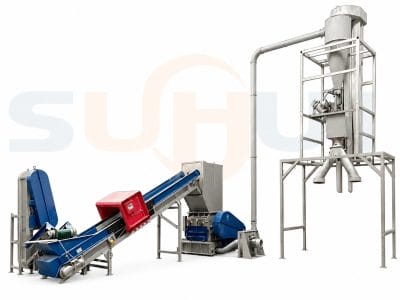
El molino de plástico SUHUI es una máquina robusta diseñada para reducir el residuo plástico a piezas uniformes, reutilizables directamente en producción. Procesa con eficiencia una amplia gama de materiales,...
Leer Más
La trituradora de tubería HDPE de SUHUI está diseñada para desecho de tubería de HDPE grande, rígida y de pared gruesa proveniente de redes de agua potable, distribución de gas,...
Leer Más
La trituradora de doble eje de SUHUI reduce tambores plásticos voluminosos, contenedores industriales, tubería de HDPE y PP, big bags, perfiles, láminas, pacas de película y residuo plástico rígido mixto...
Leer Más
La trituradora de eje único de SUHUI reduce películas plásticas, tubería, perfiles, envases rígidos, residuo de empaque y desecho industrial mixto a fragmentos con tamaño controlado por criba, listos para...
Leer Más
La trituradora de big bags de SUHUI procesa big bags FIBC, sacos a granel, bolsas de una tonelada, sacos tejidos de PP, costales de rafia y bolsas con residuo, convirtiéndolos...
Leer MásGuía de Selección
| Material / project situation | Recommended machine | Why it fits |
|---|---|---|
| Película, escamas y piezas de pared delgada ya reducidas a un tamaño manejable | Molino de Plástico | Un rotor de alta velocidad corta contra cuchillas fijas de bancada y la salida pasa por una criba, de modo que el molido sale pequeño y uniforme. Es la máquina que en la mayoría de los mercados se vende como granulador de plástico o molino triturador — un mismo principio de corte con tres nombres. Aliméntela con material predimensionado; se trabará con tambores o tubería de pared gruesa. |
| Tubería HDPE de gran diámetro y desecho de tubería rígida de pared gruesa | Trituradora de Tubería de HDPE | Una geometría de alimentación reforzada mantiene los tramos largos de tubería contra el rotor en lugar de dejarlos montarse encima. El trabajo lo hace el torque y no la velocidad, y por eso un molino de uso general se traba con el mismo material. |
| Residuo voluminoso, sin clasificar o con metal, que no alimenta ninguna máquina | Trituradora de Doble Eje | Dos ejes contrarrotantes arrastran el material y lo desgarran, de modo que tambores, bloques y desecho mixto se reducen sin clasificación previa. La salida es gruesa y normalmente requiere un segundo paso antes del lavado, así que presupueste también la máquina siguiente. |
| Residuo plástico mixto cuando la etapa siguiente exige un tamaño de partícula definido | Trituradora de Un Solo Eje | Un empujador hidráulico mantiene el material contra el rotor y una criba intercambiable define el tamaño de salida, lo que hace repetible el resultado de lote en lote. Cambiando la criba cambia el tamaño de partícula sin cambiar de máquina. |
| Big bags de PP, FIBC, sacos tejidos y otros empaques fibrosos | Trituradora de Big Bags | El PP tejido se enrolla en un rotor convencional en lugar de ser cortado por él. Aquí la geometría de cuchillas y el control de alimentación están hechos para material fibroso, y la salida son tiras que una línea de lavado puede transportar, no madejas enredadas. |
| Desecho posconsumo húmedo, pegajoso o muy contaminado | Dos máquinas, no una | Las cribas se ciegan con material húmedo o pegajoso, así que una máquina con criba por sí sola es la respuesta equivocada. Pretriture grueso, lave y después muela el material ya seco. La arena y la arenilla de este tipo de desecho además acortan la vida de las cuchillas, lo que es un costo operativo y no de compra. |
La configuración de la máquina y de la línea la deciden estos factores del proyecto. Confirmarlos temprano hace que la recomendación sea más rápida y más precisa.
Envíe los datos de su proyectoLos compradores buscan las tres palabras y muchas veces se refieren a la misma máquina. Los nombres describen cómo se corta el material, no qué tan buena es la máquina.
| Clase de máquina | Cómo corta | Alimentación típica | Carácter de la salida |
|---|---|---|---|
| Trituradora | Baja velocidad, alto torque. Un eje giratorio con discos de corte desgarra el material. | Desecho voluminoso, de pared gruesa, enfardado o mixto, que no entra en una máquina más pequeña | Piezas gruesas, dimensionadas por criba o por la geometría del eje |
| Molino (también se vende como plastic granulator machine o plastic grinder machine) | Alta velocidad. Las cuchillas del rotor cortan contra cuchillas fijas y la salida atraviesa una criba. | Material ya dimensionado: película, escamas, piezas de pared delgada, material triturado | Molido más pequeño y uniforme, listo para lavado o peletizado |
| Peletizadora | Funde y extruye, y luego corta las hebras o en la cara de la matriz. | Molido limpio y seco | Pellets — otro proceso, no una reducción de tamaño |
Si una cotización dice granulator, confirme qué máquina le están ofreciendo antes de comparar precios. En la mayoría de los mercados de habla inglesa la palabra designa el molino de alta velocidad que produce escamas; en los listados de equipos que llegan de Asia a veces designa la línea de peletizado que produce pellets. Las dos difieren en un orden de magnitud de costo.
Para una comparación más extensa de los tres principios de corte, vea granulador, trituradora o molino. Para elegir entre clases de máquina a partir de su propio material, la tabla de selección de arriba es el camino más rápido.
La cantidad de ejes es la principal decisión de ingeniería dentro de la familia de trituradoras. La define cómo se comporta el material al encontrarse con el rotor, y no solo la producción objetivo.
Configuración
Cómo corta

Eje únicoUn rotor, un empujador hidráulico que mantiene el material contra las cuchillas y una criba que define el tamaño de salida.

Doble ejeDos ejes contrarrotantes con cuchillas intercaladas arrastran el material y lo desgarran. Normalmente sin criba.
Ideal para
Eje únicoPelícula, bolsas, tramos de tubería y bloques de purga — todo lo que va a alimentar una línea de lavado o de peletizado.
Doble ejePretriturar residuo voluminoso o sin clasificar: tambores, bloques de pared gruesa, desecho mixto contaminado con metal.
Control de salida
Eje únicoDefinido por la criba y repetible de lote en lote; el tamaño de partícula cambia con la criba.
Doble ejeLo fijan el ancho y el espaciado de las cuchillas. Más grueso y menos uniforme.
Torque
Eje únicoModerado. El corte proviene de la velocidad del rotor contra las cuchillas fijas.
Doble ejeAlto por unidad de potencia del motor, porque viene de dos ejes accionados y de un reductor más pesado.
A tener en cuenta
Eje únicoLas cribas se ciegan con material húmedo o pegajoso; el desecho contaminado desgasta las cuchillas más rápido.
Doble ejeLa salida normalmente todavía necesita pasar por un molino o por una máquina de eje único antes del lavado.
En la práctica la división es simple. Si el material ya es manejable y la etapa siguiente necesita un tamaño definido, especifique una trituradora de eje único. Si el problema es que el material está demasiado grande, demasiado duro o demasiado mezclado para alimentar cualquier cosa, ponga delante una trituradora de doble eje.
La tubería de pared gruesa y los big bags FIBC aparecen con la frecuencia suficiente como para tener configuraciones propias. La trituradora de tubería HDPE y la trituradora de big bags son máquinas de eje único, con geometría de alimentación y rotores ajustados a esos dos materiales.
Dos cifras enmarcan el presupuesto. Dónde cae un proyecto entre ellas lo decide una lista corta de opciones, y hay un costo recurrente que nunca aparece en la cotización.
Presupuesto de referencia
USD 10.000–30.000
Capacidad
200–1.000 kg/h
FOB, solo la máquina. Los transportadores, la detección de metales y la extracción de polvo se cotizan por separado.
Las cuchillas son un consumible, y lo que duran depende casi por completo de lo que pasa por ellas. La purga limpia de producción interna es suave; el desecho posconsumo que trae arena, arenilla o algún perno ocasional no lo es. Las cuchillas normalmente pueden girarse a un filo nuevo y más adelante rectificarse antes de reemplazarlas, así que vale la pena hacer tres preguntas junto con el precio de la máquina.
Pregunta 01
¿Cuántos filos de corte tiene?Una cuchilla que puede girarse varias veces antes de rectificarla dura mucho más que una que no.Pregunta 02
¿Se puede reafilar localmente?Rectificar en su propio mercado evita mandar las cuchillas de ida y vuelta en cada intervalo de servicio.Pregunta 03
¿Cuánto cuesta un juego de repuesto?A lo largo de unos años esto pesa más que la diferencia entre dos precios de máquina.Los rangos de precio por categoría para lavado, peletizado y líneas completas están en la vista general de máquinas de reciclaje de plástico. Las cifras exactas dependen del material y de la producción, y se confirman con la cotización.
Before You Ask
Para recibir una recomendación más precisa, envíe su tipo de material, la forma en que llega, el nivel de contaminación, la capacidad requerida, el producto final buscado, el espacio en planta, la tensión eléctrica local y el país de destino. Las fotos o videos del material también son de gran ayuda.
Indíquenos su material y su producción objetivo. Respondemos con recomendaciones concretas, no con respuestas comerciales genéricas.
Envíe a SUHUI su tipo de material, capacidad objetivo, producto final, espacio disponible en planta, tensión eléctrica y país de destino. Las fotos o videos del material ayudan a nuestro equipo a recomendar la máquina o la configuración de línea completa más adecuada.


