A PP PE film compacting pelletizing line densifies and pelletizes washed polyethylene and polypropylene film into reusable pellets through compacting, extrusion, filtration and pellet cutting.


The SUHUI PP PE film compacting pelletizing line transforms post-industrial and post-consumer polypropylene (PP) and polyethylene (PE) film waste into high-quality recycled pellets. It processes a wide range of plastic film types including agricultural mulch film, greenhouse covers, LDPE packaging film, HDPE bags, and stretch wrap — removing contaminants such as dirt, sand, inks, and adhesives to produce clean, uniform output.
The SUHUI PP PE film compacting pelletizing line transforms post-industrial and post-consumer polypropylene (PP) and polyethylene (PE) film waste into high-quality recycled pellets. It processes a wide range of materials including agricultural mulch film, greenhouse covers, LDPE packaging film, HDPE bags, stretch wrap, raffia, filament, woven bags, and non-woven fabric — removing contaminants such as dirt, sand, inks, and adhesives to produce clean, uniform output.
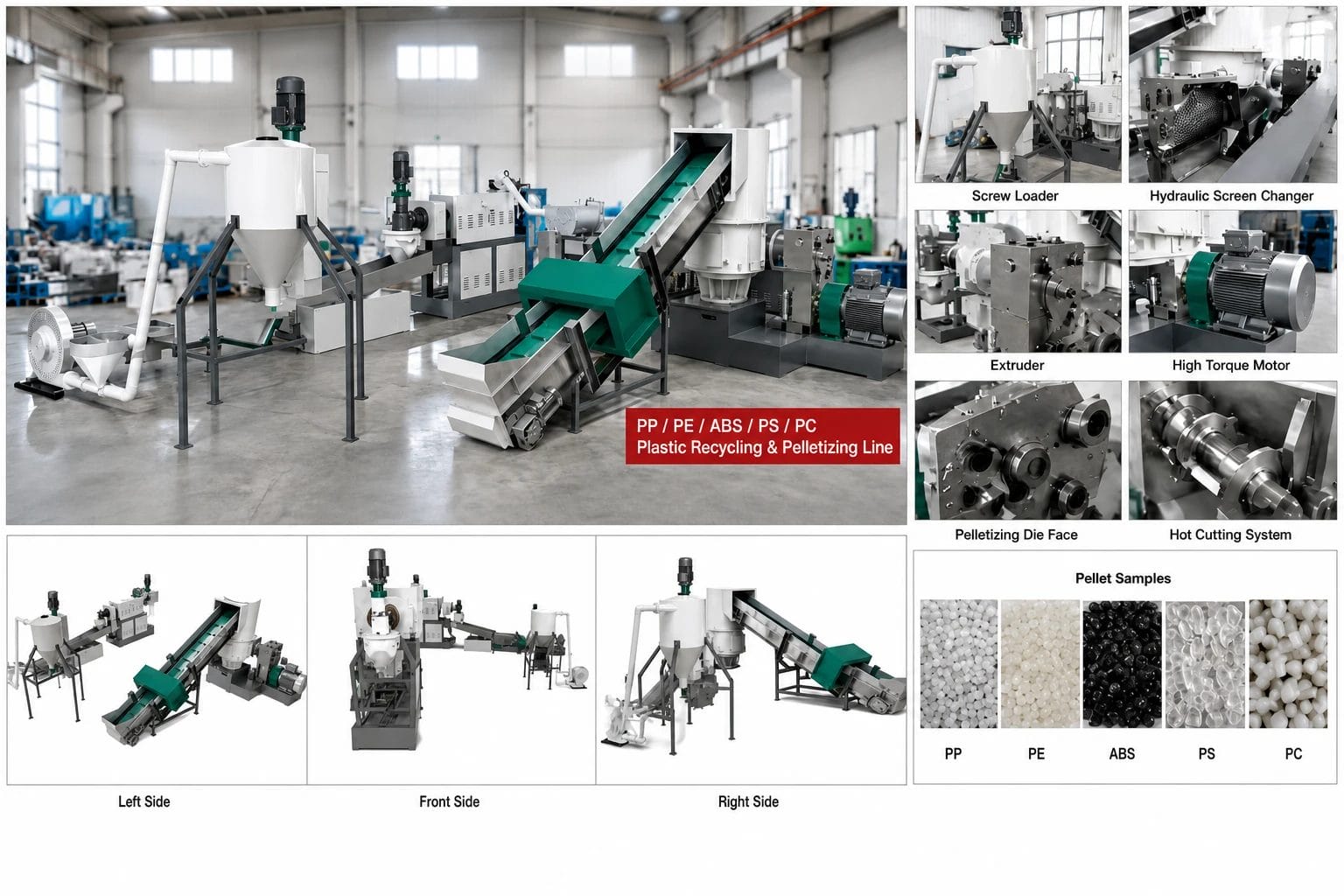
Unlike a standard washing line that produces flakes, this line goes one step further by integrating a direct pelletizing extruder after drying, converting clean film flakes into uniform recycled PP/PE pellets in a single continuous process. The pelletizing section uses the SHP series compactor-type granulating system with electromagnetic heating, vacuum degassing, and selectable filtration and pelletizing configurations. Output pellets are suitable for manufacturing new blown film, bags, containers, and injection-molded products.
With closed-loop water recycling reducing water consumption by 60–80% and integrated heat recovery systems, the SUHUI PP PE film compacting pelletizing line is designed for efficient, low-cost operation across the full SHP capacity range.
| Parameter | SHP80 | SHP100 | SHP120 | SHP140 | SHP160 | SHP180 |
|---|---|---|---|---|---|---|
| Capacity (kg/h) | 150–250 | 300–420 | 400–600 | 600–750 | 800–950 | 1,000–1,200 |
| Energy Consumption (kWh/kg) | 0.2–0.33 | |||||
| Compactor Motor Power (kW) | 37–45 | 55–75 | 75–90 | 90–132 | 132–160 | 160–185 |
| Extruder Motor Power (kW) | 55–75 | 90–110 | 132–160 | 160–200 | 250–315 | 315–355 |
| Compactor Volume (L) | 300 | 500 | 800 | 1,000 | 1,200 | 1,400 |
| Vacuum Exhaust Zones | 1–2 | |||||
| Footprint L×W×H (mm) | 10300×6200×3500 | 10300×6200×3750 | 11400×6450×3980 | 11400×6450×4250 | 14800×6850×4460 | 14800×6850×4850 |
The complete compacting pelletizing line integrates upstream washing and drying with the pelletizing unit above. Total line capacity and configuration depend on feedstock type, contamination level, and facility layout. Contact SUHUI for a complete line proposal.
The line processes a wide range of post-industrial and post-consumer film waste, including PE, PP, CPP, BOPP, PS, EPS, ABS, PA, PLA, and PET films, as well as raffia, filament, woven bags, and non-woven fabric — sourced from production factory trim or post-washing recycling operations. Incoming material is sorted to remove non-plastic debris before entering the crushing and washing stages.
The pelletizing section (SHP series) covers SHP80 (150–250 kg/h) through SHP180 (1,000–1,200 kg/h). The upstream washing line capacity is matched to the pelletizing unit. Contact SUHUI for model selection based on your feedstock volume, film type, contamination level, and facility layout.
The line produces uniform 2–5 mm recycled PP/PE pellets suitable for direct use in blown film production, bag manufacturing, injection-molded containers, and plastic compounding applications. A vibratory screening stage removes fines and oversized pieces to ensure consistent pellet quality. Pellet size and shape can be adjusted by selecting the appropriate pelletizing configuration (strand, water ring, or underwater).
The integrated water filtration and recirculation system continuously treats and reuses process water throughout all washing and rinsing stages, reducing fresh water consumption by 60–80% compared to open-loop systems. The SHP compactor granulating unit adds further efficiency with an energy consumption of only 0.2–0.33 kWh/kg of output, compared to conventional single-stage dryer-extruder systems. Certification: CE, ISO9001:2008.
Tell us your material type, condition, required capacity and target output. Photos or videos help.
SUHUI reviews the feeding method, process route and machine configuration for your material.
You receive an equipment list and quotation, with capacity, layout, voltage and automation matched to the project.
Production, testing, export packing and installation guidance through to commissioning.

To receive a more accurate recommendation, please include your material type, material condition, required capacity, target output, plant space, local voltage and destination country in the message. Photos or videos of your raw material are also helpful.

The SUHUI PET flakes glass fiber twin screw pelletizing line produces high-performance engineering plastic pellets by compounding recycled PET flakes with glass fiber reinforcement (10–40% loading). The resulting composite pellets deliver significantly enhanced tensile strength, flexural modulus, thermal stability, and dimensional rigidity compared to unreinforced recycled PET.

The SUHUI PVC granulating pelletizing line converts rigid uPVC and flexible PVC scrap — offcuts, cable insulation, window profiles and post-consumer PVC — into uniform 2–4 mm recycled PVC pellets. Multi-zone temperature control in the stable 160–200°C window, corrosion-resistant twin-screw extrusion, in-line stabilizer dosing and integrated fume extraction protect PVC from degradation, while air-cooled die-face hot cut pelletizing delivers dry, uniform pellets for pipe, profile, cable and fitting production.

The SUHUI rigid plastic granulating pelletizing line processes HDPE, PP, PS, ABS and mixed rigid plastic waste into uniform 2–5 mm recycled pellets. Heavy-duty granulating, high-torque twin-screw extrusion, multi-stage melt filtration and precision pelletizing handle industrial scrap, post-consumer rigid packaging and moulding offcuts at 300–3,000 kg/h, producing clean raw material for injection moulding, blow moulding and extrusion.


