A single shaft shredder reduces plastic waste into controlled, screen-sized pieces using one rotor and a hydraulic pusher before washing, crushing or pelletizing.


The SUHUI single shaft shredder reduces plastic films, pipes, profiles, rigid containers, packaging waste and mixed industrial scrap into screen-controlled fragments for granulators, washing lines, pelletizing lines or direct reprocessing. It uses a high-speed rotor, fixed counter-blades, interchangeable screen basket, modular hardened steel blades, auto-reverse protection and PLC touchscreen control.
The SUHUI single shaft shredder is a robust industrial machine designed to reduce a wide range of plastic waste into uniform fragments for recycling and downstream processing. Equipped with a high-torque rotor and precision-ground hardened steel blades, it delivers consistent size reduction for films, pipes, profiles, rigid containers, and packaging waste.
Unlike double shaft shredders, the single shaft design combines a fast-rotating rotor with fixed counter-blades and a bottom screen, giving precise control over output fragment size. This makes it the preferred choice for operations requiring specific particle dimensions for downstream granulators, washing lines, or direct reprocessing.
With a modular blade system, auto-reverse function, and PLC automation, the SUHUI single shaft shredder is designed for reliable, low-maintenance operation across recycling facilities and plastic manufacturing plants.

Single shaft shredder working process from material loading, rotor engagement, continuous size reduction, screen sizing, and discharge conveying.

The single shaft shredder can process PP and PE films, rigid containers, HDPE and PVC pipes, plastic profiles, plastic sheets, packaging waste, and mixed industrial plastic scrap.

The single shaft shredder uses rotating blades, fixed counter-blades, and an interchangeable screen basket to control output fragment size for downstream processing.
A single shaft shredder is best suited for applications where controlled output size is important, because the screen basket determines which fragments can exit the cutting chamber. A double shaft shredder is better for very bulky, thick-walled, or difficult-to-shred material where high torque is the primary requirement, but its output size is usually less uniform because it does not rely on a screen basket.

Single shaft shredders provide screen-controlled output size, while double shaft shredders provide higher torque for bulky or thick-walled materials with less uniform particle sizing.
The SUHUI single shaft shredder is designed for practical daily operation. Modular blade segments can be inspected, rotated, resharpened, or replaced individually. The quick-open rotor chamber and removable screen basket simplify access for cleaning and maintenance. Safety systems such as emergency stop, overload protection, safety door interlocks, and PLC diagnostics help protect operators and equipment during continuous operation.

Maintenance and safety features include modular blade segments, quick-open rotor chamber, removable screen basket, auto-reverse protection, overload protection, emergency stop, safety door interlocks, and PLC touchscreen control.
Screen-controlled shredder output can be used as a stable feed material for granulators, washing lines, and pelletizing lines. Uniform fragments improve feeding consistency, reduce oversized material problems, and help downstream equipment operate more smoothly. Sized shredded plastic can also be collected in silos or sold as pre-shredded scrap when matched to buyer requirements.

Sized shredder output can feed plastic granulators, recycling washing lines, single-screw or twin-screw pelletizing lines, collection silos, or direct resale as pre-shredded scrap.
The SUHUI single shaft shredder processes PP and PE films, rigid containers such as bottles, buckets, and crates, HDPE and PVC pipes and profiles, plastic sheets, packaging waste, and mixed industrial plastic scrap. Its rotor and counter-blade system handles both flexible materials and rigid plastics.
Output fragment size is controlled by the perforated screen basket installed at the base of the cutting chamber. Only fragments small enough to pass through the screen holes exit the machine. Different screen baskets can be fitted for different downstream requirements.
A single shaft shredder uses one rotor and a screen basket for more uniform output sizing. A double shaft shredder uses two counter-rotating shafts for higher torque on bulky or thick-walled materials, but output size is generally less uniform because there is no screen basket.
The auto-reverse function monitors rotor load. When excessive resistance is detected, the rotor reverses to release the blockage before resuming forward shredding. This helps protect the rotor bearings, drive system, and cutting chamber from overload damage.
The machine uses modular blade segments that can be individually inspected, rotated, resharpened, or replaced. The quick-open rotor chamber and removable screen basket provide access for blade inspection, cleaning, and replacement during routine maintenance.
Shredded fragments can feed plastic granulators for further size reduction, recycling washing lines for cleaning, single-screw or twin-screw pelletizing lines for pellet production, and collection silos for storage or resale as pre-shredded scrap.
Tell us your material type, condition, required capacity and target output. Photos or videos help.
SUHUI reviews the feeding method, process route and machine configuration for your material.
You receive an equipment list and quotation, with capacity, layout, voltage and automation matched to the project.
Production, testing, export packing and installation guidance through to commissioning.

To receive a more accurate recommendation, please include your material type, material size, hardness, desired output size, hourly capacity, feeding method and downstream process in the message.

The SUHUI jumbo bag shredder machine processes FIBC jumbo bags, bulk bags, ton bags, woven PP bags, PP raffia sacks and residue-contaminated bags into screen-controlled PP strips and flakes for washing, granulation and pelletizing. It uses an anti-winding rotor, reinforced cutting chamber, interchangeable screen basket, PLC control and optional dust extraction for industrial PP bag recycling.

The SUHUI HDPE pipe shredder is designed for large, rigid and thick-walled HDPE pipe scrap from water supply, gas distribution, drainage and pipe manufacturing applications. It uses a reinforced feed opening, low-speed high-torque rotor, hardened alloy blades, PLC control and discharge conveyor to reduce large pipe waste into HDPE chunks suitable for granulation, washing or pelletizing.
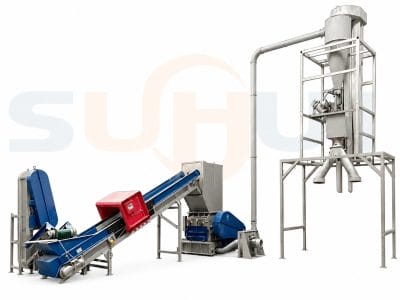
The SUHUI plastic crusher is a robust machine designed to reduce plastic waste into uniform pieces for direct reuse in manufacturing. It efficiently processes a wide range of plastic materials including HDPE, LDPE, PP films, fibers, and woven bags, transforming post-industrial and post-consumer waste into high-quality recycled raw materials.

The SUHUI double shaft shredder reduces bulky plastic drums, industrial containers, HDPE and PP pipes, jumbo bags, profiles, sheets, film bales and mixed rigid plastic waste into manageable first-stage fragments for granulators, washing lines, finer shredders or pelletizing systems. It uses dual counter-rotating shafts, interlocking hardened steel blades, hydraulic overload protection, auto-reverse control and PLC operation.


