An HDPE pipe shredder cuts large HDPE pipes and thick-wall pipe waste into smaller pieces for crushing, washing or pelletizing.


The SUHUI HDPE pipe shredder is designed for large, rigid and thick-walled HDPE pipe scrap from water supply, gas distribution, drainage and pipe manufacturing applications. It uses a reinforced feed opening, low-speed high-torque rotor, hardened alloy blades, PLC control and discharge conveyor to reduce large pipe waste into HDPE chunks suitable for granulation, washing or pelletizing.
The SUHUI HDPE pipe shredder is a heavy-duty size reduction machine built for large, rigid high-density polyethylene pipes from water supply, gas distribution, drainage, and pipe manufacturing applications. It is designed to process long, thick-walled pipe scrap and large-diameter HDPE pipes up to 1,200 mm without manual pre-cutting for standard configurations.
Compared with general plastic shredders, HDPE pipe shredding requires stronger feeding support, higher cutting torque, a reinforced chamber, and wear-resistant blades. SUHUI uses a low-speed, high-torque rotor design to pull rigid pipe sections into the cutting zone steadily, reduce jamming risk, and produce HDPE chunks suitable for downstream granulation, washing, or pelletizing.
For plastic recycling plants, municipal pipe waste handlers, and pipe extrusion factories, the HDPE pipe shredder creates a practical first step for turning bulky pipe scrap into reusable recycling feedstock.

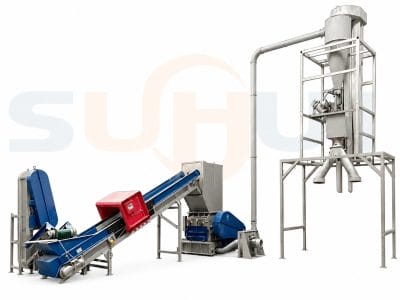
HDPE pipe shredding process from large pipe loading and primary shredding to output conveying and downstream recycling.

The reinforced feed opening supports large-diameter HDPE pipe loading and reduces the need for manual pre-cutting.
Large HDPE pipe is difficult to recycle because of its diameter, wall thickness, rigidity, and bulk volume. Standard crushers or light-duty shredders often require pipe pre-cutting before feeding, which increases labor cost and slows down recycling throughput.
The SUHUI HDPE pipe shredder is designed around the pipe shape itself. Long pipe sections can be supported near the feed opening, while the rotor gradually pulls the pipe into the chamber. This makes the machine suitable for pipe manufacturers handling production scrap, recycling plants processing post-consumer pipe waste, and municipal waste operations handling discarded drainage or utility pipes.

The low-speed, high-torque rotor, hardened alloy blades, and counter blades are designed for thick-wall HDPE pipe size reduction.
HDPE pipe places high stress on the cutting system. Thick pipe walls can resist initial bite, and curved pipe sections can shift during cutting. A suitable pipe shredder must generate enough torque to pull material inward while keeping the chamber stable.
SUHUI’s rotor and counter-blade system is designed to apply steady cutting force to rigid thermoplastic pipe. Hardened alloy blades cut against fixed counter blades, while the reinforced chamber supports continuous impact and abrasion. The low-speed design helps reduce excessive heat generation and supports longer blade service life compared with high-speed cutting methods.
Shredded HDPE pipe output can be used in several downstream recycling routes. If a smaller and more uniform particle size is required, the shredded chunks can feed a plastic granulator. If the pipe scrap contains soil, labels, or other surface contamination, the material can move to a recycling washing line before pelletizing. Clean shredded HDPE can also feed a single-screw or twin-screw pelletizing line to produce recycled HDPE pellets.

Shredded HDPE output can be routed to a granulator, washing line, or pelletizing line according to the required final recycled material.
Pipe shredding is a heavy-load application, so maintenance access and safety protection are important for stable daily operation. The SUHUI HDPE pipe shredder includes service access for blade inspection, chamber cleaning, and routine maintenance. The control system supports emergency stop and overload protection to help protect operators and equipment during abnormal feeding or excessive load conditions.

Accessible blade areas, PLC control, safety interlocks, and service panels help simplify maintenance and daily operation.
The HDPE pipe shredder is suitable for recycling plants and manufacturers that handle bulky pipe scrap. Common input materials include water supply pipes, gas distribution pipes, drainage pipes, cable protection pipes, production offcuts, rejected pipe sections, and post-consumer HDPE pipe waste.

Typical applications include water supply pipe, gas pipe, drainage pipe, and production scrap recycling.
The SUHUI HDPE pipe shredder is designed for large rigid HDPE pipes up to 1,200 mm in diameter for standard project requirements. Custom feeding and chamber configurations can be discussed for special pipe dimensions, wall thicknesses, or non-standard pipe profiles.
Large HDPE pipe is thick-walled, rigid, curved, and bulky. General shredders may jam, stall, or require pre-cutting. A dedicated HDPE pipe shredder uses stronger feeding support, reinforced chamber structure, and low-speed high-torque cutting to process pipe scrap more reliably.
For standard pipe dimensions within the machine configuration, the oversized feed opening and long feed support allow direct pipe feeding without routine pre-cutting. Extremely oversized or unusual pipe sections should be confirmed with SUHUI before project configuration.
The machine produces shredded HDPE chunks or flakes according to the configured cutting and discharge setup. The output can be collected directly or sent to a granulator, washing line, or pelletizing line for further recycling.
Common downstream equipment includes a plastic granulator for smaller particle size, a washing line for contaminated pipe scrap, and a pelletizing line for producing recycled HDPE pellets. The route depends on input cleanliness and final material requirements.
Blades should be inspected regularly based on operating hours, material contamination, and throughput. Service access areas allow maintenance teams to inspect, replace, or resharpen blades and clean the cutting chamber during scheduled maintenance.
Tell us your material type, condition, required capacity and target output. Photos or videos help.
SUHUI reviews the feeding method, process route and machine configuration for your material.
You receive an equipment list and quotation, with capacity, layout, voltage and automation matched to the project.
Production, testing, export packing and installation guidance through to commissioning.

To receive a more accurate recommendation, please include your material type, material size, hardness, desired output size, hourly capacity, feeding method and downstream process in the message.

The SUHUI single shaft shredder reduces plastic films, pipes, profiles, rigid containers, packaging waste and mixed industrial scrap into screen-controlled fragments for granulators, washing lines, pelletizing lines or direct reprocessing. It uses a high-speed rotor, fixed counter-blades, interchangeable screen basket, modular hardened steel blades, auto-reverse protection and PLC touchscreen control.

The SUHUI double shaft shredder reduces bulky plastic drums, industrial containers, HDPE and PP pipes, jumbo bags, profiles, sheets, film bales and mixed rigid plastic waste into manageable first-stage fragments for granulators, washing lines, finer shredders or pelletizing systems. It uses dual counter-rotating shafts, interlocking hardened steel blades, hydraulic overload protection, auto-reverse control and PLC operation.
The SUHUI plastic crusher is a robust machine designed to reduce plastic waste into uniform pieces for direct reuse in manufacturing. It efficiently processes a wide range of plastic materials including HDPE, LDPE, PP films, fibers, and woven bags, transforming post-industrial and post-consumer waste into high-quality recycled raw materials.

The SUHUI jumbo bag shredder machine processes FIBC jumbo bags, bulk bags, ton bags, woven PP bags, PP raffia sacks and residue-contaminated bags into screen-controlled PP strips and flakes for washing, granulation and pelletizing. It uses an anti-winding rotor, reinforced cutting chamber, interchangeable screen basket, PLC control and optional dust extraction for industrial PP bag recycling.


