


Understanding how a drinking straw making machine works is the starting point for any buyer evaluating this type of equipment. A drinking straw making machine is a purpose-built extrusion line that converts polypropylene (PP) or polyethylene (PE) resin into finished drinking straws at high speed, with controlled diameter, wall thickness, length, and output consistency.
This guide explains how a PP drinking straw making machine works, the main machine types available, how PP, paper, and PLA straw machines differ, and what to check before specifying a system for your factory.
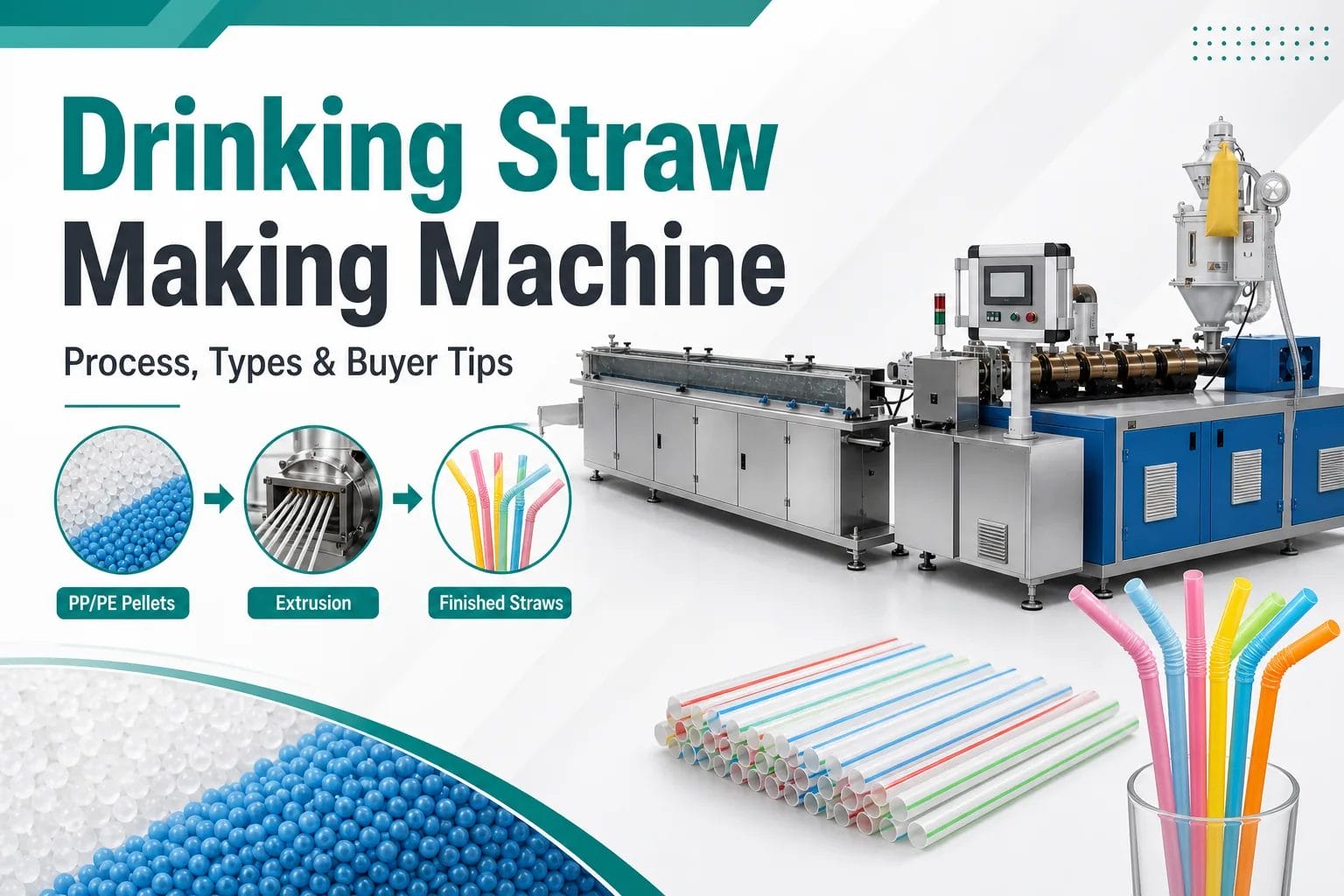 Drinking Straw Making Machine: Process, Types & Buyer Tips.
What Is a Drinking Straw Making Machine?
A drinking straw making machine, more precisely a drinking straw extrusion line, is a connected production system that melts PP or PE resin, forms it into a hollow tube through a die, cools and sizes the tube, pulls it forward, and cuts it into individual straws.
The output is a uniform finished drinking straw ready for collection, counting, and packaging. A single PP drinking straw making machine can produce dozens to hundreds of straws per minute depending on line speed, straw diameter, wall thickness, and model configuration.
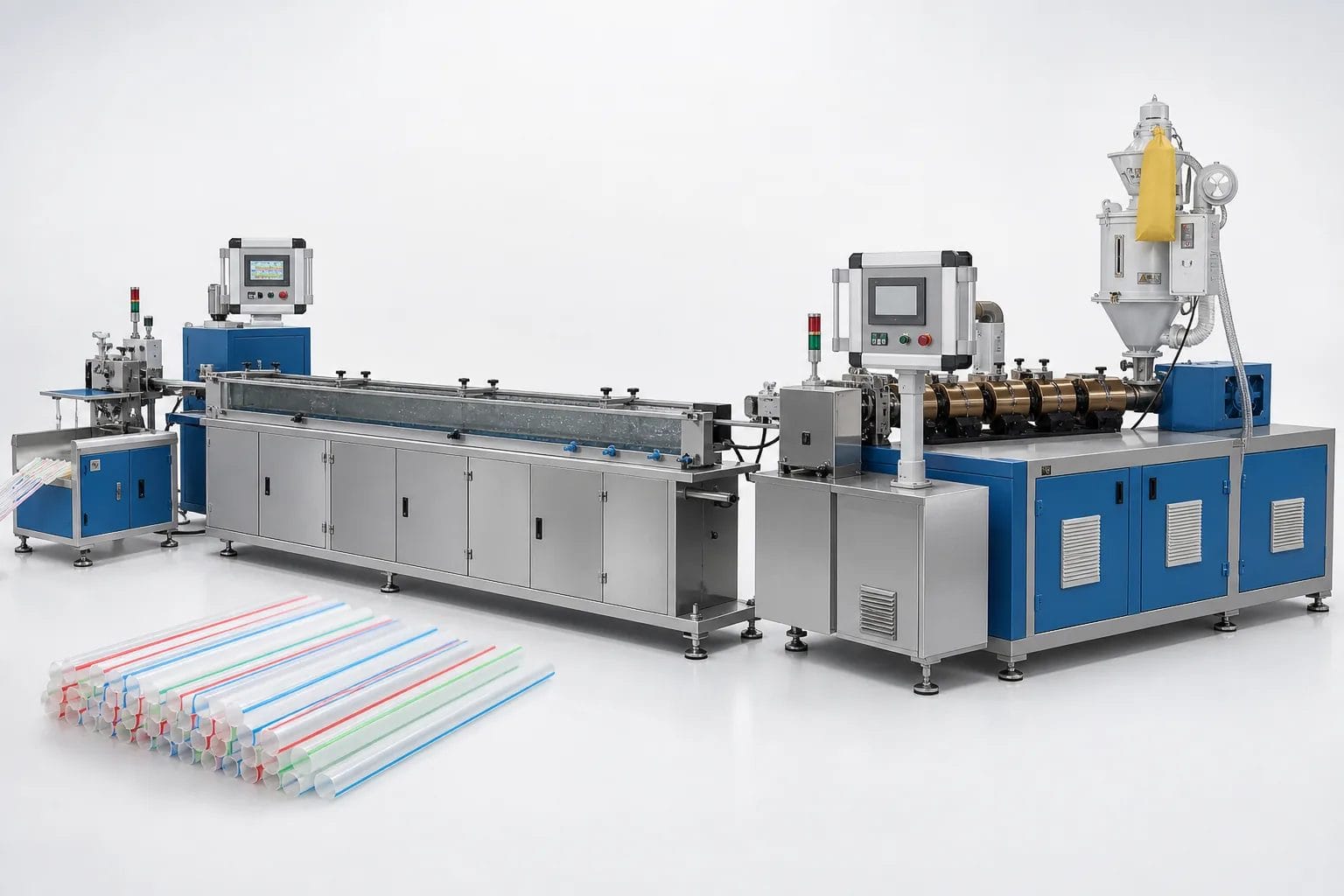 A PP drinking straw making machine converts PP or PE resin into finished straight, flexible, or specialty drinking straws.
These machines are used by:
- Straw manufacturers supplying foodservice distributors, restaurants, beverage brands, and packaging companies.
- Plastic product factories diversifying into disposable, reusable, or specialty straw production.
- Recycled-content producers using PP or PE pellets to manufacture compliant straw products.
How a Drinking Straw Making Machine Works
A drinking straw making machine works through a continuous extrusion process. Raw material is fed into an extruder, melted, shaped into a hollow tube, cooled, pulled forward, cut to length, and collected as finished straws.
 The drinking straw making process includes feeding, extrusion, die forming, cooling, haul-off, cutting, and finished straw collection.
Stage 1 – Raw Material Feeding
PP or PE pellets are loaded into the hopper above the extruder barrel. The resin must be dry and free-flowing because excess moisture can create bubbles, unstable extrusion, or surface defects in the finished straw.
For striped or multi-color straws, a secondary feeder can introduce color material at the die head. This creates a spiral stripe or color effect without changing the basic straw structure.
Stage 2 – Extrusion and Melting
Inside the extruder barrel, a rotating screw conveys, melts, and pressurizes the plastic resin. Temperature zones along the barrel are controlled according to the resin type. PP is commonly processed around 200-230°C, depending on formulation and line design.
Stable temperature control and screw speed are important because they affect melt viscosity, wall thickness, output consistency, and surface finish.
 In the extrusion stage, PP or PE pellets are melted, pressurized, and formed into hollow straw tubes through a precision die.
Stage 3 – Die Head and Tube Forming
The melted plastic is pushed through a tube die with a central mandrel and outer die opening. The die gap controls wall thickness, while the outer die opening controls straw diameter. Interchangeable die sets allow the same machine to produce multiple straw sizes.
Stage 4 – Vacuum Calibration and Water Cooling
The hot straw tube enters a vacuum calibration and cooling section. Water cooling stabilizes the tube shape, while calibration helps maintain consistent outer diameter. This stage is critical for producing straws that meet diameter and wall thickness requirements.
Stage 5 – Secondary Cooling
After initial calibration, the straw tube continues through one or more cooling water channels. Additional cooling prevents deformation when the tube is pulled forward by the haul-off unit.
Stage 6 – Haul-Off
The haul-off unit grips the straw tube and pulls it forward at a controlled speed. The relationship between extrusion output and haul-off speed affects wall thickness. Faster pulling can create thinner walls, while slower pulling can produce thicker walls.
 Cooling channels and haul-off units stabilize straw diameter and pull the tube forward at a controlled production speed.
Stage 7 – Automatic Cutting
A flying-knife or rotary cutting system cuts the moving straw tube into set lengths without stopping the line. Digital length control improves repeatability when producing different straw types, such as cocktail straws, standard straws, or long bubble tea straws.
 The automatic cutting system cuts continuous straw tubes into uniform finished straw lengths.
Stage 8 – Collection and Output
Finished straws are collected in bins or conveyed to counting and packaging equipment. The final output quality depends on consistent extrusion, precise cooling, stable haul-off, and accurate cutting.
 PP and PE pellets are processed through an extrusion line to produce straight, flexible, and specialty drinking straws.
PP Drinking Straw Making Machine in Operation
The following video shows a SUHUI PP drinking straw making machine running at full speed, demonstrating the complete extrusion, cooling, cutting, and output sequence.
PP, PLA and Paper Straw Machines: Process Differences
Buyers often compare a PP straw making machine, a PLA straw making machine, and a paper straw machine as if they are interchangeable. In practice, they use different materials, forming methods, temperature controls, tooling, and downstream packaging requirements.
| Machine Type | Production Process | Typical Output | Key Buyer Check |
|---|---|---|---|
| PP / PE plastic straw making machine | Plastic extrusion through a tube die, followed by cooling, haul-off, and cutting | Straight plastic straws, jumbo straws, bubble tea straws, specialty plastic tubes | Confirm diameter range, die change time, cutting tolerance, and stable high-speed output |
| PLA straw making machine | Modified extrusion with tighter temperature control for compostable resin | PLA or biodegradable straws for markets requiring compostable materials | Confirm resin formulation, drying requirements, barrel temperature control, and tooling compatibility |
| Paper straw making machine | Paper slitting, spiral winding, gluing, drying, and cutting | Multi-layer paper straws | Confirm paper grade, glue system, drying method, and food-contact compliance |
For SUHUI’s current product range, the main focus is PP / PE plastic straw extrusion. A plastic straw making machine is closer to a small precision extrusion line than to a recycling line: the key control points are melt stability, tube diameter, wall thickness, haul-off speed, and cutting accuracy.
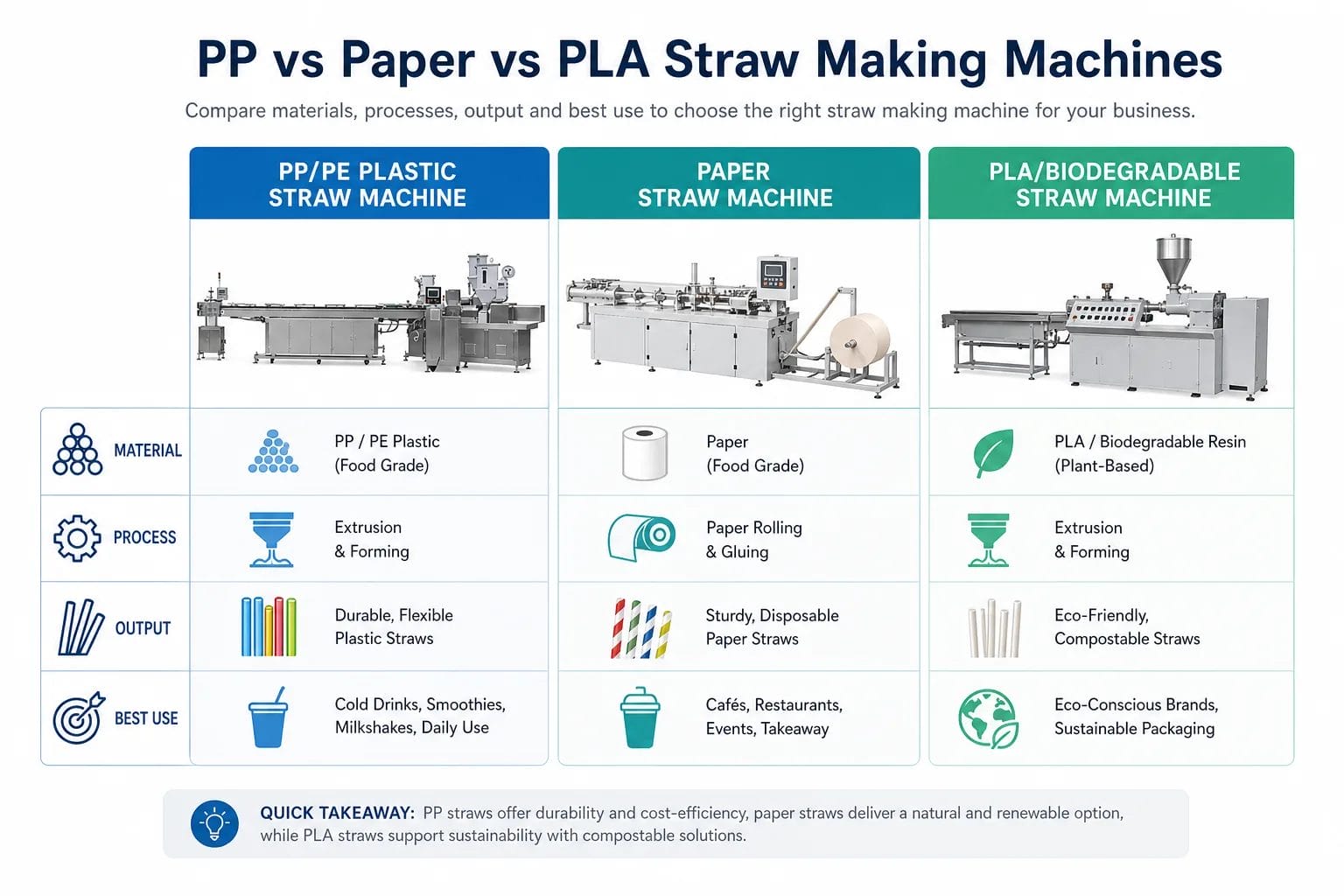 PP, paper, and PLA straw machines use different materials, processes, and output formats, so buyers should match the machine type to their target market.
Straight, Flexible and Specialty Straw Production
A standard straw extrusion machine produces continuous straight straw tubes before cutting. From that base process, factories can manufacture different straw formats by changing die size, haul-off settings, cutting length, color feeding, and downstream handling.
- Straight drinking straws usually require stable diameter control, clean surface finish, and accurate cutting length.
- Jumbo or bubble tea straws need larger die sets, stronger haul-off stability, and reliable cutting at longer lengths.
- Striped or colored straws require color feeding and die-head control so the stripe remains consistent during high-speed extrusion.
- Flexible straws normally require an additional bending or corrugation process after extrusion and cutting.
If your project includes wrapped straws, flexible straws, counting, or automatic packing, confirm whether those steps are included in the plastic straw production line or supplied as separate downstream equipment.
Key Technical Specifications: SUHUI PP Straw Making Machine
| Specification | JH01-245 | JH01-250 | JH01-255 |
|---|---|---|---|
| Material | PP / PE | PP / PE | PP / PE |
| Straw Diameter | φ1-14 mm | φ1-14 mm | φ1-14 mm |
| Straw Length | 3-1,000 mm | 3-1,000 mm | 3-1,000 mm |
| Max. Output | >25 kg/h | >35 kg/h | >45 kg/h |
| Line Speed | >250 m/min | >250 m/min | >250 m/min |
| Main Motor | 5.5 kW | 7.5 kW | 11 kW |
| Color Options | 1 color + 1 stripe | 1 color + 1 stripe | 1 color + 1 stripe |
How to Choose a PP Drinking Straw Making Machine
1. Required Production Capacity
Match machine output to your daily production plan. A higher-capacity machine can reduce unit cost, but oversizing increases investment cost and energy consumption. Build in a reasonable capacity buffer for maintenance and startup loss.
2. Straw Diameter and Product Range
Confirm the diameter range you need, such as cocktail straws, standard drinking straws, jumbo straws, or bubble tea straws. If you plan to produce multiple sizes, make sure the machine supports die changes and stable operation across the full range.
3. Wall Thickness Control
Wall thickness affects straw strength, flexibility, and raw material consumption. A stable extruder, accurate die, and controlled haul-off speed are all important for consistent wall thickness.
4. Cutting Precision
Straw length consistency matters for packaging and product appearance. Ask about cutter type, length tolerance, digital setting capability, and whether the cutting system can maintain accuracy at high line speed.
5. Die Change Flexibility
If your factory produces different straw diameters or product styles, die change time affects production efficiency. Ask the supplier how long a die change takes and what tooling is included.
6. Spare Parts and Technical Support
Wear parts such as cutters, belts, calibration sleeves, and electrical components should be easy to replace. Confirm spare part availability, installation support, operator training, and after-sales response time before purchasing.
For the detailed product configuration, see the SUHUI drinking straw making machine. For the full product category, visit PP drinking straw making machine.
Conclusion
A drinking straw making machine converts PP or PE pellets into finished straws through feeding, extrusion, die forming, cooling, haul-off, cutting, and collection. The right configuration depends on capacity, straw size range, material type, cutting precision, and service support.
SUHUI Machinery manufactures PP/PE drinking straw making machines for different output requirements, with model options covering straw diameters from φ1 mm to φ14 mm and straw lengths from 3 mm to 1,000 mm.
Contact SUHUI Machinery to discuss your required straw diameter, output capacity, material type, and production layout.
Frequently Asked Questions
Is a drinking straw making machine the same as a straw extrusion machine?
For plastic straws, yes. A drinking straw making machine is a specialized straw extrusion machine that melts PP or PE resin, forms a hollow tube through a die, cools and sizes the tube, pulls it forward, and cuts it into finished straws. Paper straw machines use a different winding and gluing process.
Can one plastic straw making machine produce different straw sizes?
Yes, one plastic straw making machine can usually produce multiple straw diameters and lengths if it is equipped with the correct die sets and cutting settings. Buyers should confirm the supported diameter range, die change time, length control range, and whether the line can remain stable at the required output speed.
What is the difference between a PP straw machine and a PLA straw making machine?
A PP straw machine processes polypropylene resin, which is widely used for rigid plastic drinking straws. A PLA straw making machine processes compostable PLA resin and usually needs tighter drying, temperature control, and tooling compatibility. The best choice depends on the target market, material rules, and required straw performance.
Can a PP straw production line make flexible straws?
The extrusion line produces the straight plastic straw tube first. Straw production is one of the narrower applications of a plastic extrusion machine, running at high line speed with very small tube diameters. Flexible straws normally require an additional bending or corrugation process after extrusion and cutting. If flexible straw production is required, confirm whether the supplier includes downstream bending, counting, and packing equipment in the complete line.
What straw sizes can SUHUI’s machine produce?
SUHUI’s PP drinking straw making machine supports straw diameters from φ1 mm to φ14 mm and lengths from 3 mm to 1,000 mm. This covers cocktail straws, standard drinking straws, jumbo straws, bubble tea straws, short specialty tubes, and long custom straw formats.
What should buyers confirm before ordering a drinking straw making machine?
Confirm the target material, straw diameter range, straw length range, output capacity, cutting tolerance, die change flexibility, color stripe requirement, spare parts availability, installation support, and whether downstream counting, bending, wrapping, or packing equipment is included.
Have a Material You Need to Process?
Send the polymer, its form and your target output. We will come back with a line configuration and a realistic budget range.


