


Buying a plastic recycling line is one of the largest single equipment decisions in any recycling operation. The choice between a washing line, a pelletizing line, or a shredder determines what input material you can handle, what output you can sell, and which buyers you can serve. For a plastic waste recycling plant, the real question is how to convert dirty, mixed, or bulky waste into clean, sellable material at consistent quality.
This guide explains what a plastic recycling line is, how washing, pelletizing, and shredding systems differ, how each line works, and how to choose the right plastic recycling equipment configuration for your feedstock, target output, and plant layout.
 Plastic recycling lines combine shredding, washing, and pelletizing systems to turn waste plastic into usable recycled output.
What Is a Plastic Recycling Line?
A plastic recycling line is a series of industrial machines connected in sequence to process post-consumer or post-industrial plastic waste into a usable output, usually clean flakes, recycled pellets, or shredded regrind for further manufacturing.
Unlike a single recycling machine, such as one shredder or one granulator, a recycling line integrates multiple processing stages into one coordinated system. Depending on the input material and the required output, a complete line may include size reduction, washing, separation, drying, melting, filtering, and pelletizing. The key is that all machines are matched by material type, contamination level, moisture target, and throughput capacity.
Most plastic recycling systems are built around three core line types:
- Plastic washing line – cleans contaminated plastic waste into high-purity flakes.
- Plastic pelletizing line – melts and re-granulates clean flakes or regrind into recycled pellets.
- Plastic shredding line – reduces bulky plastic waste into smaller pieces for downstream processing.
Many complete recycling operations combine all three in sequence: shredding – washing – pelletizing.
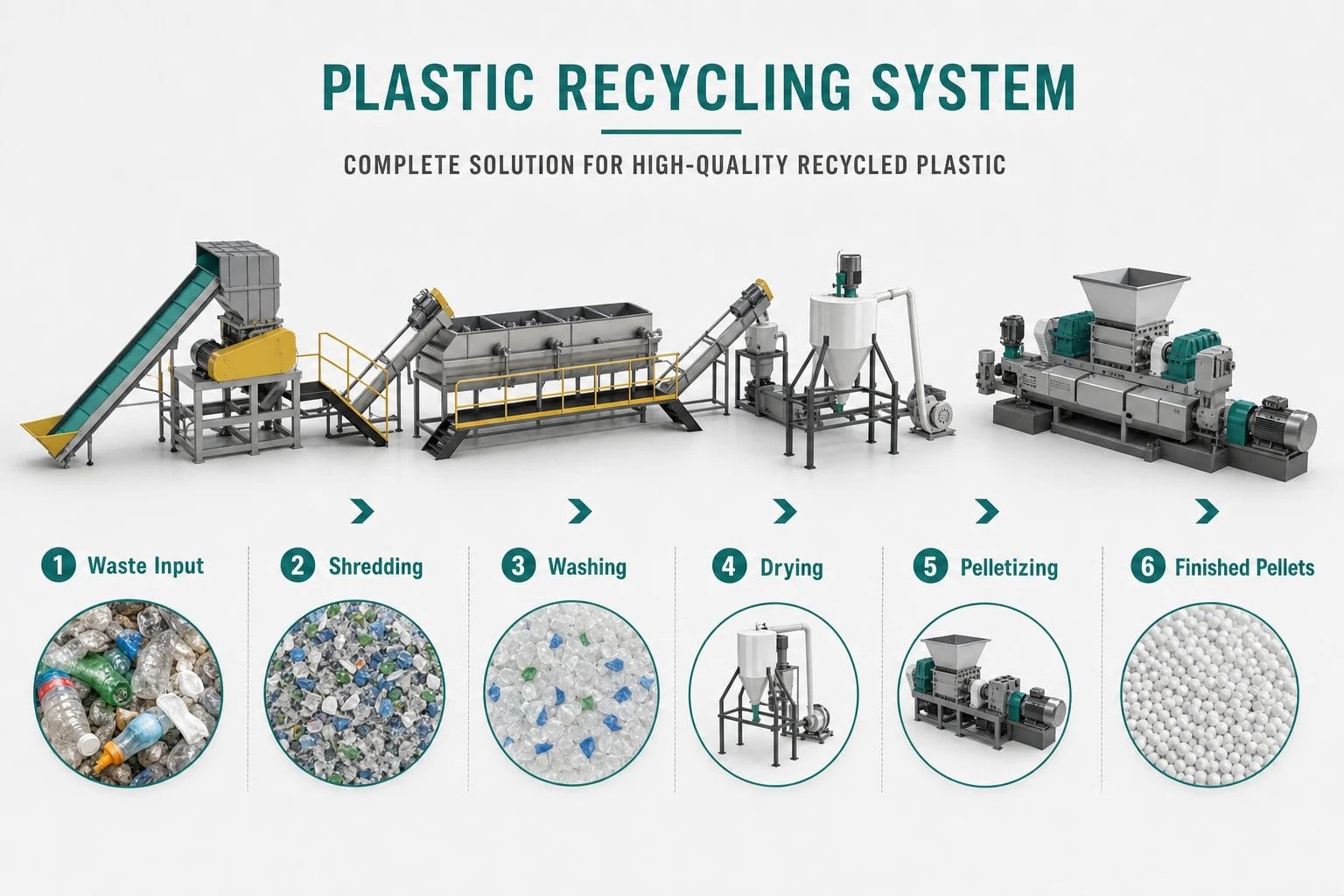 A complete plastic recycling system can move from waste input through shredding, washing, drying, pelletizing, and finished pellet output.
Start with the Output: Regrind, Flakes, or Pellets
The easiest way to choose plastic recycling equipment is to start with the product you want to sell. A plant that sells clean flakes needs a different configuration from a plant that sells pellets or only reduces bulky waste for regrind.
| Target Output | Typical Equipment Combination | Best-Fit Project | Common Bottleneck |
|---|---|---|---|
| Shredded regrind | Shredder, crusher or granulator, conveying and storage | Clean industrial scrap, bulky plastic size reduction, pre-processing before sale | Output size control and blade wear |
| Clean flakes | Shredding or crushing, washing, separation, dewatering, drying | PET bottles, HDPE bottles, PP/PE film, jumbo bags, dirty post-consumer material | Washing strength, separation accuracy, final moisture |
| Recycled pellets | Size reduction, washing if needed, drying, extrusion, filtration, pelletizing | Recyclers selling resin to extrusion, injection molding, film blowing, or compounding users | Flake purity, moisture before extrusion, melt filtration, line balance |
This output-first approach keeps the article from becoming a generic equipment list. It also helps buyers decide whether they need a washing line, a pelletizing line, a shredding line, or a complete plastic recycling system.
Plastic Recycling Line Components by Material
The best plastic recycling line layout depends on the material stream. PET bottles, HDPE bottles, PP/PE film, rigid plastic scrap, and bulky pipes may all belong to plastic recycling, but they do not use the same machine sequence. A useful recycling plant design starts by matching the material to the right combination of shredding, washing, drying, and pelletizing equipment.
| Material Stream | Typical Line Configuration | Target Output | Best Next Step |
|---|---|---|---|
| PET bottles | Sorting, label removal, crushing, hot washing, float-sink separation, drying | Clean PET flakes | Use a PET bottle recycling process guide or PET washing line layout |
| HDPE bottles and containers | Sorting, shredding or crushing, washing, separation, drying | Clean HDPE flakes or pellets | Separate bottle washing needs from pipe shredding needs |
| PP/PE film | Shredding, friction washing, floating, squeezing, drying, optional pelletizing | Washed film flakes or recycled pellets | Compare film washing and compacting pelletizing options |
| Rigid plastic scrap | Shredding or crushing, optional washing, extrusion pelletizing | Regrind or recycled pellets | Check whether the feedstock is clean enough for direct pelletizing |
| Pipes, drums, bales, bulky waste | Single-shaft or double-shaft shredding, crushing, washing or storage | Shredded regrind or prepared feedstock | Start with shredder type and output size selection |
This material-first view also prevents keyword and equipment confusion. A PET bottle recycling line should not be configured like a plastic film recycling line, and a plastic shredder should not be treated as a complete washing or pelletizing system by itself.
 A PET bottle sorting washing line is one example of a complete plastic recycling system built around material sorting, washing, separation and drying.
The Plastic Washing Line: Cleaning Contaminated Waste
A plastic washing line removes contamination from plastic waste, including soil, labels, adhesives, oil, and chemical residues. Its output is clean, dry flakes that can be sold directly or fed into a downstream pelletizing line.
How it works: Plastic waste is fed into the line, shredded or crushed into uniform pieces, passed through washing and separation stages, mechanically dewatered, and thermally dried. A typical washing system may include pre-washing, friction washing, float-sink separation, hot washing, centrifugal dewatering, and drying. For pelletizing-ready flakes, moisture control is especially important because excessive moisture can affect extrusion stability and pellet quality.
Best suited for:
- Post-consumer PET bottles and HDPE bottles.
- Agricultural film, packaging film, PP film, PE film, and LDPE film – see the PP PE soft film recycling washing line.
- PP woven bags and jumbo bags – see the PP jumbo bag recycling washing line.
- Mixed post-consumer plastic bales that require sorting, washing, and drying before reuse.
Output: clean flakes, sold directly or used as feedstock for pelletizing.
Different plastic materials require different washing line configurations. Thin film needs a system designed to prevent wrapping and tangling, while PET bottles need label removal, bottle sorting, hot washing, and flake separation. For material-specific guides, see how a plastic film recycling line works, how a PET bottle recycling machine works, and how an HDPE recycling machine works.
 Plastic washing lines remove contamination from film, bottles, and rigid plastics to produce clean flakes for sale or pelletizing.
 PET bottle washing systems use multiple modules to handle sorting, label removal, washing, separation, drying and clean flake collection.
 HDPE bottle recycling lines require a different washing and separation setup from PET bottle systems because HDPE floats and has different contamination challenges.
PET Bottle Washing Line – Live Demonstration
The video below shows a complete PET bottle recycling washing and sorting line in operation, from bale input through to clean, dry flake output:
The Plastic Pelletizing Line: Turning Flakes into Pellets
A plastic pelletizing line converts cleaned plastic flakes, washed film, or pre-processed regrind into uniform recycled pellets through feeding, melting, filtration, cutting, cooling, and drying.
How it works: Plastic flakes or film are fed into an extruder, melted under controlled temperature and pressure, filtered to remove fine contaminants, and cut into pellets by strand cutting, hot-face cutting, or underwater cutting. The pellets are then cooled, dried, classified, and packed for sale or reuse in manufacturing.
Key equipment in a pelletizing line:
- Feeding system or compactor, depending on material bulk density.
- Single-screw or twin-screw extruder.
- Melt filter or screen changer.
- Die head and pellet cutting system.
- Pellet dryer, classifier, and bagging system.
Best suited for:
- PP, PE, PET, PVC, ABS, and other recycled flakes or regrind. PVC is the exception that needs its own configuration — see the PVC granulating pelletizing line.
- Film, bottle-grade flakes, rigid plastic flakes, and post-industrial scrap.
- Soft film applications that need a compactor-fed system, such as the PP PE film compacting pelletizing line.
Output: recycled pellets for injection molding, film blowing, pipe extrusion, sheet extrusion, compounding, and other downstream applications.
For a full technical walkthrough of the pelletizing process and equipment, see how plastic pellets are made.
 Plastic pelletizing lines melt, filter, and cut clean flakes or film into uniform recycled plastic pellets.
The Plastic Shredding Line: Front-End Size Reduction
A plastic shredding line is usually the first stage in a recycling system. It uses crusher and shredder equipment to reduce bulky plastic waste, such as bales, large hollow containers, thick-walled parts, pipes, profiles, drums, and industrial scrap, into smaller pieces that can be washed, pelletized, transported, or sold as regrind.
How it works: Material is fed into a single-shaft, double-shaft, or specialized shredder. Rotating blades tear, crush, and cut the material into a controlled output size. The shredded output is discharged by conveyor to a washing line, crusher, granulator, storage system, or pelletizing line.
Types of plastic shredders:
| Type | Best for | Typical output size |
|---|---|---|
| Single-shaft shredder | Film, pipe, profiles, thick plastics, purgings | 20-100 mm |
| Double-shaft shredder | Large hollow containers, drums, bales, mixed bulky waste | 50-150 mm |
| Four-shaft shredder | Mixed waste requiring more consistent output | 10-30 mm |
| Crusher / granulator | Pre-cleaned material and finer size reduction | 5-20 mm |
Best suited for:
- Pre-processing before washing or pelletizing.
- Volume reduction of bulky plastic waste.
- Preparing plastic pieces for a plastic crusher or downstream recycling line.
- Standalone size reduction where the output is sold as regrind.
For a deeper comparison of shredder types and selection criteria, see our industrial plastic shredder guide.
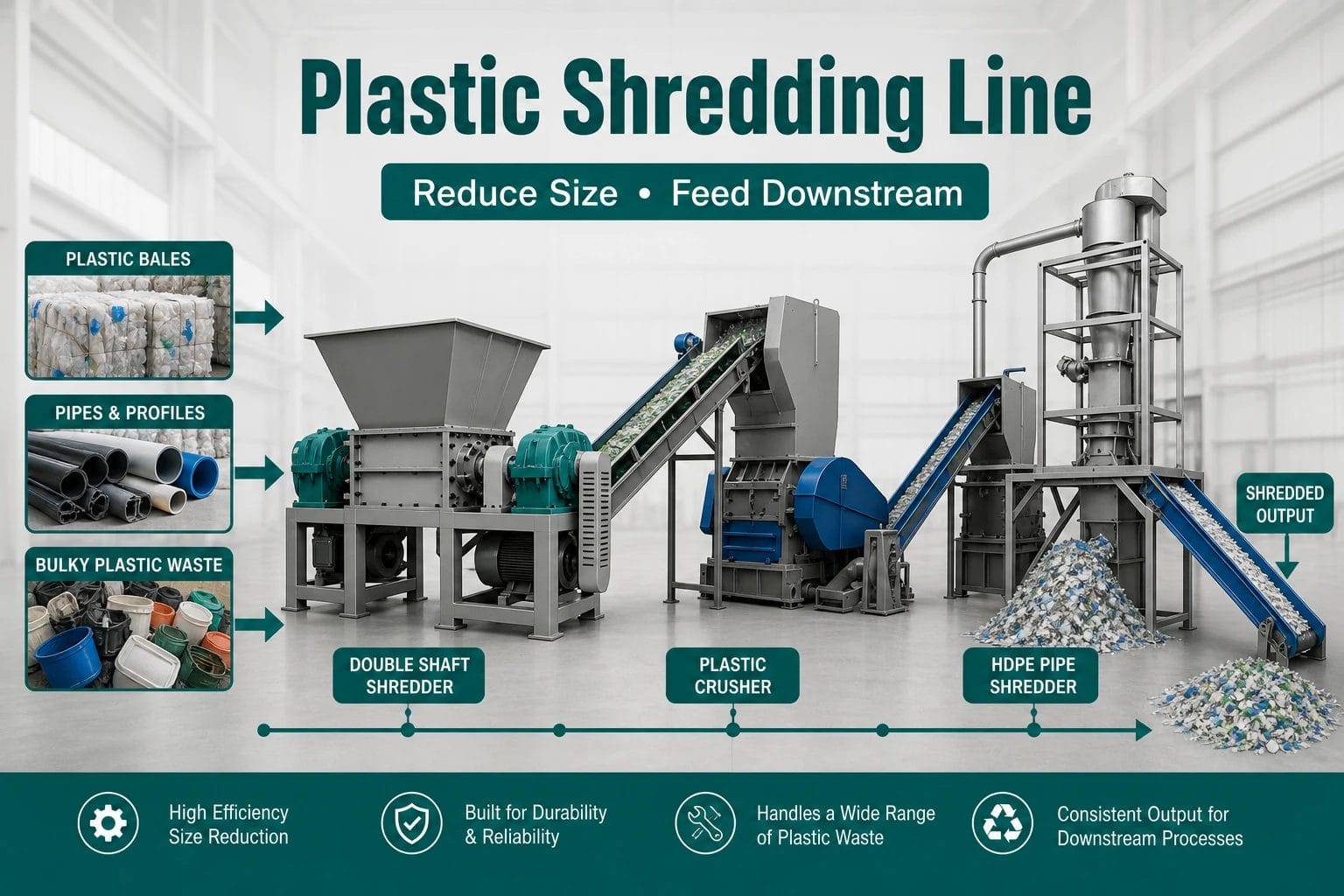 Plastic shredding lines reduce bulky waste into smaller pieces for washing, crushing, pelletizing, or regrind sales.
 A single shaft shredder is commonly used when plastic waste needs controlled size reduction before washing, crushing or pelletizing.
 A double shaft shredder is better suited to bulky waste, hollow containers, drums, bales and mixed plastic scrap that need strong tearing force.
 A plastic crusher or granulator produces smaller regrind after shredding or when the feedstock is already clean enough for fine size reduction.
How a Complete Plastic Recycling System Works
For operations handling contaminated post-consumer material, a complete plastic recycling system often combines shredding, washing, and pelletizing in one matched production flow:
- Incoming plastic waste – collected, sorted, and prepared by material type.
- Shredding line – reduces bulky material into manageable pieces.
- Washing line – removes dirt, labels, oils, and other contamination.
- Dewatering and drying – reduces moisture before sale or extrusion.
- Pelletizing line – melts, filters, and cuts clean material into pellets.
- Finished output – clean flakes, shredded regrind, or recycled pellets.
The systems must be matched by capacity. If the shredder can process 2,000 kg/h but the washing line handles only 1,000 kg/h, the line will bottleneck. If the washing line produces flakes too wet for pelletizing, extrusion stability and pellet appearance can suffer. A well-designed recycling line is therefore not just a list of machines; it is a balanced process.
 Different recycling line configurations produce different outputs, including shredded regrind, clean flakes, and recycled pellets.
Washing vs Pelletizing vs Shredding: Which Line Do You Need?
| Line type | Main job | Best input | Main output | When to choose it |
|---|---|---|---|---|
| Plastic washing line | Clean and separate contaminated plastic | Dirty film, bottles, bags, rigid containers | Clean flakes | Choose this when contamination removal is the main requirement. |
| Plastic pelletizing line | Melt and re-granulate plastic | Clean flakes, washed film, regrind, post-industrial scrap | Recycled pellets | Choose this when your buyers need pellets for manufacturing. |
| Plastic shredding line | Reduce bulky plastic size | Pipes, drums, bales, large containers, thick plastic scrap | Shredded pieces or regrind | Choose this as a front-end stage before washing or pelletizing. |
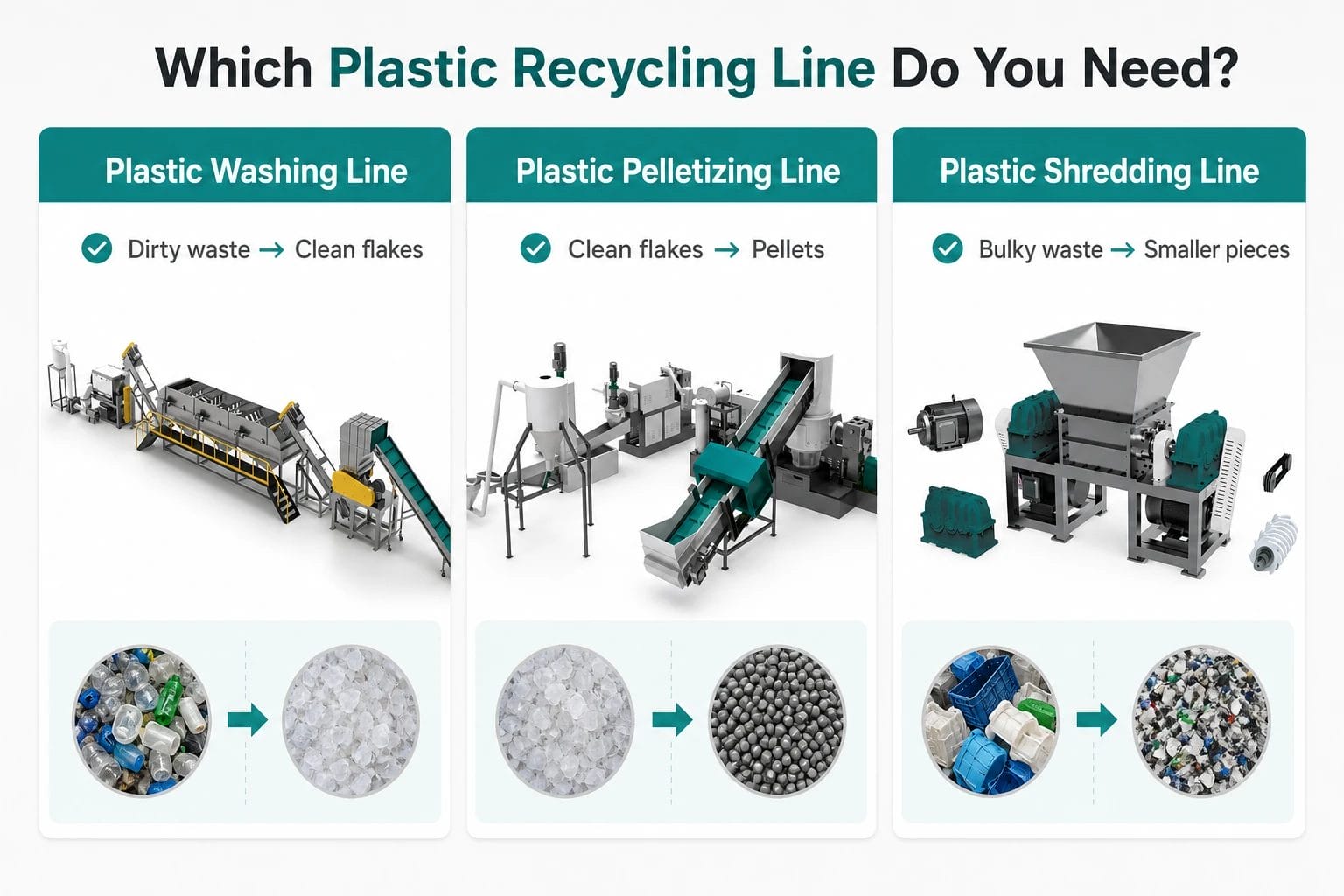 Choose a washing line for clean flakes, a pelletizing line for pellets, or a shredding line for front-end size reduction.
What Affects Plastic Recycling Machine Cost?
Plastic recycling machine cost depends less on one machine price and more on the full process configuration. Two projects with the same hourly capacity can have very different investment levels if one handles clean factory scrap and the other handles dirty mixed post-consumer waste.
| Cost Driver | Why It Changes the Budget | Buyer Question |
|---|---|---|
| Input contamination | Dirty material needs stronger washing, separation, drying, water treatment, and labor | Is the feedstock clean industrial scrap or mixed post-consumer waste? |
| Output requirement | Clean flakes, low-moisture flakes, and pellets require different process stages | Will you sell regrind, flakes, or pellets? |
| Material type | PET, HDPE, PP/PE film, rigid plastics, and pipes need different equipment layouts | Which material stream will the line process most of the time? |
| Capacity and automation | Higher throughput, automatic sorting, dosing, bagging, and controls increase investment | What hourly capacity is supported by your real daily feedstock supply? |
| Water and energy systems | Hot washing, thermal drying, water recycling, and wastewater treatment affect both CapEx and OpEx | What are the local water, power, and discharge constraints? |
For this reason, a useful quotation should begin with feedstock photos, contamination level, target output, expected daily input, available labor, and local utility conditions rather than only asking for a machine price.
How to Choose the Right Plastic Recycling Line
In practice, equipment selection comes down to four questions every buyer should answer before requesting a quotation.
1. What material are you processing?
The plastic type and form factor determine the equipment layout. A PET bottle washing line is different from a PP film washing line, and both are different from a pipe shredding or pelletizing system. Define your primary input material first.
2. How contaminated is the material?
Post-consumer material from households, farms, or collection centers usually needs more washing, separation, and drying. Clean post-industrial scrap may require only shredding and direct pelletizing.
3. What output do your buyers need?
If buyers want flakes, a washing line may be enough. If buyers need pellets, you need pelletizing downstream. If the material is too bulky to feed directly, shredding must come first.
4. What capacity do you actually need?
Over-sizing increases capital and operating cost, while under-sizing creates bottlenecks. Calculate realistic daily input volume, expected working hours, contamination level, and target output before choosing a capacity.
A plastic recycling line is not a single machine. It is an integrated system designed around your feedstock, contamination level, output requirement, and target capacity. Get the configuration right at the start and you avoid most of the costly retrofits that catch newer recyclers later.
SUHUI Machinery builds plastic recycling washing lines, pelletizing lines, shredders, crushers, and complete recycling systems for major plastic types including PET, HDPE, PP, PE, LDPE, PVC, and ABS. If you want to discuss a configuration for your feedstock and capacity, browse our plastic recycling washing line range, review our plastic recycling pelletizing line range, or contact SUHUI Machinery for a project recommendation.
Frequently Asked Questions
What equipment is included in a plastic recycling line?
A plastic recycling line may include shredders, crushers, washing tanks, friction washers, float-sink separators, dewatering machines, thermal dryers, extruders, melt filters, pelletizers, conveyors, silos, and bagging systems. The exact equipment list depends on the input material and target output.
What is the difference between a plastic washing line and a pelletizing line?
A plastic washing line removes contamination and produces clean flakes. A plastic pelletizing line melts clean flakes, film, or regrind and turns them into recycled pellets. If the material is dirty, washing normally comes before pelletizing.
How do I choose the right plastic recycling line?
Start with the material type, contamination level, target output, and hourly capacity. Choose washing for dirty waste, pelletizing for clean flakes or regrind, and shredding when bulky plastic must be reduced before downstream processing.
What comes first in a plastic recycling system, shredding or washing?
For bulky material, shredding normally comes first because large plastic waste must be reduced before washing. In bottle or film systems, crushing, shredding, or granulating may be integrated into the front end of the washing line.
What output can a plastic recycling line produce?
The main outputs are shredded regrind, clean flakes, and recycled pellets. Choose regrind for simple size reduction, flakes for washed material resale or downstream extrusion, and pellets when buyers need a denser, uniform recycled resin product.
What affects plastic recycling machine cost?
The main cost drivers are material type, contamination level, output requirement, capacity, automation level, washing strength, drying system, water treatment, and whether pelletizing is included. A line for clean factory scrap costs much less than a full post-consumer washing and pelletizing system.
Have a Material You Need to Process?
Send the polymer, its form and your target output. We will come back with a line configuration and a realistic budget range.


