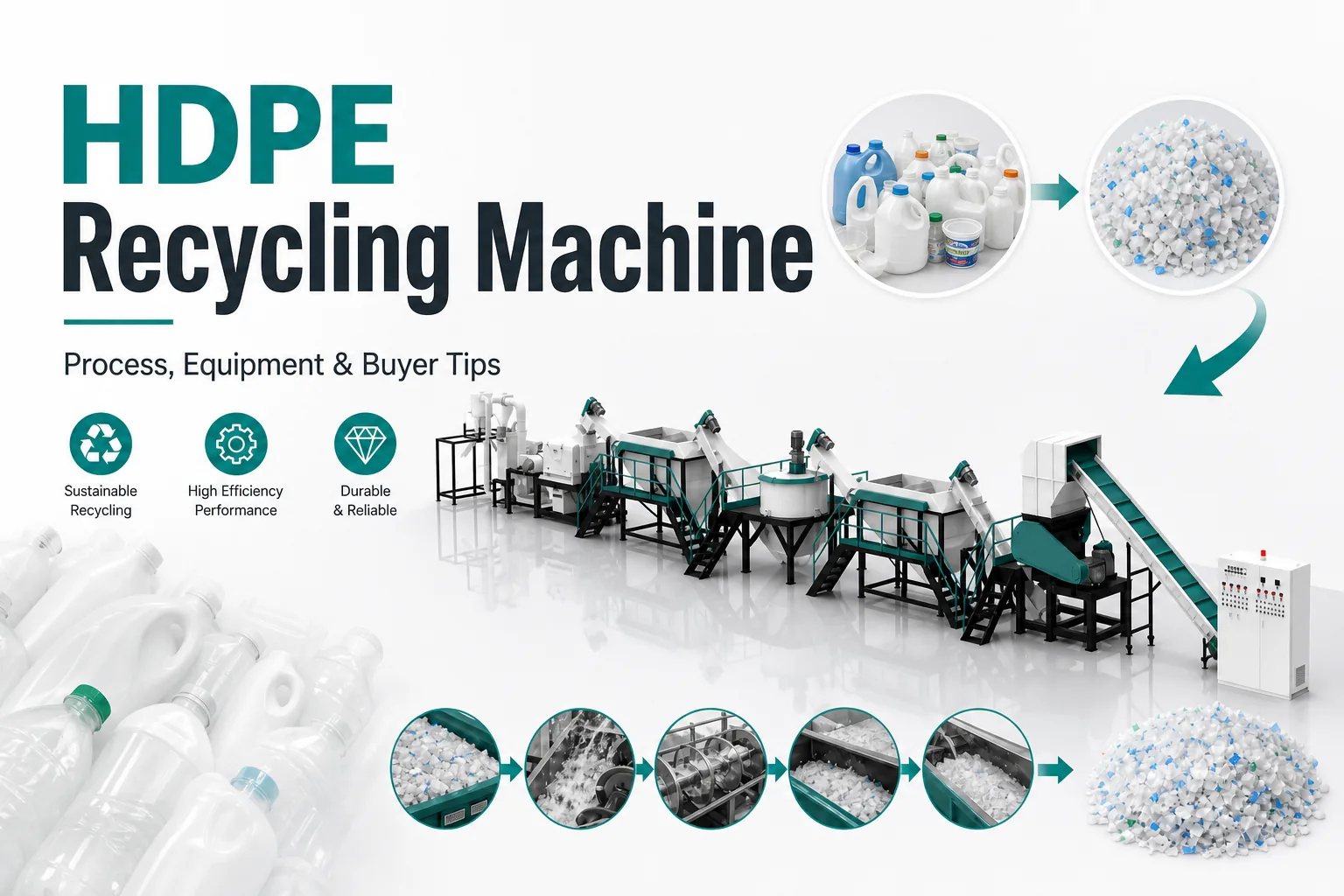
HDPE is one of the most widely recycled plastics because it is rigid, chemically resistant, relatively easy to separate by density, and valuable in downstream markets such as pipe extrusion, blow molding, injection molding, and recycled-content packaging.
But an HDPE recycling machine is not a single standalone machine. In real recycling plants, it is usually a configured line: feeding, sorting, crushing or shredding, washing, float-sink separation, dewatering, drying, and sometimes pelletizing. The best setup depends heavily on whether the input is HDPE bottles, rigid containers, large pipes, film, or mixed hard plastic scrap.
This guide explains how an HDPE recycling machine works, what each stage does, how bottle, pipe, and film recycling configurations differ, and what to check before choosing a system for your operation.
 HDPE Recycling Machine: Process, Equipment & Buyer Tips.
What Is an HDPE Recycling Machine?
An HDPE recycling machine is an industrial recycling system designed to reduce, wash, separate, dry, and reprocess high-density polyethylene waste into reusable HDPE flakes or pellets.
For bottle and container recycling, the system is more accurately called an HDPE recycling washing line. It processes post-consumer or post-industrial HDPE waste through a series of connected machines, including a conveyor, sorting unit, crusher or granulator, washing tanks, friction washers, float-sink separators, centrifugal dryers, and thermal dryers.
Typical HDPE input materials include:
- Dairy packaging – milk bottles, juice bottles, yogurt containers, and similar rigid packaging.
- Household containers – detergent bottles, shampoo bottles, cleaning product bottles, and jerry cans.
- Industrial containers – drums, chemical barrels, and rigid HDPE storage containers.
- Agricultural HDPE waste – irrigation fittings, chemical containers, and selected rigid farm packaging.
- Pipe and profile scrap – large HDPE pipes, fittings, thick-wall sections, and production offcuts.
For rigid bottle and container waste, SUHUI’s HDPE rigid milk bottle recycling washing line is the most relevant product page. It covers the full washing sequence for post-consumer HDPE dairy bottles and similar rigid packaging, with output flakes suitable for pelletizing, pipe extrusion, or molding applications.
Why HDPE Recycling Is Different from PET Recycling
HDPE vs PET recycling is not just a material-name difference. HDPE and PET behave differently in water, melt at different temperatures, serve different downstream markets, and require different quality-control priorities.
| Factor | HDPE Recycling | PET Recycling | Buyer Impact |
|---|---|---|---|
| Density behavior | HDPE floats in water | PET sinks in water | Float-sink tank setup and material collection points are different |
| Common input | Milk bottles, detergent bottles, drums, jerry cans, pipes | Beverage bottles, food containers, PET packaging | Front-end sorting, label removal, and crushing requirements differ |
| Downstream use | Pipe extrusion, blow molding, injection molding, recycled containers | Fiber, sheet, strapping, bottle-to-bottle applications | The target market decides flake purity, color sorting, and pelletizing needs |
| Main quality concern | Oil, milk residue, detergent, labels, mixed plastics, final moisture | PVC contamination, label glue, color sorting, IV retention, moisture | Do not use PET line assumptions when specifying an HDPE bottle washing line |
This is why an HDPE bottle washing line should be specified separately from a PET bottle recycling machine, even if both systems include sorting, crushing, washing, density separation, and drying.
How an HDPE Recycling Machine Works
An HDPE recycling machine works by reducing bulky HDPE waste into smaller flakes, washing away surface contamination, separating HDPE from heavier plastics and metals, removing moisture, and preparing the clean output for storage, sale, extrusion, or pelletizing.
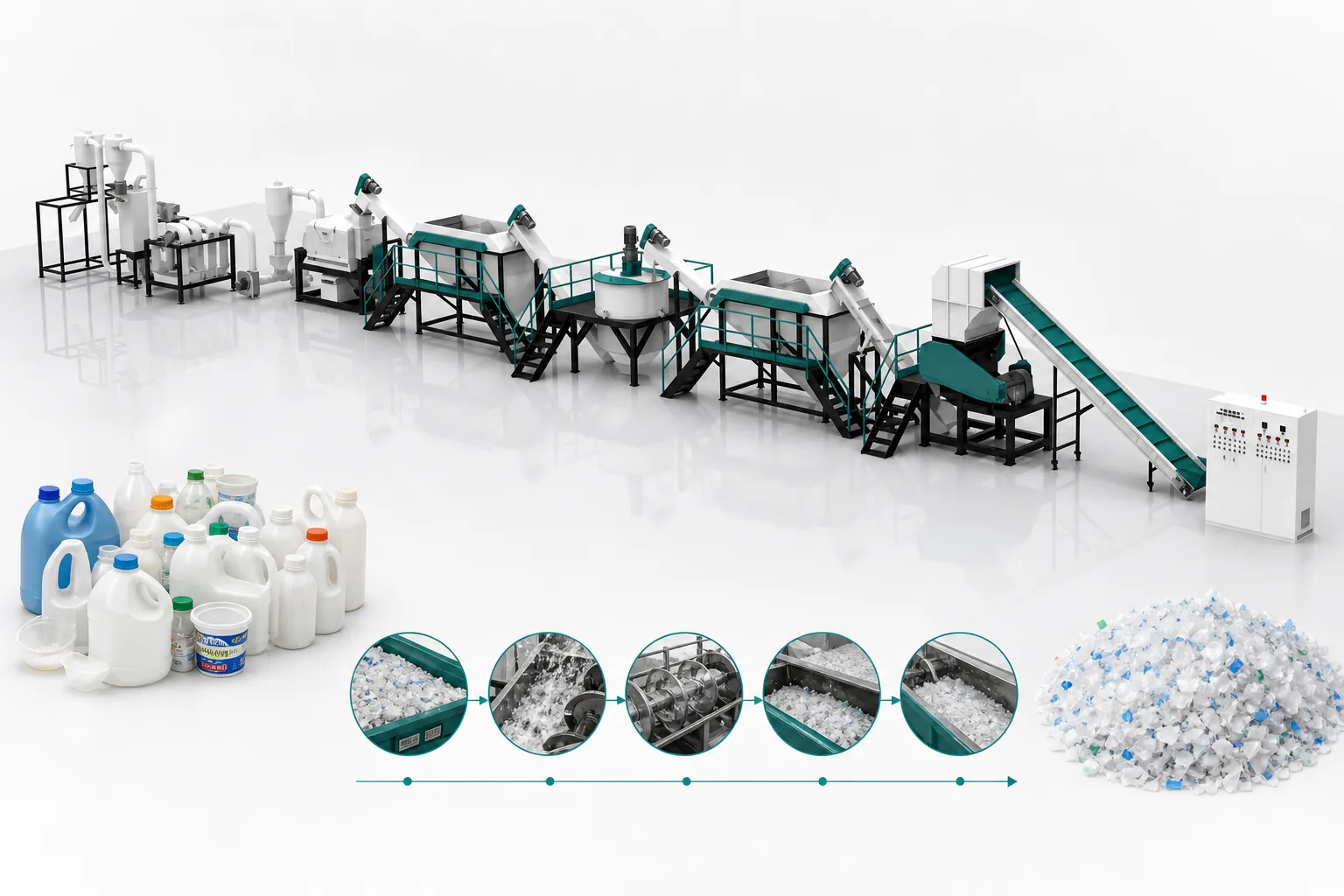 A complete HDPE recycling machine line can convert used HDPE bottles and containers into clean flakes ready for pelletizing, extrusion, or molding.
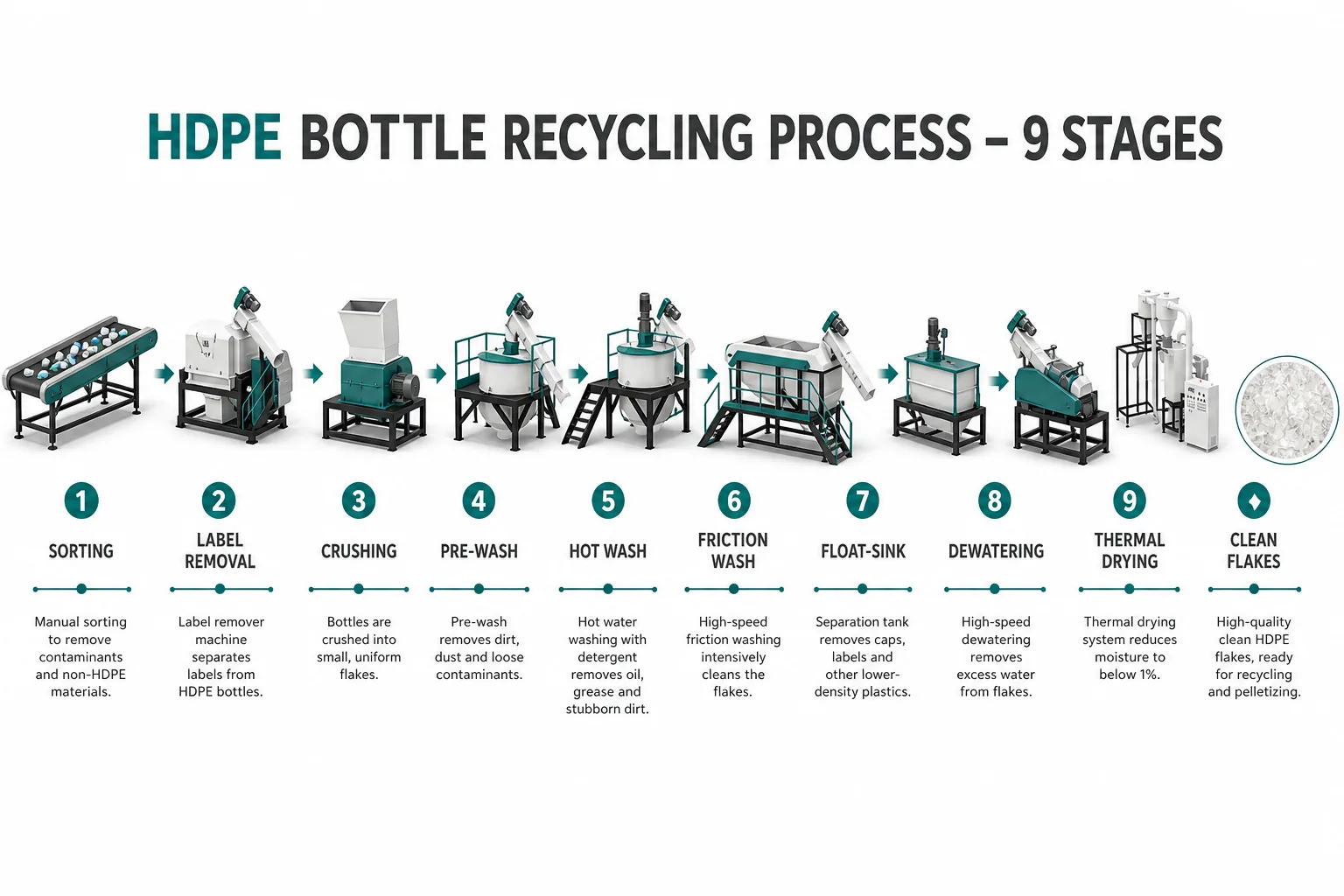 The HDPE bottle recycling process usually includes sorting, label removal, crushing, pre-washing, hot washing, friction washing, float-sink separation, dewatering, and thermal drying.
Stage 1 – Sorting and Material Inspection
The line begins with sorting. Workers or automated systems remove non-HDPE materials such as PET, PVC, PP, metal, glass, rubber, and heavily contaminated waste. This stage matters because no washing line can fully correct poor feedstock quality if incompatible materials are allowed to enter continuously.
PVC contamination is especially risky. Even a small amount of PVC can cause dark specks, degradation, and processing problems during downstream extrusion because PVC degrades at lower temperatures than HDPE.
Stage 2 – Label and Cap Removal
HDPE bottles often carry sleeve labels, paper labels, glue, and PP or PE caps. A label remover or pre-treatment unit separates as much label and cap material as possible before crushing. Removing labels before size reduction prevents label fragments from being cut into small pieces that are harder to separate later.
Stage 3 – Crushing or Granulating
Sorted HDPE bottles and containers are fed into a plastic crusher or granulator, which reduces the material into uniform flakes. For bottle washing lines, the target flake size is often around 10-15 mm because this creates enough surface area for washing without producing excessive fines.
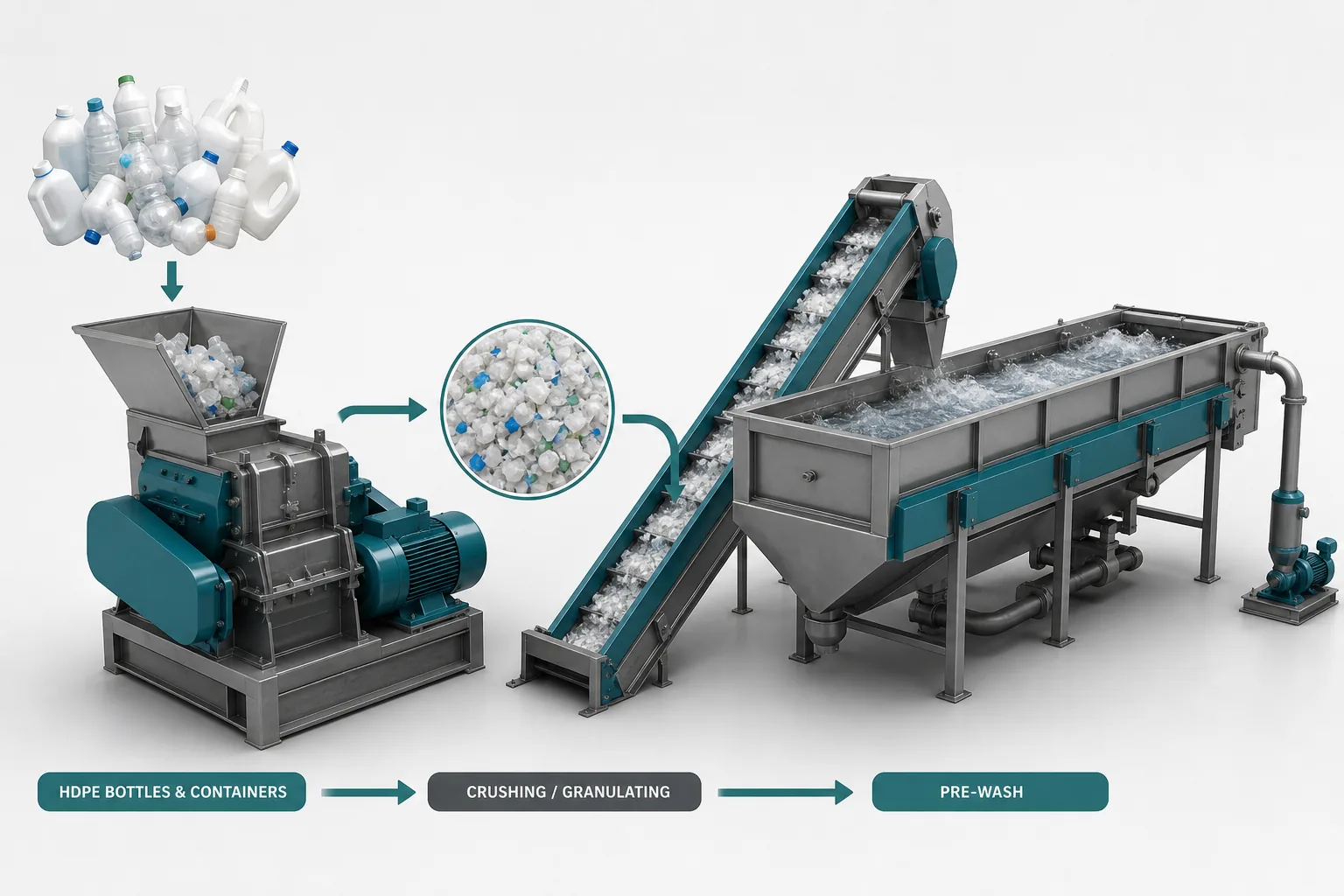 Crushing opens the HDPE bottles and containers so dirt, labels, adhesive, and liquid residues can be removed more effectively during washing.
Stage 4 – Pre-Washing
After crushing, HDPE flakes enter a pre-wash section. This removes loose dirt, sand, paper fragments, residual liquid, and light surface contamination before the more energy-intensive hot washing stage. Pre-washing also protects downstream equipment by reducing abrasive solids in the water circuit.
Stage 5 – Hot Washing
Hot washing is one of the most important stages in HDPE bottle recycling, especially for milk bottles and detergent containers. Heated water, cleaning agents, and agitation help remove milk fat, oil, organic residue, adhesive, and label glue that cold water cannot fully clean.
For high-value output, the hot wash tank must be sized for enough contact time. If flakes move through too quickly, adhesive and oily contamination can remain on the surface and later create odor, discoloration, or gel defects in extrusion.
Stage 6 – Friction Washing
A friction washer uses high-speed mechanical scrubbing to remove contamination left after pre-washing and hot washing. This stage is particularly useful for flakes with embedded adhesive residue, label fragments, or dirt trapped on irregular surfaces.
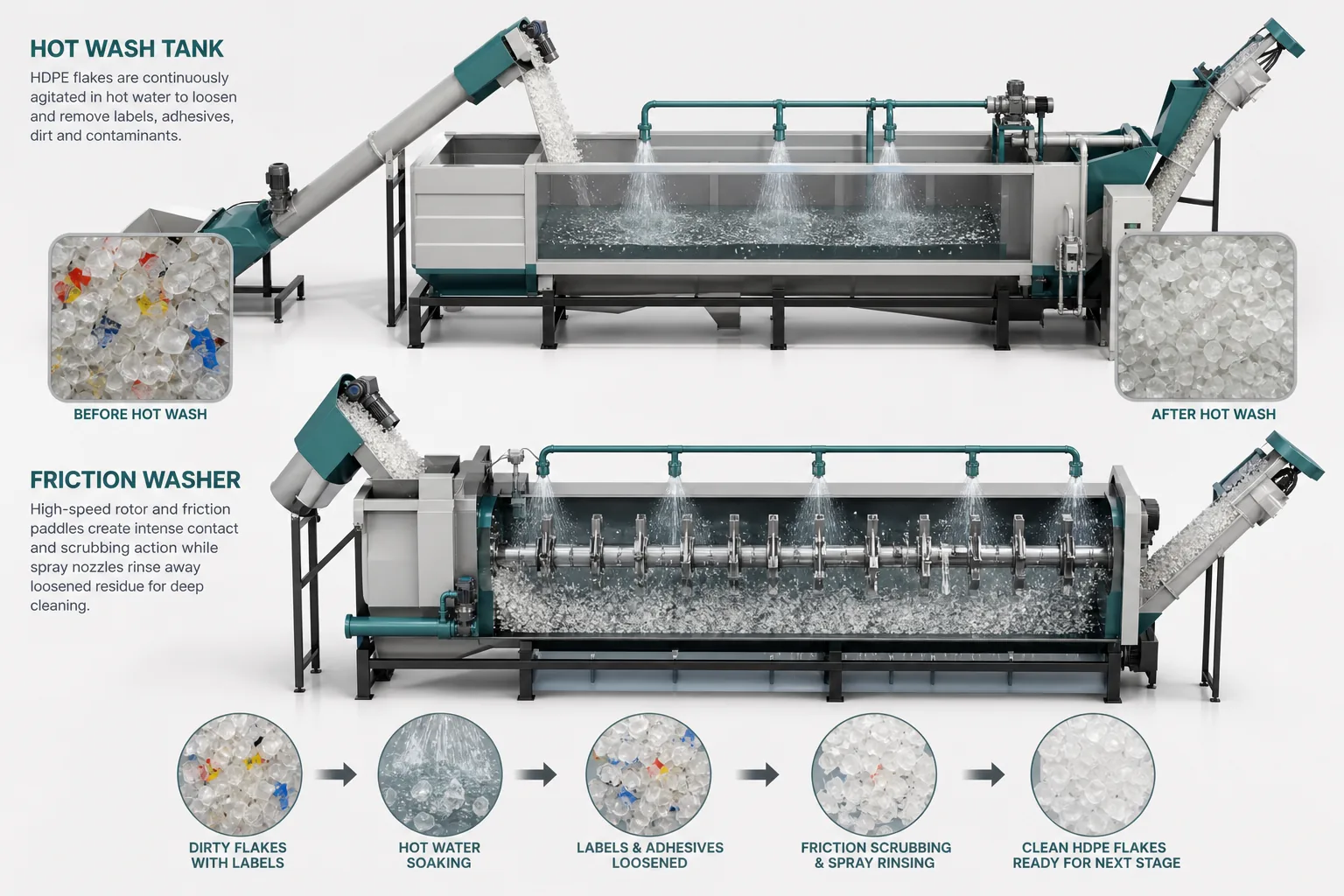 Hot washing and friction washing work together: hot water loosens oil and adhesive, while mechanical scrubbing removes residue from the HDPE flake surface.
Stage 7 – Float-Sink Separation
Float-sink separation uses a simple property of HDPE: its density is lower than water. HDPE flakes float, while many contaminants such as PET, PVC, metal, and glass sink. This makes density separation one of the most reliable mechanical methods for improving HDPE flake purity.
| Material | Typical behavior in water | Why it matters |
|---|---|---|
| HDPE flakes | Float | Main target material collected from the surface |
| PP caps | Float | May require separate removal if output purity is strict |
| PET fragments | Sink | Must be removed before HDPE reuse |
| PVC fragments | Sink | High-risk contaminant for downstream extrusion |
| Metal and glass | Sink | Can damage extrusion and pelletizing equipment |
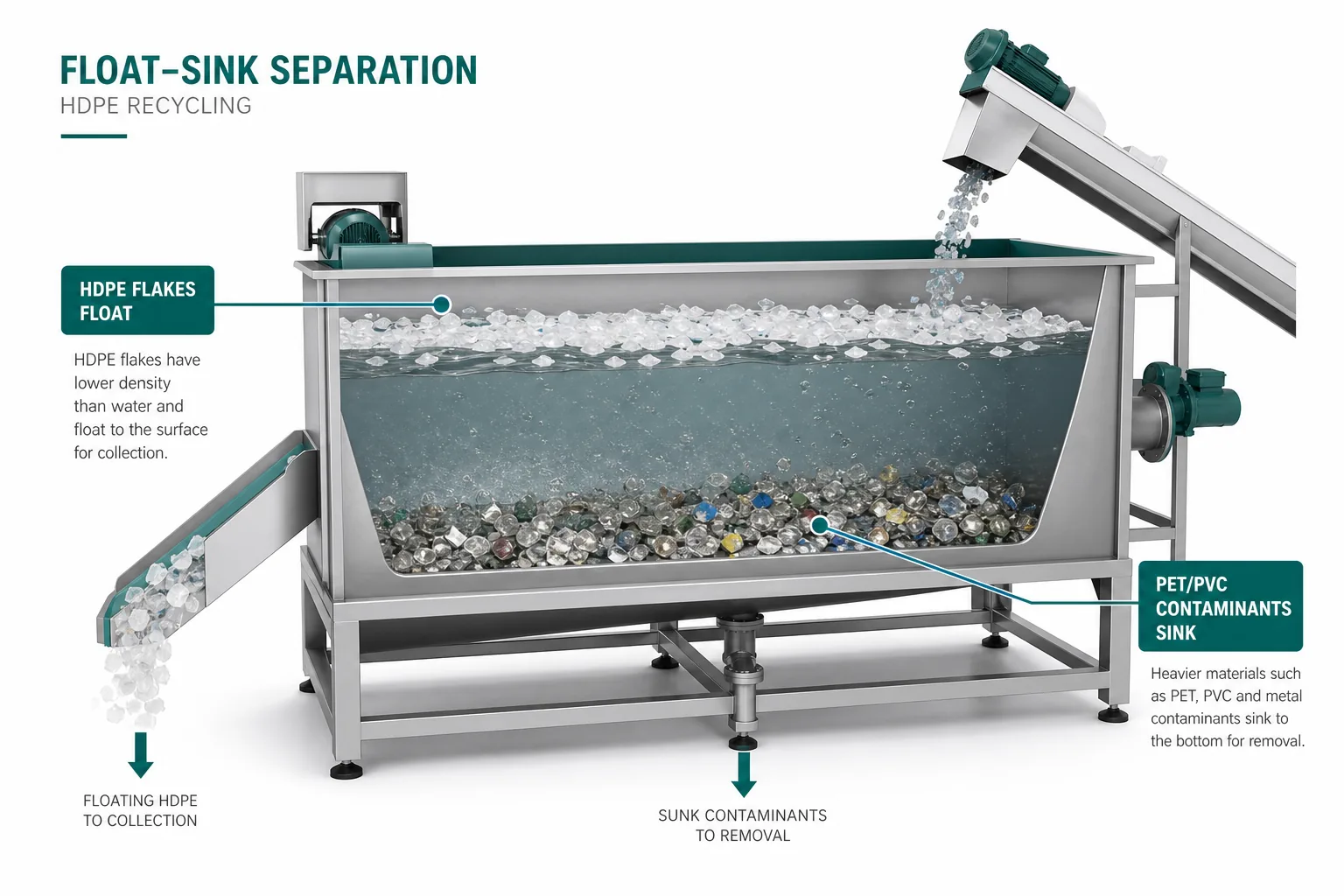 Float-sink separation helps remove heavier contaminants because HDPE floats in water while PET, PVC, metal, and glass sink.
Stage 8 – Dewatering and Rinsing
Clean HDPE flakes are rinsed to remove remaining detergent or caustic residues, then fed into a centrifugal dryer. Mechanical dewatering removes most surface water and prepares the flakes for final thermal drying.
Stage 9 – Thermal Drying and Output
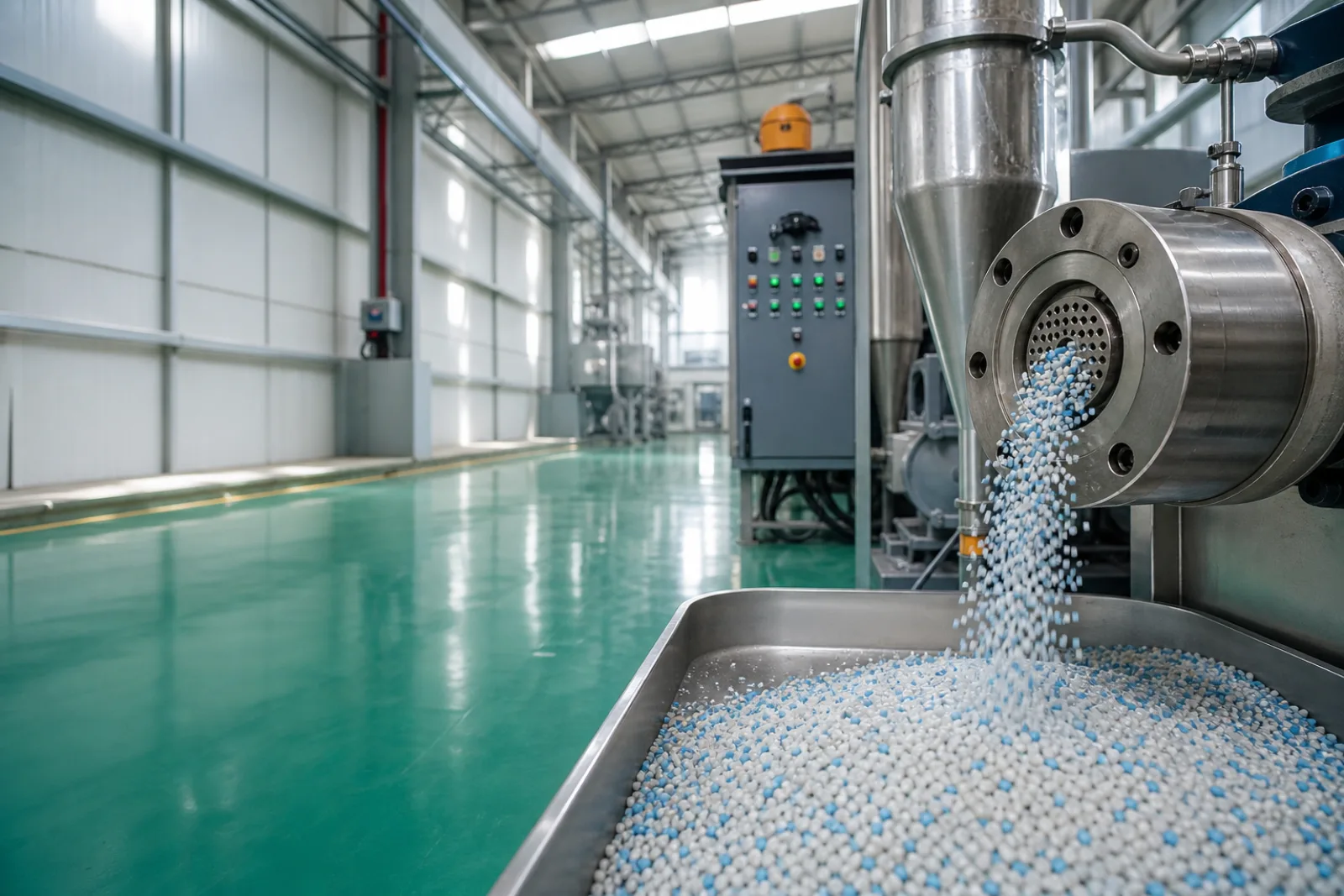
The final drying stage uses hot air to reduce residual moisture to the level required for downstream processing. For direct pelletizing or extrusion, moisture is usually targeted below 1%. The final output can be sold as clean HDPE flakes, stored for later processing, or fed into a pelletizing line.
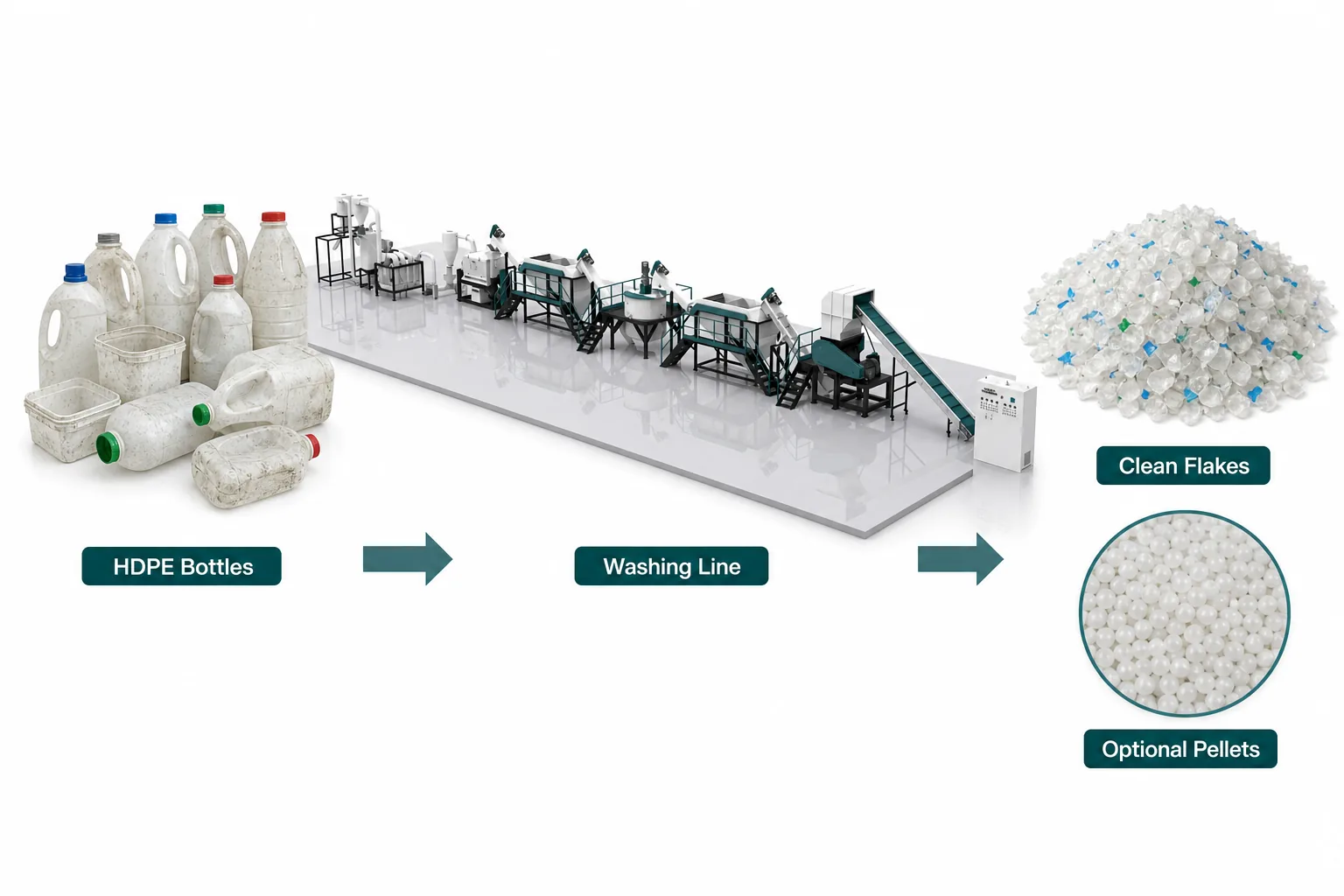 A well-configured HDPE recycling line turns used bottles and containers into clean flakes, with optional pelletizing for higher-value recycled resin output.
HDPE Flakes or Pellets: Which Output Should You Target?
Some buyers only need clean HDPE flakes, while others need recycled HDPE pellets for extrusion or molding. The right output depends on the end customer, local market demand, quality target, and whether the plant has downstream pelletizing capacity.
| Output Option | What It Requires | Best For | Key Risk |
|---|---|---|---|
| Washed HDPE flakes | Strong sorting, hot washing, float-sink separation, dewatering, and drying | Selling to pelletizers, pipe producers, or compounders that accept flakes | Moisture, mixed PP, residual labels, odor, and inconsistent color can reduce value |
| Recycled HDPE pellets | Clean dry flakes plus a rigid plastic granulating pelletizing line | Pipe extrusion, blow molding, injection molding, and higher-value resin supply | Poor flake purity creates black specks, gels, odor, or unstable extrusion |
If the output will go directly into pelletizing, the washing line must control moisture and contamination more tightly. A weak drying section can make even clean-looking flakes difficult to pelletize consistently.
HDPE Bottle, Pipe, and Film Recycling Are Not the Same
One reason buyers get confused is that the phrase “HDPE recycling machine” can refer to several different recycling configurations. HDPE bottles, HDPE pipes, and HDPE film are all polyethylene materials, but they do not behave the same in the front end of the line.
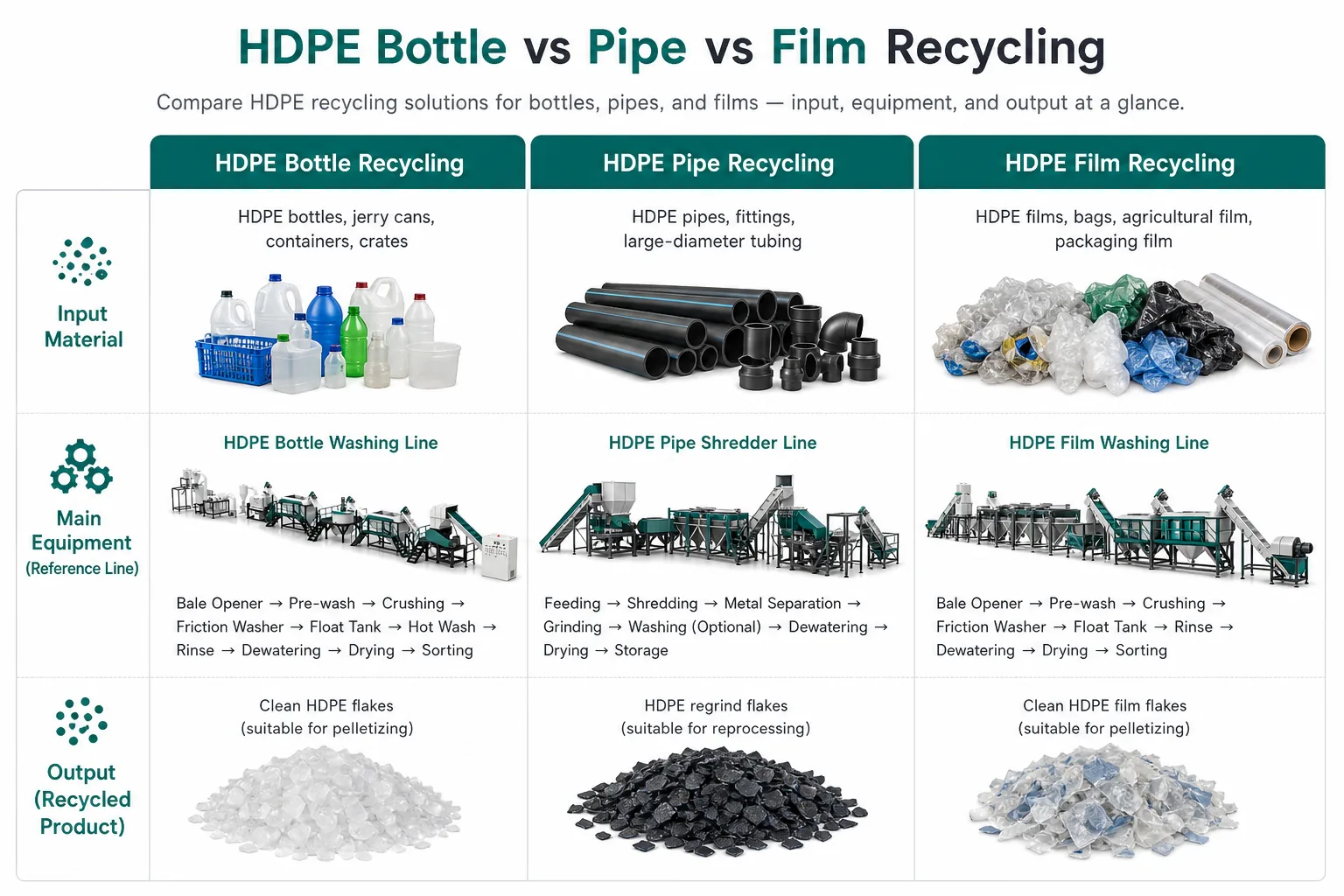 HDPE bottle, pipe, and film recycling require different front-end equipment even when the downstream goal is clean flakes or recycled pellets.
HDPE Bottle and Container Recycling
This is the most common application for an HDPE washing line. It handles hollow packaging such as milk bottles, detergent bottles, jerry cans, and drums. The key equipment usually includes label removal, crushing, hot washing, friction washing, float-sink separation, dewatering, and drying.
HDPE Pipe Recycling
Large HDPE pipes require a stronger front-end machine. A standard bottle granulator is not designed to accept long, thick-wall pipe sections. For this application, a dedicated HDPE pipe shredder is used to reduce pipes into manageable fragments before granulating, washing, or pelletizing.
Pipe recycling often focuses less on label removal and more on cutting torque, feed opening size, blade strength, and downstream size control.
HDPE Film Recycling
HDPE film, stretch film, bags, and agricultural film require a different washing approach because the material is light, flexible, and easy to tangle. Film lines typically need wet granulation, friction washing, squeezing or densifying, and drying systems designed for low-bulk-density material. That is exactly what a PP PE film washing line is built around, running 300–2,000 kg/h with float-sink density separation.
For film-specific processing, the better reference is the plastic film recycling line guide, rather than a rigid HDPE bottle washing line.
Key Equipment in an HDPE Recycling Line
A complete HDPE recycling system can be configured in different ways, but the core equipment usually includes the following machines.
| Equipment | Main function | Buyer note |
|---|---|---|
| Feeding conveyor | Moves waste into the line | Should match bale size, manual loading method, and line capacity |
| Sorting section | Removes non-HDPE material | Important for mixed rigid plastic bales |
| Label remover | Separates sleeve labels and loose labels | Especially important for milk bottles and detergent bottles |
| Crusher or granulator | Reduces bottles and containers into flakes | Output size affects washing efficiency and yield |
| Hot wash tank | Removes oil, milk fat, glue, and organic residue | One of the biggest quality-control stages |
| Friction washer | Scrubs flake surfaces mechanically | Improves cleanliness and optical quality |
| Float-sink tank | Separates HDPE from denser contaminants | Critical for PET, PVC, metal, and glass removal |
| Centrifugal dryer | Removes most surface water | Reduces load on thermal drying |
| Thermal dryer | Reduces final moisture | Needed when flakes go into pelletizing or extrusion |
| Pelletizing line | Converts flakes into recycled pellets | Use a rigid plastic granulating pelletizing line when pellet output is required |
What Determines HDPE Flake Quality?
The quality of recycled HDPE flakes depends less on one single machine and more on how the full line is configured. A good crusher with a weak washing system will still produce poor output. A strong washing system with mixed feedstock and poor sorting will also struggle.
Input Material Consistency
Source-separated HDPE milk bottles are easier to process than mixed rigid plastic bales. If the input contains PET, PVC, multilayer packaging, chemical residue, or heavy dirt, the line needs stronger sorting and washing capacity.
Washing Temperature and Contact Time
Hot washing must be strong enough to remove oils, milk fat, and adhesive. Temperature, detergent concentration, agitation, and contact time all affect the final cleanliness of the flakes.
Density Separation Efficiency
Float-sink tanks must provide enough residence time and water flow control. If the tank is overloaded, PET or PVC fragments can remain mixed with floating HDPE flakes, reducing output purity.
Final Moisture Control
Moisture is a practical production issue. Wet flakes are harder to store, transport, and pelletize. For direct extrusion or pelletizing, final moisture below 1% is usually the target.
How to Choose an HDPE Recycling Machine
Before choosing an HDPE recycling machine, define the input and output clearly. The same equipment list cannot be used for every HDPE waste stream.
1. Confirm the HDPE Waste Type
Start with the material. Are you processing milk bottles, detergent bottles, chemical drums, mixed rigid plastics, HDPE pipes, or film? Bottle lines, pipe shredding systems, and film washing lines have different front-end designs.
2. Match Capacity to Real Feedstock Volume
HDPE recycling lines are commonly sized by kg/h. A 300 kg/h line can suit smaller operations, while industrial plants may require 1,000-2,500 kg/h or more. Oversizing increases capital cost and energy use; undersizing creates bottlenecks and reduces plant throughput.
3. Define the Output: Flakes or Pellets
If your customer buys clean flakes, a washing and drying line may be enough. If you need a more uniform recycled resin product, add downstream pelletizing. For rigid HDPE flakes, the rigid plastic granulating pelletizing line is the relevant downstream system.
4. Check Water, Energy, and Wastewater Requirements
Hot washing and rinsing consume water and energy. A closed-loop water treatment and recycling system can reduce fresh water consumption and wastewater discharge, which is important for long-term operating cost and local compliance.
5. Evaluate Maintenance and Spare Parts
Blade wear, screen cleaning, pump maintenance, bearing replacement, and dryer maintenance all affect uptime. For continuous recycling operations, reliable spare parts and practical maintenance access are just as important as the quoted capacity.
Frequently Asked Questions
Is an HDPE recycling machine the same as an HDPE bottle washing line?
For bottle and container waste, yes. An HDPE recycling machine usually refers to a connected HDPE bottle washing line with sorting, crushing, hot washing, friction washing, float-sink separation, dewatering, and drying. Pipe and film recycling require different front-end equipment.
Why does HDPE float while PET sinks?
HDPE has a density lower than water, so clean HDPE flakes float in a float-sink tank. PET has a higher density than water, so PET fragments sink. This density difference is one reason HDPE and PET bottle recycling lines must be configured differently.
What is the difference between an HDPE bottle recycling line and an HDPE pipe shredder?
An HDPE bottle recycling line focuses on label removal, crushing, washing, density separation, and drying. An HDPE pipe shredder focuses on reducing large, thick-wall pipes into fragments before further granulating, washing, or pelletizing.
Should I sell washed HDPE flakes or make recycled HDPE pellets?
Sell washed HDPE flakes if your buyers are pelletizers, pipe producers, or compounders that accept flakes. Add a pelletizing line if you need a denser, more uniform recycled resin product for extrusion, blow molding, injection molding, or higher-value resin supply.
What moisture level should recycled HDPE flakes have?
For direct pelletizing or extrusion, recycled HDPE flakes are usually dried to below 1% moisture. Mechanical dewatering lowers most surface water first, then thermal drying brings the flakes to the final moisture target.
Can one HDPE recycling line process bottles, pipes, and film?
Not efficiently. HDPE bottles, pipes, and film need different front-end designs. Bottles need label removal, crushing, washing, and density separation. Pipes need a heavy-duty HDPE pipe shredder. Film needs equipment designed for flexible, low-bulk-density material, such as wet granulation, squeezing, and specialized drying.
Related Products
- HDPE Rigid Milk Bottle Recycling Washing Line – for post-consumer HDPE bottles, dairy packaging, containers, and rigid packaging waste.
- HDPE Pipe Shredder – for large-diameter HDPE pipes and thick-wall pipe scrap.
- Plastic Crusher – for reducing HDPE, LDPE, PP, film, fiber, and mixed plastic waste into smaller pieces.
- Rigid Plastic Granulating Pelletizing Line – for converting cleaned HDPE and other rigid plastic flakes into recycled pellets.
Have a Material You Need to Process?
Send the polymer, its form and your target output. We will come back with a line configuration and a realistic budget range.