


Industrial plastic shredders are the front-line machines in many plastic recycling operations. Before plastic waste can be washed, pelletized, or reprocessed, it must often be reduced from bulky, irregular forms – bottles, pipes, films, bales, woven bags, drums, and containers – into manageable fragments. Choosing the right machine for your material stream directly affects throughput, downstream washing quality, pelletizing stability, and total recycling line economics.
This guide explains how industrial plastic shredders work, the main equipment types SUHUI manufactures, how shredding differs from plastic crushing, and what specifications to evaluate when selecting a system.
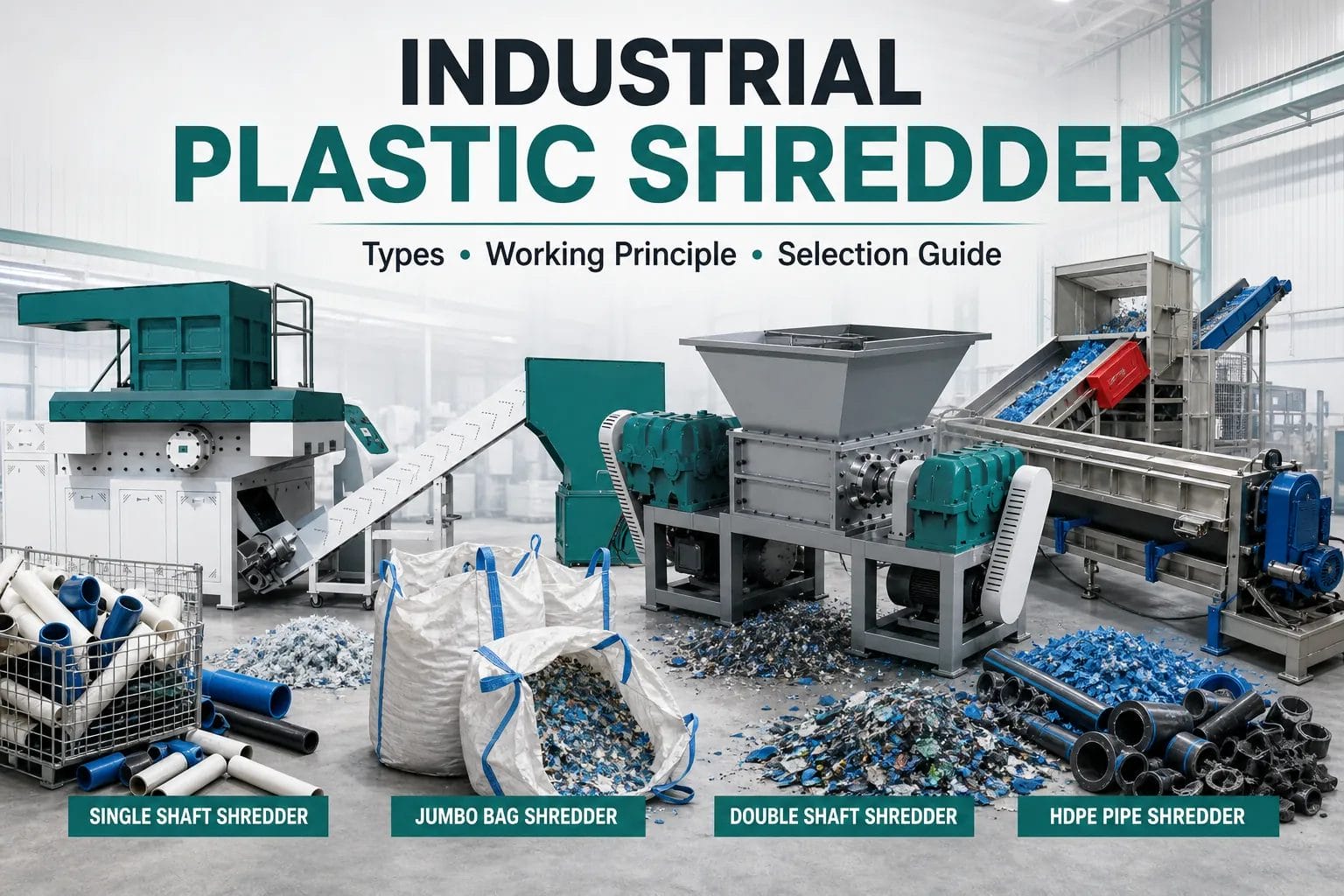 Size-reduction equipment prepares bulky plastic waste for washing, crushing, or pelletizing. Baled or contaminated film goes on to a PP PE film washing line; clean rigid regrind can feed a pelletizing line directly.
What Is an Industrial Plastic Shredder?
An industrial plastic shredder is a heavy-duty size reduction machine that uses rotating blades, shafts, or rotors to cut, tear, and compress plastic waste into smaller fragments. Unlike light-duty equipment, these recycling machines are designed for continuous high-volume operation and can process materials ranging from thin film and woven bags to thick-walled containers and large HDPE pipe sections.
Shredding is usually the first mechanical step in a plastic recycling line. It reduces the bulk volume of incoming waste and prepares the material for conveying, washing, drying, crushing, or pelletizing. A well-matched shredder also controls output size, which affects washing efficiency and downstream equipment stability.
SUHUI’s range of crusher and shredder equipment covers single shaft shredders, double shaft shredders, HDPE pipe shredders, jumbo bag shredders, and plastic crushers for secondary size reduction.
How an Industrial Plastic Shredder Works
Although each machine type is built differently, the basic working principle is similar: plastic material enters through an infeed hopper, a powered rotor or shaft assembly grips and cuts the material, fixed counter-blades create the shear point, and shredded output exits through a screen, grate, or discharge conveyor.
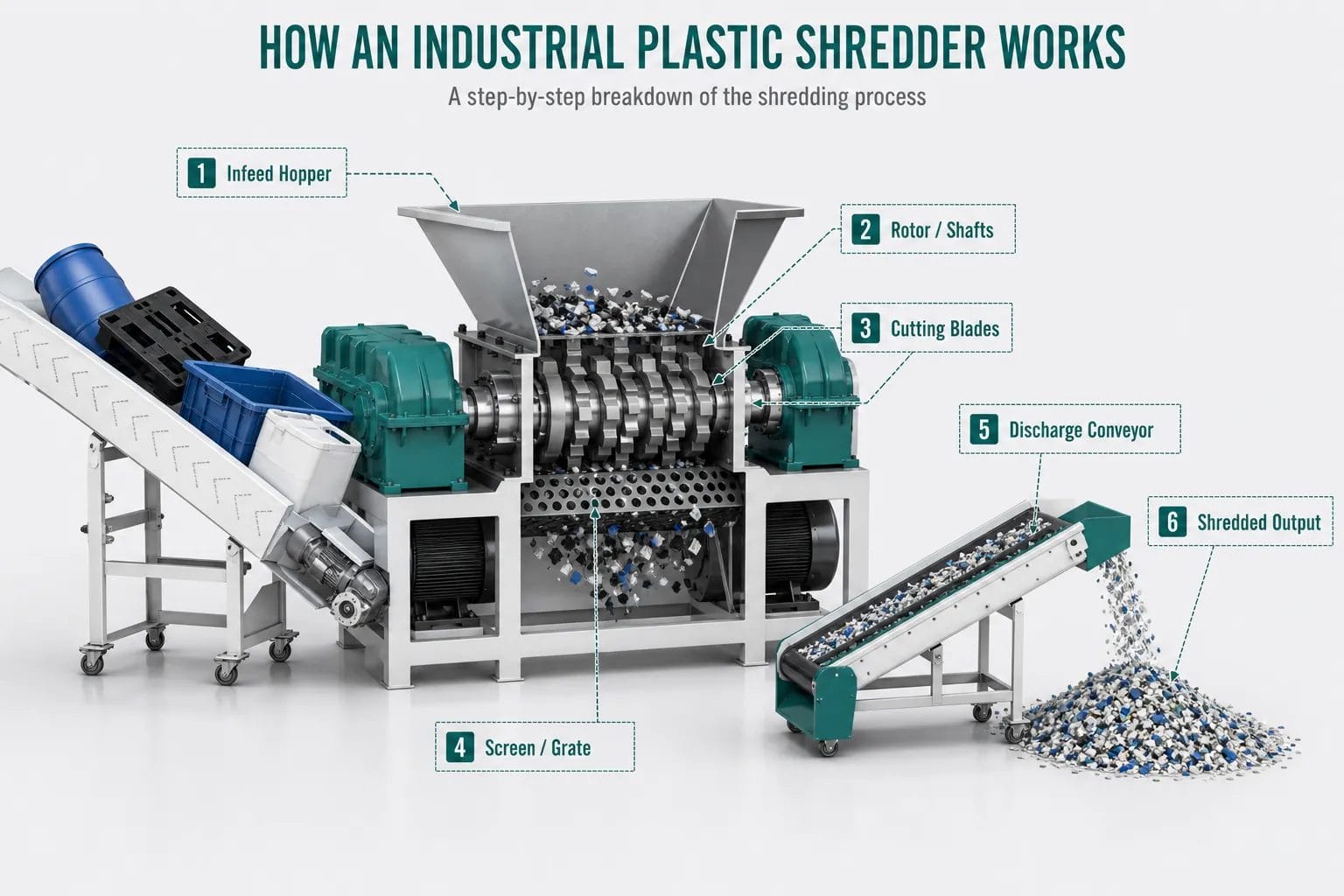 The process uses an infeed hopper, rotor or shafts, cutting blades, screen, and discharge conveyor to produce controlled output.
The core components in a plastic shredder include:
| Component | Function |
|---|---|
| Infeed hopper | Receives raw plastic waste and guides it into the cutting chamber. |
| Rotor or shaft assembly | Carries the rotating blades and determines cutting action, torque, and feeding behavior. |
| Fixed counter-blades | Create the shear point where plastic is cut or torn into smaller fragments. |
| Screen or grate | Controls maximum output size in screen-based shredder designs. |
| Drive system | Uses electric motor, gearbox, or hydraulic drive to provide cutting torque. |
| Discharge conveyor | Transfers shredded plastic to a crusher, washing line, storage bin, or pelletizing line. |
Single shaft machines usually use a rotor and hydraulic pusher to control feeding. Double shaft machines use two counter-rotating shafts to grip and tear bulky material. Specialist systems for HDPE pipe and jumbo bags modify the feeding structure and blade design to match difficult material forms.
Industrial Plastic Shredder in Operation
The video below shows a SUHUI single shaft machine processing hard plastic waste, including the cutting chamber, blade action, and fragment output:
Which Shredder Fits Each Plastic Waste Stream?
Equipment selection depends on the shape, thickness, flexibility, contamination level, and target output size of the input material. A plastic shredder machine for woven bags should not be selected the same way as a system for HDPE pipe, rigid containers, or mixed post-consumer bales.
 Four common machine types include single shaft, double shaft, HDPE pipe, and jumbo bag configurations.
| Waste Stream | Recommended Machine | Why It Fits | Downstream Process |
|---|---|---|---|
| Film, woven PP bags, raffia, soft plastic waste | Single shaft shredder or jumbo bag shredder | Controlled feeding and anti-wrapping blade design reduce tangling | Film washing, squeezing, drying, pelletizing |
| Rigid containers, crates, drums, mixed bulky plastics | Double shaft shredder | High torque shafts grip and tear bulky material before secondary reduction | Plastic crusher, washing line, storage, pelletizing |
| Large HDPE, PE, or PPR pipe sections | HDPE pipe shredder | Wide infeed and heavy-duty cutting structure reduce manual pre-cutting | Crusher, washing, granulating, pipe material recycling |
| Pre-shredded rigid plastic requiring finer pieces | Plastic crusher or plastic granulator | Higher-speed cutting produces smaller, more uniform regrind | Washing, drying, extrusion, pelletizing |
1. Single Shaft Shredder
A single shaft shredder uses one powered rotor with rows of hardened blades. A hydraulic ram or pusher plate feeds plastic waste toward the rotor, allowing controlled cutting against fixed counter-blades.
 A single shaft shredder is suitable for mixed plastic waste where controlled output size is important.
Best suited for:
- PP and PE film, woven bags, raffia, and soft plastic waste.
- Rigid plastic containers, bottles, crates, and bins.
- Small to medium plastic pipes and profiles.
- Post-industrial trim scrap and edge trim.
Typical output size: 20-80 mm, depending on screen size and material type.
Single shaft equipment is often the most versatile choice for recycling lines that need predictable output size before washing, crushing, or pelletizing.
2. Double Shaft Shredder
A double shaft shredder uses two counter-rotating shafts with interlocking blades. The shafts grip and pull plastic waste downward, producing high shear force and strong self-feeding performance.
 A double shaft shredder is designed for bulky, thick-walled, and mixed plastic waste that requires high-torque primary size reduction.
Best suited for:
- Large plastic containers, drums, tanks, and automotive plastic parts.
- Mixed or contaminated post-consumer plastic bales.
- Thick-walled pipe and profile offcuts.
- Primary size reduction before secondary crushing or washing.
Typical output size: 40-150 mm. Double shaft systems usually produce coarser output than single shaft systems and are commonly used as the first stage for bulky waste.
3. HDPE Pipe Shredder
An HDPE pipe shredder is designed for large-diameter HDPE, PE, and PPR pipes that cannot be fed easily into standard shredder hoppers. The wider infeed structure and heavy-duty blade carriers help process long or thick pipe sections with less manual pre-cutting.
Best suited for:
- Municipal water supply and gas distribution pipe waste.
- Large irrigation and drainage pipe sections.
- Post-industrial pipe offcuts from extrusion lines.
- Bulky HDPE fittings and pipe-related scrap.
4. Jumbo Bag Shredder
A jumbo bag shredder is a specialist machine for FIBCs, ton bags, bulk bags, woven PP bags, raffia fabric, and flexible packaging waste. These materials can wrap around ordinary shafts if the blade geometry is not designed for fabric-like plastic.
Best suited for:
- Used PP woven jumbo bags from chemical, food, agricultural, and logistics industries.
- PP raffia and woven fabric waste.
- Non-woven PP bags and flexible packaging.
 HDPE pipe shredders and jumbo bag shredders are specialist machines for difficult plastic waste forms.
Plastic Shredder vs Crusher vs Granulator
Shredders, crushers, and granulators all reduce plastic size, but they are used at different stages of a recycling line. A shredder is normally used for primary size reduction of bulky or difficult-to-feed plastic waste. A plastic crusher or plastic granulator is usually used after shredding to produce smaller, more uniform regrind for washing, drying, extrusion, or pelletizing.
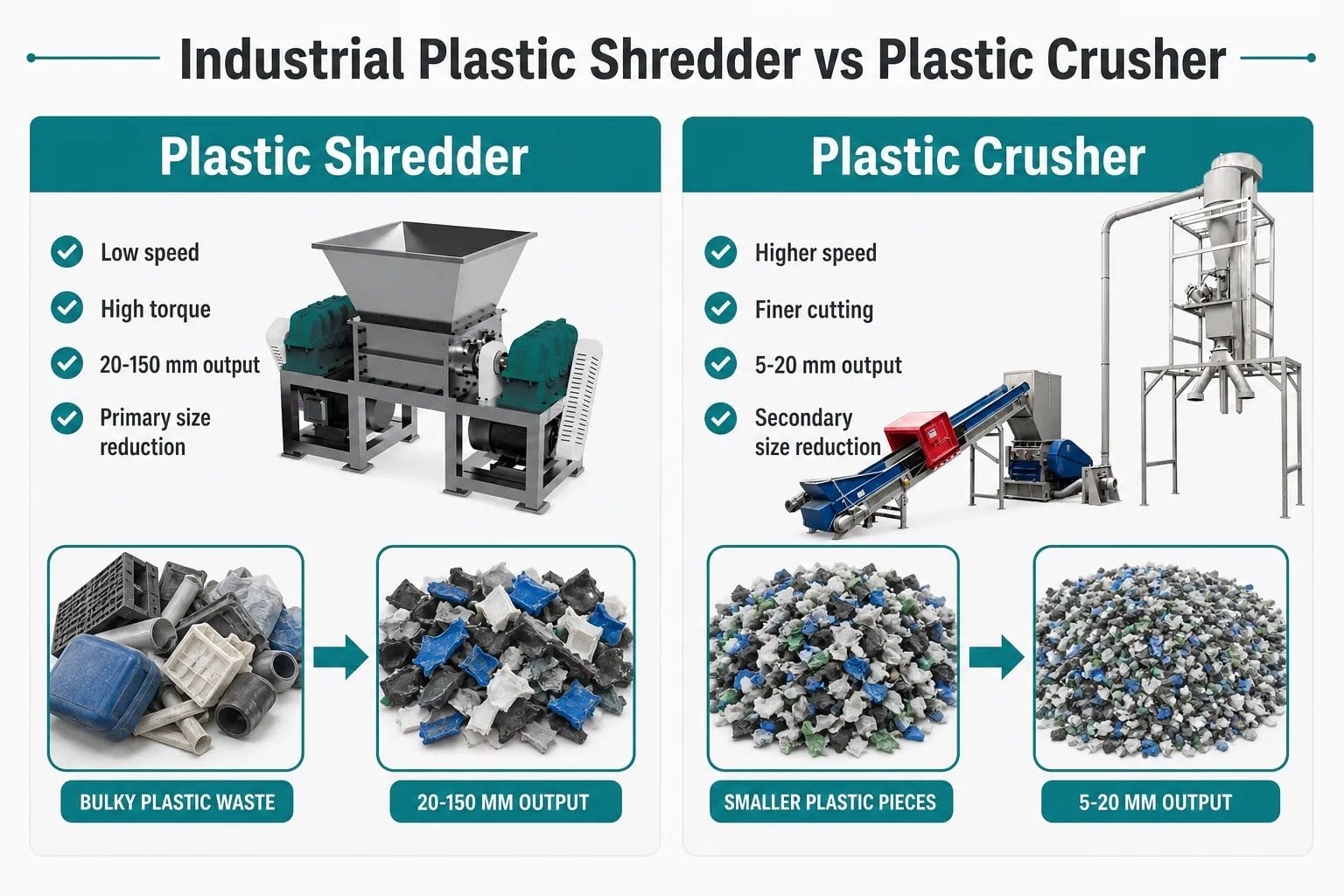 A plastic shredder handles primary size reduction, while a plastic crusher produces finer pieces for downstream processing.
| Item | Industrial Plastic Shredder | Plastic Crusher | Plastic Granulator |
|---|---|---|---|
| Operating role | Primary size reduction | Secondary size reduction | Fine regrind / controlled granulation |
| Typical input | Bulky plastic, pipes, bags, containers, bales | Pre-shredded plastic, smaller rigid waste, flakes | Clean or pre-sized rigid plastic, sprues, runners, trim scrap |
| Typical output | 20-150 mm pieces | 5-20 mm pieces | Small, more uniform regrind depending on screen size |
| Operating speed | Low speed, high torque | Higher speed, finer cutting | High-speed cutting with screen-controlled output |
| Best use | Preparing difficult waste for downstream handling | Producing smaller pieces for washing or pelletizing | Producing consistent regrind before extrusion or reuse |
In many recycling systems, the machines work in sequence: the shredder breaks down bulky waste first, the crusher reduces the material further, and the granulator can produce more consistent regrind when the downstream process requires smaller, controlled particles.
How to Choose the Right Industrial Plastic Shredder
Choosing a size-reduction system should start with the material, not the machine model. The same design will not perform equally well on woven bags, HDPE pipe, film bales, and thick-walled containers.
1. Input Material Type and Form
Material form is the first selection factor. Woven bags need anti-wrapping cutting geometry, HDPE pipes need a wide infeed and heavy-duty cutting structure, and bulky rigid plastics need enough torque and chamber volume for stable feeding.
2. Required Throughput
Capacity is usually rated in kg/h. Match the machine to your downstream washing or pelletizing line capacity with practical headroom. An undersized unit creates a bottleneck; an oversized unit increases investment and energy cost without improving the whole line.
3. Target Output Size
If the material is going into a washing line, coarser output may be acceptable. If the material needs further crushing, pelletizing, or more intensive washing, a smaller and more consistent output size may be required.
4. Blade Material and Maintenance
Blades are the main wear parts in any size-reduction machine. Check blade material, hardness, replacement method, expected service life, and whether individual blades can be replaced without changing the full rotor or shaft assembly.
5. Drive System and Overload Protection
Electric drives with gearboxes and variable frequency control are common in plastic recycling. Hydraulic or high-torque systems may be needed for especially dense or difficult material. Overload protection is important because plastic waste streams often contain hard or irregular pieces.
Related Products
- Single Shaft Shredder – For films, rigid plastics, pipes and mixed post-consumer waste
- Double Shaft Shredder – For bulky, thick-walled and mixed plastic waste streams
- HDPE Pipe Shredder – For large-diameter HDPE, PPR and PE pipes
- Jumbo Bag Shredder – For PP woven jumbo bags and raffia fabric
- Plastic Crusher – For secondary size reduction and finer plastic pieces
Frequently Asked Questions
Is a plastic shredder machine the first machine in a recycling line?
For bulky waste, yes. A plastic shredder machine is often the first size-reduction machine because it can accept pipes, drums, containers, woven bags, film bales, and mixed bulky plastics. Smaller or cleaner material may go directly to a plastic crusher or granulator instead.
When should I choose a single shaft shredder?
Choose a single shaft shredder when output size control is important and the material can be fed with a hydraulic pusher, such as film, woven bags, rigid containers, small pipes, profiles, trim scrap, and mixed post-industrial plastic waste.
When should I choose a double shaft shredder?
Choose a double shaft shredder for bulky, thick-walled, or difficult-to-feed plastic waste that needs high torque and strong self-feeding. It is commonly used for large containers, drums, mixed bales, pipe offcuts, and primary size reduction before crushing.
What is the difference between a plastic shredder, crusher, and granulator?
A plastic shredder handles bulky primary size reduction. A plastic crusher reduces pre-shredded or smaller material into finer pieces. A plastic granulator is used when the process needs more consistent regrind for washing, extrusion, pelletizing, or direct reuse.
Why does HDPE pipe need a specialist shredder?
HDPE pipe is long, thick, and difficult to feed into a standard hopper. An HDPE pipe shredder uses a wider infeed structure, stronger cutting chamber, and heavy-duty blade design so large pipe sections can be processed with less manual pre-cutting.
Can one industrial plastic shredder process all plastic waste?
No single machine is ideal for every plastic waste stream. Film, woven bags, HDPE pipes, rigid containers, mixed bales, and jumbo bags require different feeding structures, blade geometry, torque, and output size control. The equipment should be matched to the specific material stream.
Ready to select the right industrial plastic shredder for your recycling operation? Contact SUHUI Machinery to discuss your material stream, throughput requirements, and downstream process.
Have a Material You Need to Process?
Send the polymer, its form and your target output. We will come back with a line configuration and a realistic budget range.


