An HDPE rigid milk bottle recycling washing line removes labels and caps, crushes and hot-washes HDPE milk bottles into clean flakes for pelletizing or reuse.


The SUHUI HDPE rigid milk bottle recycling washing line processes post-consumer HDPE dairy packaging into clean HDPE flakes or optional recycled pellets through label and cap removal, shredding, hot alkaline washing, friction scrubbing, float-sink separation, drying and closed-loop water recycling. Standard configurations support 300-2,500 kg/h input capacity.
The SUHUI HDPE rigid milk bottle recycling washing line specializes in processing post-consumer high-density polyethylene (HDPE) dairy packaging waste into clean, high-purity flakes or pellets suitable for reuse in food-contact or industrial manufacturing applications.
Designed specifically for the challenges of dairy bottle recycling, including milk fat residues, foil labels, adhesive sleeves, and mixed caps, the line integrates heavy-duty shredding, multi-stage hot alkaline washing, friction scrubbing, float-sink separation, and thermal drying to achieve consistently clean output for food-grade and non-food recycled material applications.
Built for operational efficiency, the system incorporates closed-loop water recycling that reduces fresh water consumption by up to 70%, low-energy drying technology, and automated non-HDPE removal. Processing capacity scales from 300 to 2,500 kg/h to suit small and large recycling operations.

HDPE milk bottle recycling washing line workflow from pre-sorting, label and cap removal, shredding, washing, separation, drying and optional pelletizing.

The HDPE milk bottle washing process targets milk fat residues, labels, caps, adhesives, PVC, PET, metals, surface dirt and organic residues through different removal stages.
| Parameter | Standard Range / Configuration |
|---|---|
| Input Material | Post-consumer HDPE milk bottles, juice bottles, and similar rigid dairy containers |
| Processing Capacity | 300–2,500 kg/h |
| Output Material | Clean HDPE flakes or optional recycled HDPE pellets |
| Flake Size After Shredding | 10–15 mm |
| Hot Alkaline Washing Temperature | 60–80°C |
| Fresh Water Reduction | Up to 70% with closed-loop water recycling |
| Final Moisture Content | < 1% after thermal drying |
| Optional Module | UV sterilization and pelletizing system |
Final configuration depends on feedstock condition, contamination level, capacity target, output requirements, and available factory layout. Contact SUHUI for a customized technical proposal.
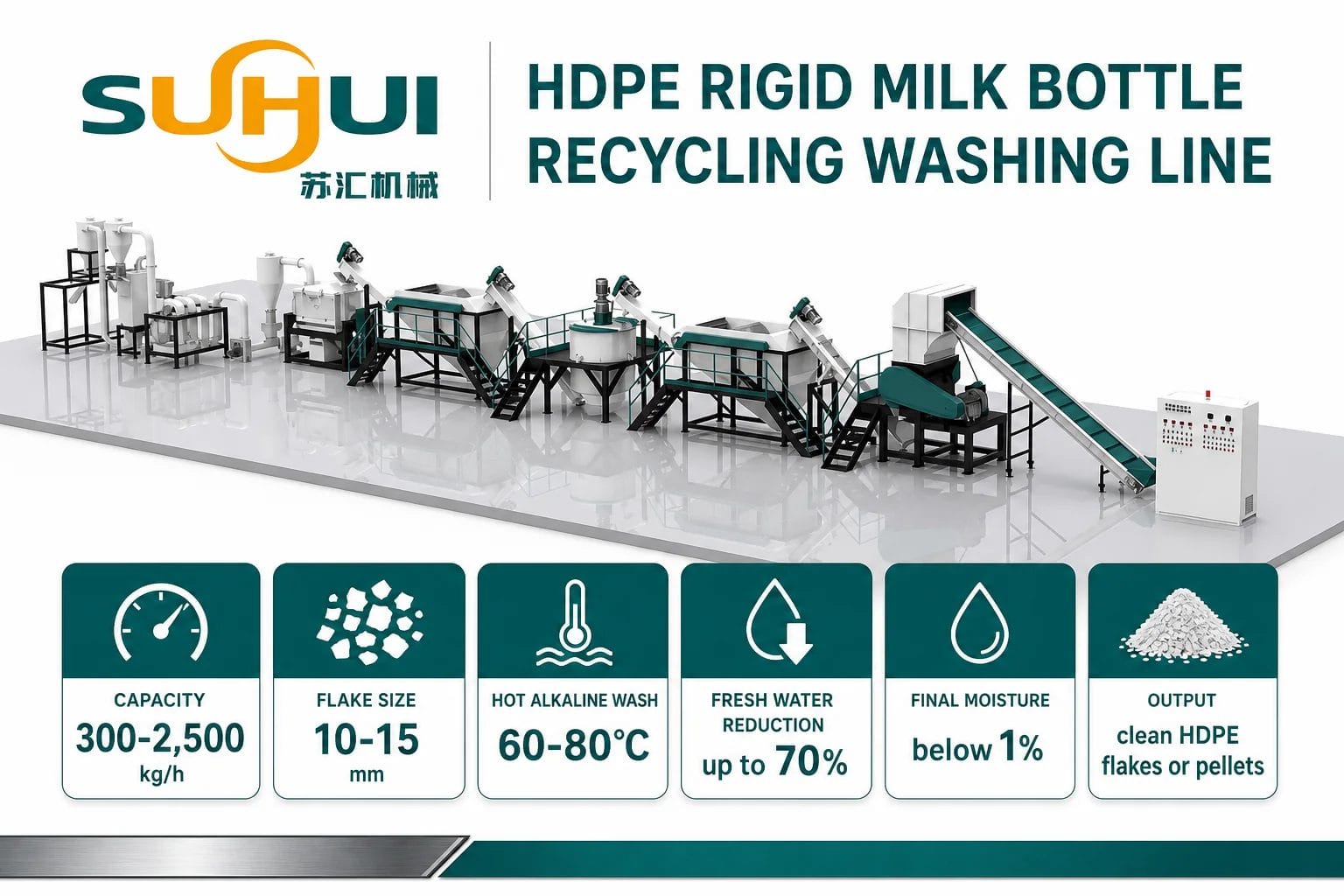
Standard HDPE milk bottle washing line configurations support 300 to 2,500 kg/h input capacity, 60–80°C hot alkaline washing, up to 70% fresh water reduction, and final moisture below 1%.

Final line configuration should be matched to feedstock type, milk fat contamination, label and cap condition, capacity target, output application, and optional pelletizing requirement.
After shredding, washing, separation, dewatering, and thermal drying, clean HDPE flakes can be used in food-contact packaging applications when the required downstream compliance process is in place, or in industrial manufacturing applications that use recycled HDPE flakes or pellets. For the wider equipment picture across bottles, drums, pipes and rigid HDPE scrap, see our HDPE recycling machine guide.
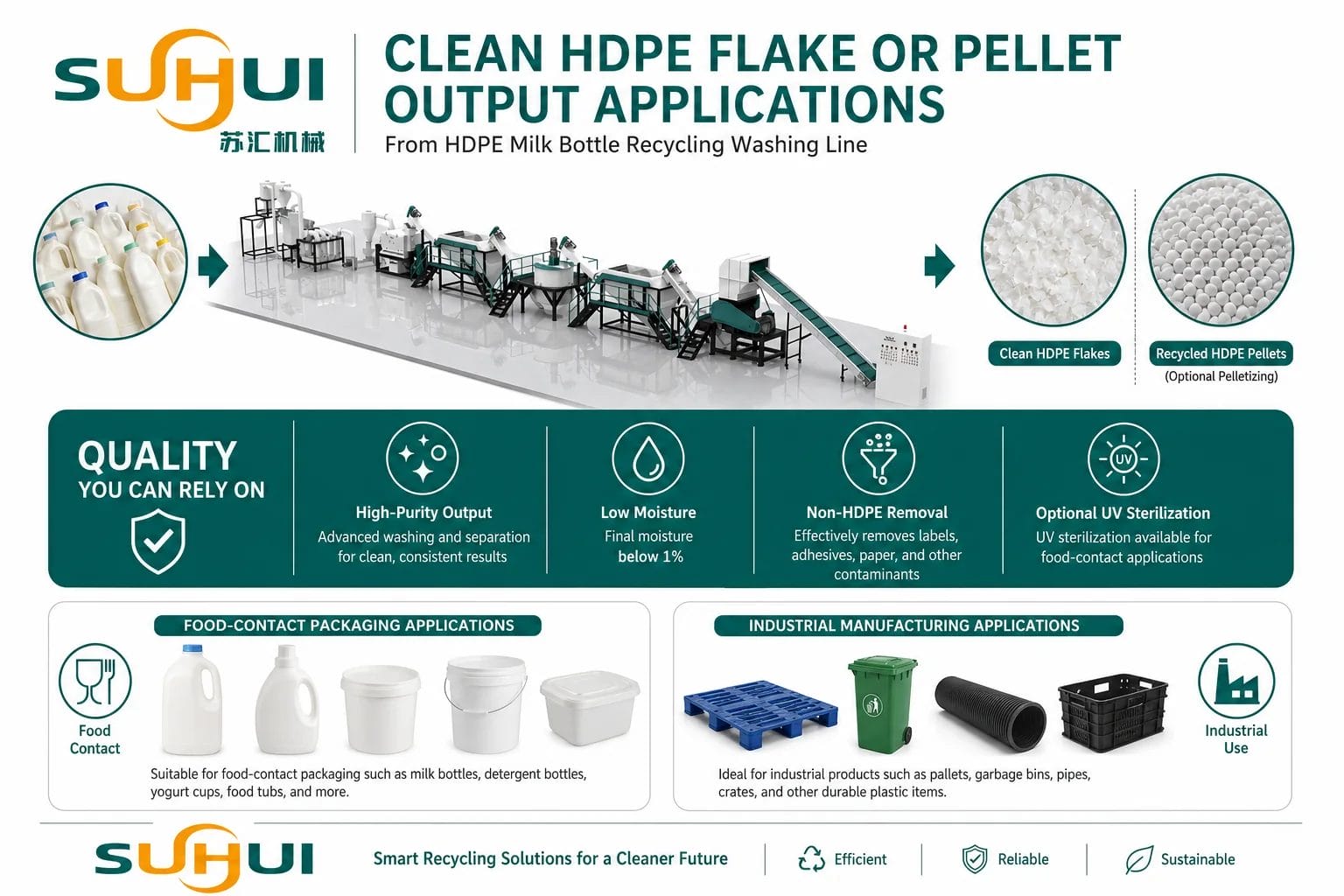
Clean HDPE flakes or optional recycled HDPE pellets can serve food-contact packaging projects and industrial manufacturing applications when matched to the required quality standard.
The HDPE milk bottle washing line recirculates process water across pre-washing, hot alkaline washing, friction scrubbing, and float-sink separation. Physical filtration removes suspended solids, while chemical dosing restores pH and cleaning agent concentration before water is reused in the washing process.

Closed-loop water recycling treats and reuses process water across the washing stages, reducing fresh water consumption by up to 70%.
The SUHUI HDPE rigid milk bottle recycling washing line is designed for post-consumer dairy packaging including HDPE milk bottles, juice bottles, and similar rigid dairy containers. It handles bottles with sleeve labels, residual PP or PE caps, and milk fat contamination.
Food-grade quality depends on the complete cleaning sequence: shredding into 10–15 mm flakes, pre-washing, 60–80°C hot alkaline washing, friction scrubbing, float-sink separation, centrifugal dewatering, thermal drying below 1% moisture, and optional UV sterilization for food-contact applications.
The SUHUI HDPE milk bottle recycling washing line supports throughput from 300 kg/h for smaller recycling operations to 2,500 kg/h for industrial-scale facilities. The modular design allows capacity to be matched to feedstock volume, factory layout, and downstream pelletizing requirements.
Process water from pre-washing, hot alkaline washing, friction scrubbing, and float-sink stages is collected, filtered, chemically adjusted, and recirculated back into the washing line. This closed-loop approach reduces fresh water consumption by up to 70% compared with open-circuit washing systems.
Yes. The line includes dedicated label and cap removal systems upstream of shredding. Removing labels and caps before shredding prevents them from becoming fine fragments that are harder to separate downstream, improving final HDPE flake cleanliness.
Properly processed HDPE flakes can achieve above 99% HDPE content, with residual contaminants reduced to below 1% by weight. Final flake moisture after thermal drying is below 1%. Specific purity outcomes depend on input material consistency and upstream sorting quality. Flake purity targets differ by downstream use; our overview of the plastic recycling process explains how the washing stage sets the ceiling for everything after it.
Tell us your material type, condition, required capacity and target output. Photos or videos help.
SUHUI reviews the feeding method, process route and machine configuration for your material.
You receive an equipment list and quotation, with capacity, layout, voltage and automation matched to the project.
Production, testing, export packing and installation guidance through to commissioning.

To receive a more accurate recommendation, please include your material type, material condition, required capacity, target output, plant space, local voltage and destination country in the message. Photos or videos of your raw material are also helpful.

The SUHUI PP PE soft film recycling washing line turns contaminated PP and PE film waste — agricultural mulch film, greenhouse covers, stretch wrap, LDPE/LLDPE packaging film — into clean, dry flakes ready for pelletizing or direct sale. Anti-tangle shredding, multi-stage washing, float-sink density separation and two-stage dewatering bring final moisture below 5%. Five standard configurations cover 300–2,000 kg/h, built in S.S 304 stainless steel with closed-loop water recycling. Factory-direct from SUHUI with export and after-sales support.
The SUHUI PET bottle sorting washing line recycles post-consumer PET bottle bales into clean PET flakes through bale breaking, optical sorting, label removal, crushing, hot alkaline washing, float-sink separation, drying and flake optical sorting. Standard configurations support 500-3,000 kg/h input capacity.

The SUHUI PP jumbo bag recycling washing line is a specialized system designed to recycle used polypropylene (PP) bulk bags, FIBCs (Flexible Intermediate Bulk Containers), and ton bags into clean, reusable PP flakes or pellets. These woven PP bags accumulate heavy contamination from bulk material transport — including embedded sand, soil, chemical powders, and moisture — requiring more intensive processing than standard plastic film recycling.


