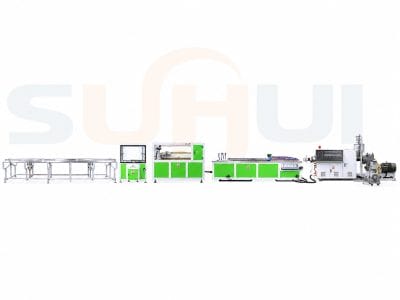
PVC pressure & drainage pipe
Water supply, drainage and conduit pipe from PVC dry-blend, 16–630 mm

From polymer to finished product
Pipe, profile, straw or lamp cover — the product specification defines the extruder, die, calibration and downstream equipment. SUHUI engineers each extrusion line backward from your dimension range, output target and material plan.

An extrusion project starts from the opposite end of a recycling project. Recycling asks "what waste do I have?"; extrusion asks "what product must I deliver?". A plastic pipe extrusion line, a profile extrusion line and a drinking straw making machine share the same physics — screw, die, calibration, haul-off — but the product specification changes every one of those components.
Dimension range, wall thickness, applicable standard and line speed decide the extruder size and screw type: heat-sensitive PVC dry-blend needs a conical twin-screw extruder, while HDPE, PPR and PP pellets run on single screws. The same logic continues downstream — vacuum tanks, haul-off tonnage, cutter type, belling, coiling and stacking all follow the product, not the other way around.
Material strategy is the second decision. Virgin pellets, in-house reclaimed scrap and recycled pellets from a SUHUI recycling line can all feed the same extruder if pellet quality is controlled — and multi-layer co-extrusion lets a recycled core hide behind virgin skins to cut material cost without failing the standard.
Use this hub as a specification map: start from the product you need to produce, check the recommended machines, understand the six line sections that control quality, then send SUHUI your product drawing or sample for line-level engineering.
Each row connects a real product requirement to the machines and technical guidance most likely to matter.


Water supply, drainage and conduit pipe from PVC dry-blend, 16–630 mm
Pressure pipe up to large diameters, including 3-layer co-extrusion
Plumbing and heating pipe with tight wall-thickness tolerance
Window, door, trunking, decorative and construction profiles
Food-grade straight, flexible and spoon straws at high line speed
Translucent polycarbonate lamp housings and diffuser profiles
An extrusion line is one synchronized system. Every section either holds the product tolerance — or exports its error to the next machine.
 01
01PVC dry-blend needs heating-cooling mixing; PE and PPR need clean, dry pellets with stable dosing. Formulation errors made here surface later as scrap at the die.
 02
02Conical twin screws suit heat-sensitive PVC dry-blend; single screws suit PE, PPR and PP pellets. Screw geometry, L/D ratio and temperature control set melt quality and output.
 03
03The die distributes melt into the final cross-section. Spiral distributors, adjustable centering and co-extrusion layers determine wall uniformity and material savings.
 04
04Vacuum sizing sleeves fix the outer diameter while spray tanks remove heat in stages. Tank length and water management must match line speed and wall thickness.
 05
05The haul-off sets wall thickness against extruder output; planetary or chipless cutters deliver clean square ends. Synchronization here decides dimensional stability.
 06
06Belling machines form socket ends, coilers wind small-diameter pipe, printers add marking and stackers organize output. Downstream scope defines how much labor the line needs.
This live directory follows the WordPress product catalog, so newly published extrusion machines appear in the correct cluster automatically. Recycling equipment lives in its own hub: plastic recycling machines.
Categories listed the way buyers specify them: pipe products first, then profiles, then high-speed straw extrusion.
Single and multi-cavity lines for PVC, HDPE and PPR pipe, plus tube-shaped products such as straws and lamp covers.
View categoryExtrusion lines for PVC and PP construction, window and decorative profiles.
View categoryHigh-speed extrusion systems for food-grade PP drinking straws.
View categoryMachines that turn scrap and compound into extrusion-ready pellets — and keep startup waste inside the material loop.
Compacting and pelletizing systems that convert flakes, film and PVC compound into uniform extrusion-ready granules.
View categoryMixers, squeezer-dryers and solid-state polymerization systems that support the main line.
View categoryThe extruder does not care where the pellets came from — the product standard does. Choose the material strategy first; the line is specified to protect it.

Resin, stabilizer and filler blended in-house with heating-cooling mixers for full formulation control.

Pressure-pipe grades run directly on single-screw lines; drying and dosing keep the melt stable.

Certified virgin PP for straws and food-contact products, processed on dedicated clean equipment.

Pipe offcuts, profile scrap and cable compound repelletized into extrusion-ready PVC granules.

Washed rigid regrind converted into uniform pellets for non-pressure pipe and profile layers.

Startup lumps, rejected pipe and edge trim shredded and crushed back into the material loop.
Two extrusion lines with the same nominal output can deliver very different wall-thickness accuracy, changeover time and material consumption. A useful comparison fixes the product dimension range, standard and material plan before comparing machine lists.
Co-extrusion layers, gravimetric dosing, automatic wall-thickness control and downstream automation all move both the price and the cost per meter produced. Deciding these with an engineer early avoids re-quoting a line that was scoped against the wrong product assumptions.
Study the process, then specify with confidence:
Use these factory-direct FOB ranges for budgeting. The final quotation depends on your product dimension range, output target, material plan and downstream scope.
| Extrusion line | Dimension range | Reference price (FOB) |
|---|---|---|
| PVC pipe extrusion line | Φ16–630 mm | $25,000 – $85,000 |
| HDPE pipe extrusion line | Φ20–800 mm | $35,000 – $150,000 |
| PPR pipe extrusion line | Φ20–800 mm | $35,000 – $150,000 |
| Profile extrusion line | Width 100–400 mm | $20,000 – $50,000 |
| Pipe diameter | Reference price (FOB) |
|---|---|
| Φ16–40 mm (twin-cavity) | $25,000 – $30,000 |
| Φ50–160 mm | $30,000 – $35,000 |
| Φ75–250 mm | $35,000 – $40,000 |
| Φ110–315 mm | $45,000 – $50,000 |
| Φ160–450 mm | $50,000 – $60,000 |
| Φ315–630 mm | $75,000 – $85,000 |
| Pipe diameter | Reference price (FOB) |
|---|---|
| Φ20–110 mm | $35,000 – $40,000 |
| Φ50–250 mm | $40,000 – $50,000 |
| Φ160–450 mm | $65,000 – $75,000 |
| Φ280–630 mm | $85,000 – $100,000 |
| Φ315–800 mm | $90,000 – $150,000 |
Ranges are factory-direct FOB figures for budgeting only and exclude sea freight, duties and on-site installation. PPR pipe lines are priced in line with the HDPE table. A firm quotation is issued after reviewing your product specification, output target and plant conditions.
Dimension range, output target, co-extrusion layers and downstream scope move both price and cost per meter. Send your product drawing or sample and a SUHUI engineer will map a concrete line and budget.
As a factory-direct plastic extrusion line manufacturer and supplier, SUHUI produces extruders, dies, calibration tables and downstream equipment in our own Zhangjiagang workshop. Each line is fully assembled, wired and trial-run with material before packing — so commissioning at your plant repeats a test that already passed.
That also means dies and calibration sleeves are matched to your exact dimension range, not picked from a generic size list. After delivery, the same engineers who built the line support installation, startup and spare parts directly.

Include the product type and dimension range, applicable standard, target output in kg/h, material plan, available plant space, voltage and destination country. A drawing or sample photo makes the proposal faster and more precise.

Share practical product data. Our team will reply with a line direction rather than a generic brochure.
Send product drawings or samples, target output and your material plan. SUHUI will map the necessary line sections and equipment.